Handwriting is more than alphabet-shaped ink. It is a coordinated performance involving movemr, and whichever pen was not mysteriously stolen from the kitchen drawer.
Graphology attempts to interpret personality or behavior from features such as letter size, slant, spacing, pressure, and margins. It can be an entertaining framework for observing handwriting, but its personality claims have not demonstrated dependable scientific validity. Controlled studies and research reviews generally find that graphology performs poorly as a personality or job-performance assessment. =”note”>
Important note: Use the beginner tips below for curiosity, journaling, creative character studies, or structured observationnot for diagnosing mental health conditions, judging someone’s honesty, selecting employees, or making legal decisions. For questions about whether two documents were written by the same person, consult a trained forensic document examiner.
What Handwriting Analysis Can and Cannot Tell You
The phrase handwriting analysis is often used for two very different activities. Graphology tries to connect writing style with personality. Forensic document examination compares known and questioned writing to evaluate possible authorship, alteration, forgery, or document origin.
Professional forensic examiners study combinations of distinctive writing habits under standardized procedures. They may compare letter construction, stroke direction, proportions, spacing, connecting movements, pen lifts, line quality, and natural variation. Their work is supported by laboratory practices, formal standards, quality controls, and carefully limited conclusions. It is not the same as declaring that a person is adventurous because the crossbar on a lowercase “t” resembles a tiny flagpole. ng is also affected by age, motor control, writing speed, fatigue, physical discomfort, visual feedback, pen pressure, and task familiarity. A rushed grocery list may look very different from a carefully written wedding invitation, even when the same hand produced both. ollect a Useful Handwriting Sample
Before analyzing anything, obtain a sample that is long enough to reveal repeated habits. One hurried signature or a two-word sticky note provides very little information. Ask the writer to fill at least half a page with natural text. A short story, description of the day, or copied paragraph works well.
Whenever possible, use unlined white paper and an ordinary ballpoint pen. Let the writer choose a comfortable sitting position and write at a normal pace. Do not tell the person which features you plan to inspect because that may cause conscious changes.
Record the conditions under which the sample was made. Was the writer standing? Was the paper resting on a hard desk? Was the person rushing, tired, cold, nervous, or using an unfamiliar pen? Context does not make the analysis less interesting. It makes it less likely to wander into fantasyland wearing a detective hat.
How to Analyze Handwriting: 11 Beginner Tips
1. Study the Entire Page Before Individual Letters
Begin with the page’s overall appearance. Does the writing look compact or expansive? Is it orderly, crowded, airy, decorative, restrained, or hurried? Do the lines form a consistent block, or does the text roam across the page like it is searching for better real estate?
Traditional graphology treats the whole page as an expression of how a writer organizes energy and space. A neatly arranged page is sometimes associated with planning, while a more spontaneous layout is associated with flexibility. Those interpretations should be treated as conversation starters rather than facts.
Write down your first visual impression before zooming in. Then return to it after completing the other ten steps. You may discover that your original impression was supported by several observable featuresor that it was merely influenced by beautiful ink.
2. Establish the Writer’s Normal Baseline
Never treat one unusual feature as a permanent personality clue. Compare several samples written on different days and for different purposes. Look for characteristics that repeat despite natural variation.
Suppose a writer normally uses upright letters but produces a strongly right-slanted thank-you note. That change might reflect faster writing, a different pen position, or an effort to make the message look expressive. It does not automatically announce an emotional transformation.
A useful baseline includes ordinary notes, longer passages, and a signature. Repeated patterns matter more than isolated strokes. This “compare before concluding” habit is one of the most valuable lessons beginners can borrow from forensic practice.
3. Measure the General Size of the Writing
Compare the middle-zone letterssuch as “a,” “e,” “m,” and “o”with the spacing between lines. Classify the writing as relatively small, medium, or large. Avoid measuring one dramatic capital letter and declaring the case closed.
In traditional graphology, large writing is often linked with outward expression, visibility, or social confidence. Small writing is commonly associated with concentration, privacy, or attention to detail. Medium-sized writing is described as adaptable or balanced.
Reality is less theatrical. Letter size can be shaped by eyesight, education, available space, writing purpose, and motor habits. Someone completing a tiny form may write like an ant with excellent penmanship. Use size as one observation within a larger pattern.
4. Observe the Slant of Repeated Letters
Examine letters with tall vertical strokes, including “l,” “t,” “h,” and “d.” Do they lean consistently to the right, remain upright, tilt left, or switch directions?
Classic graphology often associates a right slant with emotional responsiveness or sociability. Upright writing is traditionally connected with self-control or independence, while a left slant may be interpreted as reserve. Mixed slants are sometimes described as emotional variability.
Do not apply these labels mechanically. Slant may change with paper angle, handedness, writing speed, posture, or the style taught in school. A left-handed writer may position the page differently from a right-handed writer, producing a visual effect that has more to do with ergonomics than emotion.
5. Examine Spacing Between Letters, Words, and Lines
Spacing is easier to evaluate when you separate it into three categories. First, look at the distance between letters inside each word. Second, compare the spaces between words. Third, inspect the vertical distance between lines.
Traditional interpretations associate wide word spacing with a preference for independence or personal space. Narrow spacing is often linked with sociability or a desire for closeness. Crowded lines may suggest haste or an effort to fit more information into limited space.
Before assigning meaning, check the practical explanation. Did the writer have only one index card? Was the paper ruled narrowly? Was the message being squeezed into a greeting card beneath a suspiciously large printed poem? Layout constraints can overpower normal spacing habits.
6. Follow the Baseline Across Each Sentence
The baseline is the imaginary line on which the words rest. On unlined paper, writing may travel upward, remain level, slope downward, or rise and fall in waves.
Traditional graphology links an ascending baseline with optimism or enthusiasm and a descending baseline with tiredness or discouragement. A steady baseline is commonly associated with emotional control or persistence. Wavy lines are sometimes interpreted as changing energy.
A single downward line should not be treated as evidence of sadness. The writer may have been running out of room, rotating the paper, or writing without visual guides. Compare several lines and several samples. Consistency is more informative than one sentence taking a scenic route toward the bottom corner.
7. Estimate Writing Pressure Carefully
Pressure describes how firmly the writing instrument contacts the paper. Turn the sheet over and look for impressions. You can also compare dark, deeply marked strokes with lighter lines, although ink flow can make this misleading.
Heavy pressure is traditionally associated with intensity, determination, or strong emotional responses. Light pressure is often connected with sensitivity, adaptability, or lower physical energy. Variable pressure may reflect changing speed or emphasis.
Pressure is influenced by the pen, writing surface, grip, fatigue, pain, motor control, and learned habits. Modern handwriting research measures pressure as a physical variable, but that does not establish a reliable path from a dark stroke to a specific personality trait.
8. Look at Rhythm, Fluency, and Line Quality
Rhythm refers to the flow of movement across the page. Fluent writing often contains smooth curves, confident connections, and relatively continuous movement. Less fluent writing may show tremulous strokes, frequent corrections, blunt starts, or many pen lifts.
Beginners sometimes assume that smooth writing means confidence and shaky writing means nervousness. That conclusion is far too broad. Tremor, age, pain, medication effects, neurological conditions, an unstable writing surface, or an extremely ambitious amount of coffee may influence line quality.
Observe without diagnosing. Note whether the rhythm changes during the sample. The first paragraph may be carefully controlled, while the final lines become faster and less precise. That pattern can tell you about the writing process without pretending to reveal the writer’s private thoughts.
9. Compare Upper, Middle, and Lower Letter Zones
Graphology divides handwriting into three zones. The upper zone includes tall strokes in letters such as “b,” “d,” “f,” “h,” “k,” and “l.” The middle zone contains the main bodies of letters such as “a,” “e,” “m,” and “o.” The lower zone includes descending strokes in “g,” “j,” “p,” “q,” and “y.”
Traditional systems connect the upper zone with ideas and aspirations, the middle zone with daily life and social behavior, and the lower zone with physical drives or practical activity. Large upper loops may be described as imaginative, while short upper strokes may be labeled practical.
Use the zones to organize visual comparison, not to perform psychological archaeology. Check whether the proportions remain stable and whether loops are open, narrow, retraced, or omitted. Repeated construction habits are more concrete than symbolic interpretations.
10. Review Margins and Page Use
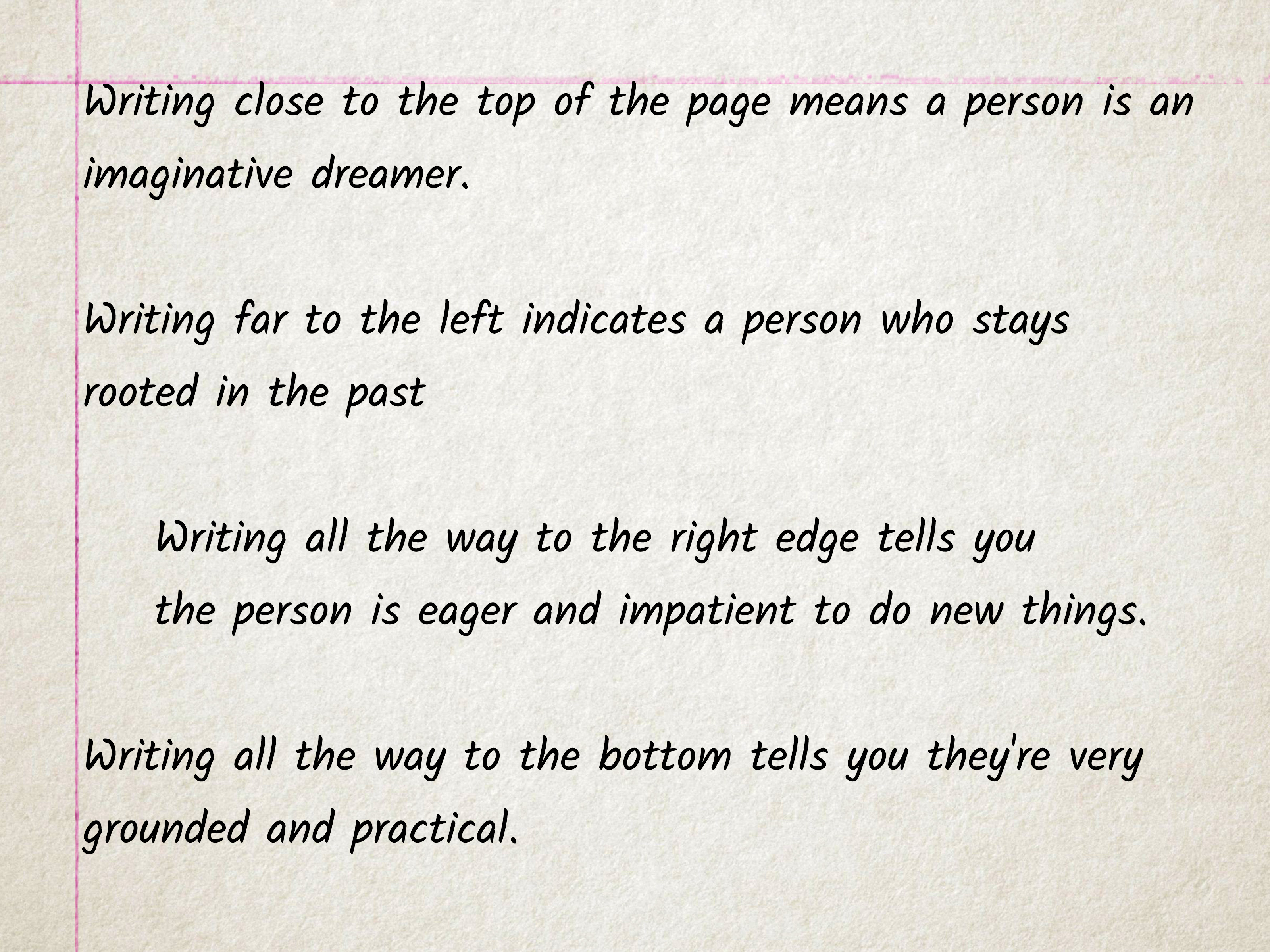
Observe the blank space around the writing. Is the left margin consistent? Does the right margin narrow as each line continues? Is the top of the page crowded while the lower half remains empty?
Traditional graphologists sometimes associate a wide left margin with moving away from the past, while a narrow left margin is linked with caution or attachment. A wide right margin may be described as hesitation about the future. These are symbolic claims, not established psychological measurements.
A more practical analysis asks how the writer plans space. Consistent margins may show deliberate page management. Irregular margins may result from speed, spontaneous composition, or varying line lengths. Compare margins only when the writer had enough paper and freedom to arrange the text naturally.
11. Analyze the Signature Separatelyand Combine Clues
A signature is a rehearsed personal mark rather than ordinary handwriting. It may be larger, faster, more decorative, or less readable than the writer’s normal text. Compare its size, slant, pressure, legibility, underline, flourishes, and distance from the body of the sample.
Traditional graphology treats a readable signature as a sign of openness and an illegible signature as a preference for privacy or efficiency. A much larger signature may be interpreted as a public image that exceeds the writer’s everyday self-presentation. Yet many signatures are illegible simply because they have been repeated thousands of times at checkout counters and delivery doors.
Finish your analysis by looking for clusters. Do not say, “The writing is small, therefore the writer is shy.” A responsible summary sounds more like this: “The sample is compact, closely spaced, upright, and consistently organized. Traditional graphology might associate that combination with concentration and restraint, but the observation is not a validated personality assessment.”
Common Beginner Mistakes to Avoid
The first mistake is relying on a handwriting chart that assigns one fixed meaning to each feature. Human behavior is too complex for a menu in which a looped “y” automatically comes with commitment issues.
The second mistake is analyzing content rather than form. If a sample says, “I dislike parties,” you do not need graphology to predict that the writer may skip Saturday’s karaoke marathon. Cover the words or use a language you cannot read when practicing visual analysis.
The third mistake is making medical conclusions. Changes in handwriting can sometimes accompany physical, neurological, visual, developmental, or motor difficulties, but a casual handwriting review cannot identify their cause. Concerns about a sudden or persistent change should be discussed with an appropriate health professional. do not use graphology to make employment decisions. The Equal Employment Opportunity Commission has noted that handwriting analysis used in hiring may raise legal concerns, particularly when it produces information related to disability or other protected characteristics. ce-Based Lessons for Practicing Handwriting Analysis
Beginners commonly start by examining dramatic features: enormous capitals, long lower loops, sharp points, or a signature that resembles a weather event. After reviewing more samples, however, the quieter details become more useful. Repeated spacing, the construction of common letters, and changes in rhythm often reveal more about how a sample was produced than one spectacular flourish.
A productive first exercise is to collect three samples of your own writing. Write one page slowly, one at your normal pace, and one while pretending you have thirty seconds before the microwave begins beeping. Compare the results. Letter size may shrink, connections may increase, punctuation may disappear, and the baseline may become less controlled. Your personality did not change three times. The writing conditions did.
Another useful experience is comparing notes written with different tools. Try a smooth gel pen, a cheap ballpoint, a pencil, and a thick marker. Pressure, width, speed, and letter formation may shift substantially. The exercise quickly cures the beginner’s temptation to treat every dark stroke as evidence of emotional intensity.
Practice also reveals the importance of repeated letters. Choose a sample containing several examples of “t,” “g,” “m,” and “I.” At first, the letters may appear nearly identical. A closer look may show different crossbar positions, loop shapes, entry strokes, pen lifts, or connecting movements. Some variation is normal. The goal is not to find perfect copies but to identify the range of forms a writer habitually produces.
It is equally helpful to analyze a sample without knowing who wrote it. Familiarity creates expectations. A neatly written page from a disorganized friend may feel “surprising,” encouraging you to invent explanations that fit what you already believe. Anonymous practice reduces that temptation and exposes how easily confirmation bias enters the process.
Keep a worksheet with columns labeled observation, traditional interpretation, alternative explanation, and confidence. For example, an observation might read, “Words are closely spaced.” The traditional interpretation might be, “Preference for social closeness.” Alternative explanations could include limited paper, fast writing, or a school-taught style. Confidence should remain low unless the spacing repeats across several natural samples.
Many learners discover that handwriting analysis becomes more interesting when they stop trying to “solve” the writer. The page becomes a record of movement, adaptation, habit, and context. You can notice which letters are simplified, where speed increases, how space is managed, and where the pen pauses without turning those details into a verdict about someone’s character.
The most valuable experience is learning to say, “I do not know.” That phrase is not a failure. It is the difference between careful observation and confident storytelling. A responsible beginner describes visible patterns, considers several explanations, and keeps graphological interpretations clearly labeled as speculative.
Conclusion
Learning how to analyze handwriting begins with patient observation. Examine the complete page, establish a baseline, and then review size, slant, spacing, alignment, pressure, rhythm, letter zones, margins, and signatures. Always combine several repeated features rather than building a personality judgment from one dramatic stroke.
Graphology can add structure and entertainment to the study of handwriting, but it should not be mistaken for a scientifically validated personality test. The smartest analyst remains curious, records what is actually visible, considers writing conditions, and resists conclusions that sprint far beyond the evidence.