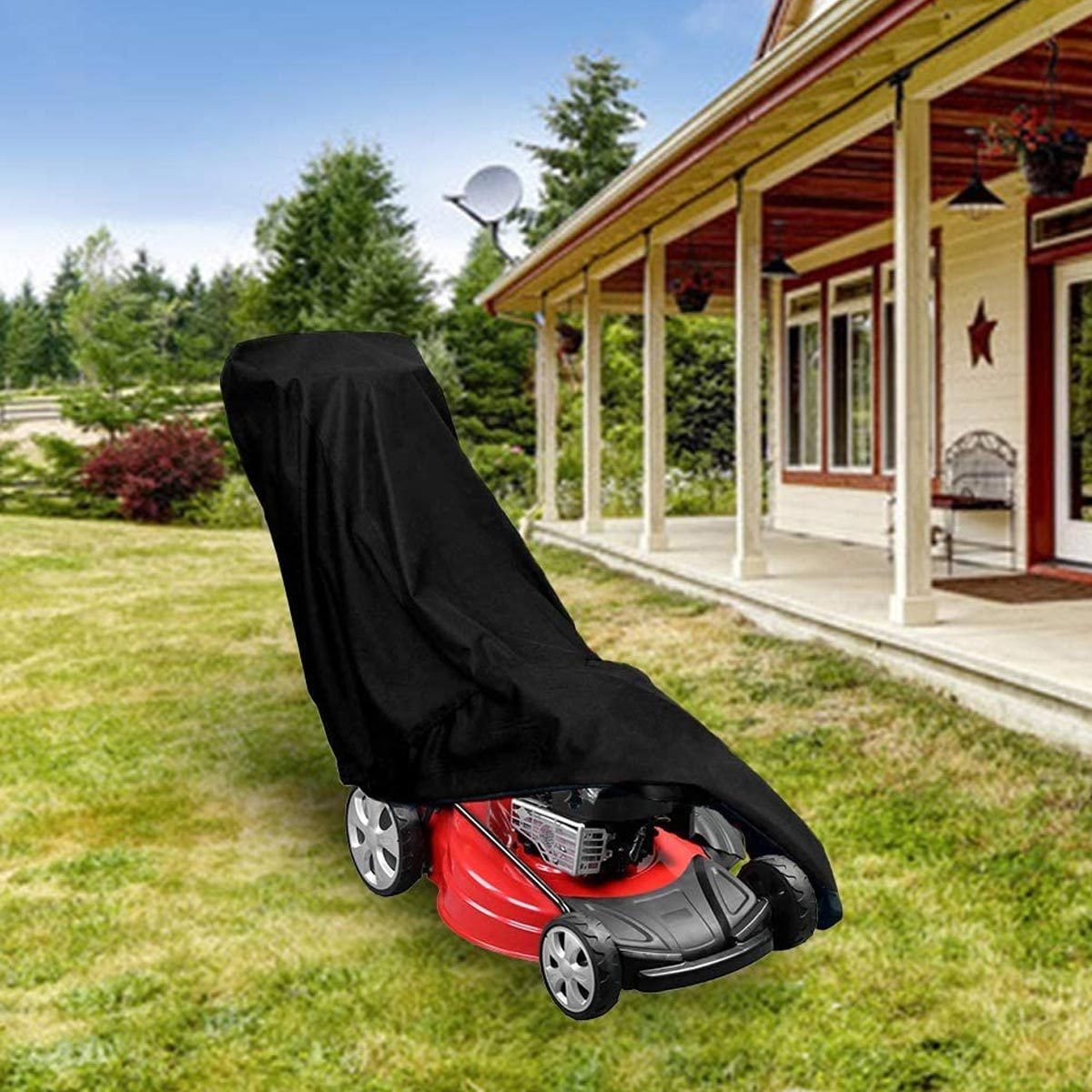
A lawn mower may be built to chew through thick grass, but that does not mean it enjoys spending its retirement hours under rainwater, bird droppings, tree sap, pollen, and the occasional ambitious spider. Whether you own a compact electric mower, a traditional gas-powered push mower, a lawn tractor, or a zero-turn machine, a properly fitted lawn mower cover can reduce exposure to moisture, sunlight, dust, and windblown debris.
The important phrase is properly fitted. Tossing a blue plastic tarp over a mower and holding it down with one heroic brick is not quite the same thing. A quality cover should fit securely, resist tearing, shed water, provide enough ventilation to reduce trapped condensation, and remain manageable when you need to remove it.
After comparing manufacturer specifications, retailer feedback, storage recommendations, fabric construction, closure systems, and compatibility, these four lawn mower covers stand out for different types of equipment and storage situations.
Quick Comparison of the Best Lawn Mower Covers
| Cover | Best For | Fit | Standout Feature |
|---|---|---|---|
| Classic Accessories Walk Behind Lawn Mower Cover | Affordable everyday protection | Gas, electric, and reel push mowers | Low-cost, lightweight design with integrated storage sack |
| RYOBI ACMC02 Lawn Mower Cover | Standard 20- to 21-inch mowers | Walk-behind and vertically stored mowers | Resists tearing, shrinking, and stretching |
| Tough Cover Premium Lawn Tractor Cover | Heavy-duty riding mower protection | Most lawn tractors up to 75 by 47 by 49 inches | 600D marine-grade fabric with double-stitched seams |
| Classic Accessories Zero-Turn Mower Cover | Zero-turn mowers and windy storage areas | Available in 50- and 60-inch widths | Reinforced vent and elastic shock-cord hem |
Why Your Lawn Mower Needs a Cover
Even when a mower is stored in a garage or shed, dust, insects, pollen, grass particles, and humidity can reach exposed components. Outdoor storage adds rain, snow, ultraviolet radiation, falling leaves, tree sap, and birds that apparently view expensive outdoor equipment as premium real estate.
Moisture is the biggest concern. It can encourage corrosion on the mower deck, fasteners, blade hardware, electrical contacts, and battery terminals. Sun exposure may fade plastic panels, weaken some materials, and age rubber components. Accumulated debris can also block vents and settle around controls or engine housings.
A cover is not a substitute for maintenance or dry storage. It is an additional protective layer. The mower should still be cleaned, cooled, and dried before covering. Manufacturers such as Briggs & Stratton and Toro recommend storing mowers in clean, dry locations and using a cover to protect against moisture and contamination.
1. Classic Accessories Walk Behind Lawn Mower Cover
Best Affordable Cover for Push Mowers
The Classic Accessories Walk Behind Lawn Mower Cover is a practical choice for homeowners who want straightforward protection without spending nearly as much on the cover as they did on their first mower. It is designed to fit gas-powered, electric, and manual reel mowers, making it one of the more versatile options for ordinary residential equipment.
Its fabric has a water-resistant and water-repellent coating that helps protect the mower from light rain, dust, pollen, dirt, and garage debris. It can also cover many mowers with the rear grass catcher still attached, reducing the need to remove and store the bag separately.
The cover is relatively lightweight, so one person can put it on or remove it without performing a backyard wrestling move. An integrated stuff sack provides convenient storage when the cover is not being used.
What We Like
- Compatible with gas, electric, and reel-type walk-behind mowers
- Water-resistant coated fabric
- Covers many attached rear grass catchers
- Integrated storage sack
- Good value for garage, shed, or covered-patio storage
Potential Drawbacks
This is an economical water-resistant cover rather than a heavy-duty shelter for continuous exposure to severe storms. Homeowners storing a mower outdoors year-round may prefer thicker fabric, sealed seams, tie-down straps, or a purpose-built storage shed. Its lightweight construction may also need additional securing in strong winds.
Best for: Homeowners storing a standard push mower in a garage, shed, carport, or other partly protected location.
2. RYOBI ACMC02 20- to 21-Inch Lawn Mower Cover
Best Fitted Cover for Standard Walk-Behind Mowers
Most full-size residential walk-behind mowers use a cutting deck around 20 or 21 inches wide. The RYOBI ACMC02 is designed specifically for this popular size range, giving it a neater fit than oversized universal covers that sometimes resemble a deflated parade balloon.
Although it carries the RYOBI name, the cover has universal fitment for many 20- and 21-inch mowers. It protects against weather, dust, and pollen and is made to resist tearing, stretching, and shrinking. One particularly useful feature is compatibility with vertically stored mowers with decks measuring up to 21 inches.
Vertical-storage compatibility matters because folding or upright mowers create a different profile from equipment stored flat on four wheels. A conventional loose cover may slide down, expose the handle, or bunch around the deck. The ACMC02 is shaped to accommodate this increasingly common storage arrangement.
What We Like
- Universal fit for most 20- and 21-inch walk-behind mowers
- Suitable for compatible vertically stored mowers
- Protection against weather, dust, and pollen
- Fabric resists tearing, stretching, and shrinking
- Cleaner appearance than an oversized universal cover
Potential Drawbacks
Owners of smaller 13- to 18-inch mowers should select the corresponding smaller RYOBI cover instead. Measure the deck and folded-handle height before ordering, especially if your mower has unusually large wheels, a bulky grass bag, or aftermarket attachments.
Best for: Owners of 20- or 21-inch battery and gas mowers, particularly models designed for upright storage.
3. Tough Cover Premium Lawn Tractor Cover
Best Heavy-Duty Cover for Riding Lawn Mowers
A riding mower requires more fabric, stronger seams, and better overall construction than a small push-mower cover. The Tough Cover Premium Lawn Tractor Cover meets those needs with 600D marine-grade fabric, double-stitched seams, and an interior waterproof coating.
The cover measures approximately 75 inches long, 47 inches wide across the front, and 49 inches high. That size is intended to fit many popular lawn tractors, but measuring remains essential. Check the mower at its widest and tallest points, including the steering wheel, seat back, discharge chute, and any permanently installed accessories.
The 600-denier fabric is a major attraction. Denier describes fiber mass and is commonly used as a rough indication of fabric weight and durability. It does not automatically guarantee waterproof performance, but a well-constructed 600D cover is generally more substantial and abrasion-resistant than a thin 150D or 200D cover.
This model protects against rain, snow, ultraviolet exposure, pollen, dust, and loose debris. The manufacturer also provides an 18-month warranty, which adds reassurance when the cover will be used through multiple seasons.
What We Like
- Heavy-duty 600D marine-grade fabric
- Double-stitched seams
- Interior waterproof coating
- Protection against rain, snow, UV exposure, dust, pollen, and debris
- Designed for both gas and electric lawn tractors
- 18-month manufacturer warranty
Potential Drawbacks
Heavier fabric takes longer to dry and occupies more storage space when folded. The listed dimensions may not accommodate tractors with large bagging systems, canopies, roll bars, or oversized attachments. Remove detachable accessories or measure the complete setup before purchasing.
Best for: Lawn tractors stored outdoors, under a carport, or in a drafty shed where stronger fabric and increased abrasion resistance are worthwhile.
4. Classic Accessories Zero-Turn Mower Cover
Best Ventilated Cover for Zero-Turn Mowers
Zero-turn mowers have wide decks, exposed seats, control levers, and an unusual shape that makes generic tractor covers a questionable fit. The Classic Accessories Zero-Turn Mower Cover is offered in 50- and 60-inch widths and is designed around that distinctive profile.
Its Weather-X fabric includes a water-resistant backing for protection against rain, snow, sunlight, dust, abrasion, and wind. An elastic shock cord runs through the lower hem, helping the cover grip the mower rather than waving farewell during the first serious gust.
The reinforced air vent is especially useful. Ventilation allows some air circulation and helps reduce ballooning when wind gets beneath the fabric. It can also limit moisture accumulation, although no cover can completely prevent condensation caused by humidity and temperature changes.
A storage bag is included, making the cover easier to organize during mowing season. That sounds like a small detail until a loose mower cover becomes the garage’s largest and least cooperative floor decoration.
What We Like
- Purpose-built shape for zero-turn mowers
- Available in 50- and 60-inch widths
- Water-resistant Weather-X backing
- Elastic shock-cord hem
- Reinforced ventilation to reduce wind ballooning
- Storage bag included
Potential Drawbacks
The standard model is water-resistant rather than completely waterproof during prolonged exposure. Measure beyond the cutting-deck width because the cover must also clear the seat, control arms, wheels, and rear engine area. Mowers equipped with roll-over protection systems or large baggers may require a different cover.
Best for: Residential zero-turn mowers stored in garages, sheds, carports, or moderately exposed outdoor locations.
How to Choose the Right Lawn Mower Cover
Measure the Entire Mower
Do not choose a cover based only on cutting-deck width. Measure the mower’s total length, maximum width, and maximum height. Include the handle, seat, steering wheel, control bars, discharge chute, wheels, and grass catcher.
A cover should be large enough to reach below the important components without dragging excessively on the ground. Too tight, and the fabric may stretch against sharp corners. Too loose, and wind can turn it into a sail.
Understand Water-Resistant Versus Waterproof
Water-resistant fabric handles dew, splashes, and light or moderate rain. Waterproof construction generally requires a nonporous coating or membrane plus well-protected seams. Even then, water can enter around openings, and condensation may form underneath.
For indoor storage, breathable water-resistant fabric may be preferable. For exposed outdoor storage, look for heavier coated material, double-stitched or sealed seams, and a secure lower closure.
Look for a Secure Hem or Straps
Elastic hems, drawstrings, buckles, and adjustable straps help keep the cover attached during windy weather. A fitted hem is usually adequate inside a garage. Outdoor storage may require multiple attachment points.
Prioritize Ventilation
Ventilation reduces fabric ballooning and lets humid air escape. It is especially valuable in warm, damp climates or unconditioned sheds. Vents should be covered or angled so they admit air without inviting rain.
Check Heat Resistance and Cooling Requirements
Never place a cover over a mower immediately after use. Gas engines, mufflers, electric motors, batteries, and drive components can remain warm. Heat may damage the cover’s coating or, in extreme cases, create a safety risk. Let the machine cool completely first.
How to Use a Lawn Mower Cover Correctly
- Clean the mower. Brush away grass clippings, leaves, mud, and dust, particularly around the deck and ventilation openings.
- Let it dry. Covering wet grass residue traps moisture exactly where you do not want it.
- Allow complete cooling. Never cover a hot engine, muffler, motor, or battery compartment.
- Remove or secure sharp accessories. Pointed brackets and discharge-chute edges can wear through fabric.
- Center the cover. Position fitted sections over the handle, seat, or engine before pulling the cover downward.
- Tighten the closure. Secure the elastic hem, drawstring, or straps without putting excessive strain on the seams.
- Inspect periodically. After heavy rain or major temperature changes, check for trapped moisture and allow the mower to air out when necessary.
Practical Experiences: What Owners Learn After Using a Mower Cover
The most common lesson is that fit matters more than expected. A cover can be made from impressive fabric, but if it hangs six inches above the ground or stretches tightly over the discharge chute, protection and durability suffer. Taking five minutes to measure the mower usually prevents months of irritation.
Wind is another excellent teacher. Lightweight covers often perform well in garages and enclosed sheds, yet become much less convincing in open yards. Elastic edging helps, but a drawstring or underbody strap provides greater security. Owners in windy regions frequently discover that adding a fitted strap is more effective than stacking objects around the cover’s edge. Bricks may hold down one corner, but they also create sharp pressure points and are eager to meet your toes after dark.
Condensation surprises many first-time buyers. A waterproof outer surface does not mean the mower will remain perfectly dry underneath. Humid air can become trapped, particularly when a warm day is followed by a cold night. The moisture may then condense on metal surfaces. Ventilation, dry equipment, and occasional airing are therefore just as important as the cover’s water rating.
Another practical lesson is to clean before covering. A mower coated with damp grass clippings remains dirty under even the finest cover ever sewn. Wet organic debris holds moisture against painted and unpainted metal. It can also create odors and encourage corrosion. A stiff brush and several minutes of drying provide more benefit than simply hiding the mess.
Owners of gas mowers also learn to respect cooling time. A mower may feel cool around the handle while the muffler remains extremely hot. Pulling a synthetic cover over hot equipment can soften protective coatings, mark the fabric, or damage seams. Waiting until the entire machine is cool is the safest habit.
Sun exposure creates a different pattern of wear. Covers stored in direct sunlight may gradually fade, even when their UV-resistant treatment remains functional. Inspect the top panels and high-stress areas each season. Small abrasions are easier to patch before they become large tears.
For vertically stored electric mowers, shape is especially important. A cover designed for upright storage stays in place more reliably and avoids leaving the folded handle exposed. Before storing an electric mower, follow the manufacturer’s battery guidance. Many experts recommend keeping removable batteries indoors in a dry, temperature-controlled location during extreme cold.
Finally, experienced owners treat a cover as part of a storage system, not a magic force field. The best arrangement is a clean mower, a dry and ventilated location, an elevated surface, appropriate seasonal maintenance, and a fitted cover. A cover can block dust, pollen, rain, sap, and debris, but it cannot correct flooding, persistent humidity, old fuel, or a family of mice that has already signed a lease inside the shed. Proper storage and routine maintenance still do the heavy lifting.
Final Verdict
The best lawn mower cover depends on the machine and its storage environment. The Classic Accessories Walk Behind Cover is an affordable solution for basic push mowers, while the RYOBI ACMC02 offers a better-defined fit for 20- and 21-inch machines. Riding-mower owners needing thicker material should consider the 600D Tough Cover Premium Lawn Tractor Cover. For zero-turn equipment, the Classic Accessories Zero-Turn Cover combines specialized sizing, a secure hem, and useful ventilation.
Whichever model you choose, measure carefully, let the mower cool, remove damp clippings, and inspect beneath the cover periodically. A modest cover supported by good storage habits can protect a much larger equipment investment.
Note: Product dimensions, availability, prices, materials, and warranty terms may change. Confirm current specifications and compatibility with the mower manufacturer or seller before purchasing. The recommendations above synthesize information from equipment manufacturers, U.S. retailers, storage manuals, lawn-care publications, and cover manufacturers reviewed in July 2026.