Some art challenges begin with a fancy sketchbook, a new tablet, and the innocent belief that “this won’t take too long.” Then reality walks in wearing a Snorlax hoodie and says, “There are more than a thousand Pokémon now. Good luck.” That is exactly what makes the humanized Pokémon art project by Chey, also known online as Endifi or Frosty, so fascinating. It is not just a fan-art gallery. It is a long-term creative marathon, a love letter to Pokémon, and a reminder that imagination does not need perfect circumstances to go wonderfully wild.
Chey is a freelance artist who was born with osteogenesis imperfecta, a genetic condition often called brittle bone disease. Because the condition affects bone strength and mobility, Chey uses a wheelchair and has described drawing as one of the biggest constants in life. The original project went viral because it combined three things the internet tends to adore: Pokémon nostalgia, character design, and a creator with enough determination to look at the National Pokédex and say, “Yes, all of them.” That is not ambition. That is Elite Four-level ambition.
The challenge is simple to describe but difficult to execute: take Pokémoncreatures already packed with color, personality, elemental themes, silhouettes, and loreand redesign them as human characters. The result is a collection of Pokémon gijinka artwork, a style of humanization that turns animals, objects, mascots, or fictional beings into human-inspired designs while keeping their recognizable essence. A great gijinka does not merely slap Pikachu ears on a hoodie and call it a day. It asks: What would this character wear? How would they stand? What kind of expression would they have? Would they be a mischievous streetwear kid, a royal moonlit guardian, a quiet scholar, or someone who definitely owns too many dramatic capes?
What Makes This Pokémon Humanization Project So Compelling?
Pokémon fan art has existed almost as long as the franchise itself. Since the late 1990s, fans have been drawing starters, legendary Pokémon, evolutions, trainers, fakemon, regional forms, and crossover characters on forums, sketch blogs, Tumblr, DeviantArt, Instagram, Reddit, and every platform where someone can upload a JPEG before dinner. But drawing every Pokémon as a human adds a specific kind of pressure. It is not one clever illustration. It is a system.
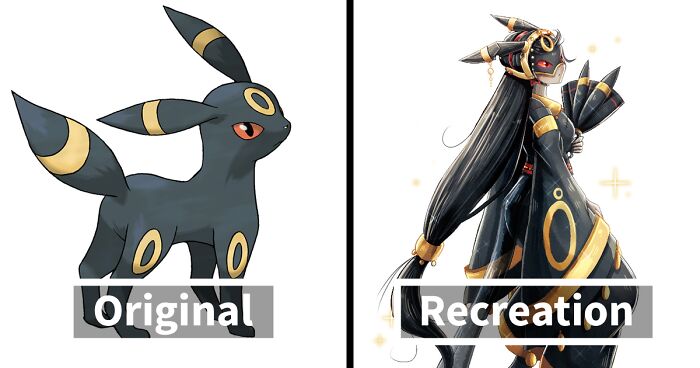
Each Pokémon has to be translated through design language. Umbreon, for example, naturally lends itself to dark elegance, lunar motifs, gold rings, and a mysterious personality. Vaporeon suggests flowing fabric, aquatic colors, soft shapes, and maybe the relaxed confidence of someone who always knows where the nearest beach is. Jolteon asks for sharp energy, electric movement, yellow accents, and a hairstyle that looks like it has personally fought a balloon. Corviknight can become a blue-armored knight. Gourgeist can turn into a stylishly spooky figure with autumn drama. Unown, a set of letter-like Psychic-type Pokémon, becomes a playground for typography-inspired character concepts.
That is the magic of gijinka art: the viewer recognizes the original Pokémon, but the artist has not simply copied it. The design feels interpreted. It has been filtered through fashion, anatomy, personality, cultural references, color theory, and character storytelling. This is why fan artists often develop such devoted audiences. Fans are not only looking at a finished drawing; they are watching a familiar character become new again.
The Artist Behind The Challenge
Chey’s story gives the project emotional weight without turning it into a pity parade. The important point is not “an artist created despite disability,” as if creativity has to ask permission from mobility. The stronger point is that Chey created with focus, humor, and personal passion while navigating a body that requires adaptation. Modern disability-language guidance encourages neutral, respectful descriptions rather than phrases that frame disabled people as tragic, helpless, or inspirational merely for existing. The title uses the wording of the original viral post, but in the body of this article, “wheelchair user” and “disabled artist” are more respectful and current terms.
Chey has explained that Pokémon has been part of life since childhood. Like many fans, early memories of the games, commercials, creatures, and companion-like fantasy of the franchise helped build a creative foundation. Pokémon is especially powerful for artists because it turns design into personality. A tiny turtle can feel heroic. A ghost can be cute. A sheep can become a fluffy celebrity. A rock snake can have more charisma than half the people in your group chat.
That blend of nostalgia and design challenge is what makes the project so shareable. It invites longtime fans to say, “I know that one!” while also giving non-fans something to appreciate: costume design, color choices, line work, poses, expressions, and the sheer scale of the task.
Why Pokémon Works So Well As Human Fan Art
Pokémon is unusually suited to humanization because each creature already carries a strong design identity. The franchise uses typesFire, Water, Grass, Electric, Ghost, Fairy, Dragon, Steel, and moreas creative shorthand. Those types give artists visual clues. Fire-type gijinka designs might use warm colors, sharp silhouettes, flame-shaped hair, leather jackets, or performance energy. Grass-types may lean into botanical patterns, soft fabrics, earth tones, or garden-prince elegance. Ghost-types get to have all the fun: veils, old jewelry, shadowy layers, eerie smiles, and outfits that say, “I may haunt your attic, but I do it fashionably.”
The best humanized Pokémon designs usually preserve three core elements: color palette, silhouette, and personality. Color tells the viewer who the character is before they notice details. Silhouette keeps the design readable, even from a distance. Personality gives the design life. A humanized Onix should not look like a random person in gray. The design needs weight, toughness, and an earthbound presence. A humanized Dewgong might feel graceful, icy, and serene. A humanized Cofagrigus could borrow from ancient tomb imagery, gold ornamentation, and haunted elegance.
This is where Chey’s work stands out. The drawings are not only “Pokémon but human.” They often feel like original characters who could walk into a fantasy RPG, a fashion illustration series, or an anime opening sequence and immediately have a theme song. Some designs are glamorous. Some are cute. Some are dramatic. Some look like they could defeat you in battle and then politely recommend a skincare routine.
The Creative Discipline Of Drawing Every Pokémon
Drawing one character is fun. Drawing ten is a project. Drawing hundreds is a lifestyle choice. Drawing every single Pokémon is the kind of challenge that requires organization, patience, and probably snacks placed within arm’s reach. The official Pokédex currently lists over a thousand Pokémon, and even when Chey’s viral post was first published, the franchise already had hundreds of species across multiple generations. That means the artist has to manage repetition, design fatigue, and the temptation to say, “Maybe Magikarp can just be a guy holding a fish.”
A massive art challenge like this requires more than drawing skill. It requires a workflow. The artist must study the original Pokémon, identify its strongest visual traits, sketch possible human forms, choose costume elements, refine the pose, color the piece, and make sure it still feels connected to the source. Then the artist has to do it again. And again. And again. Somewhere around the fossil Pokémon, most people would be bargaining with the universe.
But that repetition can also be empowering. Long-form challenges help artists build consistency. They reveal strengths and weaknesses. They force experimentation. A cute Pokémon may test facial expressions. A legendary Pokémon may test composition. A Bug-type may test texture. A Steel-type may test armor. A blob-shaped Pokémon may test the artist’s ability to avoid screaming into the void. Every new design becomes practice in problem-solving.
Fan Art, Community, And Why People Respond To Projects Like This
Fan art thrives because it turns private affection into public conversation. When someone posts a humanized Pokémon, viewers respond with memories, jokes, requests, critiques, and emotional reactions. A person who has not thought about Vaporeon since childhood may suddenly feel pulled back to a Game Boy screen, a trading card binder, or an after-school TV routine. Nostalgia is powerful, and Pokémon nostalgia may be one of the strongest known substances on Earth, right after coffee and “free shipping.”
Online communities also give disabled artists broader access to audiences. A creator can build a following from home, post finished work, sell commissions, share progress, and connect with people who value the art rather than making assumptions about the body behind it. Digital platforms are not perfectalgorithms can be chaotic little goblinsbut they have opened doors for artists who may face barriers in traditional gallery, convention, or workplace environments.
That visibility matters. Seeing a wheelchair-using artist take on a huge creative project can challenge narrow ideas about disability and productivity. It also pushes back against the lazy assumption that disabled lives are small lives. Chey’s project is big, colorful, nerdy, persistent, and full of personality. In other words, it is exactly the kind of thing the internet was made for before it became 40% login pop-ups.
Specific Examples That Show The Range Of The Series
The 40-picture collection includes designs that demonstrate how flexible Pokémon gijinka art can be. Umbreon becomes a moody, elegant figure with dark tones and glowing accents. Pikachu-inspired twins turn the franchise mascot into a playful electric duo. Corviknight takes on a knightly blue-armored identity, which feels natural for a Pokémon already associated with ravens, steel, and medieval flair. Vaporeon receives a graceful aquatic treatment, while Dewgong becomes icy and refined.
Wooloo, one of the fluffiest modern Pokémon, is practically begging to become a cozy character with soft clothing and rounded shapes. Gourgeist opens the door to Halloween-inspired fashion. Kabuto and Omanyte bring fossil energy, mystery, and ancient-sea weirdness. Cofagrigus offers one of the richest design opportunities, with Egyptian-inspired motifs and ghostly luxury. These examples show that the series is not limited to cute mascots. It spans elegance, horror, comedy, fantasy, mythology, and fashion illustration.
The strongest pieces in a project like this are often the ones where the artist makes a surprising choice. Instead of translating every feature literally, a good design chooses what to emphasize. Maybe the Pokémon’s tail becomes a scarf. Maybe its shell becomes a cloak. Maybe its wings become sleeves. Maybe its type becomes the character’s entire attitude. Humanization works best when it feels clever rather than crowded.
Why Disability Representation In Art Should Be More Than A Headline
The original headline grabs attention because it mentions the artist’s wheelchair use. That context is part of Chey’s story, but it should not overshadow the work itself. Disability representation is most meaningful when disabled creators are seen as full artists: skilled, funny, ambitious, imperfect, evolving, and capable of making work that is valuable for reasons beyond biography.
There is a delicate balance here. On one hand, ignoring disability can erase real barriers. On the other hand, overemphasizing disability can flatten a person into a symbol. The better approach is to recognize the full picture. Chey is a disabled artist. Chey is also a Pokémon fan, a designer, a storyteller, a freelancer, a community creator, and someone willing to undertake a project so large that even Professor Oak might raise an eyebrow.
That is why this collection resonates. It is not a medical story wearing an art hat. It is an art story with a real human life behind it. The drawings do not ask viewers to applaud out of sympathy. They invite viewers to enjoy the creativity, notice the craft, and maybe rethink what creative persistence looks like.
Experiences And Lessons From A Pokémon Gijinka Challenge
Anyone who has attempted a long art challenge knows the emotional cycle. Day one feels heroic. Day two feels organized. Day five feels exciting. Day twelve feels suspicious. By day thirty, your sketch layers have names like “final_final_REAL_final_v7,” and you have developed a personal relationship with the undo button. A project like drawing every Pokémon as a human magnifies that experience. It demands enthusiasm, but it also demands systems.
One relatable experience is learning that inspiration is not always loud. Sometimes the idea for a design arrives instantly. Pikachu? Easy: electric colors, cheek marks, sporty energy, maybe a streetwear silhouette. Umbreon? Moonlit elegance, black and gold, mysterious posture. But other Pokémon are less cooperative. How do you humanize a pile of eggs? A magnet? A key ring? A haunted appliance? Pokémon, bless its strange little heart, contains creatures that are basically design riddles with eyes. Those are the moments that turn fan art into real creative training.
Another experience is discovering how much research goes into something that looks playful. A good gijinka artist may study clothing references, cultural motifs, armor shapes, hairstyles, fabric movement, animal anatomy, color psychology, and the original Pokémon’s game lore. A Water-type does not always need blue hair. A Ghost-type does not always need black clothes. A strong design can surprise the viewer while still feeling recognizable. That balance is hard, and the only way to improve is to keep drawing.
There is also the experience of managing physical energy. For disabled artists, art-making can require planning around pain, fatigue, mobility, appointments, medication, accessible workspace setup, or limited reach. Digital art can help because tools can be rearranged, shortcuts can reduce strain, and work can be saved at any stage. But digital art is not magically effortless. Long sessions can still be tiring. Hands cramp. Backs complain. Tablets misbehave at the exact moment a line finally looks good. The creative process is still physical, even when the canvas is digital.
Community feedback becomes part of the journey, too. Viewers often request their favorite Pokémon, praise specific designs, or debate whether a humanized version captures the “soul” of the creature. That can be motivating, but it can also be overwhelming. A large audience may see the project as entertainment; the artist experiences it as labor, learning, and personal expression. The healthiest fan communities remember that behind every upload is a person who needs rest, respect, and occasionally a break from drawing elaborate boots.
The biggest lesson is that creative identity is built through repetition. One drawing can show talent, but a long challenge shows commitment. Each finished character becomes evidence that progress is possible in small steps. That is especially meaningful in a project tied to disability, because it reframes productivity. The goal is not to move at someone else’s pace. The goal is to keep returning to the work. A line today. A color pass tomorrow. A finished piece next week. Eventually, the gallery grows.
For fans, Chey’s Pokémon humanization project is entertaining because it makes familiar creatures feel fresh. For artists, it is useful because it demonstrates design thinking. For disabled creatives, it may feel affirming because it shows a creator shaping a large, joyful world from an accessible creative space. And for everyone else, it is a reminder that imagination is wonderfully stubborn. It will find a way into the room, pull up a chair, open the Pokédex, and start sketching.
Conclusion
“I’m A Wheelchair-Bound Artist And I Challenged Myself To Draw Every Single Pokémon As A Human (40 Pics)” is more than a catchy viral title. It is a snapshot of what happens when fandom, discipline, disability representation, and character design meet in one ambitious project. Chey’s humanized Pokémon series celebrates the charm of the franchise while proving how much originality can exist inside fan art. Each design is a translation, not a copy: a way of asking what makes a Pokémon recognizable when its creature form becomes a person.
The project also reminds us to look beyond the easy inspirational headline. Chey’s wheelchair use and osteogenesis imperfecta are part of the story, but the art deserves attention on its own terms. The real achievement is not simply creating while disabled. It is creating with vision, consistency, humor, and enough courage to take on a Pokédex-sized mountain of ideas. That is the kind of challenge that makes artists better and gives fans something to cheer forpreferably while resisting the urge to shout, “Do my favorite next!” every three seconds.
Note: This article preserves the original first-person title for search relevance while using respectful, modern disability language throughout the main content.