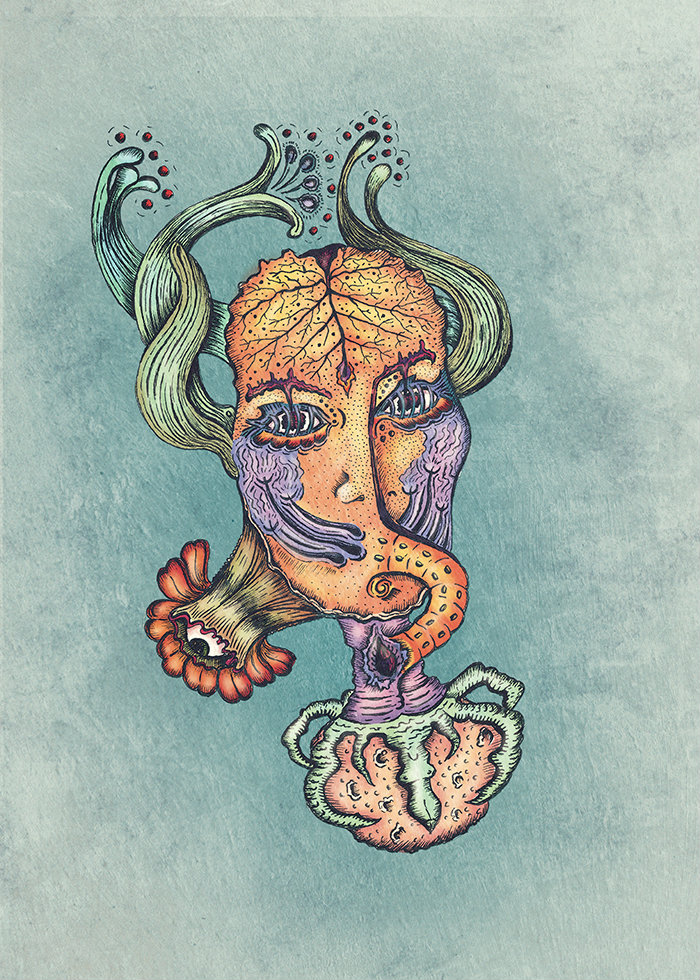
Note: This article uses Interimly Overrated as both a real artwork reference and a broader lens for discussing the language of surreal, darkly colorful portraiture.
Some portraits want to flatter you. Some want to impress you. And some stroll into the room wearing electric blue lipstick, a funeral-black background, and the emotional stability of a thunderstorm. Those are the portraits we are here for.
Interimly Overrated – Surreal Darkly Colorful Portraits is a title that sounds half like an art show, half like a dramatic text message sent at 2:13 a.m., which is exactly why it works. It captures a visual language that has become impossible to ignore: portraits drenched in saturated color, threaded with dream logic, and haunted by something just a little off. Eyes are too still. Skin glows too vividly. Backgrounds feel cosmic, theatrical, or emotionally radioactive. The face is familiar, but the mood says, “Please do not assume everything is fine.”
That tension is the magic. Surreal darkly colorful portraits pull from a long tradition of artists using dreams, symbolism, distortion, and heightened color to explore what realism often leaves politely untouched. Instead of showing a face as simple likeness, they treat portraiture as psychological weather. A cheekbone can feel like a cliff edge. Green can imply illness, envy, glamour, or alien divinity. Red can read as desire, danger, rebellion, or all three at once, which is frankly excellent value for one color.
Today, this style feels especially relevant because modern audiences are deeply suspicious of clean surfaces. We know people contain multitudes, contradictions, online selves, private selves, and at least one version of themselves that only shows up after midnight. Surreal portraiture understands this. It does not paint identity as neat. It paints identity as layered, unstable, theatrical, and alive.
What Makes Surreal Darkly Colorful Portraits So Addictive?
The first reason is simple: they are visually loud in the best way. A darkly colorful portrait does not whisper from across the room. It grabs your peripheral vision, steals your attention, and then refuses to explain itself. Rich violets, acid greens, bruised blues, blood reds, and candlelit oranges create immediate visual drama. Even before you read the symbolism, your nervous system has already RSVP’d.
The second reason is that these portraits operate on two tracks at once. They are seductive and unsettling. Beautiful and faintly cursed. Glamorous and emotionally complicated. That duality is what keeps viewers staring longer than they planned. At first glance, you notice the color. At second glance, you notice the distortion. At third glance, you begin negotiating with your own feelings.
And that is where the style earns its keep. Surreal portrait art is not merely decorative weirdness. At its best, it visualizes inner life: memory, grief, longing, fear, desire, dissociation, fantasy, reinvention, and the many moods that do not sit still long enough for a normal school-photo portrait. The result is less “Here is what I look like” and more “Here is what it feels like to be me inside my own head.”
The History Behind the Mood
To understand why this aesthetic works so well, it helps to remember that Surrealism was never just about odd imagery for the sake of being quirky. Its roots are tied to the dream world, the unconscious, irrational association, and the desire to break away from polite reason. In other words, Surrealism gave artists permission to stop behaving so respectfully toward visible reality. Once that door opened, portraiture changed with it.
Instead of using the face to confirm social status or physical likeness alone, artists began using it as a site of transformation. Faces could fracture, double, melt, hybridize, or become masks. Bodies could symbolize psychic states. Backgrounds could act like emotional spillover. A portrait was no longer just about the sitter. It became an encounter with dream, memory, desire, or dread.
Color also became more psychologically slippery. Bright hues were no longer required to mean joy, and darkness no longer had to be monochrome. One of the smartest lessons in modern art is that a vivid palette can hide terrible tension. Brightness can distract, seduce, mock, or intensify pain. A neon glow can feel more ominous than a gray wall if the mood underneath it is wrong enough. That is why darkly colorful portraits hit so hard: the palette lures you in, but the emotional undercurrent quietly rearranges the furniture in your brain.
Why the Face Is the Perfect Surreal Battlefield
Portraiture is uniquely suited to surrealism because human beings are already experts at reading faces. We search them for safety, mood, honesty, attraction, fatigue, and hidden agendas. The minute an artist distorts a face, exaggerates a feature, or changes color beyond realism, the viewer feels the shift instantly. We notice because our brains are trained to notice.
That makes portraiture an ideal place for psychological experimentation. A slightly elongated neck can suggest fragility or unease. Unnaturally smooth skin can make a sitter appear iconic, distant, or unreal. Eyes that are too large, too dark, or too empty can turn beauty into tension. A shadow placed where it should not be can create the feeling of withheld information. The portrait still feels human, but it no longer behaves normally. And once normality slips, interpretation rushes in.
That interpretive gap is the playground. Surreal portraits invite viewers to project meaning, which makes them unusually sticky in memory. You may forget a realistic painting you admired. You are less likely to forget the portrait in which the face looked calm, the colors looked festive, and the whole image somehow felt like a glamorous panic attack.
The Core Ingredients of the Style
1. Saturation with restraint
The best darkly colorful portraits are not just bright. They are strategically bright. Artists often contrast luminous focal colors against deep backgrounds or muted secondary tones. That creates dramatic tension and keeps the image from becoming visual confetti. The palette feels bold, but controlled.
2. Distortion with purpose
Surreal portraiture works when distortion feels intentional rather than random. A floating object, a split face, an impossible shadow, an animal detail, a doubled profile, or a background that behaves like a dream all suggest meaning. The image becomes stranger, but not empty.
3. Beauty with menace
This aesthetic loves the edge where attraction meets discomfort. Glossy skin, elegant posture, decorative flourishes, and polished surfaces often coexist with themes of vulnerability, mortality, alienation, or psychic pressure. The viewer feels pulled in and warned off at the same time. That contradiction is the whole party.
4. Symbolism that does not overexplain itself
Flowers, masks, birds, insects, mirrors, tears, moons, flames, drapery, theatrical lighting, or fragmented bodies often appear in this kind of work. The point is not to decode every symbol like a crossword puzzle. The point is to create a mood dense enough to reward repeat viewing.
Why This Aesthetic Feels So Current
Surreal darkly colorful portraits fit the emotional atmosphere of the present almost suspiciously well. We live in an era obsessed with self-presentation and equally obsessed with the instability of the self. Social platforms reward color, clarity, style, and immediate visual punch. But emotionally, people are drawn to art that admits complexity, contradiction, anxiety, and transformation. This style delivers both. It is visually arresting enough for the scroll and psychologically strange enough for the afterthought.
It also gives contemporary artists room to discuss identity without reducing it to a slogan. Portraiture today often carries questions about race, gender, memory, power, nightlife, vulnerability, and self-fashioning. A surreal approach lets artists speak through atmosphere, color, and visual metaphor rather than literal explanation. A figure in blue midnight light can say more about freedom or danger than a paragraph ever could.
That is part of why the style keeps resurfacing. Whenever realism starts feeling too obedient, artists return to the surreal. Whenever beauty feels too polished, they let it crack. Whenever identity feels oversimplified, they make the portrait stranger. The genre survives because human beings do not experience life in tidy, evenly lit realism. We experience it in flashes, distortions, dreams, fears, half-memories, and moods that arrive wearing excellent color choices.
So Is It Really “Overrated”?
The funny thing about a title like Interimly Overrated is that it sounds like a critique while secretly sounding fascinated. That is often how audiences talk about surreal portraiture. They call it dramatic, moody, too online, too stylized, too self-aware, too this, too that. And yet they keep looking.
Maybe the better question is not whether surreal darkly colorful portraits are overrated, but whether they are doing exactly what memorable art should do. They disrupt passive viewing. They make emotion visible without flattening it. They remind us that the portrait has never been just a record of appearances. At its most potent, it is a staged collision between body, psyche, performance, and symbol.
And honestly, in a world full of bland visual sameness, a portrait that looks like it came from a dream, a confession, and a thundercloud all at once is not a problem. It is a public service.
Experiences Viewers Often Have with Surreal Darkly Colorful Portraits
One of the most interesting things about surreal darkly colorful portraits is how they change while you are looking at them. A lot of art gives you the basic message in the first few seconds. These portraits absolutely do not. They pull a small trick: first they read as style, then they read as mood, and only after that do they begin to read as emotion. The experience is layered.
Many viewers describe a kind of double response. First comes attraction. The color does its job. Jewel tones, inky shadows, glowing skin, theatrical reds, and cosmic blues are hard to resist. The image feels lush, cinematic, and glamorous. But then the second response kicks in: discomfort. Maybe the hands are too still. Maybe the eyes are avoiding you in a way that feels deliberate. Maybe the mouth is calm while the background looks like the emotional equivalent of broken glass. You realize the portrait is not simply pretty. It is tense.
That shift from attraction to unease is often what makes the experience memorable. Viewers are not just admiring technique; they are being made aware of their own expectations. We are used to portraits offering stability. We expect the face to anchor us. In surreal portraiture, the face often becomes the opposite: a portal, a mask, a performance, a warning, a riddle, or a confession that refuses to use indoor voice levels.
Another common experience is recognition without certainty. People often feel that a surreal portrait is emotionally true even when it is visually impossible. A green shadow across the face may not be realistic, but it can feel exactly like exhaustion. A halo of violent pink may not exist in everyday life, but it can feel like panic, desire, reinvention, or grief. This is one reason the genre connects so strongly with modern audiences. It mirrors how emotion actually behaves. Feelings rarely arrive in tidy beige realism.
There is also the experience of delayed interpretation. You leave the image, and it keeps working on you. Hours later, you remember a small detail: a split profile, a floating object, a weirdly ceremonial hand, a color contrast that felt too beautiful for such a bleak atmosphere. The portrait stays active in memory because it was never fully solved. It remains open, and that openness is part of its power.
For artists, collectors, and casual viewers alike, these portraits can also feel oddly validating. They suggest that contradiction is not failure. You can be luminous and troubled, elegant and strange, composed and unraveling, all in the same frame. That complexity feels honest. It gives visual form to emotional states that ordinary portraiture often sands down until they become socially acceptable.
And perhaps that is the deepest experience this genre offers: permission. Permission for beauty to be uneasy. Permission for color to be emotional instead of merely decorative. Permission for portraiture to stop acting like a passport photo with better lighting and start behaving like a living map of the inner world. Once viewers feel that freedom, it is very hard to go back to portraits that only say, “Here is a face,” when they could have said, “Here is a universe pretending to hold still.”
Conclusion
Interimly Overrated – Surreal Darkly Colorful Portraits sounds like a provocation, but the aesthetic behind it is anything but disposable. It belongs to a rich visual tradition shaped by dream logic, emotional symbolism, and a refusal to let portraiture remain merely polite. These works thrive in contradiction: dark yet radiant, beautiful yet unnerving, intimate yet theatrical, human yet transformed.
That is exactly why they endure. Surreal darkly colorful portraits do more than represent a face. They stage the invisible. They let color carry emotional voltage. They allow the self to appear unstable, symbolic, and gloriously unfinished. And in a cultural moment that prizes both visual intensity and emotional complexity, that is not an overhyped niche. It is one of the most compelling ways portraiture continues to evolve.