History preserved the words, victories, scandals, and spectacular wardrobe choices of famous people, but it was less reliable with their faces. Before photography, appearance depended on painters, sculptors, coins, death masks, and occasionally flattering patrons who preferred fewer wrinkles and considerably more majesty.
Dutch artist Bas Uterwijk, also known as Ganbrood, explores that uncertainty through artificial intelligence. Using surviving paintings, sculptures, and other visual references, he creates photorealistic portraits of historical figures, mythological personalities, fictional characters, and famous works of art. The results can feel uncannily familiaras though Napoleon, Mona Lisa, or Marcus Aurelius has wandered into a modern photography studio.
These images are not recovered photographs or scientifically proven reconstructions. They are informed artistic interpretations. That distinction matters, but it does not make them less fascinating. If anything, the uncertainty is part of the fun.
How Bas Uterwijk Creates His AI Historical Portraits
Uterwijk brings an unusually useful collection of skills to the project. His professional background includes special effects, computer-generated imagery, 3D animation, video games, documentary work, and photography. Each field deals with the same slippery challenge: making an invented image feel believable.
He began experimenting with generative adversarial networks, or GANs, around 2019. A GAN uses two competing neural-network components. One generates images, while the other evaluates whether those images resemble the material on which the system was trained. Through repeated adjustments, the software becomes increasingly capable of producing faces that look photographiceven when the person depicted never stood before a camera.
Uterwijk has used tools such as Artbreeder to guide facial structure, age, expression, lighting, and other characteristics. He may also combine several visual references and refine details manually. The machine supplies possibilities; the artist chooses which possibility tells the most convincing visual story. In other words, the software brings a very large box of crayons, but it does not decide what to draw.
Why “Really” Belongs in Quotation Marks
A painted portrait is already an interpretation. A Roman bust may idealize a ruler, a Renaissance patron may request cosmetic diplomacy, and a self-portrait may emphasize mood rather than anatomical precision. An AI system then interprets those interpretations through patterns learned from modern photographs.
The finished portrait is therefore a plausible face, not historical proof. Hair texture, skin tone, eye color, age, and expression may involve educated decisions or creative invention. Training data can introduce additional bias, especially when some populations are overrepresented in collections of modern facial photographs. The most responsible way to view these works is as visual hypotheses: compelling “what if” images rather than passport photos delivered two millennia late.
29 Historical and Popular Figures Reimagined as Real People
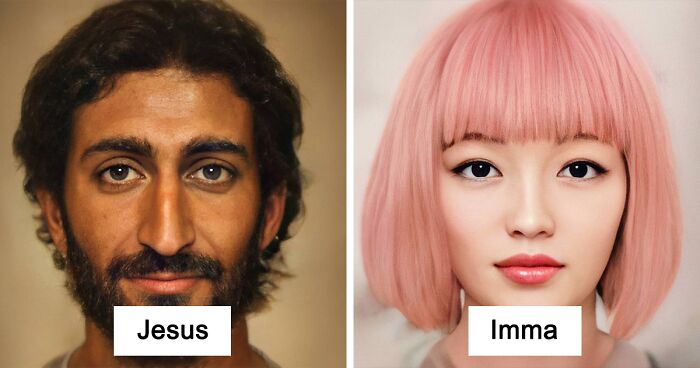
1. Jesus
Uterwijk’s revised Jesus portrait moves away from the polished, Northern European face common in later Western art. The result feels more grounded in the eastern Mediterranean world, although no authenticated contemporary portrait exists. It is a thoughtful interpretation, not a definitive likeness.
2. Vincent van Gogh
Van Gogh left numerous self-portraits, but they differ in color, expression, and proportion. Uterwijk translates their angular features, red hair, and searching gaze into a photographic face. The eyes remain intense enough to make small talk seem entirely out of the question.
3. The Statue of Liberty
Frédéric Auguste Bartholdi designed Liberty Enlightening the World as a monumental symbol, not a portrait of an ordinary New Yorker waiting for coffee. Uterwijk turns the copper icon’s stern classical features into a believable woman, reminding viewers that even national symbols are built from recognizable human forms.
4. William Shakespeare
Only a limited number of images are seriously connected with Shakespeare, and debates about their authenticity have lasted longer than some theatrical productions. The AI-assisted version gives the familiar high forehead, narrow face, beard, and watchful eyes a modern photographic presence.
5. The Woman From The Birth of Venus
Sandro Botticelli’s Venus was never intended as documentary evidence. Her proportions, flowing hair, and serene expression belong to Renaissance poetry in painted form. Uterwijk’s treatment imagines the face beneath that graceful idealization, producing someone who appears human while retaining the painting’s dreamlike calm.
6. A Fayum Mummy Portrait
Fayum portraits were painted in Roman Egypt and placed over the faces of mummies. Many already seem startlingly immediate, with direct gazes and individualized features. The AI interpretation adds photographic light and skin texture, narrowing a distance of nearly two thousand years with remarkable ease.
7. Napoleon Bonaparte
Napoleon’s public image was shaped by official paintings designed to communicate authority, stability, and heroic ambition. The reimagined face feels less like an imperial emblem and more like an ambitious, slightly exhausted man who has just discovered another coalition forming against him.
8. Leonardo da Vinci’s Vitruvian Man
The Vitruvian Man is an anatomical study of ideal human proportions, not a confirmed portrait of a named sitter. Uterwijk nevertheless gives the drawn figure volume, color, and personality. The transformation illustrates how readily viewers invent a life story once a face appears photographic.
9. Jacqueline Roque
Jacqueline Roque, Picasso’s second wife and frequent muse, was photographed extensively. Here the interest is not archaeological discovery but translation: Uterwijk converts Picasso’s stylized visual language back into photographic realism. It is an experiment in reversing artistic abstraction.
10. Alexander the Great
Ancient portraits of Alexander often descended from an influential type associated with the sculptor Lysippos. Wavy hair, an upward gaze, and youthful energy helped communicate heroic leadership. The AI portrait makes those conventions feel personal, though it cannot separate genuine anatomy from royal branding.
11. Venus de Milo
The famous marble sculpture represents Aphrodite, the Greek goddess identified with the Roman Venus. Its smooth, idealized face offers few ordinary imperfections. By adding pores, color, and subtle asymmetry, the digital portrait turns a museum icon into someone who might plausibly pass you in a crowd.
12. Rembrandt van Rijn
Rembrandt documented himself repeatedly through paintings, drawings, and etchings. Those self-portraits show aging, changing fashions, and shifting emotional tones. Uterwijk’s reconstruction draws from a richer record than most historical faces, preserving the artist’s deep-set eyes, broad nose, and unvarnished humanity.
13. Julius Caesar
Coins and sculptural portrait types provide clues to Caesar’s appearance, but even Roman realism carried political messages. The reconstructed Caesar looks lean, alert, and severe. He resembles a formidable administratorwhich is appropriate for a man whose calendar reform still tells us when to attend meetings.
14. Aphrodite
Because Aphrodite is mythological, there can be no historically correct face. This image instead asks what a photographic version of an ancient beauty ideal might look like. The answer reveals as much about modern expectations as it does about classical sculpture.
15. Tintin
Hergé’s young reporter is built from deliberately simple lines, a round face, and perhaps the most professionally committed forelock in comics. Giving Tintin realistic anatomy is playful rather than historical, yet the recognizable spirit survives the journey from ink to simulated photography.
16. Rogier van der Weyden’s Portrait of a Lady
The original portrait presents an elegantly dressed woman with lowered eyes, tightly arranged hair, and refined features. Uterwijk softens the geometric precision of the painting into lifelike skin and expression while preserving its quiet, self-contained mood.
17. Marcus Aurelius
Surviving sculptures established the philosopher-emperor’s curled hair, beard, and thoughtful expression. The digital version makes Stoicism look surprisingly approachable. He could be preparing to discuss virtueor politely explain why your delayed flight is outside your control.
18. Albrecht Dürer
Dürer’s self-portraits carefully constructed his identity as an intellectual and prestigious artist. Uterwijk preserves the long hair, symmetrical features, and unwavering gaze while translating the painted surface into photographic detail. The confidence remains fully intact.
19. Caligula
Portraits of Roman emperors combined personal likeness with imperial messaging, while later accounts added layers of reputation and legend. Uterwijk’s Caligula appears young and controlled rather than theatrically villainous. History, after all, rarely gives villains convenient glowing red eyes.
20. Emperor Caracalla
Caracalla’s sculptural portraits are famous for their cropped hair, furrowed brow, and sharply turned head. The photorealistic adaptation retains that confrontational intensity. He looks as if someone has just suggested reducing the military budget.
21. A Figure From an Ilya Repin Painting
Russian painter Ilya Repin was celebrated for psychologically powerful realism. Translating one of his painted subjects into photographic form is a subtler transformation because the source already communicates individual character, texture, and emotional weight.
22. Isabella Brant
Isabella Brant, the first wife of Peter Paul Rubens, appears in affectionate portraits by the artist. Uterwijk’s version reinterprets the period clothing, expression, and painterly softness as a candid human presence, allowing the sitter to step beyond the formal conventions of her era.
23. Mona Lisa
Leonardo’s Mona Lisa may be the most analyzed face in Western art. Uterwijk’s recreation keeps the famous composure while adding realistic skin and contemporary lighting. Her expression remains elusive, proving that even AI cannot force history’s most famous sitter to explain the joke.
24. Jan Mankes
Dutch painter Jan Mankes created intimate, restrained works and died at only 30. His photographic reimagining has a delicate, introspective quality that fits the emotional atmosphere associated with his paintings and known portraits.
25. Imma
Imma is a Japanese virtual model rather than a person recovered from the past. Her inclusion creates a clever loop: a digital personality is interpreted through another digital process to appear even more photographic. Reality briefly leaves the room to collect itself.
26. Snow White
Snow White belongs to folklore and popular animation, so this portrait is pure visual speculation. The challenge is preserving recognizable innocence and iconic features without producing a face that looks like a cartoon wearing a realism filter.
27. Lucius Annaeus Seneca
Ancient sculptural types traditionally identified with Seneca offer the starting point for this stern, weathered face. The reconstruction gives the Roman philosopher a strong physical presence while reminding us that the identification of some classical portraits remains debated.
28. Jonathan Banks
Actor Jonathan Banks is already known through modern photography and television. His appearance in the collection functions as a test of resemblance rather than historical recovery. It lets viewers compare algorithmic interpretation with a living photographic record.
29. Girl With a Pearl Earring
Johannes Vermeer’s celebrated work is a “tronie,” a character study rather than a conventional commissioned portrait. The sitter’s identity remains unknown. Uterwijk’s version gives her realistic skin and dimensionality while preserving the dramatic glance that has captivated viewers for centuries.
What These Photorealistic Recreations Canand CannotTell Us
The most reliable reconstructions begin with multiple independent references. Van Gogh and Rembrandt left many self-portraits. Jacqueline Roque and Jonathan Banks were photographed. Ancient rulers may be represented by coins, busts, and repeated portrait types. Comparing several sources can reveal consistent traits, but consistency does not automatically equal truth. Copies may descend from the same idealized model.
Mythological and fictional figures occupy a different category. Aphrodite, Venus, Tintin, and Snow White never possessed historically recoverable faces. Their portraits explore how visual symbols might translate into human anatomy. Likewise, Mona Lisa and Girl With a Pearl Earring represent real or possible models filtered through an artist’s technique, composition, and purpose.
The project succeeds when it encourages curiosity rather than certainty. A convincing image can make historical people feel emotionally accessible, but photorealism is not evidence. The smoother and more believable an AI-generated portrait becomes, the more important labeling and context become.
Why Seeing a Human Face Changes Our Relationship With History
Names and dates keep history organized, but faces make it personal. A marble emperor can feel like an institution. Give him skin texture, uneven eyebrows, and the faint shadow of a beard, and he suddenly resembles a person who slept badly, worried about rivals, and probably had strong opinions about dinner.
That emotional bridge explains the appeal of AI historical portraits. They do not replace museum objects, scholarly research, or archaeological reconstruction. Instead, they invite viewers to return to those sources with better questions: Who commissioned the original image? What message was it intended to send? Which features were observed, and which were invented?
A More Rewarding Way to Experience the 29 Portraits
The best way to explore Uterwijk’s collection is not to race through it and decide whether each face looks “right.” Begin by hiding the name, if possible, and study the portrait as though it belonged to an unknown person. Notice the age, expression, lighting, posture, and emotional impression. Does the sitter seem guarded, amused, tired, severe, or approachable? Then reveal the identity and observe how quickly historical reputation changes what you think you see.
Caligula offers a particularly revealing experiment. Without the label, viewers may see a serious young man. Once his name appears, the same neutral mouth or concentrated stare can suddenly look cruel. The pixels did not change; the viewer’s expectations did. That small experience demonstrates how strongly stories influence facial interpretation.
Next, compare every digital portrait with its source material. Place Uterwijk’s Van Gogh beside several self-portraits rather than only one. The differences become as interesting as the similarities. One painting sharpens the cheeks, another changes the beard, and another shifts the color of the eyes. Instead of exposing a single “correct” Van Gogh, the comparison shows how the painter repeatedly reconstructed himself.
Try the same exercise with Rembrandt. His large body of self-portraiture lets viewers follow him across decades. The AI portrait may appear like a stable answer, but the originals reveal a person changing with age, technique, circumstance, and artistic intention. A face is not a logo; even a photograph captures only one instant.
The mythological and fictional portraits invite a different experience. Ask which details make Tintin remain Tintin after his clean lines become human skin. Is it the hair, youthfulness, expression, or the accumulated memory of the comics? With Aphrodite or Snow White, consider whether the generated face reflects an ancient ideal, a modern beauty standard, or a mixture of both.
Finally, examine the figures for whom photographs already exist. Jacqueline Roque and Jonathan Banks provide useful reality checks. If an AI interpretation differs from the photographic subject, that does not necessarily mean the experiment failed. It exposes how style, training data, and human selection reshape even a documented face.
This slower viewing method turns a viral image collection into a miniature lesson about portraiture. It encourages curiosity without demanding blind belief. You may leave without knowing exactly what Caesar or Shakespeare looked like, but you will understand more about how their faces reached usand why every historical image deserves at least one raised eyebrow.
Conclusion
Bas Uterwijk’s AI-assisted portraits make famous historical figures feel close enough to recognize while preserving the mystery that makes them compelling. His 29 recreations range from evidence-based interpretations of photographed or frequently portrayed people to imaginative versions of gods, fictional characters, and anonymous artistic subjects.
The images should not be mistaken for definitive historical reconstructions. Their real value lies in the conversation between technology, art, and memory. They encourage us to look again at paintings, sculptures, and coinsnot as imperfect substitutes for photographs, but as complex objects shaped by artists, patrons, politics, and time.
Note: These portraits are artistic interpretations created with AI-assisted tools and human editing. They should be viewed as plausible visual experiments, not authenticated photographs or scientifically conclusive reconstructions.