Bubbles look like tiny floating jokes: round, shiny, fragile, and gone the moment you try to show them to someone. But behind that soap-film sparkle is a surprisingly serious world of physics, chemistry, biology, medicine, climate science, food engineering, and even space research. Yes, bubbles are adorable. They are also miniature laboratories that explain why oceans smell salty, why whipped cream feels luxurious, why ultrasound images can become clearer, and why your kitchen sink occasionally looks like it is auditioning for a foam party.
The science of bubbles is useful because a bubble is not just “air with a wet jacket.” It is a boundary between gases and liquids, shaped by surface tension, pressure, evaporation, surfactants, light, and geometry. When many bubbles gather, they become foam, and foam is everywhere: in bread, shampoo, ocean spray, firefighting systems, insulation materials, medical imaging, and industrial manufacturing. Below are ten weirdly useful scientific facts about bubbles that prove these tiny spheres deserve more respect than they get from birthday parties and dishwashing commercials.
1. Bubbles Are Round Because Nature Is Cheap With Energy
A free-floating bubble forms a sphere because a sphere gives the smallest possible surface area for a given volume. That matters because creating surface area costs energy. Liquids behave as if their surfaces are stretched elastic skins, a property called surface tension. When a soap film encloses air, surface tension pulls the film inward from every direction. The most efficient shape is a sphere, so the bubble becomes round without needing a tiny architect inside wearing a hard hat.
This fact is useful far beyond backyard bubble wands. Engineers study surface tension when designing sprays, droplets, coatings, and microfluidic devices. The same principle helps explain why raindrops begin nearly spherical, why oil droplets bead up in water, and why tiny liquid systems behave differently from large ones. In the world of very small things, surface forces can dominate gravity. That is why a water droplet on a leaf can look like a glass marble while an ocean does not politely curl itself into a ball.
2. Soap Does Not Simply “Make” BubblesIt Tames Water
Plain water has strong surface tension because water molecules cling tightly to one another. That is great for water striders and dramatic raindrops, but terrible for blowing long-lasting bubbles. Soap changes the game by adding surfactant molecules. These molecules have one end that likes water and another end that avoids it. They arrange themselves at the surface, reducing the water’s surface tension enough for a film to stretch without immediately snapping.
A soap bubble film usually has a thin layer of water sandwiched between two layers of soap molecules. That layered structure gives the bubble flexibility. Additives such as glycerin or sugar can help slow evaporation, making bubbles last longer. This is why some homemade bubble recipes feel almost magical: they are not magic, just chemistry with better branding.
This explains why dish soap, shampoo, and laundry detergents behave the way they do. Surfactants help water spread across greasy surfaces, loosen dirt, suspend oils, and create foam. Bubbles are not doing all the cleaning by themselves, but they are visual proof that surface chemistry is hard at work.
3. The Colors in Bubbles Are Tiny Measuring Tools
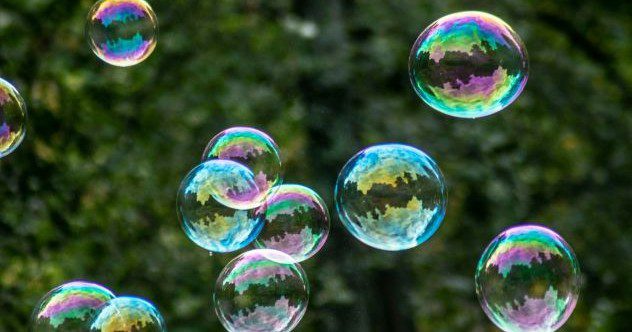
The rainbow colors on a soap bubble are not painted on. They are created by thin-film interference. Light reflects from both the outer and inner surfaces of the bubble film. Because the film is extremely thin, the reflected light waves can overlap, strengthen some colors, and cancel others. As the film drains and changes thickness, the colors shift.
That pretty swirl is useful information. Scientists and engineers can use similar interference patterns to study thin films, coatings, lenses, and delicate materials. When a bubble begins to show dark patches, the film may be becoming so thin that visible light no longer reflects strongly from it. In bubble language, that dark patch often means, “I am about to retire from public life,” followed by a tiny pop.
Thin-film color also helps explain why oil slicks, anti-reflective coatings, and some insect wings shimmer. A bubble is basically a floating demonstration of optical physics, which is impressive for something that can be destroyed by a sneeze.
4. Small Bubbles Have Higher Pressure Inside
A small bubble has a stronger curvature than a large bubble, and that curvature creates a pressure difference. The smaller the bubble, the higher the internal pressure compared with the surrounding liquid or air. This is described by the Laplace pressure principle: tighter curvature means greater pressure.
This is why tiny bubbles in foam tend to disappear while larger bubbles grow. Gas diffuses from the higher-pressure small bubbles into lower-pressure larger bubbles, a process related to Ostwald ripening. It is one reason foams age, collapse, and change texture over time. A fresh cappuccino foam can look glorious, but wait too long and the tiny bubbles surrender to physics. Your coffee did not betray you; it obeyed thermodynamics.
Understanding bubble pressure is useful in food science, cosmetics, materials engineering, and medicine. The size of bubbles can affect texture, stability, strength, and how gases move through liquids. Whether someone is designing a shaving foam, a medical microbubble, or a light insulating material, bubble size is not a decorative detailit is a performance feature.
5. Foam Is a Geometry Problem That Solves Itself
When bubbles pack together, they become foam. Unlike a single bubble, foam bubbles are not usually perfect spheres. They press against one another and form shared walls. The foam constantly rearranges itself to reduce total surface area while still enclosing gas. In other words, foam is nature doing math while looking like bathwater.
Foam structures follow geometric rules often associated with Plateau’s laws. Bubble films meet in predictable angles because those arrangements minimize energy. This makes foam interesting to mathematicians, physicists, architects, and materials scientists. The study of foams has inspired ideas about efficient structures, lightweight materials, and cellular patterns.
You can see similar space-saving logic in honeycombs, plant tissues, and some engineered materials. Foam is useful because it combines lightness with volume. That is why bubble-filled structures appear in packaging, insulation, cushions, helmets, construction materials, and even aerospace research. A pile of bubbles may look chaotic, but hidden inside is an energy-saving geometry lesson.
6. Popping Bubbles Can Launch Tiny Droplets Into the Air
When a bubble bursts at a liquid surface, it can eject tiny droplets. At the ocean surface, breaking waves trap air underwater, creating bubble plumes. Those bubbles rise, collect organic material and salt, then burst, launching sea spray aerosols into the atmosphere. These aerosols can influence clouds, air quality, and climate processes.
This is one of the weirdest useful facts about bubbles: the pop of a bubble can connect the ocean to the sky. Sea spray carries salts and organic compounds from seawater into the air. Scientists study this process to better understand weather, marine chemistry, and how particles form in the atmosphere. The beach smell you associate with vacation is partly a complicated conversation between waves, biology, salt, sunlight, and bursting bubbles.
Bubble bursting also matters in public health and environmental research because droplets can transport substances from liquid surfaces into the air. That does not mean every bubble is scary. It means bubbles are surprisingly effective messengers between water and atmosphere, which is both elegant and slightly dramatic.
7. Cavitation Bubbles Can Clean, Cut, and Cause Trouble
Cavitation happens when bubbles form and collapse rapidly in a liquid because of pressure changes. When these bubbles collapse, they can produce intense local forces. In controlled settings, cavitation is useful. Ultrasonic cleaners use tiny cavitation bubbles to help remove grime from jewelry, dental tools, laboratory equipment, and delicate machine parts. The bubbles collapse near surfaces and help dislodge particles from places a cloth could never reach.
But cavitation is not always welcome. In pumps, propellers, and turbines, collapsing bubbles can damage metal surfaces over time. Engineers work hard to reduce harmful cavitation because it can create noise, vibration, efficiency loss, and erosion. So bubbles can be both cleaning crew and tiny demolition team, depending on where they show up.
This dual personality makes cavitation important in engineering, medicine, chemistry, and manufacturing. It is a reminder that bubbles are not automatically gentle just because they look like something a cartoon fish would enjoy.
8. Microbubbles Can Help Doctors See Inside the Body
Microbubbles are extremely small gas bubbles, often stabilized by shells made of lipids, proteins, or polymers. In medical ultrasound, microbubble contrast agents can improve imaging because gas bubbles scatter sound waves much more strongly than surrounding tissues or blood. This can help doctors evaluate blood flow, organ perfusion, and certain vascular structures.
Researchers are also studying microbubbles for targeted drug delivery and other therapeutic uses. The idea is that bubbles can respond to ultrasound energy in controlled ways. In some research settings, that response may help open temporary pathways or deliver substances more precisely. This area is complex and carefully regulated, but the basic idea is wonderfully strange: tiny bubbles may help medicine become more visible and more targeted.
The usefulness comes from physics. Bubbles compress and expand differently from liquids and tissues when exposed to sound waves. That makes them excellent acoustic markers. The same basic bubble behavior that makes foam fizz can, at microscopic scale, become a tool for imaging the human body.
9. Bubbles Make Food Feel Better
Bubbles are the unsung engineers of texture. Bread rises because gas bubbles expand inside dough, creating a soft crumb. Whipped cream is delicious partly because fat and proteins stabilize air bubbles. Ice cream depends on tiny air cells for smoothness and scoopability. Meringue is basically a sweet foam with a pastry chef’s ego. Sparkling water feels lively because carbon dioxide bubbles stimulate the mouth and nose.
Food scientists care deeply about bubble size and stability. Large, uneven bubbles can make bread coarse. Tiny stable bubbles can make desserts feel creamy and luxurious. In batters, doughs, foams, and beverages, bubbles affect appearance, mouthfeel, flavor release, and shelf life. A perfect pancake is not just flour and hope; it is controlled gas expansion.
This is why overmixing, undermixing, temperature, fat content, and proteins matter so much in cooking. You are not merely following a recipe. You are managing a bubble ecosystem. Sometimes the ecosystem rewards you with fluffy cake. Sometimes it gives you a dense muffin that could be used as a doorstop. Either way, bubbles were involved.
10. Bubbles Are Excellent Detectors
Bubbles are useful because they reveal things we cannot easily see. A soap solution can show gas leaks by forming bubbles where air escapes. Divers watch bubbles to understand breathing and movement underwater. Scientists study bubble streams from the seafloor to learn about methane release, underwater geology, and marine chemistry. Engineers analyze bubble patterns in pipes, reactors, and tanks to understand mixing and flow.
Bubbles can also affect sound underwater. Clouds of bubbles scatter and absorb acoustic energy, which is why researchers and engineers study bubble curtains for reducing underwater noise in some construction and marine settings. In industrial systems, bubbles can improve mixing and oxygen transfer, but they can also create measurement problems, block flow, or reduce efficiency if they are not controlled.
That is the strange genius of bubbles: they are both tools and clues. They show pressure changes, leaks, chemical reactions, biological activity, and energy transfer. A bubble is rarely just a bubble. It is often evidence.
Real-World Experiences: What Bubbles Teach Us When Science Leaves the Lab
One of the easiest ways to appreciate bubble science is to make a simple bubble solution and then change one variable at a time. Use plain water first and try to blow bubbles. You will probably get disappointment with a side order of wet hands. Add dish soap and suddenly the water stretches into films. Add a small amount of glycerin or sugar, and the bubbles may last longer because evaporation slows down. That tiny kitchen experiment demonstrates surface tension, surfactants, humidity, evaporation, and film stability without requiring a lab coat or a grant proposal.
Humidity is especially noticeable. On a dry day, bubbles pop quickly because the water in the film evaporates faster. On a humid day, bubbles can float longer and sometimes land on soft, damp surfaces without bursting. This is why bubble performers often prefer controlled indoor environments. The bubble is not being moody; the air is stealing its water.
Another everyday lesson appears at the sink. Hot water, grease, soap, and motion create different kinds of foam depending on how much surfactant is present and how stable the films become. If you wash a greasy pan, the first round of soap may foam less because surfactant molecules are busy interacting with oils. After the grease is reduced, foam becomes easier to build. This is not a perfect cleanliness meter, but it is a useful clue that chemistry is changing in the water.
Cooking offers even better bubble experiences. Watch pancake batter on a griddle. Small bubbles rise, expand, and pop at the surface, signaling that heat is moving through the batter and gases are forming. In bread dough, bubbles are trapped by gluten networks, and their expansion creates softness. In whipped egg whites, proteins unfold and stabilize air bubbles. If fat contaminates the bowl, the foam may fail because fat interferes with the protein network. That is why bakers act like a tiny drop of yolk is a kitchen villain.
Even a glass of sparkling water is a bubble lesson. Bubbles usually form at tiny imperfections on the glass surface, called nucleation sites. If the glass is very smooth, fewer bubbles may appear. If there are scratches, dust, or textured points, bubbles form more easily. The same principle helps explain boiling, where bubbles form at nucleation sites as liquid changes into vapor.
For children, classrooms, science clubs, or curious adults, bubbles are one of the best low-cost science demonstrations because they are visual, safe when handled sensibly, and instantly engaging. They show invisible forces in a visible way. A bubble wand turns molecular attraction into a sphere. Foam turns geometry into a pile of shimmering cells. A popping bubble turns stored surface energy into motion. The experience is memorable because bubbles do not lecture. They perform.
Conclusion: Bubbles Are Tiny Science With Big Practical Value
Bubbles may be playful, but they are not simple. They reveal how liquids minimize energy, how surfactants reshape surfaces, how light interacts with thin films, how gases move through liquids, how ocean spray reaches the atmosphere, and how microscopic gas pockets can help medical imaging. They shape foods, clean surfaces, damage machinery, protect materials, signal leaks, and inspire mathematicians. Not bad for something that often lives for less than five seconds.
The next time a bubble floats past you, resist the urge to dismiss it as childish. That tiny glowing sphere is a physics lecture, a chemistry trick, an engineering model, and a climate clue wrapped in a film thinner than a whisper. Of course, you can still pop it. Science allows joy.
Note: This article synthesizes established scientific information from reputable educational, government, medical, and research-based references. Source links are not embedded in the body copy so the article remains clean and ready for web publication.