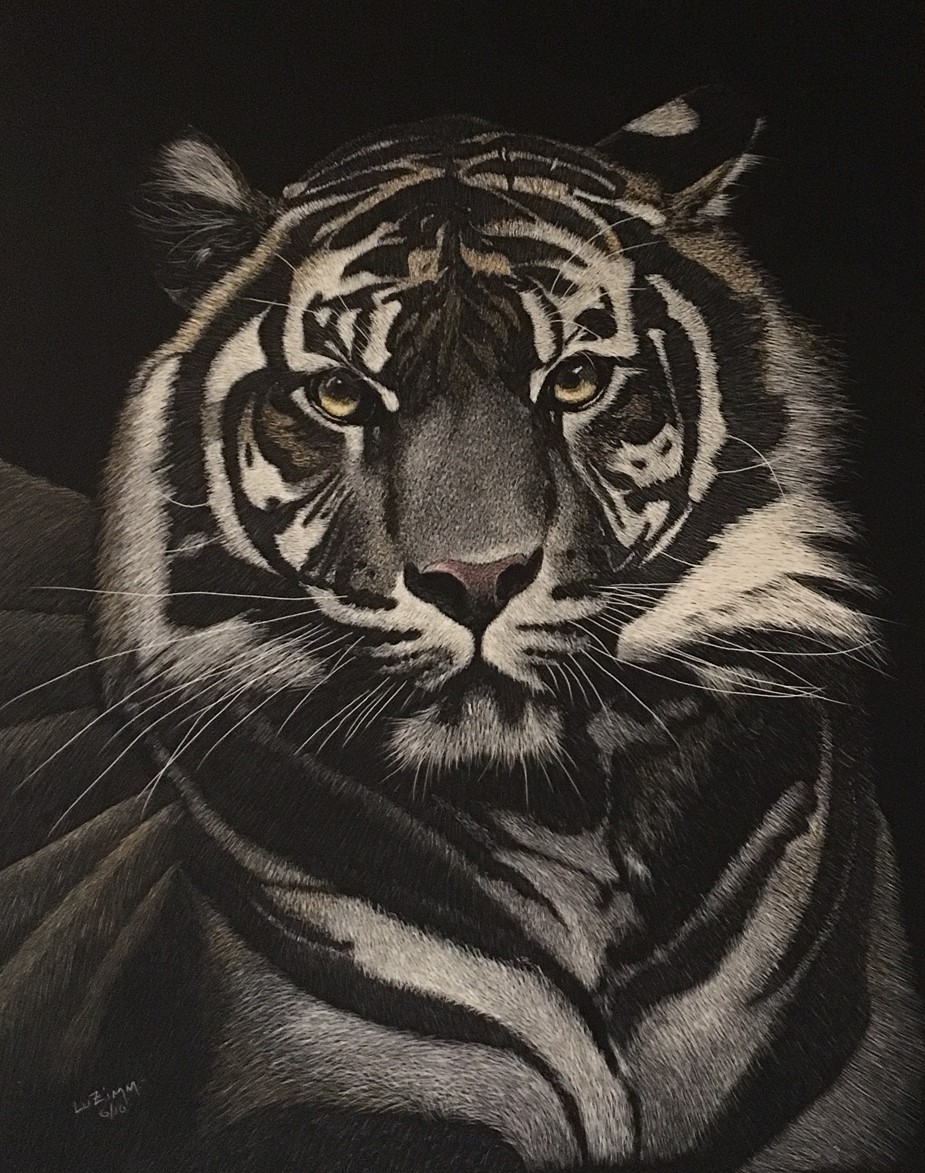
Some animals are beautiful. Some animals are powerful. And then there is the Sumatran tiger, which somehow manages to look like royalty, mystery, and a thunderstorm wearing orange at the same time. One glance at this magnificent cat and it becomes obvious why artists, wildlife lovers, photographers, and anyone with functioning eyeballs become instantly fascinated.
The Sumatran tiger is not just another big cat with good lighting. It is the smallest living tiger form, a forest-built predator shaped by dense tropical habitat, stealth hunting, and survival in one of the most threatened ecosystems on Earth. Its dark coat, closely spaced stripes, muscular frame, and intense gaze give it a dramatic look that feels almost designed for art. Unfortunately, its beauty comes with heartbreaking urgency. This tiger is critically endangered, and its shrinking habitat has pushed it frighteningly close to the edge.
That is exactly what makes the subject so compelling. A Sumatran tiger is not merely stunning to look at; it represents wildness under pressure, elegance under threat, and the kind of animal that can still stop a room cold without saying a word. Not that tigers talk, of course. If they did, humans would probably interrupt them anyway.
Why the Sumatran Tiger Looks So Unforgettable
The first thing most people notice is the face. A Sumatran tiger has a concentrated, almost sculpted expression. The eyes seem locked in permanent focus, as if they are evaluating the universe and finding it slightly underprepared. Its cheeks are full, its whiskers stand out dramatically, and its gaze carries that rare combination of calm and danger. In visual art, that is gold. In the wild, that is your cue to respect the distance.
Its coat is another major reason the animal looks so striking. Sumatran tigers tend to have darker orange fur than many other tiger populations, and their black stripes are set closer together. This creates a richer, denser pattern that helps them disappear into rainforest shadows, tall grasses, and broken light under the forest canopy. In other words, nature gave this tiger both camouflage and style. Honestly, that feels a little unfair to the rest of us.
Then there is the build. While smaller than other tigers, the Sumatran tiger is hardly delicate. Adult males can reach around eight feet in length and weigh up to about 310 pounds. That smaller size is actually part of the tiger’s advantage. It is better suited to moving through dense forests, maneuvering around roots, slopes, brush, and swampy terrain where bulkier cats would be less efficient. The result is a predator that looks compact, athletic, and intensely controlled.
Their beauty is not only visual. It is functional. Every detail serves survival. The stripes are unique to each individual, almost like fingerprints. Their night vision is extraordinary. Their bodies are built for ambush, not parade. Yet somehow, in serving function, the tiger becomes even more visually impressive. That is why a portrait of a Sumatran tiger often feels more powerful than a generic wildlife image. You are looking at a masterpiece shaped by evolution, not a costume department.
The Rainforest Stage That Made This Tiger
The Sumatran tiger lives only on the Indonesian island of Sumatra, where it occupies tropical broadleaf evergreen forests, freshwater swamp forests, peat swamps, upland forests, and mountain landscapes. This range matters because habitat shapes appearance and behavior. A tiger adapted to a dense island forest does not move or look exactly like one built for wider continental landscapes.
In Sumatra, the forest is both home and hunting ground. It is where the tiger stalks wild pigs, deer, and other prey, where mothers raise cubs, and where adults maintain territories. Tigers are mostly solitary, except for mothers with cubs, and they need large connected spaces to hunt, breed, and move safely. When those spaces are broken apart, the tiger’s world becomes smaller, riskier, and more chaotic.
One of the most important places for this species is the Leuser Ecosystem, a globally significant landscape where Sumatran tigers still share habitat with orangutans, elephants, and rhinos. That alone tells you how biologically rich this island is. It also tells you how much is at stake. When a place can support all of those species, losing it is not just a local tragedy. It is an international conservation failure wearing tropical greenery.
Why This Tiger Is So Endangered
The main threat is habitat loss, and the phrase “habitat loss” can sound weirdly tidy for something so destructive. In reality, it means forests being cleared, fragmented, drained, logged, converted, or sliced apart for agriculture, roads, plantations, settlement, and development. Large, connected tiger habitat becomes smaller, more isolated patches. A tiger that once moved across a functioning landscape is suddenly boxed into broken pieces of it.
Oil palm expansion has played a major role in that decline. It is one of the most frequently cited drivers of forest loss in Sumatra, and studies have linked it to major reductions in tiger habitat. Even when forest is not completely erased, fragmentation changes everything. Tigers need room to disperse, find mates, and follow prey. Cut the forest into pieces, and the animal does not just lose land. It loses options.
Poaching is the second major threat, and it remains brutal in both impact and logic. Tigers are killed for the illegal wildlife trade, and the loss of even a few individuals can be devastating when a population is already small and fragmented. Add declining prey, accidental snaring, and conflict with humans when tigers move closer to farms or villages, and the pressure becomes relentless.
This is why public population estimates are often described in sobering terms. Depending on the source and the counting method, commonly cited figures range from fewer than 400 mature individuals to roughly 400 to 600 animals in the wild overall. None of those numbers are comforting. None of them say, “Relax, nature has this covered.” They say the opposite.
What Makes the “500-600 Left” Message So Powerful
When people hear a number like 500 or 600, it can sound abstract. But imagine reducing an entire wild tiger population to something small enough to fit into a modest stadium section, then scattering those animals across fragmented forests, protected areas, and unprotected landscapes with roads, pressure, and danger between them. Suddenly, the statistic is not a statistic anymore. It is a warning.
The Sumatran tiger is the last surviving tiger population of the Sunda Islands. Tigers in Java and Bali are gone. That fact gives the Sumatran tiger a double significance. It is not only a rare big cat. It is the last living representative of a tiger lineage that has already vanished elsewhere. That is one reason the species carries so much emotional weight in conservation storytelling and wildlife art.
Its beauty makes people pay attention, but its rarity gives that beauty consequence. A striped face in a painting or scratch-art piece is not just decorative. It can symbolize the last chapter of something ancient, fierce, and irreplaceable. A tiger portrait that would otherwise be “nice wall art” becomes something larger: a visual reminder that magnificence does not guarantee survival.
Conservation Efforts That Still Offer Real Hope
The story is serious, but it is not hopeless. Conservation groups, researchers, local communities, wildlife authorities, and accredited zoos have all contributed to keeping the Sumatran tiger from sliding even faster toward extinction. Camera traps, population monitoring, habitat mapping, corridor protection, anti-poaching patrols, and law-enforcement work all matter. So does the less glamorous but equally critical work of land-use planning.
One of the most promising shifts in modern tiger conservation is the growing emphasis on people-centered strategies. That means working with communities living in tiger landscapes, not treating them as background scenery in a wildlife documentary. Long-term tiger survival depends on trust, local partnerships, sustainable livelihoods, and reducing conflict between people and large predators. Put simply, forests do not save themselves, and conservation does not succeed by ignoring the humans sharing the landscape.
Zoos also play a role when they participate in coordinated breeding programs, public education, and field conservation support. A tiger in a well-managed conservation program is not a substitute for a wild tiger, but it can help build awareness, maintain genetically managed populations, and connect the public emotionally to animals they will never see in the rainforest. That connection matters. People protect what they value, and people value what they can feel.
Why the Sumatran Tiger Is Such a Powerful Subject for Art
A Sumatran tiger is almost unfairly perfect as an art subject. The contrast is incredible. The striping is dramatic. The eyes do half the storytelling before the artist even gets warmed up. And because the species is endangered, the image carries meaning beyond technique. A well-made tiger artwork can be decorative, emotional, educational, and symbolic all at once.
That is especially true for scratch art, where contrast does the heavy lifting. The dense stripes, strong facial planes, and intense highlights of a tiger lend themselves beautifully to the medium. Every scratch line can echo fur texture, shadow, tension, and movement. The result can feel alive in a way that flatter subjects simply do not. A bowl of fruit may be lovely, but it rarely looks like it could judge your life choices.
For collectors and wildlife lovers, artwork featuring a Sumatran tiger can also serve as a conversation starter. It invites questions: Why this tiger? Where does it live? How many are left? What happened to its forest? Great animal art does more than fill wall space. It makes people curious, and curiosity is often the first step toward compassion.
A More Personal Reflection: The Experience of Encountering the Sumatran Tiger
There is a very specific feeling that comes from really looking at a Sumatran tiger, whether in art, in a documentary, at a conservation-focused zoo, or in a photograph taken deep in the rainforest. It is not the same feeling you get from seeing a generic “big cat” image. It is more layered than that. First comes admiration. Then surprise. Then, if you know the backstory, a kind of sadness quietly walks into the room and sits beside you.
The admiration is easy to explain. The animal is breathtaking. The lines of the body are elegant. The patterning is hypnotic. The face seems almost too expressive to belong to a creature that owes us absolutely nothing. A Sumatran tiger can look regal, alert, patient, and dangerous all in one frame. It is the sort of animal that makes people stop mid-sentence, which is useful, because humans are not always at their best when talking nonstop.
Then comes the surprise, because many people do not realize how different this tiger feels from larger, more commonly pictured tiger populations. A Sumatran tiger has a denser, more intimate kind of power. It does not feel built for open spectacle. It feels built for shadows, silence, and sudden movement. Even in still imagery, you can sense the forest around it. You can almost imagine the wet leaves, the filtered light, and the tension of a place where every sound matters.
But the strongest part of the experience is emotional. Once you learn how few remain, the tiger’s beauty becomes harder to separate from vulnerability. That changes the way you look. The stripes are still beautiful, but now they also feel precious. The face is still majestic, but now it carries the weight of survival. The animal is no longer just impressive. It becomes meaningful.
That is why artwork inspired by the Sumatran tiger can have such unusual power. A viewer may first respond to the visual drama, but the deeper response comes from what the tiger represents: wild forest, disappearing habitat, resilience, fragility, and the uncomfortable truth that human appetite for land and products can erase creatures we claim to admire. The image becomes part celebration and part warning.
For many people, the experience also creates a strange mix of awe and responsibility. Awe because the tiger still exists at all, still moving through rainforest corridors, still raising cubs, still carrying thousands of years of evolution in every muscle and stripe. Responsibility because knowing about its plight removes the luxury of indifference. Once you understand that this animal survives in shrinking fragments of habitat, it becomes much harder to shrug and move on to snack content.
In that sense, the Sumatran tiger is unforgettable not only because it looks magnificent, but because it leaves behind a feeling. It reminds us that the natural world can still astonish us, and that astonishment should lead somewhere. Ideally toward respect, support for conservation, better choices, and a refusal to treat extinction like background noise. A tiger this beautiful deserves more than admiration. It deserves a future.
Conclusion
The Sumatran tiger is one of the most visually arresting animals on Earth, and that is not poetic exaggeration. It is a small-for-a-tiger, forest-adapted predator with dark orange fur, tightly packed black stripes, immense physical control, and a face that seems designed to haunt memory. Yet its majesty is inseparable from its danger of disappearance. Habitat reduction, fragmentation, poaching, prey loss, and human conflict have pushed this species into a narrow and precarious corner.
That is exactly why the animal matters so much in conservation and in art. A Sumatran tiger is not only a subject of beauty. It is a symbol of what still survives, what has already been lost elsewhere, and what can still be protected if effort meets urgency. To look at this tiger closely is to feel wonder. To understand its situation is to feel responsibility. And when both feelings arrive together, they can be powerful enough to move people from admiration to action.