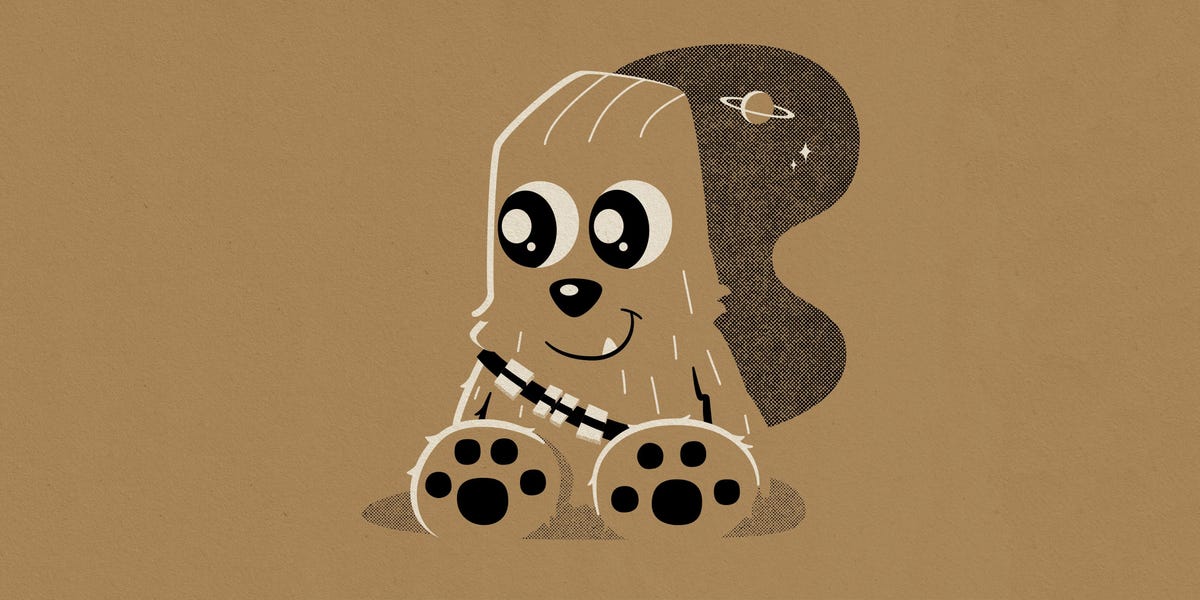
Some characters walk onto the screen and become icons. Grogu, better known to half the galaxy and at least three-quarters of the internet as Baby Yoda, waddled into The Mandalorian and instantly conquered timelines, toy shelves, sketchbooks, and probably a few hearts that had sworn they were “too old for this.” He arrived tiny, mysterious, and absurdly expressive. One minute viewers were watching a dusty bounty hunter story. The next, they were collectively whispering, “Oh no. I would protect this green child with my entire tax refund.”
That reaction is exactly why Baby Yoda remains such a powerful subject in Star Wars illustrations. He is more than a cute character. He is a visual event. His giant eyes, soft ears, oversized robe, and careful little hand gestures make him instantly readable from across a room or from the size of a phone thumbnail. In an era crowded with digital spectacle, Grogu feels surprisingly intimate. He looks like a secret sketch that escaped a Lucasfilm notebook and decided to become everyone’s favorite space toddler.
This is what makes the phrase “Baby Yoda – Star Wars Babies – Star Wars Illustrations” so rich for fans, artists, and pop culture writers. It is about a character, yes, but it is also about a creative wave. Grogu revived the old magic of Star Wars design while inspiring a new generation of illustrations, posters, fan art, plush-inspired drawings, minimalist prints, holiday cards, and mashups that turned the galaxy far, far away into a surprisingly cuddly place.
Why Baby Yoda Became an Instant Visual Legend
Star Wars has always known the power of silhouette. Darth Vader’s helmet. R2-D2’s dome. Yoda’s ears. Grogu follows that tradition beautifully. His design is simple enough to recognize in a split second, but detailed enough to reward artists who want to play with texture, light, and mood. That combination is illustration gold.
Part of the magic is contrast. Baby Yoda exists inside a rough, dusty frontier story full of armor, blasters, broken machinery, and morally questionable strangers. Then in the middle of all that grit sits a tiny green child sipping soup, stealing snacks, pressing buttons he has absolutely been told not to touch, and blinking like he has not a single concern in the universe. It is visual comedy built into the frame.
His appeal also comes from restraint. Grogu does not explain himself much. He does not arrive with a monologue, a giant lore dump, or a neon sign saying “future franchise cornerstone.” He mostly looks, listens, coos, reaches, and occasionally uses the Force in a way that makes everyone in the room reconsider their priorities. Because he says so little, illustrators can project a lot onto him. He can be sweet, mischievous, sleepy, wise, chaotic, or heroic depending on the line, color palette, and pose.
The genius of “cute, but not too cute”
One reason Grogu works so well is that he was not designed as a syrupy mascot. He has charm, but he also has oddness. His proportions are adorable, yet his face still carries that ancient, slightly alien Yoda-family seriousness. That balance gives artists more room to explore. A drawing of Grogu can lean warm and whimsical, or it can feel mythic and strangely profound. Few “baby” characters can pull off both a nursery print and a cinematic poster without looking ridiculous. Grogu somehow does.
Star Wars Babies: Why the Franchise Keeps Returning to Childlike Wonder
Star Wars is full of war, empires, betrayals, and family drama so intense it could power its own droid. But beneath all that, it has always been fascinated by innocence. Luke begins as a restless dreamer. Anakin starts as a gifted child. Ezra Bridger brings youthful curiosity to rebellion. Even Yoda, despite speaking like a philosopher who swallowed a grammar puzzle, has always represented wonder as much as wisdom.
Grogu turns that current into something more visible. He brings childhood to the foreground, not as comic relief alone, but as emotional gravity. He changes Din Djarin from a cool lone gunman into a protector. He softens scenes without draining them of tension. He reminds the audience that Star Wars is not just about winning battles. It is also about choosing what deserves to be saved.
That is why the phrase Star Wars babies resonates beyond novelty. Fans are not simply looking for infant versions of famous characters with huge heads and tiny boots. They are responding to the idea that softness has a place in epic storytelling. Grogu proves that a character can be physically small and still feel culturally massive.
More than a meme, less than a lecture
Baby Yoda absolutely became a meme, of course. The internet did what the internet does: it adopted him, renamed him, printed him on everything that could physically hold ink, and treated every new expression like breaking geopolitical news. But the reason the meme lasted is that the character underneath was solid. Grogu was not just a reaction image with ears. He had emotional function, narrative importance, and design integrity. That staying power matters in art. Trends fade. Strong shapes endure.
Why Baby Yoda Took Over Star Wars Illustrations
Illustrators love Grogu because he is flexible. He can fit almost any visual language. Want watercolor softness? Perfect. Want a retro sci-fi poster? Great. Want a minimalist print with two ears and a floating pram? That works too. Want a full painterly scene with dramatic backlighting and a tiny green hand reaching out through fog? Also yes. Grogu is like the Swiss Army knife of fan art subjects, only much cuter and less likely to poke your finger.
His color story helps too. The green skin, tan robe, silver pram, and dusty desert environments give artists a built-in palette that feels calm and cinematic. He looks good in warm neutrals, cool moonlight blues, holiday reds, comic-book brights, or soft pastel nursery tones. That is rare. Many characters have a single signature look. Grogu can be reinterpreted endlessly without losing recognizability.
Then there is expression. Illustrators do not need a hundred action poses to make him compelling. They need a tilted head, a tiny cup, a floating frog, a wide-eyed glance, or a slightly smug look after he has done something questionable and knows he will still be forgiven. Great character illustration often depends on micro-expression, and Grogu delivers those in bulk.
From fan art to décor
Another reason Baby Yoda illustrations exploded is that they are not confined to fandom spaces. Grogu art moved into home décor, greeting cards, nursery prints, desktop figurines, seasonal crafts, and handmade gifts. Some Star Wars art can feel too niche for casual viewers. Grogu is different. He is recognizable even to people who have not memorized Jedi lore, and that broad appeal helped turn Star Wars illustration into something more playful and mainstream.
Official Star Wars Art Helped Fuel the Craze
Lucasfilm did not just introduce Grogu as a character; it surrounded him with striking visual storytelling. The end-credit concept art in The Mandalorian helped cement the show’s aesthetic identity, and artists such as Christian Alzmann, Ryan Church, Brian Matyas, and others contributed to the lush, painterly style that fans now associate with the series. Those images matter because they frame Grogu not only as a plot point, but as a design object worthy of lingering attention.
The official artwork also keeps reminding fans that Star Wars is still a handmade-looking universe even when backed by cutting-edge production. Grogu’s popularity benefited from that feeling. He was not introduced as a glossy digital mascot floating in empty pixels. He felt tactile. Weighty. Illustratable. Like something a concept artist could sketch in a coffee-fueled burst of inspiration before lunch and then spend years watching the world obsess over.
That artistic momentum expanded beyond the main series. Grogu crossed into stylized projects, including animated work and collaborations that emphasized how well his design translates across mediums. He can be rendered realistically, cartoonishly, or poetically without losing his identity. That is a sign of a character built on strong visual fundamentals.
The practical-puppet advantage
One of the smartest creative decisions behind Grogu was using practical puppetry and animatronic performance as often as possible. That choice gave him texture, imperfections, and physical presence. For illustrators, this is a gift. It means there is something tangible to study: folds in fabric, subtle shadows, a slight head turn, the way his ears catch light. A hand-drawn or digitally painted Grogu often feels alive because the original screen version already feels touchable.
How to Make a Great Baby Yoda Illustration
If you are creating Star Wars illustrations yourself, Grogu rewards a simple rule: do not overcomplicate him. The strongest Baby Yoda art usually starts with shape language. Focus on the ears, the eyes, the robe collar, and the smallness of the body inside oversized clothing. Those proportions do a lot of the storytelling for you.
1. Start with silhouette
Before adding eyelashes, robe wrinkles, or dramatic lighting, check whether the figure is recognizable in pure outline. If it is, you are already halfway home. Grogu’s silhouette should feel balanced between fragile and iconic.
2. Use expression sparingly
Grogu is funniest and most charming when the emotion is just slightly underplayed. A tiny eyebrow shift or a subtle mouth shape can do more than a giant cartoon grin. Think less “theme park mascot,” more “small mystical gremlin caught near the snack table.”
3. Let the environment support the mood
Because Grogu is small, the world around him matters. A huge cockpit seat, a floating pram, a desert horizon, a metallic corridor, or a glowing control panel can make him feel even more vulnerable and memorable. Scale is part of the charm.
4. Respect the warmth
Even when you push into dramatic art, Baby Yoda illustrations work best when they keep some warmth. This is not a character built for cold detachment. He can be mysterious, but he should never feel emotionally blank. A hint of tenderness is part of the visual DNA.
What Baby Yoda Means for the Future of Star Wars Art
Grogu has already outgrown the label of breakout side character. He is now one of the central visual ambassadors of modern Star Wars. As the franchise continues to expand, and as The Mandalorian and Grogu moves the duo onto the big screen, his artistic life will likely keep evolving. We will see more cinematic posters, more stylized reinterpretations, more crossover aesthetics, more collector art, and probably enough seasonal merchandise to decorate a small moon.
But the best reason Grogu will endure is not corporate. It is creative. Artists keep returning to him because he offers a rare combination of familiarity and mystery. He belongs to Star Wars, yet he still feels slightly unknowable. He is adorable, but not shallow. Ancient, but childlike. Funny, but emotionally sincere. In other words, he is exactly the kind of contradiction great illustration thrives on.
Baby Yoda did not merely become popular. He became drawable. And in pop culture, that is sometimes the bigger superpower.
Extended Experiences: What It Feels Like to Live in the Age of Baby Yoda Art
There is a particular kind of joy that happens when a character escapes the screen and starts showing up everywhere people make things with their hands. Grogu inspired that kind of joy almost immediately. You could feel it in the way fans doodled him in notebook margins, painted him on tote bags, sculpted him out of snow, reimagined him in watercolor, stitched him into embroidery, or turned him into holiday ornaments that somehow made a Christmas tree look like it had joined a rebel cell.
That experience matters because it says something about how modern fandom works. People do not just consume characters anymore. They remix them, display them, soften them, joke with them, and bring them into daily life. Baby Yoda was especially suited for this because he never felt locked behind a wall of intimidating lore. Even people with only a passing knowledge of Star Wars could look at him and understand the assignment: this tiny creature is precious, weird, and probably about to cause trouble in an adorable way.
For artists, drawing Grogu often becomes a strangely relaxing exercise. His face invites softness. His robe invites texture. His smallness invites protective composition. Many fan artists describe a similar creative rhythm when working on characters like him: the sketch begins as a quick joke, then turns into a polished piece because the pose keeps getting funnier or sweeter. A cup in one hand becomes a whole café parody. A floating pram becomes a moonlit poster. A sleepy expression becomes a nursery print that non-fans end up loving too.
There is also the social experience of Baby Yoda art. Unlike some fandom work that only hardcore insiders appreciate, Grogu illustrations have unusually broad audience appeal. You can post one online and get reactions from Star Wars veterans, casual viewers, parents, kids, and people who have never watched a full film but still know exactly who that little green bean is. That broad recognition creates a fun feedback loop. Artists are encouraged to make more. Viewers share more. The character keeps evolving visually in public.
And then there is the emotional part. A lot of Baby Yoda illustrations are not just cute. They are comforting. They carry the feeling of safety, found family, playfulness, and gentleness in a noisy media environment that often rewards shock over sincerity. Grogu gave fans permission to enjoy softness without irony. You could love blasters, bounty hunters, starships, and galactic warfare, and still stop everything for a tiny alien wrapped in a robe that looked two sizes too big. Honestly, that may be one of the healthiest things Star Wars has done for the collective internet brain.
In that sense, the experience of Baby Yoda art is bigger than one character. It is a reminder that illustration can make fandom feel personal. A painting, sketch, sticker, or print can take a blockbuster icon and turn it into something intimate enough for a bedroom wall, a gift bag, a child’s bookshelf, or a quiet smile on a stressful day. Grogu may have started as a surprise reveal in a streaming series, but in the hands of artists, he became something even more durable: a shared visual language for delight.
Conclusion
Baby Yoda remains one of the smartest visual successes in modern franchise storytelling. Grogu works because he combines classic Star Wars mystery with immediate emotional clarity. He is built for cinema, built for memes, and maybe most importantly, built for illustration. Whether you love painterly concept art, fan sketches, minimalist posters, or whimsical nursery prints, his design keeps offering fresh possibilities. In a crowded galaxy of icons, that tiny green face still feels new.