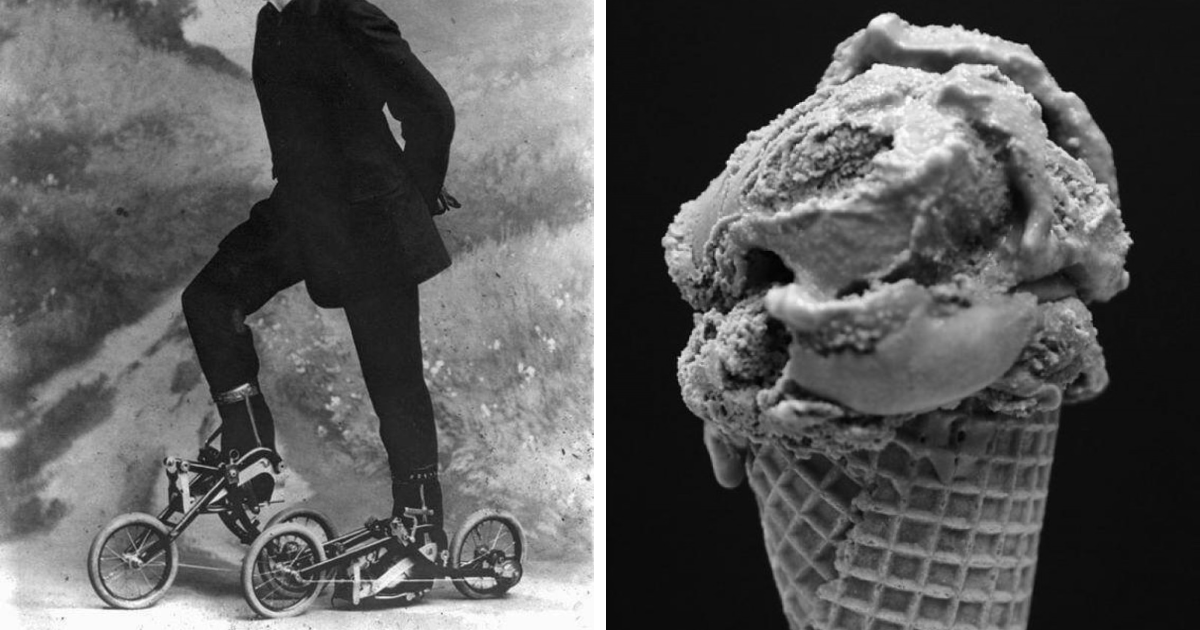
History loves a good prank. Just when you think something belongs to the age of smartphones, shopping malls, or your grandmother’s attic, the timeline slides in wearing a tuxedo and says, “Actually, this has been around forever.” That is the fun of surprising history facts: they make the modern world look a lot less modern and a lot more like one long remix.
In this list, I rounded up 20 things that are much older than most people assume, from selfies and teddy bears to lipstick, board games, and even vending machines. Some of these ancient origins are thousands of years old. Others are “only” older than your favorite nostalgic movie. Either way, the result is the same: your mental timeline is about to need a software update.
20 Things That Are Much Older Than You Think
Pic #1: Selfies Are Way Older Than Front-Facing Cameras
If selfies feel like a product of social media, history would like a word. Robert Cornelius took what is widely recognized as the first photographic self-portrait in 1839 in Philadelphia. That means the selfie showed up long before hashtags, ring lights, or someone saying, “Wait, let me do one more with the good angle.” The technology was clunky, the exposure was long, and yet the impulse was deeply familiar: “I should probably document my face.”
Pic #2: Teddy Bears Have Been Hugging Back Since 1903
The teddy bear feels timeless because, honestly, it kind of is. Morris Michtom put stuffed “Teddy bears” in his shop window in 1903 after Theodore Roosevelt’s nickname became linked to a famous bear-hunt story. That makes the toy older than sliced bread as a mass-market staple, and probably older than many people’s assumptions by a good few decades. Soft toy, hard historical mileage.
Pic #3: ZIP Codes Are Older Than a Lot of American Pop Culture Icons
Many people think of ZIP Codes as basic modern infrastructure, but the five-digit system officially arrived on July 1, 1963. That means ZIP Codes predate plenty of household technologies and trends people casually label “old school.” They are such a normal part of daily life now that it is easy to forget someone actually had to invent them. Even mail had to level up eventually.
Pic #4: The Zipper Is Not a Recent Convenience
The zipper often feels like one of those ordinary inventions that must have arrived somewhere around the same time as the microwave and suburban carpeting. Not even close. Its important early form, Whitcomb Judson’s “clasp locker,” debuted in 1893. In other words, the zipper has been quietly saving pants and jackets since the 19th century. Buttons had a monopoly, and then metal teeth showed up like a tiny industrial revolution.
Pic #5: Comic Strips Were Already Making Money in the 1890s
Modern visual storytelling did not begin with superhero movies or even Sunday paper nostalgia. The Yellow Kid became the first successful commercial comic strip in the 1890s, proving that illustrated serial humor has deep roots. By the time many people think mass entertainment was “starting,” comics were already building audiences, brands, and merchandising potential. Basically, the internet did not invent fandom; it just gave it faster Wi-Fi.
Pic #6: Instant Cameras Were a Reality in 1948
People often associate instant photography with the 1970s, but the Polaroid Land Camera Model 95 began production in the fall of 1948. That is surprisingly early for a device that feels so retro-cool and mid-century futuristic at the same time. The promise was magical then and still feels magical now: press the button, get the memory. No filters, no cloud backup, and no “storage almost full” warning trying to ruin the moment.
Pic #7: Eyeglasses Go Back to the 1200s
Glasses are one of those inventions that feel practical, modern, and maybe Renaissance-adjacent at oldest. But the first eyeglasses are generally dated to around 1280 in Italy. Early versions helped readers and copyists keep working when their eyesight weakened. So yes, while you may think your glasses are a contemporary nuisance, the basic idea has been helping humans squint less for more than seven centuries.
Pic #8: Bifocals Were Already Brilliant in 1785
Even if regular spectacles are ancient, bifocals sound like a more recent optimization. Benjamin Franklin revealed his design for bifocal glasses in 1785, after getting tired of switching between pairs for near and far vision. That is peak practical genius. It also means that one of the most relatable complaints in history“I do not want to keep changing glasses”got a smart solution before the United States had even finished being a very young country.
Pic #9: Tattoos Have Been Around for More Than 5,000 Years
Tattoos may be trendy, personal, rebellious, artistic, sentimental, or all four before lunch, but they are definitely not new. The famous mummy known as Ötzi the Iceman, dated to roughly 5,300 years ago, preserves some of the oldest known tattoos on a human body. That makes body ink older than most empires people remember from school. Human beings have been decorating, marking, and meaning-making with skin for a very long time.
Pic #10: Lipstick Is Practically Ancient Royalty
If lipstick seems like a modern beauty-counter staple, archaeology disagrees. Researchers have identified a nearly 4,000-year-old red cosmetic in a decorated stone vial from what is now Iran. That pushes lip color deep into the ancient world, where appearance, status, beauty, and ritual were already tightly connected. So the next time someone calls lipstick a modern obsession, remember: humans have been trying to perfect the dramatic entrance for millennia.
Pic #11: Toothpaste Is Older Than Toothbrushes
This one feels rude, but it is true. Tooth powders and toothpaste-like mixtures are thought to date back as far as 5000 B.C. in Egypt. Ancient formulas included ingredients that sound less “mint fresh” and more “kitchen shelf meets geology lab,” but the goal was the same: cleaner teeth. Oral care was already a concern thousands of years ago, which means people have been searching for the perfect dental routine far longer than the modern toothpaste aisle suggests.
Pic #12: Toe Socks Were Already a Thing 1,600 Years Ago
Those split-toe socks that look suspiciously modern? Versions of them existed in ancient Egypt between about A.D. 250 and A.D. 420. They were likely designed to be worn with sandals, which means ancient people had already figured out the fashion-meets-function problem that still haunts footwear today. Frankly, it is comforting to know that even centuries ago, someone was trying to make socks cooperate with a specific shoe situation.
Pic #13: Fast Food Is Older Than Fast Cars
Grab-and-go dining is not a product of drive-thrus and delivery apps. In ancient Pompeii, thermopolia served ready-made food from counters fitted with jars, offering quick meals to customers on the move. These Roman snack bars were a real thing, and dozens have been found. So yes, fast food has roots in the ancient world. Humans have always wanted something convenient, warm, and edible without cooking it themselves. Civilization, in many ways, is just scalable snacking.
Pic #14: Toilets Have a Longer History Than People Expect
Modern bathrooms feel modern until history barges in with plumbing receipts. Ancient sanitation systems using running water date back at least 5,000 years, and Roman cities had public toilets tied to major water systems. If you want a more familiar benchmark, the first modern flushable toilet was described in 1596. So while bathrooms may still inspire home-renovation panic today, the basic human mission of “please make this more sanitary” has been around forever.
Pic #15: Board Games Have Been Keeping People Competitive for 5,000 Years
Board games may feel like a rainy-day invention for families avoiding screens, but play is ancient. Evidence from Mexico suggests people in the Americas may have been using game boards as early as 5,000 years ago. That is a wonderful reminder that strategy, luck, rivalry, and the urge to say “those are absolutely not the rules” are deeply human behaviors. We did not invent game night. We inherited it from very determined ancestors.
Pic #16: The Alphabet Has Been Changing the World for 4,000 Years
Writing systems are ancient, but the alphabet itself still feels like such an elegant invention that it is easy to forget how old it is. PBS’s coverage of early alphabet history points to origins around 4,000 years ago in the Sinai desert. That simple set of symbols eventually became the foundation for most written languages used by huge parts of the world. One of humanity’s biggest upgrades was basically turning sound into portable code.
Pic #17: The Olympics Began Nearly 3,000 Years Ago
For something that now comes with television packages, sponsorship deals, and endless highlight reels, the Olympics are astonishingly ancient. The Games originated in ancient Greece nearly 3,000 years ago, with written records dating to 776 B.C. They were already old before most of the civilizations people casually mention in pop-history conversations had hit their stride. Global spectacle, athletic obsession, and competitive bragging rights? Humanity locked those in early.
Pic #18: Vending Machines Go Back to the First Century
Vending machines feel aggressively modern, like they should only exist next to fluorescent lights and questionable office coffee. But an early version was described in the first century A.D. by Hero of Alexandria. It dispensed holy water when a coin triggered a mechanical lever system. That means the basic idea of “insert money, receive item, feel weirdly satisfied” is far older than anyone standing in front of a snack machine at midnight probably realizes.
Pic #19: Alcatraz Was Historical Before It Was Hollywood-Famous
Most people think of Alcatraz as the notorious federal prison, but that is only one chapter. The original Alcatraz lighthouse was constructed in 1854 and was the first lighthouse built on the U.S. West Coast. Long before it became shorthand for escape-proof incarceration, it was already an important navigational landmark. That layered history is what makes some places so fascinating: the version in pop culture is often only the loudest chapter, not the first.
Pic #20: The Andromeda Galaxy Photo You See Is 2.5 Million Years Old
This one is almost unfair, because space always wins the age contest. Andromeda is about 2.5 million light-years away, so when we observe it, we are seeing light that left the galaxy around 2.5 million years ago. In other words, cosmic photography is literal time travel. You are not just looking far away; you are looking into the ancient past. Suddenly your old yearbook photo feels a lot less dramatic.
Why These Surprising Old Things Feel So Weirdly Personal
There is a special kind of delight that comes from learning the true age of familiar things. It is not just surprise. It is a mini identity crisis with better lighting. You look at a selfie, a tube of lipstick, a zipper, or a board game and realize that what felt thoroughly modern is actually part of a very long human story. The object stays the same, but your relationship to it changes. Suddenly, daily life feels less disposable. It starts to feel connected.
That is probably why lists like this keep pulling people in. They do not just teach dates. They expose continuity. Humans thousands of years ago were not using the same materials or devices we use now, but they were often chasing the same goals: convenience, beauty, comfort, entertainment, memory, hygiene, status, communication, and maybe a tiny bit of showing off. Ancient Egyptians wanted cleaner teeth. Romans wanted quick meals. Early inventors wanted easier ways to dress, see, photograph, or distribute goods. Strip away the tools, and the motivations are hilariously familiar. We are all just newer versions of very old habits.
There is also something comforting about discovering that the world is older, stranger, and more inventive than it first appears. We live in a culture that loves to congratulate itself for being new. Every product launch acts like civilization began last Tuesday. But history is full of people who were clever, curious, stylish, practical, and occasionally dramatic long before modern branding existed. Learning that there were ancient fast-food counters, first-century vending machines, or 1,600-year-old socks with split toes punctures the illusion that the past was dull and monochrome. It was full of problem-solving, aesthetics, upgrades, fads, and workarounds.
That shift in perspective can make ordinary things feel richer. A pair of glasses becomes part of a centuries-long effort to keep reading. A teddy bear turns into a cultural artifact with a specific historical spark. A comic strip becomes evidence that people have always loved serialized humor and recognizable characters. Even a boring ZIP Code starts to look like a design solution to a growing, moving, increasingly complicated society. These are not just old objects. They are receipts from humanity’s ongoing experiment in making life a little easier, funnier, prettier, or more manageable.
And maybe that is the biggest reason this topic sticks. It reminds us that history is not trapped behind museum glass. It is in your bathroom drawer, your toy shelf, your mailbox, your camera roll, your kitchen table, and the stories you tell yourself about what counts as “modern.” Once you start noticing that, the world gets more interesting fast. Everything around you begins to look like a sequel, not an original. And honestly, that might be the most humbling and entertaining plot twist of all.
Final Thoughts
The best surprising history facts do more than make you say, “No way.” They make the present look deeper, funnier, and more connected than it did five minutes earlier. These 20 things that are much older than you think prove that ancient origins are hiding in plain sight, tucked inside everyday objects, cultural habits, and famous landmarks. So the next time something feels wildly modern, do not be too confident. History has a habit of showing up early, staying late, and leaving the rest of us to catch up.