A Rubik’s Cube solver finishing a 3×3 cube in 4.56 seconds sounds like the kind of thing that should come with a tiny smoke machine, dramatic lighting, and a disclaimer that says, “Please do not blink.” Yet that is exactly the kind of speed a well-built cube-solving robot can reach when clever algorithms, fast motors, and a surprisingly stubborn plastic puzzle all agree to cooperate.
The 4.56-second solve made waves because it sits in a fascinating middle ground. It is not the fastest robot solve ever recorded, and it is no longer faster than the very best human speedcubers. But for a compact, maker-style Rubik’s Cube solving robot built with accessible design ideas, 3D-printed parts, stepper motors, and custom software, it is wildly impressive. It proves that the cube is no longer just a desk toy that ruins your afternoon. It is a playground for robotics, computer vision, mechanical engineering, math, and the eternal human desire to say, “I can make this faster.”
What Happened: A 4.56-Second Rubik’s Cube Solver
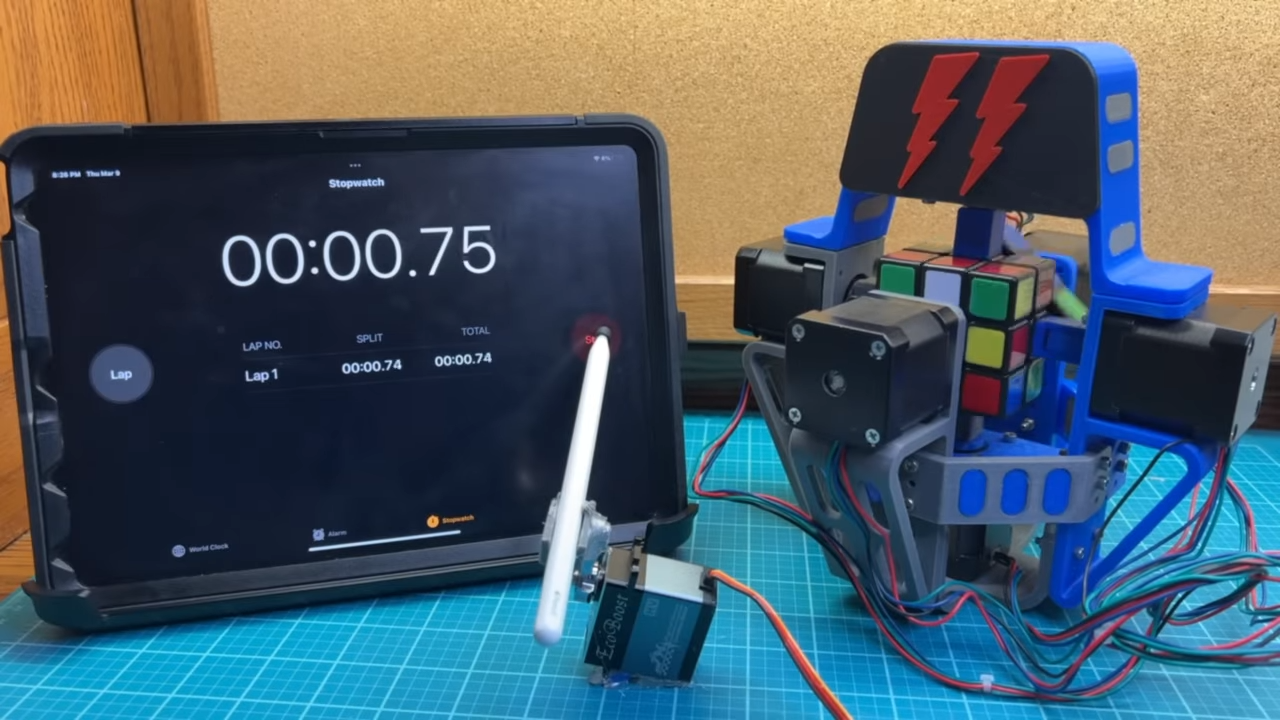
The headline comes from a Rubik’s Cube solving robot project by Aaed Musa, whose machine achieved a fastest solve of 50 moves in 4.56 seconds. The robot was designed to solve a standard 3×3 Rubik’s Cube using a compact and lightweight structure, six Nema 17 stepper motors, 3D-printed PLA components, and a web-based interface for entering the cube configuration.
In simple terms, the machine does three big jobs. First, it needs to understand the scrambled cube. Second, it needs to calculate a solution. Third, it needs to physically twist the cube fast enough to make the final time look ridiculous. That final step is where many cube robots either become engineering art or very expensive confetti makers.
What makes the 4.56-second time especially interesting is the move count. A 50-move solution in 4.56 seconds means the robot was turning at a rapid pace while keeping enough control to avoid locking up, overshooting, or launching the cube into another ZIP code. The project reportedly averaged around 75 moves per solve, which means the fastest attempt was not just about raw motor speed. It also benefited from a more efficient solution path.
Why 4.56 Seconds Is Impressive
To casual solvers, anything under one minute feels magical. To intermediate cubers, sub-30 seconds is a proud milestone. To serious speedcubers, sub-10 is where things start getting spicy. So when a machine solves a cube in 4.56 seconds, it steps into elite territory, even if the modern record books have moved beyond that mark.
The key achievement is not simply “robot turns cube quickly.” Plenty of machines can move fast in isolation. The real challenge is coordinating speed, force, grip, timing, and error tolerance. A Rubik’s Cube has moving layers, spring tensions, corner-cutting limits, and mechanical friction. Turn too gently and the cube does not move. Turn too hard and the mechanism jams. Turn too early and the next face is not aligned. Congratulations, you have invented a colorful paperweight.
A 4.56-second solve suggests the robot’s hardware and software reached a practical balance. The motors had enough torque to rotate layers quickly, the frame held the cube in position, and the control system executed the solution sequence without wasting much time between moves. In robotics, shaving milliseconds often requires dozens of small improvements. Faster acceleration here, cleaner alignment there, less pause between commands, and suddenly a “fast” robot becomes a “did that just happen?” robot.
Is 4.56 Seconds a World Record?
No, and that distinction matters. The 4.56-second result is a notable maker-project achievement, not the current all-time robot or human world record.
As of May 2026, official human 3×3 speedcubing has become almost absurdly fast. Teodor Zajder recorded a 2.76-second 3×3 single at GLS Big Cubes Gdańsk 2026, while Xuanyi Geng recorded a 3.71-second official 3×3 average at Deqing Small & Special 2026. Those numbers are so low that explaining them to a beginner feels like explaining teleportation with snacks.
Robots have gone even further. Purdue University students built Purdubik’s Cube, a robot recognized by Guinness World Records for solving a 3x3x3 puzzle cube in 0.103 seconds. That is faster than a typical human blink. At that speed, the cube is not so much “solved” as politely rearranged by a tiny mechanical thunderstorm.
Still, calling Musa’s 4.56-second robot “not the record” misses the point. Not every great engineering project needs to beat the entire planet. Sometimes the achievement is building something that works beautifully, demonstrates a serious understanding of the problem, and inspires other builders to improve it. In that sense, the 4.56-second solver absolutely earns attention.
How a Rubik’s Cube Solving Robot Works
1. It Reads or Receives the Cube State
A robot must know where every color sticker is before it can solve anything. Some robots use cameras and computer vision to scan all six faces. Others rely on manual input, smart cubes, or web interfaces where the user enters the cube configuration.
Musa’s project used an HTML web server to enter the cube configuration. That approach avoids some computer vision headaches, such as lighting problems, sticker glare, camera calibration, and the eternal mystery of whether orange is actually red wearing a hat. While camera-based systems are more autonomous, manual or web-based input can be reliable and easier to debug.
2. It Calculates the Solution
Once the cube state is known, software generates a sequence of moves. Many cube solvers use algorithms inspired by human methods such as CFOP, or computer-optimized approaches such as the two-phase algorithm popularized by Herbert Kociemba.
CFOP stands for Cross, F2L, OLL, and PLL. It is the dominant method among many human speedcubers because it balances memorization, lookahead, and finger-trick efficiency. A robot, however, does not need to “look ahead” in the human sense. It can calculate, queue, and execute moves with mechanical precision.
Kociemba-style two-phase solvers are especially popular in software projects because they can produce efficient solutions quickly. The goal is not always to find the mathematically shortest possible solution, but to find a good solution fast enough that the robot does not spend more time thinking than twisting.
3. It Executes the Moves
This is where the project becomes physical. Motors rotate cube faces according to the solution sequence. A six-motor design can control all six faces directly, which reduces the need for regrips and cube rotations. Fewer regrips usually means fewer delays.
Stepper motors are common in DIY robotics because they can move in precise increments. They are not magic, though. They need proper driver control, enough current, rigid mounting, and careful timing. A cube-solving robot is basically a tiny orchestra where every motor must enter on beat. One missed cue, and the performance turns into plastic jazz.
The Math Behind the Magic
The standard 3×3 Rubik’s Cube has over 43 quintillion possible configurations. That number is so large it sounds fake, like something a villain would demand in ransom. Yet the cube has structure, and that structure lets algorithms tame the chaos.
One of the most famous results in cube mathematics is “God’s Number.” In the half-turn metric, every legal Rubik’s Cube position can be solved in 20 moves or fewer. That does not mean humans usually solve in 20 moves. Most practical human methods use far more moves because they are designed to be learnable, repeatable, and fast to execute by hand.
Robots face a different trade-off. A robot can use solutions that are less comfortable for human fingers, but it must obey mechanical limits. The shortest solution is not always the fastest solution for a robot. A 20-move solution with awkward face changes may be slower than a 40-move solution that allows smoother simultaneous or rapid sequential turns. In robotics, “optimal” depends on the machine.
Human Speedcubers vs. Robot Solvers
Comparing humans and robots is fun, but it is not always fair. A human speedcuber brings inspection, pattern recognition, finger tricks, muscle memory, and years of practice. A robot brings motors, code, sensors, and a total lack of nerves. Robots do not get shaky hands in finals. They also do not celebrate with a dramatic table slap, which is honestly their loss.
Human solvers have a 15-second inspection window in official World Cube Association competitions. During that time, they plan as much of the early solution as possible. Elite cubers can track pieces through multiple steps, predict transitions, and execute turns at stunning speed. The best solves are a mixture of skill, practice, and occasionally a lucky scramble that seems personally delivered by the cube gods.
Robots do not solve the same way. They can scan, compute, and execute with high repeatability. The fastest robotic systems use custom mechanisms, specialized cubes, high-speed vision, and algorithms designed around mechanical motion. The Purdue record showed how far that can go: 0.103 seconds is so fast that the solve becomes almost invisible to the naked eye.
Musa’s 4.56-second solver belongs to a different but equally interesting category: the maker robot that demonstrates speed, accessibility, and clever design without needing an industrial laboratory. That is why it resonates. It feels achievable enough to inspire builders, but fast enough to make everyone watching say, “Okay, that was cool.”
Where the GAN Robot Fits In
Commercial cube-solving tools have also changed the game. The GAN Robot, for example, is designed to work with compatible GAN smart cubes and can solve a cube in about five seconds. It calculates a solution path quickly and uses a compact mechanism to twist the puzzle automatically.
That puts the commercial GAN system in the same broad performance neighborhood as Musa’s 4.56-second project. The difference is purpose. A consumer robot is designed for convenience, portability, and compatibility with an app ecosystem. A DIY or maker robot is often designed for experimentation, learning, and pushing a self-built mechanism as far as it can go.
Both are valuable. The consumer version shows how advanced cubing technology has become accessible to ordinary enthusiasts. The custom-built version shows what happens when someone asks, “What if I build my own?” and then actually survives the wiring stage.
Why People Love Watching Cube Solvers
There is something deeply satisfying about seeing disorder become order in seconds. A scrambled cube looks chaotic, but a solver reveals that the chaos has rules. Every twist has a purpose. Every color returns home. It is basically a tiny redemption arc with stickers.
Robot solvers add another layer of fascination because they turn an old puzzle into a modern engineering challenge. The Rubik’s Cube was invented in the 1970s, but it keeps finding new life through robotics, artificial intelligence, mechanical design, and competitive speedcubing. A toy that once frustrated millions of people at kitchen tables now helps students and makers explore algorithms, motion control, 3D printing, and automation.
That is why a 4.56-second solve matters beyond the number itself. It is not merely a time. It is a demonstration that an approachable engineering project can compete with elite human-level speed. It turns a familiar object into a benchmark for creativity.
Lessons From the 4.56-Second Solver
Speed Requires System Thinking
A fast cube robot is not fast because of one magical part. It is fast because the entire system works together. The algorithm must produce a usable solution. The motors must move quickly. The frame must stay rigid. The cube must tolerate rapid turns. The software must coordinate timing. The power supply must keep up. Even the smallest weakness can become the bottleneck.
Good Engineering Is Often Iteration
Projects like this rarely work perfectly the first time. Builders test, fail, adjust, reprint parts, rewrite code, burn a weekend, question their life choices, and then suddenly the machine works. The final video may show a clean 4.56-second solve, but behind it is usually a long trail of almost-solves, jammed turns, weird bugs, and “why is the motor doing that?” moments.
Accessible Tools Can Produce Serious Results
3D printing, open-source software, affordable motors, and online documentation have made projects like cube-solving robots more reachable than ever. You still need patience and skill, but you no longer need a giant robotics lab to build something impressive. The maker movement has turned ambitious engineering into a more open playground.
Experience Notes: What It Feels Like to Chase a Fast Cube Solve
Anyone who has spent time around speedcubing knows that the first solve is usually not elegant. It is slow, awkward, and full of suspicious pauses. You turn the top layer, stare at the cube like it owes you money, turn the right side, undo what you just did, and then wonder whether the stickers are judging you. But after a while, patterns appear. The cross becomes less mysterious. F2L pairs stop looking like escaped puzzle pieces. Algorithms move from conscious memory into muscle memory. Progress feels tiny at first, then suddenly dramatic.
Watching a robot solver creates a different kind of excitement. Instead of wondering whether a human can recognize the next case fast enough, you start noticing mechanical details. How firmly does the robot hold the cube? Do the layers align cleanly? Is there a pause between moves? Does the motor sound smooth or angry? A fast solve is thrilling, but a reliable fast solve is even better. Reliability is what separates a clever demo from a machine you can trust repeatedly.
The 4.56-second result captures that feeling perfectly. It is fast enough to shock people, but still slow enough that you can appreciate the motion. Ultra-fast robots solving in fractions of a second are amazing, but they can feel almost abstract because the movement is over before your brain catches up. A 4.56-second solve lets you see the process: the cube enters scrambled, the motors snap through a sequence, and the colors line up as if the machine has quietly performed a magic trick.
For builders, the most relatable part is the chain of compromises. You want more speed, but more speed creates more vibration. You want stronger motors, but stronger motors add cost, weight, heat, and control challenges. You want fewer moves, but shorter solutions may not match the robot’s best mechanical rhythm. You want perfect scanning, but lighting changes can confuse colors. Every improvement creates a new question. That is what makes the project addictive.
For beginners, the lesson is encouraging: the Rubik’s Cube is not impossible. It only looks impossible before you understand its structure. The same is true for the robot. At first glance, a cube-solving machine seems like wizardry. Break it down, though, and it becomes a list of smaller problems: read the cube, solve the cube, turn the cube. Each problem is difficult, but none is mystical.
There is also something funny and humbling about watching a robot solve in under five seconds while most people are still trying to make one white cross. But that contrast is part of the fun. The cube welcomes everyone: casual solvers, world-class competitors, math nerds, robotics students, 3D-printing enthusiasts, and people who just want a colorful desk toy that makes them look thoughtful during meetings.
The best experience related to a fast Rubik’s Cube solver is not simply witnessing the final time. It is realizing how much creativity hides behind that number. A 4.56-second solve is a timestamp, but it is also a story of design, trial, code, mechanics, patience, and probably a few deeply personal arguments with tiny screws.
Final Thoughts
“Rubik’s Cube Solver Does It In 4.56 Seconds” is more than a catchy headline. It represents the sweet spot where hobbyist engineering meets elite performance. The project may not be the fastest cube-solving robot in history, but it remains impressive because it shows how far a focused maker project can go with smart design, accessible materials, and a strong understanding of both algorithms and mechanics.
The Rubik’s Cube has lasted for decades because it is simple to understand and endlessly deep to master. A child can scramble it. A beginner can learn to solve it. A champion can solve it in a few seconds. A robot can solve it faster than a blink. And somewhere in the middle, a builder can create a 4.56-second machine that reminds us why this little cube refuses to become boring.