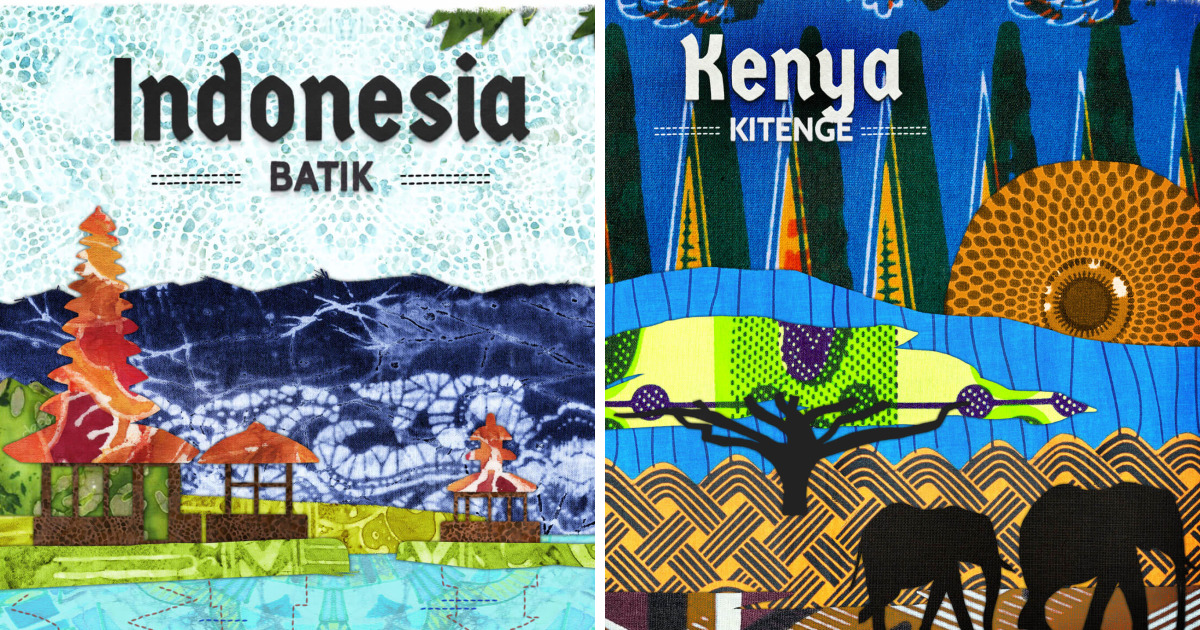
What if a place could be recognized not by its skyline, but by its stitches? That was the irresistible idea behind this textile-inspired creative experiment. Instead of painting mountains, coasts, deserts, and valleys the usual way, we imagined landscapes built from the fabrics most closely associated with those places. The result is part design exercise, part cultural love letter, and part proof that cloth can do far more than cover a couch or rescue a drafty chair.
Textiles carry memory in a way that few materials can. A woven stripe can suggest a hillside. A dense floral embroidery can feel like a blooming valley. A wax-resist pattern can pulse like sunlight on water. When we started thinking about fabric landscapes, we realized we were not just pairing scenery with pretty material. We were translating local identity into texture, color, and rhythm. In other words, we let fabric do the talking, and thankfully it had a lot to say.
This article explores how stunning landscapes can be created from unique regional fabrics, why textile art landscapes feel so emotionally rich, and what these materials reveal about craft traditions from around the world. Along the way, we will look at suzani, Mapuche weaving, batik, kitenge, Navajo textiles, and tartan, then unpack why fabric collage and quilt-based methods are such a powerful way to turn cloth into scenery.
Why Fabric Landscapes Feel So Powerful
A traditional landscape painting gives you color, line, and mood. A fabric landscape gives you all of that plus touch, history, and structure. Even when you are only looking at it on a screen, textile art suggests the hand of the maker. You can almost feel the raised embroidery, the soft worn cotton, the crisp woven wool, or the tiny irregularities that make handmade cloth feel gloriously human.
That tactile quality matters. Landscapes are not just visual places. They are lived environments. They rustle, scratch, warm, shelter, and weather over time. Textiles mirror that beautifully because they age, soften, fade, and gather meaning. A stitched horizon does not just represent land. It behaves like land: layered, imperfect, and full of stories.
Fabric collage also has a sneaky advantage over paint. It allows the artist to borrow ready-made pattern. A single scrap can contain stripes, dots, florals, checks, or symbols that would take forever to render by hand. That means a textile landscape can be built quickly in concept, but still look deeply detailed. It is basically the artistic equivalent of showing up to a potluck with a homemade pie crust and store-bought whipped cream. Smart, efficient, and still impressive.
How We Turned Local Cloth Into Scenic Art
The basic idea was simple: start with a landscape strongly associated with a region, then rebuild its forms with fabrics that are culturally tied to that same place. Mountains become patterned panels. Sky becomes dyed cotton. Fields become embroidery bursts. Rivers become bands of woven color. The method borrows from textile collage, quilting, and appliqué, where layers of fabric are assembled first and then refined with stitching, embellishment, or quilting lines.
This approach works especially well because fabric already contains visual shorthand. A tartan grid can suggest stone walls, moorland structure, and shifting Highland weather. Batik can echo water, leaves, volcanic terrain, or tropical movement. Suzani embroidery can turn a plain hillside into something ceremonial and radiant. When used thoughtfully, the textile is not decoration slapped on top of a scene. It becomes the scene’s visual language.
Artists working in quilt and fiber traditions have long used layered fabric to depict terrain and atmosphere. Fabric-collage landscape workshops often begin with a base scene, then build depth through pre-fused pieces, embroidery, beading, and quilting. Contemporary art quilters have also used collage techniques to create layered landscapes that reference specific places, proving that cloth can evoke geography with surprising precision and emotion.
Central Asia in Suzani: A Landscape That Blooms
If one fabric knows how to make an entrance, it is suzani. Traditionally associated with Uzbekistan and Tajikistan, suzani is famous for vivid embroidery, bold motifs, and a decorative energy that politely refuses to whisper. Historically, suzanis were used in domestic interiors and were an important part of a bride’s dowry, which means they carried both beauty and status. That makes them perfect for landscape work because they already have a ceremonial sense of place built into them.
When transformed into a landscape, suzani does not behave like quiet background fabric. It blooms across the terrain. Hills feel festive. Valleys seem embroidered with memory. Floral and pomegranate-like motifs can stand in for gardens, orchards, or sun-drenched plains. A sky rendered through suzani-inspired color feels less like weather and more like celebration.
What makes this textile so effective is its density. Suzani patterns do not leave much emotional empty space. That gives a landscape made from it an immediate sense of abundance. Even a simple horizon line looks elevated, almost ceremonial, as if the land has dressed up for a portrait. Frankly, if plains could attend weddings, this is what they would wear.
Chile in Mapuche Weaving: Geometry With Soul
Mapuche textiles bring a very different mood. Where suzani expands outward in floral rhythm, Mapuche weaving often feels measured, grounded, and architectural. Museum collections in the United States have highlighted Mapuche ponchos and textiles with strong geometric patterning, often in restrained but striking color palettes such as indigo and cream. Those design qualities make Mapuche-inspired landscapes feel steady and intelligent rather than ornamental.
In our imagined Chilean textile landscape, mountain slopes become geometric fields. Pattern takes the place of brushstroke. The land feels encoded, almost as if the terrain itself has been woven into symbols. That is part of what makes Mapuche textiles so visually compelling in contemporary art as well. Their geometry reads as ancient and modern at the same time.
There is also emotional depth in that structure. A Mapuche-inspired landscape does not need loud color to feel powerful. The repeating forms create rhythm, and rhythm creates memory. The result is a scene that feels calm, resilient, and rooted. It is the kind of landscape that does not beg for attention because it already knows it belongs.
Indonesia in Batik: Motion, Water, and Heat
Batik is a natural fit for fabric landscapes because the process itself is about controlled transformation. Using wax-resist dyeing, artists create barriers that shape how color flows across cloth. That means batik carries movement in its DNA. It can look watery, leafy, smoky, volcanic, floral, or windblown depending on the pattern and palette.
When used to build an Indonesian landscape, batik can mimic the layered life of the archipelago: lush vegetation, changing sky, deep water, and the dramatic force of volcanic landforms. Because wax-resist pattern often contains both precision and softness, batik makes landscapes feel alive rather than stiff. Edges blur gracefully. Color shifts feel organic. The scene seems to breathe.
This is where textile art becomes more than clever visual play. Batik is not just “pretty fabric from somewhere else.” It is a technique with a long history and a powerful visual identity. When a landscape is made from batik-inspired forms, it feels inseparable from place. The cloth does not merely cover the geography. It reveals how geography moves.
Kenya in Kitenge: Bold, Bright, and Unapologetically Joyful
For the East African portion of the concept, kitenge brings instant energy. In museum and fashion contexts, kitenge is often associated with brightly printed cotton used widely in East Africa. Related wax-print traditions, sometimes also called African prints or Ankara, are powerful examples of how textiles carry stories across continents. Their patterns can be loud, witty, symbolic, celebratory, or politically expressive.
That storytelling quality makes kitenge-inspired landscapes especially exciting. A savanna scene built from this type of cloth does not sit quietly on the wall. It sings. A sunset becomes electric. Trees punch through the composition with graphic confidence. The landscape feels social rather than solitary, as if people, markets, music, and conversation are just beyond the frame.
There is also a meaningful tension in this textile history. Wax-print traditions are entangled with colonial trade, adaptation, and local reinvention. That complexity gives the fabric depth beyond color. So when a landscape is made from kitenge-inspired prints, it can express beauty while also hinting at exchange, migration, and identity. It is cheerful, yes, but not shallow. Think of it as the stylish guest at the party who is also surprisingly well-read.
North America in Navajo Textiles: Land as Living Memory
Navajo textiles bring a different kind of gravity. Historic Navajo weaving traditions include wearing blankets, mantas, shawls, and other finely woven forms that have long held cultural and artistic importance. In more contemporary fiber art, Diné artist DY Begay has become especially celebrated for tapestry work inspired by her homeland, showing how landscape and textile can be deeply intertwined rather than merely adjacent.
That connection between cloth and homeland makes Navajo-inspired landscapes feel especially profound. Here, weaving is not a decorative overlay for scenery. It is a way of understanding land through material, color, and structure. Desert tones, horizon bands, and woven geometry can suggest mesas, light, distance, and weather with extraordinary economy.
A North American landscape built from Navajo-inspired textile language tends to feel spacious and sacred. It leaves room to breathe. The patterns do not crowd the eye; they guide it. Earth tones ground the composition, while banded structures create the sensation of distance. The result can feel less like a postcard and more like a remembered place, one where land is not background but relationship.
Scotland in Tartan: Weather, Heritage, and Order
Tartan might be the most instantly recognizable of all the fabrics in this landscape experiment. It is built through woven intersections of colored warp and weft, creating checks and stripes that carry a sense of structure even before they are cut or sewn. Historically, tartan was hand woven, and early designs were shaped in part by the dyes available to local weavers. That rootedness in material and region makes tartan especially evocative in scenic work.
In a Scottish landscape, tartan can become hills, lochs, glens, and cloudy sky all at once. Its crisscross order echoes fenced fields, layered ridgelines, and the visual rhythm of changing weather. Because tartan is so graphically strong, it can hold a composition together even when the scene becomes misty or atmospheric. In practical terms, it is the friend who always remembers the reservation details.
Tartan also carries emotional associations with belonging, kinship, heritage, and ceremony. That means a tartan landscape can feel personal even to viewers who have never set foot in Scotland. It gives scenery a social identity. The land becomes dressed in connection.
What Makes Textile Landscapes More Than a Gimmick
It would be easy to dismiss this whole idea as a charming visual stunt. Pretty places made from pretty fabrics, very nice, pass the tea. But that misses the deeper point. Textile landscapes work because cloth is one of the oldest ways humans have expressed identity, labor, status, symbolism, trade, and belonging. Landscapes do something similar for geography. Put the two together, and you get a layered portrait of place that speaks through both environment and material culture.
This kind of work also encourages slower looking. A painted landscape may invite admiration from a few feet away. A fabric landscape rewards close study. You look again to see how the river was pieced, how the tree line was stitched, why one scrap was chosen over another, and what those patterns might mean in their original context. That shift from quick viewing to patient reading is one of the great pleasures of textile art.
And perhaps most importantly, fabric landscapes remind us that craft is not secondary to fine art. Not even a little. Quilting, weaving, dyeing, embroidery, and appliqué are not hobby-lobby side quests. They are sophisticated visual languages capable of carrying emotion, geography, memory, and critique all at once.
Creative Experiences From Working With Fabric Landscapes
Once we started imagining these landscapes through cloth, the experience became unexpectedly immersive. You do not simply choose a fabric and glue it down. You begin to notice how pattern behaves like weather. A zigzag can mimic mountain tension. A floral burst can become a field in bloom. A plaid can stabilize a cliff face. A faded strip can suddenly read as fog rolling over water. The process changes how you look at both fabric and place, which is honestly a pretty good return on investment for a pile of scraps.
One of the most memorable parts of creating textile landscapes is the moment a fabric stops being “fabric” and starts becoming land. It happens fast. A remnant that looked loud on the table becomes perfect once it is cut into a shoreline. A plain neutral cloth becomes a moody sky after one line of stitching. Even tiny details matter. Loose thread ends can mimic grasses. Hand embroidery can become rainfall. A patch of worn cotton can suggest stone that has been sun-beaten for centuries.
There is also a fascinating emotional effect. Working with fabric makes the landscape feel personal almost immediately. Paint can be expressive, of course, but cloth carries previous life. A scrap may remind you of a skirt, a tablecloth, a market, a grandparent’s sewing basket, or a trip you never fully got over. That memory transfers into the scene. Suddenly the mountain is not just a mountain. It is a mountain made from a material that already meant something before it entered the artwork.
Another experience that stands out is how much restraint the process requires. Because regional textiles are often visually rich, there is a temptation to use all the boldest fabrics at once. That usually ends with the landscape looking like it had three espressos and no supervision. The stronger compositions tend to come from balance: one dramatic cloth for the focal area, quieter fabric for breathing room, and stitch work that guides the eye without shouting over the patterns.
Color behaves differently in fabric than in paint, too. Printed cloth has built-in complexity, so even a single blue can contain green, gray, white, and violet notes depending on the weave and finish. That makes skies and water especially rewarding. Layer one translucent-looking batik over a darker cotton and the result can feel like tropical depth. Place a muted tartan beside a soft wool and suddenly you have Highland weather with an attitude problem. It is visual alchemy, minus the smoke machine.
The process also teaches humility. Some fabrics you love simply refuse to cooperate. They fray too much, dominate the composition, or insist on reading as upholstery no matter how poetic your intentions are. Other fabrics, the ones you nearly ignored, become stars. A scrap with the tiniest variation in tone may become the exact hillside you were missing. Textile landscapes are full of these tiny reversals, and they make the work feel collaborative rather than controlling.
Perhaps the best experience of all is the cultural curiosity the process sparks. When you build a landscape from suzani, batik, kitenge, Navajo weaving, Mapuche geometry, or tartan logic, you naturally start asking better questions. Who made this kind of cloth? How was it used? What motifs mattered? What colors came from local dyes, trade, ceremony, or environment? The artwork becomes a doorway into deeper respect. That is where the project stops being merely beautiful and starts being meaningful.
By the end, what surprised us most was not that fabric could describe land, but that it could describe atmosphere, memory, and identity so well. Textile landscapes do not just show where a place is. They hint at how a place feels, how it is remembered, and how people have carried it with them through cloth for generations. That is a lot of work for a few stitched scraps, but somehow they pull it off with style.
Conclusion
Creating stunning landscapes from unique fabrics is more than a visually clever idea. It is a way to connect geography with craft, and beauty with cultural meaning. Suzani turns land into celebration. Mapuche weaving gives terrain structure and symbolism. Batik adds movement and atmosphere. Kitenge brings story and graphic joy. Navajo textile traditions root the landscape in lived relationship. Tartan gives scenery heritage and order. Together, they show that fabric can do what great art always does: make us see a place differently.
If there is one takeaway from this textile landscape journey, it is that cloth is never just cloth. It is memory you can fold, identity you can stitch, and history you can hold in your hands. When those qualities are shaped into a landscape, the result is not only beautiful. It is unforgettable.