Michael Jackson’s “Thriller” has been watched, copied, parodied, studied, replayed at Halloween parties, and performed by people who know the zombie dance better than they know where their house keys are. But somehow, decades after the iconic short film first shook pop culture, Twitter found a fresh way to look at it: from the perspective of Michael’s terrified date.
And once you see it that way, you cannot unsee it.
The viral joke began with a simple but hilarious question: what if the events of “Thriller” actually happened, and Ola Ray’s character posted about the date afterward? Suddenly, the most famous music video in history becomes less of a glamorous horror masterpiece and more of a chaotic dating story involving a movie theater, a suspicious boyfriend, a surprise monster transformation, a mob of dancing zombies, and the kind of red flags that could be seen from space.
That is why Twitter laughed so hard. The joke works because it takes a piece of pop culture everyone knows and flips the camera around. Instead of watching Michael Jackson as the magnetic star, we imagine being the woman standing beside him thinking, “This man just turned into a werecat, then casually led the undead in choreography. Should I call a cab?”
Why This “Thriller” Perspective Went Viral
Great internet humor often comes from changing the point of view. The original “Thriller” video is built around Michael Jackson’s star power: the jacket, the stare, the voice, the moonlit street, the sharp choreography, and the cinematic horror atmosphere. But when social media users rewatched it through the girl’s eyes, the story became wonderfully ridiculous.
From her perspective, this is not a legendary music video. This is a date that begins with a scary movie, turns into a monster reveal, continues with a cemetery-adjacent chase, and ends with the date looking directly at her with glowing eyes. Most dating advice columns would place that under “do not schedule a second outing.”
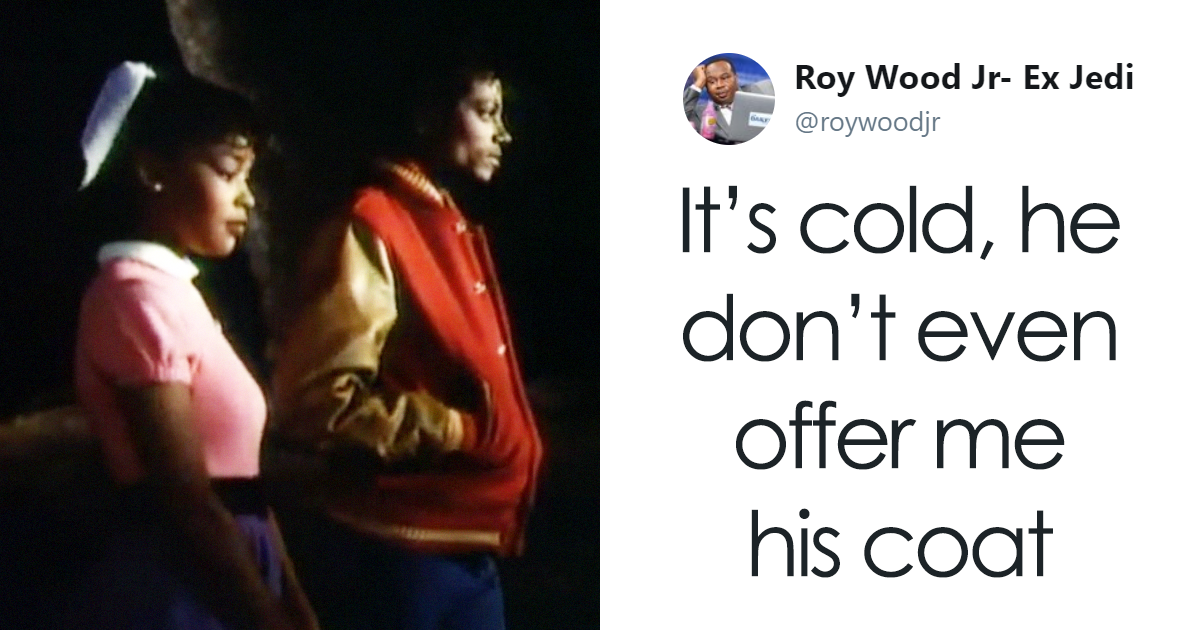
Comedian Roy Wood Jr. helped spark the viral framing by imagining Ola Ray’s character narrating the experience like a next-day social media recap. That comedic device is brilliant because it puts modern internet language over an old-school music-video plot. The contrast is the punchline. “Thriller” is dramatic, polished, and legendary; the girl’s imagined recap is practical, suspicious, and very tired.
A Quick Refresher: What Happens in “Thriller”?
Released in 1983, Michael Jackson’s “Thriller” is a nearly 14-minute horror-themed short film directed by John Landis and co-written by Landis and Jackson. It stars Jackson and Ola Ray, with a famous spoken-word performance by horror icon Vincent Price. The video begins like a vintage monster movie, shifts into a date-night scene, and then transforms into one of the most recognizable dance sequences ever filmed.
The plot is simple on paper but wild in execution. Michael and his date leave a theater after watching a scary film. As they walk through the night, the mood becomes tense. Michael teases her, sings to her, and then the world around them begins to feel unsafe. Zombies emerge. The dead dance. Michael leads them. The date runs. The line between dream, movie, and reality keeps blurring until the final creepy twist.
For viewers, it is entertainment. For Ola Ray’s character, it is basically a customer-service complaint with choreography.
Ola Ray’s Character Is the Unsung MVP of the Joke
The viral Twitter reaction works because Ola Ray’s character behaves like a believable person trapped inside a pop-culture event. She screams. She runs. She looks confused. She reacts exactly as most people would react if their date suddenly became part monster and part dance captain.
That grounded reaction is what makes the perspective funny. Michael Jackson is performing at superstar level, but she is giving the audience an emotional map: “This is not normal.” Without her, the video would still be visually stunning, but it would lose some of its story tension. She gives the madness a human witness.
In comedy terms, she is the straight character in the middle of the circus. Everyone else may be undead, possessed by rhythm, or dressed for a supernatural flash mob, but she is the person asking the reasonable questions. Why is this happening? Why are they dancing? Why is my date so calm? And, most importantly, how far are we from the nearest well-lit diner?
Why “Thriller” Still Feels Built for the Internet
Long before memes, reaction threads, quote tweets, and TikTok edits, “Thriller” already had the DNA of viral culture. It was visual, dramatic, repeatable, and instantly recognizable. The red jacket became fashion shorthand. The zombie dance became a group activity. Vincent Price’s narration became a Halloween staple. Even people who have never watched the full short film usually know the basic imagery.
That makes “Thriller” perfect for reinterpretation. A meme needs shared context, and “Thriller” has more shared context than almost any music video ever made. You can show one frame of Michael in the red jacket or one row of zombies leaning in unison, and audiences immediately understand the reference.
The “girl’s perspective” joke adds a modern layer. It does not mock the video’s greatness; it celebrates it by proving that the story is still alive enough to be reexamined. A weak cultural artifact disappears. A strong one keeps producing new jokes.
The Genius of Turning Horror Into a Bad Date Story
Part of the joke is that “Thriller” follows the structure of a date gone wrong. At first, everything seems classic and cute: movie night, walking together, a little teasing. Then the warning signs arrive fast. Michael chooses a horror movie intense enough to send his date out of the theater. He reveals a supernatural side. He seems to know more about the zombie situation than any innocent bystander should. Then, instead of running away from danger, he joins the danger with impeccable timing.
From a horror perspective, that is iconic. From a dating perspective, that is several group chats waiting to happen.
This is why people laughed: the reframing turns cinematic cool into everyday absurdity. It asks, “What would this look like if it were not Michael Jackson?” Imagine explaining to a friend that your date transformed, disappeared into a zombie crowd, and then performed synchronized choreography in the street. Your friend would not say, “Wow, what artistry.” Your friend would say, “Block him.”
“Thriller” Was Always More Than a Music Video
The reason this joke has so much material to work with is that “Thriller” was never a simple performance clip. It was a short film with a story, characters, makeup effects, a cinematic structure, and a budget far beyond the usual music video standards of its time. John Landis brought movie-making language to MTV, while Jackson brought the precision of a performer who understood that pop music could be visual theater.
The video helped shift expectations for what a music video could be. Instead of simply showing a singer performing, “Thriller” created a world. It had suspense, humor, romance, horror, dance, and a twist ending. It proved that a music video could feel like an event.
That event quality is one reason it landed in the Library of Congress National Film Registry in 2009. It was recognized not only as a famous video but as a culturally important film work. That is a rare honor and a reminder that “Thriller” changed more than the Halloween playlist.
How Twitter Keeps Classic Pop Culture Young
Twitter, now widely known as X, has a particular talent for turning old entertainment into new comedy. Users take familiar scenes and ask questions nobody asked at the time. What was the side character thinking? What did the villain’s neighbors hear? Who paid for the property damage? What would the supporting character post after surviving the plot?
The “Thriller” girl’s perspective fits perfectly into that tradition. It is not a traditional review. It is a social-media thought experiment. It treats a legendary video like a real incident and lets the humor grow from practical details.
That is why the joke traveled. It invites participation. Anyone can add a thought: the awkward ride home, the unread texts, the police report no one would believe, the friend saying, “Girl, I told you that jacket was too red.” The format turns a single video into a community comedy sketch.
Why the Joke Does Not Damage the Legacy
Some fans worry when iconic art becomes meme material, but in this case the laughter strengthens the legacy. People do not keep joking about “Thriller” because it is disposable. They joke about it because it is deeply embedded in cultural memory.
The best classics can survive affectionate teasing. In fact, they often benefit from it. Memes introduce younger audiences to older works. Someone may first encounter “Thriller” through a joke, then watch the full video, then realize why the joke works so well. Comedy becomes a doorway into appreciation.
Also, “Thriller” itself has a playful spirit. It is spooky, but it is not grim. It winks at horror films. It uses monster imagery with theatrical flair. It wants the audience to gasp, laugh, dance, and replay. The Twitter joke simply continues that mix of fear and fun in a new format.
The Girl’s Perspective: A Scene-by-Scene Comic Reading
The Movie Theater
The date begins with a horror film. Already, from the girl’s viewpoint, the night is not exactly candlelit romance. She becomes uncomfortable and leaves. Michael follows, but instead of simply comforting her, he keeps the suspense going. It is charming in music-video language. In real life, it would earn a suspicious side-eye.
The Walk Home
Walking down a dark street after a scary movie is already questionable planning. The atmosphere becomes increasingly eerie, and Michael’s calmness does not help. He sings beautifully, yes, but beauty does not cancel out the fact that the neighborhood is giving “turn around immediately.”
The Transformation
Then comes the reveal. Michael is not merely a smooth singer in a red jacket. He has a monster side. From the audience’s perspective, it is the exciting twist. From her perspective, it is the moment the date goes from unusual to “I need witnesses.”
The Zombie Dance
The zombie dance is one of the greatest choreographed sequences in pop history. But if you are the person being chased, the excellence of the footwork may not be your first concern. This is the heart of the meme: everyone watching sees genius; she sees danger with rhythm.
Why We Love This Kind of Rewatch
Rewatching familiar media from a different character’s perspective is satisfying because it reveals hidden comedy. The original story tells us where to look. The internet asks what happens if we look somewhere else.
In “Thriller,” the camera and music train us to focus on Michael. That makes sense; he is Michael Jackson. But the girl’s perspective exposes the absurdity of the plot in the funniest possible way. She is not watching a legend being made. She is trying to survive a date that has become an undead Broadway rehearsal.
This kind of rewatch also reminds us that pop culture is not frozen. A video from 1983 can still feel current when people find new angles, new jokes, and new emotional entry points. The internet did not create the greatness of “Thriller,” but it did prove the video still has fresh batteries.
Experience Notes: Watching “Thriller” From the Girl’s Perspective
Watching “Thriller” through Ola Ray’s character’s eyes changes the entire experience. The first time most people see the video, they focus on Michael Jackson’s performance. That is natural. He is magnetic in every frame. His movements are sharp, his expressions are theatrical, and his presence is so controlled that the whole production seems to orbit around him. But once the internet points out the date-night angle, the viewer’s attention shifts. Suddenly, you begin watching her face, her hesitation, her fear, and her attempts to make sense of a situation that no dating app profile could have prepared her for.
That second viewing is where the humor blooms. You start noticing practical details. Why did they walk down such a lonely street? Why is Michael so relaxed when the dead begin rising? Why does the zombie crowd know choreography? Did they rehearse? Was there a sign-up sheet? Did anyone tell the girl there would be audience participation?
The experience becomes even funnier when you imagine the aftermath. In a modern setting, she would not simply go home quietly. She would text her best friend before reaching the front door. She would post a vague status. She would create a thread. She might say she went out with a guy who seemed sweet until the moon came out and the evening became a supernatural group project. Her friends would demand details, screenshots, and possibly her location.
This is why the viral joke feels so relatable. Everyone understands the idea of a date that becomes stranger than expected. Most people have not dated someone who transformed into a creature or commanded zombies, thankfully, but many people have sat through a social situation thinking, “How did I get here?” The “Thriller” meme exaggerates that universal feeling into pop-culture absurdity.
It also makes the video more fun to revisit with friends. One person can watch for the choreography, another can watch for horror references, and another can narrate the girl’s internal monologue. That shared viewing experience turns a classic video into a party game. The jokes practically write themselves: the emergency phone call, the post-date debrief, the friend who says, “I knew something was off when he wore a full leather outfit to the movies.”
Most importantly, the girl’s perspective does not make “Thriller” smaller. It makes it richer. The video still stands as a landmark in music history, but now it also works as accidental comedy, social commentary, and a reminder that every grand legend looks different from the passenger seat. Michael Jackson gave the world a masterpiece. Twitter gave us the imaginary Yelp review of the worst-best date ever. Somehow, both are perfect.
Conclusion
The reason Twitter laughed at the girl’s perspective of Michael Jackson’s “Thriller” is simple: it turns an untouchable classic into a human situation. From the outside, “Thriller” is a landmark short film, a music-video revolution, and a Halloween tradition. From Ola Ray’s character’s point of view, it is a date that escalates from awkward to supernatural with no warning and far too much choreography.
That contrast is comedy gold. It proves that great pop culture can keep evolving long after its release. “Thriller” remains iconic because it is visually unforgettable, musically powerful, and flexible enough to survive endless reinterpretation. Whether you watch it as a horror short, a dance masterpiece, a fashion moment, or a wildly unsafe date story, it still delivers.
And if there is one lesson from the viral joke, it is this: when someone tells you the date was a thriller, ask follow-up questions.