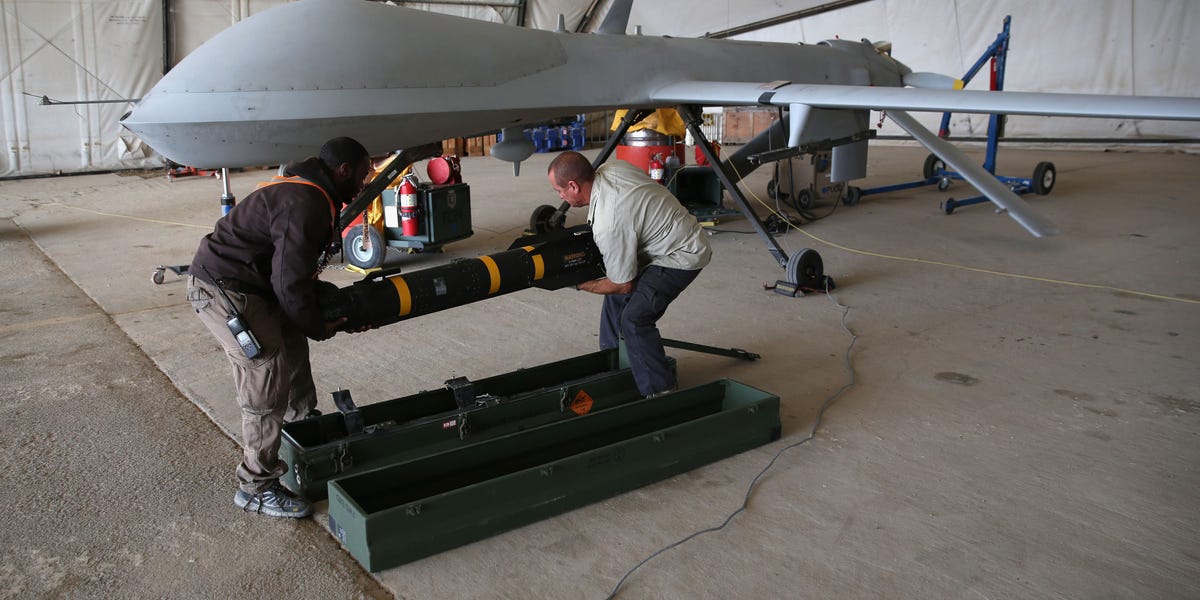
From airport cargo holds to coastal ships and drone-hunting buggies, the AGM-114 Hellfire missile has developed a strange second career: showing up exactly where nobody expects it.
The Missile With a Very Dramatic Name
The AGM-114 Hellfire missile sounds as if it was named by a committee that had just finished watching an action movie in a conference room with bad coffee. But behind the theatrical branding is one of the most widely used American precision weapons of the modern era. Originally built as a helicopter-launched anti-armor missile, the Hellfire became famous for its role on Apache attack helicopters, Predator drones, Reaper drones, and later a growing collection of platforms that would make its early designers blink twice.
At its core, the Hellfire is a compact, roughly 100-pound class precision missile designed to hit point targets: tanks, bunkers, light vehicles, fast boats, structures, and, in some configurations, slow aerial targets. It is not a giant strategic missile. It is not a city-flattening cinematic monster. It is closer to a highly specialized scalpel with a rocket motor, a seeker, and a long résumé.
That résumé is what makes the recent history of Hellfire missiles so strange. Weapons like this are supposed to live in tightly controlled spaces: military depots, secure air bases, naval magazines, training ranges, and authorized foreign military channels. Yet Hellfires have appeared in places that sound more like the start of a bureaucratic thriller: Cuba, Belgrade airport, commercial flight cargo, small naval ships, and even a Ukrainian off-road buggy reportedly used to chase drones out of the sky.
The Cuba Detour: When a Training Missile Took the Wrong Vacation
The most famous “wait, how did that get there?” Hellfire incident involved an inert training missile that was supposed to return to the United States after a NATO-related training exercise in Europe. Instead, after moving through a chain of freight routes in Spain, Germany, and France, the missile reportedly ended up loaded onto an Air France flight to Havana.
To be clear, this was not a live missile with an explosive warhead waiting to cause disaster. Public reporting described it as a dummy or captive training version, missing the operational components that would make it a battlefield weapon. Even so, it was still sensitive military technology. An inert missile can still reveal design details, interface points, seeker housing arrangements, handling systems, and manufacturing clues. In the defense world, even a “harmless” object can be a very chatty object if the wrong engineers get enough time with it.
The shipment mistake created a headache for U.S. officials, Lockheed Martin, and diplomats at an especially awkward moment. The United States and Cuba had recently restored diplomatic relations after decades of hostility, and suddenly a piece of American military hardware had wandered into Havana like a tourist who ignored every sign at the airport. The missile was eventually returned to the United States with Cuban cooperation, but the episode remains a near-perfect case study in how logistics can become national security news.
Why an Inert Missile Still Matters
Readers may wonder: if it had no explosives, why all the fuss? The answer is that weapons security is not only about preventing explosions. It is also about protecting technology, supply chains, software interfaces, export licenses, handling procedures, and classified or sensitive design insights. A missile body can reveal more than the average person might expect. In military technology, a missing screw hole can be a clue, and a missing missile is a committee meeting with sirens attached.
The Belgrade Airport Surprise
Just when the Cuba story seemed odd enough to deserve its own office folklore, another Hellfire-related incident appeared. In 2016, Serbian authorities found two U.S.-made Hellfire training missiles in wooden crates at Belgrade’s Nikola Tesla Airport. They had arrived from Beirut on an Air Serbia flight and were reportedly bound for the United States.
Again, the important word is training. Reporting indicated that the missiles were inert and did not have the operational warhead, rocket motor, or guidance system associated with live rounds. The Lebanese Army said they had been used for training and were being returned to the manufacturer under legal and administrative procedures. Still, from the airport security perspective, “two Hellfire missiles in cargo” is not exactly a routine Tuesday.
The Belgrade case highlighted the difference between danger and alarm. The crates may have been properly documented, and the missiles may have been safe as cargo, but the optics were spectacularly bad. Commercial aviation cargo systems are built to move everything from flowers to machine parts. When the item in the crate is shaped like a famous anti-tank missile, everyone suddenly becomes extremely interested in the paperwork.
The Real Star of the Story: Logistics
Most people imagine military technology moving in armored convoys under moonlight. In reality, defense logistics can involve freight forwarders, commercial carriers, customs declarations, transit hubs, air waybills, export compliance offices, and enough tracking numbers to make a spreadsheet develop self-awareness. That does not mean the system is casual. It means the system is complicated. And complicated systems occasionally produce mistakes that are not dangerous in the explosive sense but are absolutely dangerous in the reputational and security sense.
How the Hellfire Became a Multi-Platform Workhorse
The Hellfire’s journey into odd places is partly the result of its success. A weapon designed for one mission became useful for many. It began as a helicopter-launched anti-armor weapon, but over time it evolved into a family of variants used by different U.S. military branches and allied forces. It has been fitted to Apache helicopters, Cobra helicopters, Seahawk helicopters, MQ-9 Reaper drones, AC-130 gunships, littoral combat ships, and other experimental or specialized platforms.
The MQ-9 Reaper, for example, can carry multiple Hellfire missiles while performing surveillance and strike missions. The missile’s relatively compact size, precision guidance, and established production base made it attractive for missions where commanders needed a weapon smaller than a bomb but more decisive than cannon fire. In plain English: it is small enough to fit on many platforms and serious enough that nobody wants to be on the receiving end.
The Longbow Hellfire variant added radar guidance, expanding how the missile could be used in poor weather, smoke, dust, or situations where laser designation might be limited. That ability helped push the Hellfire beyond its original anti-tank identity. The same basic missile family that once focused on armored vehicles found new work in maritime defense, counter-drone roles, and precision land strikes.
Hellfires at Sea: From Tank Killer to Boat Swarm Stopper
One of the more interesting modern uses of the Hellfire is aboard U.S. Navy littoral combat ships. These ships operate close to shore, where threats can include fast attack craft, small boats, drones, and coastal targets. The Navy’s surface warfare mission package includes Longbow Hellfire missiles in a Surface-to-Surface Missile Module, giving the ship a compact punch against fast-moving threats.
In 2022, the USS Montgomery fired Longbow Hellfire missiles at a land-based target during a proof-of-concept exercise. The event demonstrated how a missile born in the Army’s anti-armor world could support naval and expeditionary missions. That is the Hellfire story in miniature: take a proven weapon, attach it to a new platform, update the mission, and suddenly the missile has another job title.
There is a practical reason for this. Developing a brand-new weapon for every new threat is expensive and slow. Adapting an existing missile with known performance, training pipelines, and supply chains can be faster. It is the defense equivalent of discovering that the old pickup truck still runs, can tow the boat, and somehow also works as a mobile office.
Drone Wars and the Hellfire’s New Trick
The rise of drones has changed the battlefield. Cheap one-way attack drones, loitering munitions, and small unmanned aircraft have forced militaries to rethink air defense. Spending million-dollar interceptors on cheaper drones can be a losing equation, but commanders still need reliable ways to stop incoming threats.
In Ukraine, reporting in 2026 described a U.S.-made Tempest vehicle equipped with what appeared to be Longbow Hellfire missiles. The system was presented as a highly mobile counter-drone platform: essentially, an off-road buggy with sensors and missile launchers. That sentence would have sounded absurd twenty years ago. Today it sounds like the future arrived wearing mud tires.
According to public reports, Ukrainian crews claimed the vehicle had already destroyed more than 20 Russian Shahed-type drones. The exact details remain partly unclear in open sources, including how many systems are deployed and the exact missile variant used. But the broader trend is unmistakable: Hellfire missiles are no longer just coming from helicopters and drones. They are being adapted for a battlefield where speed, mobility, and flexible launch platforms matter more than ever.
Is It Cost-Effective?
That is the big question. Hellfire missiles are far more expensive than many drones they might intercept. But cost-effectiveness is not only about the price of the target. It is also about the value of what the target might destroy. A $100,000-plus interceptor may look expensive against a cheaper drone until that drone is headed toward a power station, radar, ammunition depot, or apartment block. In air defense, the math is always emotional because the target is rarely just an object on a chart.
The “Flying Ginsu” and the Strange Ethics of Precision
No discussion of unusual Hellfire stories is complete without the R9X, the modified Hellfire variant often nicknamed the “Flying Ginsu” or “ninja missile.” Instead of relying on a conventional explosive warhead, the R9X has been widely reported to use kinetic impact and deployable blades to strike a specific target while reducing blast damage nearby.
This variant became publicly famous after high-profile counterterrorism strikes, including the 2022 killing of al-Qaeda leader Ayman al-Zawahiri in Kabul. Images and reporting suggested a strike with very limited surrounding damage, which drew attention to the R9X’s unusual design. It is one of the strangest chapters in the Hellfire family: a missile that became less explosive in order to become more precise.
That does not remove the ethical questions around targeted killing, civilian risk, intelligence reliability, sovereignty, or accountability. Precision does not automatically equal wisdom. But it does show how the Hellfire has evolved from a straightforward anti-tank weapon into a platform for multiple philosophies of modern warfare: destroy armor, strike vehicles, stop boats, hunt drones, and, in rare cases, hit an individual target with minimal blast.
What These Strange Sightings Teach Us
The funny part of the Hellfire story is the headline: missiles turning up in places where missiles do not belong. The serious part is what those incidents reveal. Modern weapons are not just weapons. They are logistics objects, export-controlled technologies, diplomatic liabilities, training tools, data points, and symbols of military reach.
The Cuba and Belgrade episodes show how sensitive military items can move through civilian transport networks when authorized paperwork, contractors, and freight systems intersect. The Navy and Ukraine examples show how a mature missile can be repurposed across land, sea, air, and counter-drone missions. The R9X shows how even the internal logic of a missile can change: from blast to precision impact, from battlefield armor to counterterrorism targeting.
For SEO purposes, the phrase “Hellfire missiles” naturally attracts attention because it combines military technology, mystery, and a name that practically kicks the door open. But the deeper story is not about panic. It is about adaptation and control. The same qualities that make the AGM-114 Hellfire usefulcompact size, precision guidance, multiple variants, and broad platform compatibilityalso make its movement and accountability especially important.
In other words, the Hellfire keeps turning up in unlikely places because it is useful in more places than originally imagined. That is both the genius and the headache of successful military technology.
Experience Notes: When Military Hardware Meets the Real World
Anyone who has worked around aviation, shipping, compliance, or government procurement knows that the real world runs less like a movie and more like a stack of forms with jet fuel in the background. The Hellfire stories are fascinating because they sit at that exact intersection. There is the high-tech object everyone recognizes, and then there is the ordinary machinery of moving things from Point A to Point B. The surprising part is not that military logistics are careless; the surprising part is that they are human.
Think about the layers involved. A training missile is not simply “sent back.” It is classified by condition, packed in approved containers, documented, routed, insured, cleared, inspected, and handed from one responsible party to another. Every step has a label, a person, a system, and a chance for misunderstanding. Most of the time, the process works quietly. Nobody writes headlines about the crate that arrived exactly where it was supposed to go. “Properly Managed Defense Cargo Reaches Destination” is accurate, but it is not exactly a viral masterpiece.
The moment something goes wrong, however, the object becomes famous. A crate in an airport becomes a global story. A dummy missile becomes a diplomatic issue. A training round without a warhead becomes a symbol of export-control anxiety. The public sees the word “Hellfire” and imagines danger. Officials see a chain-of-custody problem, a compliance review, and probably several people suddenly wishing their phones had fallen into a lake.
There is also a lesson for readers who follow military technology as enthusiasts. Weapons are often discussed by performance numbers: range, weight, seeker type, warhead, platform, cost. Those numbers matter, but they do not tell the whole story. A weapon’s real influence comes from the ecosystem around it. Can it be transported safely? Can allies train with it? Can it be maintained? Can it be adapted to new threats? Can commanders trust it? Can governments account for every unit when the paperwork gets boring?
The Hellfire has endured because the answer to many of those questions has usually been yes. It is not the newest missile in every category, and newer systems such as the Joint Air-to-Ground Missile are taking on expanded roles. Yet the Hellfire remains relevant because it is familiar, available, adaptable, and battle-tested. That combination is powerful. In military procurement, “works and already exists” can beat “perfect but not ready” more often than PowerPoint would like to admit.
There is a strangely practical takeaway here for non-military life, too. The Hellfire’s odd appearances remind us that complex systems fail at the seams. The seam between military and civilian shipping. The seam between contractor and government. The seam between training and operations. The seam between old missions and new threats. If you want to understand any large system, do not only study the shiny equipment. Study the handoff.
That is why these stories stick. A missile in Cuba sounds like espionage fiction. Two training missiles in Belgrade sound like an airport security fever dream. A Hellfire on a Ukrainian buggy sounds like someone let a defense engineer customize a dune racer. But underneath the drama is a simple truth: technology goes where institutions send it, wars bend tools into new shapes, and paperwork matters more than anyone wants to admit until it fails.
Conclusion: The Hellfire’s Weird Second Life
Hellfire missiles are turning up in the unlikeliest of places because the missile family has become one of America’s most adaptable precision weapons. The same AGM-114 Hellfire that started as a helicopter-launched tank killer has become a drone weapon, a ship-launched missile, a reported counter-drone interceptor, a training object in international logistics, and a platform for exotic low-collateral variants.
The oddest sightingsthe Cuba detour and the Belgrade airport discoverywere not Hollywood-style disasters. They were reminders that even inert training missiles demand careful control. The newer examples at sea and in Ukraine show a different lesson: successful weapons often outgrow their original job descriptions. The Hellfire is no longer just a missile. It is a military technology case study with fins.
And if there is one final lesson, it is this: when a weapon named Hellfire shows up somewhere unexpected, always read the fine print before panicking. It might be inert. It might be paperwork. It might be a new battlefield adaptation. Or it might be all three, which is exactly how modern defense stories become so strange, so serious, and so irresistibly readable.