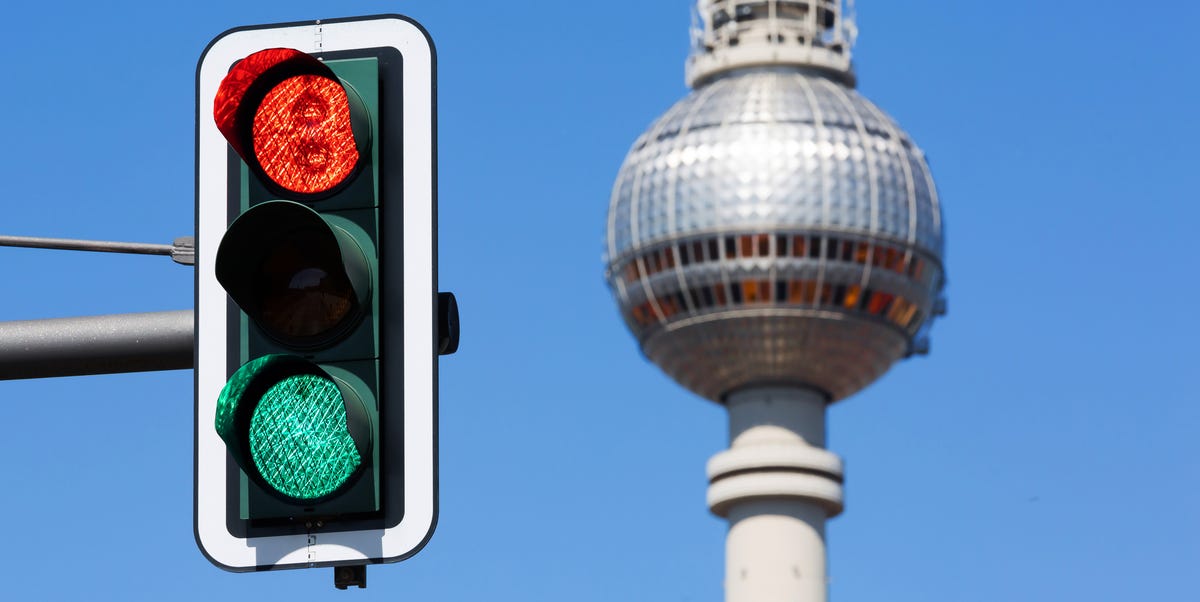
Red means stop. Green means go. Yellow means “please make a responsible decision,” though many drivers treat it like a personal challenge issued by the universe. For more than a century, the three-color traffic light has been one of the simplest and most universal pieces of road technology in America. But researchers now say the classic red-yellow-green system may need a futuristic upgrade: a fourth color.
The proposed new signal is often described as a white traffic light, though the exact color is less important than the message it would send. The idea comes from transportation researchers studying how roads could work when autonomous vehicles, connected cars, pedestrians, buses, delivery fleets, and human drivers all share the same intersections. In that mixed world, traffic lights may not just tell people when to stop or go. They may also tell us when intelligent vehicles are helping manage the flow.
So, does this mean your neighborhood traffic light will suddenly look like a tiny Christmas tree with commitment issues? Not tomorrow. The fourth-color concept is still a research proposal, not a national rollout. But it raises a serious question: if cars are becoming computers on wheels, should traffic signals stay frozen in the 1920s?
What Is the Fourth Traffic Light Color?
The fourth color proposed in the study is commonly called the white light or white phase. Its job would be different from the traditional three signals:
- Red: Stop.
- Yellow: Prepare to stop or proceed with caution.
- Green: Go when safe.
- White: Follow the vehicle in front of you because connected autonomous vehicles are coordinating the intersection.
In plain English, the white light would tell human drivers: “The smart cars have this handled. Do not improvise. Do not audition for a chase scene. Just follow the car ahead.”
The concept depends on connected automated vehicles, often called CAVs. These vehicles can communicate wirelessly with one another and with traffic-control systems. When enough of them approach an intersection, they could coordinate movement more efficiently than a traditional fixed traffic light cycle. Instead of waiting for a rigid red-green pattern, vehicles could negotiate the safest and fastest order to pass through.
Why Researchers Think Traffic Lights Need a Fourth Color
Traditional signals are good at one big task: assigning right-of-way. They divide time into chunks, allowing one direction of traffic to move while others wait. This works, but it can be wasteful. Anyone who has sat alone at a red light at 1:00 a.m. while absolutely nobody crosses the intersection understands the problem on a spiritual level.
Modern intersections are becoming more complicated. Cities must manage cars, pedestrians, cyclists, buses, emergency vehicles, delivery vans, and eventually larger numbers of autonomous vehicles. A standard signal can be timed, actuated by sensors, or coordinated with nearby lights, but it generally does not “think” in the way a connected vehicle network can.
The white phase idea tries to use the computing power of autonomous vehicles themselves. If a cluster of connected vehicles arrives at an intersection, those vehicles could help decide the best movement pattern. The traffic signal would display the fourth color to let human drivers know that a different mode is active.
How the White Light Would Work
Imagine approaching an intersection behind a self-driving shuttle, a connected delivery van, and a few regular cars. Under today’s system, all vehicles wait for the green light, even if a smarter sequence could move everyone faster. Under the proposed white phase, the autonomous vehicles would communicate with the signal controller and each other.
If there are not enough autonomous vehicles nearby, the intersection behaves normally. Red, yellow, and green continue doing their familiar jobs. But when enough connected autonomous vehicles are present, the white light activates. Human drivers then follow the vehicle ahead, while autonomous vehicles coordinate the movement pattern.
This does not mean every car randomly charges into the intersection like shopping carts in a windstorm. The system would still be governed by traffic-control logic, safety rules, vehicle spacing, and conflict avoidance. The major change is that some control shifts from the fixed signal to the networked vehicles.
The Big Benefit: Less Waiting at Intersections
The strongest argument for a fourth traffic light color is efficiency. Research simulations suggest that a white phase could reduce delays, improve travel time, and lower fuel or energy waste. That matters because intersections are traffic’s favorite place to create drama.
When cars stop and start repeatedly, they waste fuel, drain battery power, increase emissions, and create ripple effects that spread down the road. One driver braking late can create a tiny traffic wave. Multiply that by thousands of cars, and suddenly everyone is late, cranky, and blaming “traffic” as if traffic were a mysterious weather event rather than all of us collectively failing to move smoothly.
A connected-vehicle system could reduce unnecessary stopping by grouping vehicles into more efficient flows. Instead of treating every approach as a separate queue, it could use real-time data to decide which vehicles should move, slow, or follow. The result could be shorter waits and smoother intersections.
What About Pedestrians?
A smart traffic signal cannot only be smart for cars. If it helps vehicles but makes pedestrians wait forever, that is not innovation; that is just a very expensive way to annoy people in comfortable shoes.
Follow-up research on the white phase concept looked at pedestrians as well as vehicles. The idea is that connected systems could account for foot traffic and still improve movement for everyone. In theory, a white phase could shorten pedestrian wait times while also improving vehicle flow, especially as autonomous vehicles become more common.
That part is important. Cities are not racetracks. A successful fourth-light system would need to work for people crossing the street, people using wheelchairs, cyclists, older adults, children, delivery workers, and anyone who has ever sprinted across a crosswalk while carrying coffee and dignity at the same time.
Is White Definitely the Best Color?
The study uses white as the proposed fourth color, but the final color would not necessarily have to be white. What matters is that the signal must be clear, standardized, visible, and easy to understand. A fourth color would have to avoid confusion with existing lights, emergency signals, railroad signals, pedestrian signals, and local traffic-control devices.
White has advantages because it is visually distinct from red, yellow, and green. However, it could also raise practical questions. Would it be visible in bright sunlight? Would it confuse drivers who associate white lights with vehicle headlights or street lighting? How would color-blind drivers interpret it? Would a symbol, pattern, or position be needed in addition to color?
Traffic engineering is not just about inventing clever signals. It is about making signals boringly clear. That may sound dull, but boring clarity is exactly what you want when two tons of metal are deciding whether to stop or proceed.
The Fourth Light Would Require Major Rule Changes
In the United States, traffic signals are not redesigned casually. The familiar signal system is guided by federal and state standards, including rules for traffic-control devices. Current signal faces are built around red, yellow, and green indications, plus specialized arrows and pedestrian displays.
Adding a fourth traffic light color would require more than buying a new bulb and telling drivers, “Good luck, America.” It would involve engineering standards, public education, pilot programs, legal review, accessibility testing, liability planning, equipment upgrades, and coordination between cities, states, automakers, and federal agencies.
That is why researchers often point to controlled environments as possible early testing grounds. Places like ports, logistics hubs, university campuses, industrial zones, or dedicated shuttle routes could provide a safer way to test white phase technology before it appears at busy downtown intersections.
Why Autonomous Vehicles Change the Traffic Signal Conversation
Traditional drivers communicate mostly through brake lights, turn signals, eye contact, hand waves, horn taps, and the occasional facial expression best left out of polite society. Autonomous vehicles communicate differently. They can share speed, position, route intent, braking behavior, and traffic conditions through digital systems.
This creates a new possibility: traffic lights may not need to be the only “brain” at the intersection. Connected vehicles can act as mobile sensors and mobile controllers. They can provide information about what is happening in real time, helping signals respond more intelligently.
Some traffic systems already use vehicle data to improve signal timing. Connected vehicle information can help identify delays, missed greens, and congestion patterns. The white phase concept takes that idea further by allowing autonomous vehicles to help organize movement through the intersection itself.
Could This Improve Safety?
Potentially, yesbut safety is also where the idea must be tested most carefully. Autonomous driving systems may eventually reduce crashes by removing certain human errors, such as distraction, impairment, delayed reaction, or aggressive driving. However, today’s roads are still dominated by human drivers, and fully automated driving systems are not yet available to everyday consumers in the broad, universal sense many people imagine.
A fourth signal would only be safe if drivers understand it instantly. Confusion at intersections is dangerous. If one driver thinks white means “go,” another thinks it means “yield,” and a third thinks it means “my car is haunted,” the system has failed before the first pilot program gets a ribbon-cutting ceremony.
For safety, the fourth color would need consistent rules, clear driver education, fail-safe operation, and predictable behavior when communication systems fail. If the connected-vehicle network drops out, the signal must immediately return to standard red-yellow-green control.
The Human Problem: Drivers Are Not Software Updates
The hardest part of a fourth traffic light may not be the technology. It may be people.
Drivers have spent their entire lives learning three colors. Red, yellow, and green are so deeply embedded in daily behavior that we use them as metaphors outside driving. A green light means permission. A red light means stop. A yellow light means caution, unless you are late for work and have decided physics is negotiable.
Introducing a fourth color would require a cultural shift. Driver manuals would need updates. Road tests might include the new signal. Public campaigns would need to explain the white phase simply and repeatedly. Navigation apps, vehicle dashboards, and driver-assistance systems could also help teach the meaning.
The rollout would have to be gradual. A sudden nationwide change would be unrealistic. The more likely path is limited pilot testing, data collection, public education, and eventually broader standards if the system proves safe and useful.
Will Regular Drivers Lose Control?
No, not in the dramatic science-fiction sense. The white light would not mean human drivers surrender their license to a robot overlord wearing a reflective vest. It would simply mean the intersection is operating in a connected mode, and the safest instruction for human drivers is to follow the vehicle ahead.
In many ways, drivers already follow automated instructions. We obey traffic lights, lane-control signals, ramp meters, railroad gates, school-zone flashers, and navigation reroutes. The white phase would be another layer of guidance, designed for a world where some vehicles can coordinate faster and more precisely than humans can.
Still, trust matters. People will need proof that the system works. They will need to see fewer delays, not just hear promises from engineers. They will need confidence that pedestrians are protected, emergency vehicles are prioritized, and human drivers are not being pushed into confusing situations.
Why Not Just Make Traffic Lights Smarter Without Adding a Color?
That is one of the best counterarguments. Cities can already improve traffic flow with better signal timing, adaptive signals, connected vehicle data, transit priority, emergency vehicle preemption, and improved pedestrian detection. In many places, the first step should be fixing outdated signal timing, not adding a futuristic fourth light.
However, the white phase is not just about smarter timing. It is about communication. If autonomous vehicles are coordinating movement in a way human drivers cannot see, the traffic signal needs a way to explain what is happening. The fourth color is basically a public-facing message: “A special coordination mode is active.”
Without that message, human drivers might not understand why cars are moving differently. A visible signal helps keep everyone in the loop, including the people driving older vehicles without connected technology.
What Would This Mean for Cities?
For cities, a fourth traffic light color would be both an opportunity and a headache. The opportunity is smoother traffic, less idling, better fuel efficiency, shorter pedestrian waits, and more flexible intersections. The headache is everything else.
Local governments would need to evaluate cost, maintenance, equity, cybersecurity, privacy, driver education, and compatibility with existing infrastructure. Wealthier areas might adopt smart intersections first, while smaller towns could be left waiting. That would create uneven driver expectations, especially for people traveling between cities.
There is also the question of who pays. Traffic lights are public infrastructure. Autonomous vehicle benefits may involve private automakers, fleet operators, delivery companies, and ride-hailing services. If a new signal helps commercial fleets move faster, cities may reasonably ask how those benefits should be shared with the public.
When Could Fourth-Color Traffic Lights Actually Arrive?
There is no national date for white traffic lights. The concept is still in the research and modeling stage, with possible pilot projects being the realistic next step. Widespread adoption would likely depend on the growth of connected autonomous vehicles. If only a tiny percentage of cars can communicate with each other, the white phase has limited value.
In the near term, expect smarter traffic signals before brand-new colors. Cities are more likely to use connected data, camera detection, transit priority, and AI-assisted timing to reduce congestion. The fourth light becomes more relevant when autonomous vehicles are common enough to coordinate traffic in meaningful numbers.
So, the fourth color is not a prediction for next Tuesday. It is a glimpse of how streets may evolve over the next decade or two if vehicle automation continues advancing.
Experience-Based Reflections: What a Fourth Traffic Light Would Feel Like in Real Life
Think about the average daily drive. Most frustration does not come from long highway stretches. It comes from intersections: the red light that catches you after you already stopped at the previous three, the left-turn lane that moves like it is powered by a sleepy hamster, the crosswalk countdown that feels personally judgmental, and the mysterious moment when everyone has a green light except you.
A fourth traffic light would matter because intersections are where drivers feel delay most intensely. Even a short wait can feel long when the road ahead is empty. That is why the white phase sounds appealing: it promises a smoother experience where vehicles move in coordinated groups instead of stop-start clumps.
In real life, though, the first encounter with a white light would probably be awkward. Drivers would slow down, squint, and say something deeply technical like, “Uh… what is that?” Some would follow correctly. Others would hesitate. A few would assume the light was broken. This is why education would be essential before any public rollout.
The best version of the experience would feel almost invisible. You approach an intersection, the white light appears, the vehicle ahead moves smoothly, and you follow at a safe distance. There is no sudden braking, no aggressive lane changes, and no guessing game. The intersection feels less like a stop-and-go command center and more like a well-choreographed zipper merge.
For pedestrians, the experience would need to feel even more reliable. A person crossing the street should not have to understand vehicle-to-infrastructure communication to know when it is safe to walk. The pedestrian signal must remain clear, familiar, and protected. If the fourth light ever makes pedestrians feel like background characters in a robot car experiment, public trust will disappear quickly.
For drivers of older vehicles, the white phase should not require special equipment. That is one of the strengths of the idea: it gives human drivers a simple visual instruction even if their cars are not connected. You should not need a luxury vehicle, a subscription package, or a dashboard that looks like a spaceship to use a public intersection safely.
The emotional challenge is trust. People trust red lights because everyone else usually obeys them. A white light would have to earn that same trust through consistency. It cannot mean one thing in Raleigh, another in Phoenix, and “surprise, figure it out” in Los Angeles. The instruction must be as universal as stop and go.
There would also be a learning curve for defensive driving. Following the car in front sounds simple, but safe following distance still matters. Drivers would need to avoid tailgating just because the system is coordinating traffic. The white light should encourage smooth movement, not a bumper-to-bumper parade of overconfidence.
The most realistic early experience may happen in controlled places: airport roads, shipping ports, business parks, or shuttle corridors. These environments have repeat traffic patterns and fewer random variables than a chaotic downtown intersection. If people see the system working there, confidence can grow naturally.
Ultimately, the fourth traffic light is less about color and more about communication. Roads are changing. Vehicles are changing. The old signal system may still work, but it was designed for a world where the smartest object at the intersection was usually the traffic controller box. In the future, the cars themselves may become part of the control system. The fourth light is simply a way of telling humans, “Here is what the machines are doing, and here is what you should do next.”
Conclusion: A Fourth Traffic Light Is Not WeirdIt Is a Sign of What Comes Next
The idea of adding a fourth color to traffic lights sounds strange at first. After all, red, yellow, and green have worked for generations. But the road system is entering a new phase. Autonomous vehicles, connected infrastructure, smarter signals, and real-time traffic data are changing what intersections can do.
The proposed white traffic light would not replace traditional signals. It would add a new mode for a mixed future where human drivers and autonomous vehicles share the road. If the technology proves safe, understandable, and cost-effective, it could reduce delays, improve traffic flow, help pedestrians, and make intersections less frustrating.
Still, the fourth light must pass the most important test: ordinary people must understand it instantly. The future of traffic cannot depend on drivers reading a research paper at a red light. The system has to be simple, visible, reliable, and boring in the best possible way.
So yes, traffic lights may eventually need a fourth color. But before white joins red, yellow, and green, engineers, cities, automakers, and drivers will need to answer one very human question: can we make the future of traffic smarter without making it more confusing?