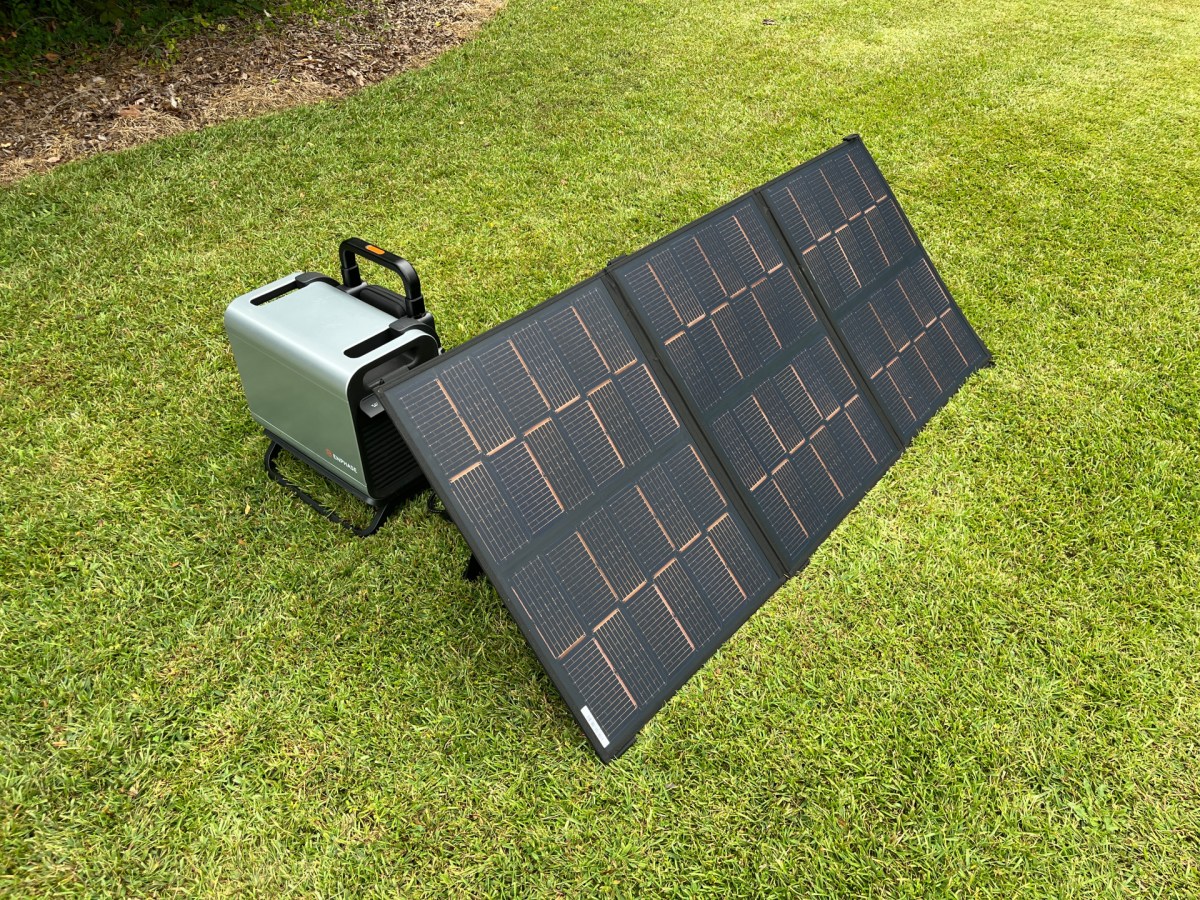
The Enphase PowerPack 1500, officially called the Enphase IQ PowerPack 1500, is not trying to be the cheapest portable power station on the shelf. It is trying to be the polished, safety-certified, fast-charging, “I have my life together” option in a category full of black plastic boxes with confusing buttons and heroic marketing claims. The big question is simple: is it actually the best portable power station for people who need power on the move?
The short answer is: it is very portable for its power class, but not lightweight in the backpacking sense. At 45.9 pounds, this is a grab-and-carry power station for outages, camping, tailgating, job sites, mobile work, and emergency backup. It is not something you casually toss into a tote bag next to sunscreen and granola bars. Unless your granola bars are made of tungsten.
In this Enphase PowerPack 1500 review, we will break down the design, capacity, charging speed, ports, solar performance, portability, real-world use cases, pros, cons, and who should buy it. We will also compare it with popular portable power station alternatives from EcoFlow, Anker, Jackery, and Bluetti so you can decide whether Enphase deserves a spot in your garage, RV, van, home office, or emergency kit.
Quick Verdict: Is the Enphase PowerPack 1500 Best for Portability?
The Enphase PowerPack 1500 is best for users who want a premium portable power station with fast wall charging, strong safety credentials, smart monitoring, solid build quality, and an optional rolling cart. It is especially appealing if you already use Enphase solar equipment at home or like the idea of managing backup power through the Enphase app ecosystem.
However, if your definition of portability means “as light as possible,” this is not the winner. Some newer 1.5 kWh-class models are lighter or offer more output for less money. The Enphase unit wins more on refinement, safety, charging speed, and connected features than raw value.
Enphase PowerPack 1500 Specs at a Glance
| Feature | Specification |
|---|---|
| Battery capacity | 1,532 Wh total / 1,500 Wh usable |
| Battery chemistry | LFP lithium iron phosphate |
| Continuous output | 1,500 VA |
| Overload output | 3,000 VA for 2 seconds |
| Weight | 45.9 lb |
| Dimensions | 16.5 in x 9.3 in x 13.6 in |
| AC outlets | 4 x 120 V AC |
| USB ports | 4 x USB-A, 2 x USB-C |
| DC output | 1 x 12 V car-style outlet |
| Wall charging | Full charge in under 75 minutes |
| Solar charging | Up to 440 W input; about 4 hours with two IQ Portable Panels in ideal conditions |
| Vehicle charging | 12 V DC charging; about 14 hours |
| Warranty | 5 years or 2,500 cycles |
| Connectivity | Bluetooth, Wi-Fi, and built-in cellular modem |
Design and Build Quality: Premium, Practical, and Slightly Fancy
The Enphase PowerPack 1500 looks more refined than many portable power stations. That may sound superficial, but design matters when a product is supposed to sit in your living room during outages, ride in your vehicle, or serve as a job-site power source. The unit has a clean shape, sturdy port covers, built-in front and rear carry handles, and a large 7-inch color LCD touchscreen.
The touchscreen is one of the more memorable parts of the design. Many power stations use tiny displays and button combinations that feel like you are entering a cheat code on a 1990s game console. Enphase goes for a more modern interface. You can check charge level, power flow, output settings, and system status directly on the device. A proximity sensor wakes the screen as you approach, which is unnecessary in the best way. It feels a little like the power station noticed you across the room and politely said, “Need watts?”
The build feels more premium than budget models. Port covers help protect the outlets, the handles are placed sensibly, and the optional IQ Cart adds a serious portability advantage. That cart has two lockable wheels, a telescopic handle, and a folding design for storage. For people who do not want to lift nearly 46 pounds repeatedly, the cart may be the accessory that turns this from “portable in theory” into “portable in real life.”
Portability: Portable, But Not Featherweight
Let us be honest: 45.9 pounds is still 45.9 pounds. The Enphase PowerPack 1500 is portable the way a small cooler full of drinks is portable. You can move it, load it into a car, carry it to the patio, or bring it to a campsite. You will also be aware that you are carrying it. Your lower back will receive the memo.
For its 1.5 kWh capacity class, the weight is reasonable but not category-leading. Some competing models are lighter, while others are heavier but offer more capacity or higher output. Enphase improves the portability story with smart design choices: dual handles, compact dimensions, weather-resistant construction, and the optional rolling cart. The cart is especially useful for tailgating, home emergency prep, small business setups, photography shoots, outdoor events, and job sites where “carry it by hand all day” is not the dream.
So, is it the best for portability? It depends on the mission. For moving between garage, driveway, campsite, porch, and vehicle, it performs very well. For hikers, minimalist campers, and people who want a one-hand battery, no. This is a power station, not a handbag with AC outlets.
Battery Capacity and Output: Enough for Essentials, Not Whole-House Backup
The Enphase PowerPack 1500 has a 1,532 Wh battery with 1,500 Wh of usable capacity. That puts it in a sweet spot for essential backup power. It can run phones, laptops, routers, lights, fans, camera gear, small kitchen appliances, power tools, and some refrigerators depending on wattage and duty cycle.
The 1,500 VA continuous output is enough for many household and outdoor tasks. You can power a home office during an outage, keep internet equipment alive, run a CPAP machine, charge multiple devices, or keep a refrigerator going for part of a blackout. The short 3,000 VA overload rating helps with startup surges, although it is not meant for sustained heavy loads.
That means you should not treat it like a whole-home generator. It is not built to run central air conditioning, electric ovens, large heaters, or multiple high-draw appliances at once. If you plug in a space heater, a microwave, and a hair dryer simultaneously, the PowerPack may respond with the battery equivalent of a raised eyebrow.
Charging Speed: One of Its Strongest Advantages
Fast charging is one of the Enphase PowerPack 1500’s biggest selling points. From a wall outlet, it can recharge fully in under 75 minutes. That is excellent for a 1.5 kWh-class portable power station. In real life, this matters more than many people realize.
If a storm is coming, you can top it off quickly. If the power returns briefly during a longer outage, you can grab a meaningful recharge before the next interruption. If you use it on a job site or at an event, you can plug it in during a break and get back to work without babysitting it all afternoon.
Solar charging is also supported, with up to 440 W of solar input. With two Enphase IQ Portable Panels in ideal sunlight, the unit can charge in about 4 hours. That is practical for camping, off-grid work, emergency backup, and outdoor events, although some competitors offer higher solar input. If solar charging speed is your top priority, EcoFlow and other brands may give you more wattage headroom. But for a portable setup, 440 W is usable and not just decorative brochure glitter.
Vehicle charging through a 12 V outlet is the slowest option, taking around 14 hours. Think of it as a backup method, not the main plan. It is handy while driving, but you would not choose it if a wall outlet or solar panels are available.
Ports and Device Support: Plenty for Real-World Use
The Enphase PowerPack 1500 includes 11 output ports: four 120 V AC outlets, four USB-A ports, two USB-C ports, and one 12 V DC output. That selection covers most use cases without requiring a nest of adapters. You can run a laptop, charge phones, keep a router online, power lights, and plug in small appliances at the same time.
The four AC outlets are especially useful. Many portable power stations include only two or three, which quickly turns into “who unplugged the lamp?” drama during an outage. The USB-C ports are good for modern phones, tablets, and laptops, while the USB-A ports are still useful for older cables and low-power accessories.
For photographers, campers, remote workers, and small crews, the port layout makes sense. For heavy tool users, the 1,500 VA output is the key limit to watch. It can handle many chargers and moderate tools, but large saws, compressors, and high-startup-load equipment may require a larger station.
Smart Features and App Control
Enphase is known for solar technology, microinverters, and energy monitoring, so it is not surprising that the PowerPack 1500 leans into connected features. The unit supports Bluetooth, Wi-Fi, and a built-in cellular modem. You can monitor battery level, energy flow, usage, and alerts through the Enphase app.
That remote visibility is genuinely useful if the unit is in a garage, van, shed, job trailer, or backup location. It also makes the PowerPack feel more like part of a home energy ecosystem rather than a standalone battery box.
The downside is that app experiences can be hit or miss. Some reviewers have praised the hardware while finding the software less intuitive than expected. That matters because smart features should reduce friction, not create a new hobby called “Why Is My Battery App Like This?” The good news is that software can improve with updates. The hardware foundation is strong; the app experience is the part Enphase should keep polishing.
Safety and Durability: A Major Selling Point
Safety is one of the biggest reasons to consider the Enphase PowerPack 1500 over cheaper alternatives. The unit uses LFP battery chemistry, which is widely favored for durability, thermal stability, and long cycle life. Enphase also emphasizes certifications such as UL 2743 for portable power packs and testing related to thermal runaway protection.
This matters for indoor use. A portable power station is often used in homes, garages, offices, RVs, and emergency situations. You want clean power, safe operation, and battery management that does not act like it was assembled during a thunderstorm by a distracted raccoon.
The PowerPack 1500 is also designed for temporary outdoor use and can operate in a wide temperature range. It can handle light rain and rougher conditions better than many basic units, though it should not be stored outside permanently or treated like waterproof camping furniture. Durable does not mean invincible.
What Can the Enphase PowerPack 1500 Run?
The answer depends on the wattage of the device and how long you need it to run. With 1,500 Wh usable capacity, the PowerPack can handle many essentials. For example, a 10 W LED light could run for days. A 60 W laptop could be charged many times. A 100 W router and modem setup could run through a long workday and beyond. A refrigerator may run for several hours or longer depending on its cycling behavior.
High-draw appliances drain the battery quickly. A 1,000 W appliance could theoretically run for about 1.5 hours under ideal conditions, but real-world efficiency, startup surges, and battery management reduce exact runtime. A 1,500 W device would push the system near its continuous output limit and drain the battery quickly. This is why portable power planning starts with wattage math, not vibes.
Enphase PowerPack 1500 vs. EcoFlow, Anker, Jackery, and Bluetti
The portable power station market is crowded, and Enphase faces strong competition. EcoFlow’s Delta 2 Max offers more capacity and higher AC output, plus higher solar input. Anker’s SOLIX F1500 is similar in capacity but typically competes strongly on output and price. Jackery’s 1.5 kWh-class models often focus on outdoor-friendly portability and simplified operation. Bluetti models often bring strong value, expandable options, or high cycle-life batteries.
Where Enphase stands out is not pure price-per-watt-hour. Its strongest advantages are fast AC charging, polished hardware, safety certifications, Enphase ecosystem integration, a large touchscreen, cellular connectivity, and the optional cart. If you already trust Enphase or want a power station that feels more like a premium energy product than a camping gadget, the PowerPack 1500 makes sense.
If your buying decision is mostly about the most watt-hours for the lowest price, Enphase may not win. Some competitors provide more capacity, higher output, or faster solar input for similar or lower pricing. In other words, Enphase is the neat, well-dressed candidate in the interview. It may not be the cheapest hire, but it shows up on time and probably color-codes the emergency kit.
Pros and Cons
Pros
- Fast wall charging in under 75 minutes
- 1,500 Wh usable capacity for essential backup power
- Premium design with large LCD touchscreen
- Four AC outlets and 11 total output ports
- LFP battery chemistry with 5-year or 2,500-cycle warranty
- Bluetooth, Wi-Fi, and cellular connectivity
- Optional rolling cart greatly improves portability
- Strong safety and temporary outdoor-use credentials
Cons
- Not the cheapest 1.5 kWh portable power station
- 45.9 lb is portable but still heavy
- Solar input is useful but not class-leading
- App experience may not feel as polished as the hardware
- Not expandable like some competing home-backup systems
- 1,500 VA output limits heavy appliance use
Who Should Buy the Enphase PowerPack 1500?
The Enphase PowerPack 1500 is a smart buy for homeowners who want reliable emergency power without dealing with gas, fumes, oil changes, or generator noise. It is also a strong fit for Enphase solar customers, remote workers, campers who bring real equipment, tailgaters, photographers, small-event organizers, and professionals who need portable power with a premium interface.
It is also good for people who value safety and support. A cheaper power station may look tempting, but if the unit will live inside your home and power essential equipment during outages, warranty coverage and certification matter.
Who Should Skip It?
Skip the Enphase PowerPack 1500 if you need the lightest possible portable battery, the lowest price per watt-hour, or a power station that can run heavy appliances for long periods. If you want whole-home backup, look at larger expandable systems. If you want a simple camping battery for phones and lights, this is probably overkill. Buying this just to charge a phone at a picnic is like hiring a symphony orchestra to play your microwave timer.
Real-World Experience Notes: Living With a 1.5 kWh Portable Power Station
Using a portable power station like the Enphase PowerPack 1500 changes how you think about electricity. At home, power usually feels invisible. Flip a switch, light appears. Plug in a laptop, battery fills. Open the fridge, cold air happens. A 1.5 kWh power station makes power visible again, because every device has a cost. Suddenly, the internet router looks innocent, the coffee maker looks suspicious, and the space heater looks like it has been stealing from the family bank account.
In a short outage, the PowerPack 1500 is the kind of device that turns panic into mild inconvenience. You can keep phones charged, run lamps, power a modem and router, and maybe keep a fridge going long enough to avoid the sad ceremony of throwing away groceries. It is quiet, clean, and indoor-friendly, which is a huge advantage over gas generators. You do not need to drag it outside, yank a starter cord, store fuel, or explain to your neighbors why your backyard sounds like a lawn mower convention at midnight.
For camping, the experience depends on your style. If you are a minimalist backpacker, the Enphase is hilariously too much. If you are car camping, overlanding, RV traveling, or setting up a comfortable base camp, it becomes extremely useful. It can run lights, recharge cameras, power a small fridge, keep laptops alive, inflate gear, and support the small luxuries that make outdoor life feel less like a survival documentary. Pair it with portable solar panels and it becomes even more flexible, though you will need good sunlight and proper panel placement to get the best recharge speeds.
On a job site, the PowerPack 1500 feels more serious. The fast AC recharge matters, the touchscreen helps with quick checks, and the port selection supports chargers, lights, test equipment, and smaller tools. It will not replace a large generator for heavy construction, but for finish work, mobile technicians, installers, photographers, and event crews, it can reduce extension-cord chaos. The optional cart is particularly useful here because carrying a 45.9-pound battery from room to room gets old faster than a phone battery in cold weather.
The best habit is to treat the unit like a power budget. Before an outage or trip, list your essentials and estimate wattage. A laptop, router, LED lamp, and phone chargers are easy. Heating elements, cooking appliances, and high-draw motors are the battery bullies. Once you understand that, the Enphase becomes less mysterious and more empowering. It gives you control, but it rewards planning. That is the real experience: not unlimited power, but dependable power you can move, manage, and trust.
Final Verdict: Is the Enphase PowerPack 1500 Worth It?
The Enphase PowerPack 1500 is one of the more polished portable power stations in the 1.5 kWh class. It is fast to recharge, easy to monitor, thoughtfully designed, and backed by a brand with serious energy-system experience. Its portability is good, especially with the optional IQ Cart, but it is not the lightest choice. Its value is strongest for buyers who care about safety, reliability, smart features, and premium build quality.
If you want a cheap battery box, look elsewhere. If you want a refined portable energy system for outages, camping, tailgating, job sites, and connected backup power, the Enphase PowerPack 1500 deserves serious consideration. It may not be the absolute best portable power station for every buyer, but it is one of the most confidence-inspiring options for people who want their backup power to feel less like a science project and more like a finished product.
Note: This publication-ready review synthesizes official manufacturer specifications, independent U.S. product-review coverage, retailer information, and comparable portable power station data. Source links are intentionally omitted for clean web publishing.