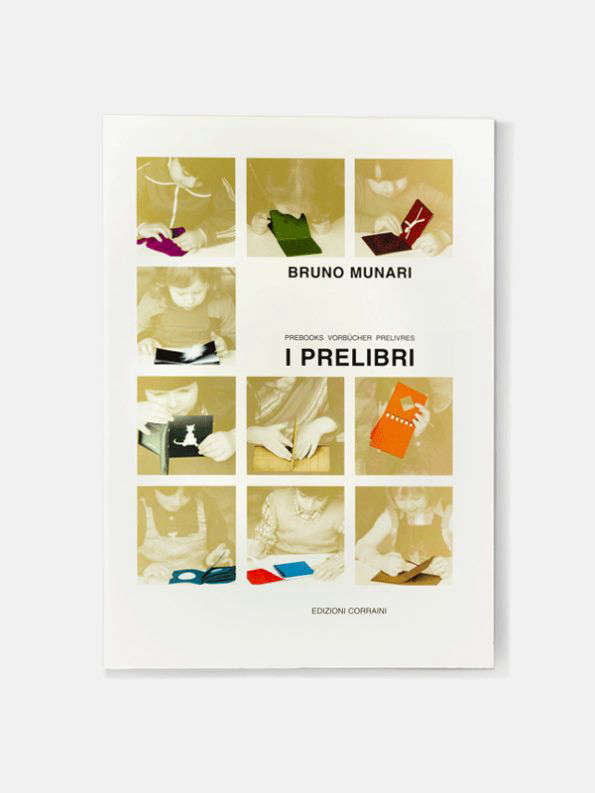
Before a child reads a sentence, a book is already doing a lot of work. It has weight. It opens. It closes. It rustles, bends, resists, invites, hides, reveals, and occasionally survives being chewed by someone with two teeth and absolute confidence. That simple truth sits at the heart of Prebooks / I Prelibri, Bruno Munari’s quietly radical set of twelve miniature book-objects first published in 1980.
Created for very young children who had not yet learned to read or write, I Prelibri asks a brilliant question: what if a child’s first book did not depend on words at all? What if the book itselfits paper, cloth, wood, plastic, binding, holes, textures, and structurebecame the story? The result is not a normal children’s book. It is more like a tiny library of sensory experiments, a playground disguised as publishing, and a reminder that curiosity arrives long before phonics worksheets.
What Are Prebooks / I Prelibri?
Prebooks / I Prelibri is a boxed collection of twelve small books designed by Italian artist, designer, inventor, and children’s book creator Bruno Munari. Each book is different in material and construction. Some are made from paper or cardboard; others use cloth, wood, transparent plastic, or other tactile materials. They are intentionally small, simple, and open-ended, built for little hands rather than literary critics with complicated scarves.
The title itself is wonderfully direct. “I Prelibri” translates as “Prebooks,” meaning books before books. These are not prequels, not sample chapters, and definitely not the thing you accidentally buy online when you meant to pre-order a bestseller. They are books that prepare a child for the idea of books: turning pages, discovering sequence, noticing difference, exploring edges, touching surfaces, and understanding that an object can hold meaning.
Unlike conventional picture books, Prebooks do not rely on a beginning, middle, and end. They do not introduce a friendly bear who learns manners by page twelve. Instead, they invite children to invent their own reading experience. A toddler can open one from either side, flip it upside down, test its texture, compare it with another, and still be “reading” in Munari’s generous sense of the word.
Bruno Munari’s Big Idea: The Book as an Object
Bruno Munari spent much of his long career refusing to stay in one lane. He worked across art, graphic design, industrial design, publishing, toys, education, and visual communication. That makes him difficult to summarize, which is usually a sign that someone was either very confused or very interesting. In Munari’s case, happily, it was the second.
Munari believed that design should awaken attention. His books for children often use cutouts, unusual papers, transparency, visual surprise, and playful structure. In this sense, I Prelibri fits naturally beside his broader experiments with “unreadable books” and artist books, where the physical form of the book communicates as strongly as words or images.
The genius of Prebooks is that they respect the intelligence of young children without demanding adult-style reading skills. A baby or toddler may not decode letters, but they can compare rough and smooth, heavy and light, flexible and stiff, transparent and opaque. They can notice cause and effect. They can learn that turning a page changes what happens next. They can discover that books are not passive objects. Books respond.
Why Prebooks Still Feel Modern
Although Prebooks first appeared in 1980, they feel surprisingly current. Today, parents, educators, librarians, and designers often talk about sensory learning, open-ended play, early literacy, and child-led exploration. Munari was already there, wearing his designer hat and quietly making everyone else catch up.
Modern early childhood research emphasizes that infants and toddlers learn through their senses. They touch, mouth, shake, drop, look, listen, and repeat. Anyone who has watched a baby throw a spoon seventeen times has witnessed scientific research with a soundtrack. Prebooks turns that natural experimentation into a reading experience.
This is one reason the collection remains admired by designers and educators. It does not treat young children as empty containers waiting for information. It treats them as active explorers. The child becomes a co-author, and the adult becomes less of a lecturer and more of a guide: “What does this feel like?” “What happens when we turn it?” “Which one makes the funniest sound?” Excellent literature may begin with a question. So may excellent mischief.
Inside the Set: Twelve Small Experiments
The twelve books in Prebooks / I Prelibri are deliberately varied. Their value comes from comparison. One booklet may feel soft, another rigid. One may reveal through transparency; another may block and conceal. One binding may behave differently from the next. The set encourages a child to build a vocabulary of experience before building a vocabulary of words.
Different Materials
The use of multiple materials is essential. Paper, cardboard, wood, cloth, and transparent plastic each produce a different sensory message. A child learns that not all pages behave the same way. Some pages bend politely. Some pages refuse, like tiny architectural critics. Some pages are smooth; others are textured. Some allow light to pass through. This variety makes reading physical.
Different Bindings
Binding is usually invisible to casual readers, but Munari turns it into part of the lesson. A book can fold, hinge, stack, flip, or resist. The way pages are connected changes how the reader moves through the object. For a child, this builds early awareness of sequence, direction, and structure without a single flashcard in sight.
No Fixed Story
Prebooks does not dictate a plot. That absence is not a weakness; it is the entire point. Without a fixed story, children are free to invent one. A transparent page may become a window. A rough surface may become a road. A hole may become a tunnel. Adults sometimes panic when there is no obvious answer. Children generally do not. They simply begin.
How Prebooks Supports Early Literacy
Early literacy does not begin with reading full sentences. It begins with attention, interaction, sound, rhythm, object handling, shared focus, and the joyful suspicion that books are worth returning to. I Prelibri supports these foundations in several ways.
It Builds Book Handling Skills
Young children need to learn how books work physically. They turn pages, open covers, recognize front and back, and discover that each action changes what they see. Prebooks gives them safe, fascinating practice with these concepts. It is literacy through hands-on discovery.
It Encourages Conversation
Because Prebooks contains no conventional text, adults naturally talk around it. They describe textures, colors, shapes, and actions. “This one is smooth.” “That one is bumpy.” “Can you see through this page?” These simple comments build language in context. The child connects words to immediate sensory experience, which is far more memorable than being informed that “translucent” will be on the quiz.
It Strengthens Attention and Curiosity
Short, open-ended interactions are ideal for very young readers. Prebooks does not demand long sitting time or perfect behavior. A child can explore one booklet for thirty seconds or spend several minutes investigating the whole set. The format respects toddler attention spans, which are famously brief unless the child has found a forbidden remote control.
Why Designers Love I Prelibri
Designers are drawn to Prebooks / I Prelibri because it distills major design principles into small objects. Form, function, material, scale, sequence, interaction, and user experience are all present. The “user” just happens to be very short and possibly wearing socks with dinosaurs on them.
Munari’s approach feels especially relevant in an age of touchscreens. Digital interfaces often simulate turning pages, sliding panels, and tapping objects. Prebooks reminds us that physical interaction came first. Real texture, real weight, and real resistance teach the body in ways glass cannot fully imitate. A screen can show wood; a wooden page can be wood. That difference matters.
For graphic designers, Prebooks is also a lesson in restraint. It does not shout. It does not overload the reader with colors, instructions, mascots, badges, rewards, and a subscription plan. It trusts the object. It trusts the child. That confidence is rare and elegant.
How Parents and Teachers Can Use Prebooks
If you have access to I Prelibri, the best way to use it is slowly. Do not rush through all twelve books like a museum guard with lunch plans. Let the child choose. Let them compare. Let them repeat. Repetition is not a failure of imagination; for children, it is how knowledge gets sturdy.
Start With Free Exploration
Place two or three of the books in front of the child and observe what happens. Which one do they reach for first? Do they touch, shake, open, close, or stack? Their choices reveal what interests them. Your job is not to force a lesson but to notice one emerging.
Add Simple Language
Use short, descriptive phrases: “soft page,” “clear page,” “heavy book,” “tiny hole,” “scratchy sound.” This turns sensory experience into language. Avoid turning every page into a lecture. A toddler does not need a TED Talk on cardboard.
Invite Comparison
Ask gentle questions: “Which one is smoother?” “Which one bends?” “Can you see my hand through this?” Comparison builds thinking skills. It also makes the child feel like a genuine investigator, which is much more fun than being a tiny audience member.
Collecting Prebooks / I Prelibri
Because of its design significance, Prebooks / I Prelibri is valued by collectors, educators, children’s book historians, and fans of Bruno Munari. Editions may vary, and prices can be high, especially for complete boxed sets or earlier printings. For many families, it may be more realistic to explore the concept through library collections, museum shops, design bookstores, or related tactile books.
If you are buying a copy, check the edition, condition, completeness of the twelve books, and the state of the box. Since the set is designed for handling, wear is normal. A pristine copy may please a collector, while a gently used copy may better honor Munari’s spirit. After all, a Prebook that has never been touched is a bit like a trampoline with a velvet rope around it.
What Prebooks Teaches Adults
The most charming twist of Prebooks is that it may teach adults as much as children. Adults often approach books as containers of information. Munari asks us to remember that books are also spaces, tools, toys, sculptures, and invitations. Before reading is intellectual, it is physical. Before a story is understood, it is encountered.
This idea can influence how we choose books for children. A strong early library does not need to be huge or expensive. It should offer variety: board books, cloth books, high-contrast images, rhymes, wordless picture books, lift-the-flap books, and sturdy books that can endure daily life. The goal is not to produce a baby genius who quotes poetry before breakfast. The goal is to make books feel familiar, joyful, and alive.
Experiences Related to Prebooks / I Prelibri
Spending time with Prebooks / I Prelibri changes the way you watch a child interact with books. The first surprise is that children rarely ask, “Where are the words?” That is an adult question. Children begin with the object in front of them. They tap, rub, turn, bend, inspect, and test. They read with their hands before they read with their eyes.
In a classroom or home setting, the experience can feel almost like a miniature design lab. Put a smooth book beside a rough one, and a toddler may move back and forth between them, discovering contrast without needing the term “contrast.” Offer a transparent page, and suddenly the book becomes a window. Hold it near light, and it becomes a shadow game. Place one book on top of another, and the child may invent stacking, sorting, or matching. The adult may have planned “reading time,” but the child has opened a research institute.
One of the most useful lessons from Prebooks is patience. Adults often want to explain too quickly. We name the material, describe the purpose, and guide the child toward the “right” use. Munari’s books reward the opposite approach. When the adult stays quiet for a moment, the child’s own investigation becomes visible. A finger follows an edge. A palm presses a texture. A page is turned, then turned back, then turned again because the experiment was not finished. This is learning, even if it looks like playing. Actually, especially because it looks like playing.
The set also changes how adults think about book damage. With ordinary books, we wince when pages are bent. With Prebooks, touch is not an accident; it is the point. Of course, care still matters, especially with collectible editions, but the philosophy is liberating. Books for young children should not be treated only as fragile treasures on high shelves. They should be reachable, usable, and loved in slightly chaotic ways. A child who drags a book across the rug may be building a relationship with reading, not committing a literary crime.
For designers, Prebooks offers a refreshing reset. It proves that interactivity does not require batteries, animation, or a cheerful button that plays the same song until everyone in the room questions their life choices. Interactivity can be as simple as a fold, a texture, a cutout, or a material that behaves unexpectedly. The best design does not always add more. Sometimes it removes instructions and lets curiosity do the heavy lifting.
For parents, the experience is tender. Sitting with a child and a wordless object book creates a kind of shared attention that feels calm and intimate. There is no pressure to perform the story correctly. You can describe, wonder, laugh, compare, or simply watch. Prebooks gives permission to treat reading as a relationship before it becomes a skill. That may be its most lasting gift.
Conclusion: Why Prebooks / I Prelibri Still Matters
Prebooks / I Prelibri remains one of Bruno Munari’s most thoughtful contributions to children’s book design because it begins at the true beginning. It understands that a child’s first encounter with books is not about decoding words. It is about curiosity, touch, movement, surprise, and shared discovery.
In twelve small book-objects, Munari created a complete philosophy of early reading: let children explore, let materials speak, let books be playful, and let adults stop over-explaining for at least thirty glorious seconds. Prebooks is beautiful because it is simple, but it is not simplistic. It turns the book into a sensory world and the child into an active reader before reading officially begins.
For parents, teachers, librarians, collectors, and designers, I Prelibri is more than a charming artifact. It is a reminder that the future reader starts with the present hand. Before the alphabet, there is attention. Before the sentence, there is touch. Before the story, there is wonder.