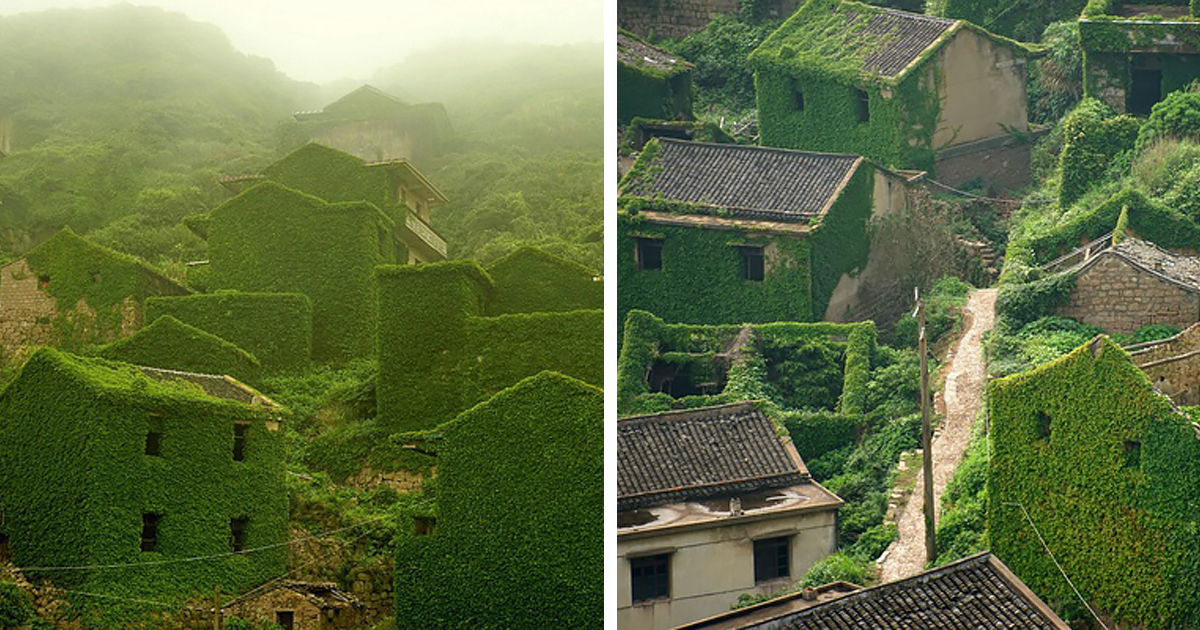
There are abandoned places, and then there is Houtouwan: a Chinese fishing village so completely covered in green vines that it looks less like a ghost town and more like Mother Nature discovered real estate investing. Perched on Shengshan Island in China’s Zhejiang province, this former coastal community has become one of the world’s most mesmerizing examples of nature reclaiming human space. The houses are still there. The stone walls still hold their shape. Windows still stare toward the East China Sea. But nearly everything is wrapped in leaves, ivy, moss, and climbing plants that seem to have signed a long-term lease.
Known widely as the abandoned Chinese fishing village being swallowed by nature, Houtouwan sits within the Shengsi archipelago, a chain of hundreds of islands east of Shanghai. Once, it was a busy fishing settlement filled with families, boats, nets, seafood, gossip, and probably at least one neighbor who knew everyone’s business. Today, the village is famous for a different kind of life: vines creeping over rooftops, plants filling courtyards, and silence where daily routines once echoed.
But Houtouwan is not just a pretty ruin for photographers. It tells a larger story about isolation, changing economies, rural migration, tourism, memory, and the surprising speed with which nature can move back in when humans move out. It is beautiful, yes. It is eerie, definitely. It is also a reminder that the world does not stop growing simply because people leave.
Where Is Houtouwan, the Abandoned Fishing Village?
Houtouwan is located on the northern side of Shengshan Island, part of the Shengsi Islands off China’s eastern coast. The archipelago lies roughly 40 miles, or about 64 kilometers, from Shanghai, depending on the route and source. While that distance may sound close on a map, island travel has its own personality. Ferries, weather, transport connections, and timing can turn a “near Shanghai” destination into a day of careful planning. The sea does not care about your itinerary, which is rude but consistent.
The village faces the ocean from a rugged, hilly shoreline. Houses were built along slopes, stacked into the landscape in a way that made sense for a community whose life revolved around fishing. The views are dramatic: blue water below, green hills above, and a cluster of abandoned homes now camouflaged by vegetation. From certain angles, Houtouwan looks like a settlement that tried to hide from the modern world and succeeded a little too well.
Its location was once an advantage. The sea provided work, food, and trade. But as China modernized and nearby urban centers grew, the same remoteness that made Houtouwan distinctive became a problem. Access to education, medical services, supplies, and better jobs became increasingly important. For many residents, the mainland and larger towns offered opportunities the village could no longer match.
A Fishing Village That Was Once Full of Life
Before it became a viral travel image, Houtouwan was a real community. Sources describe it as having once housed more than 2,000 fishermen and their families, with hundreds of homes built into the hillside. Some accounts place the former population closer to 3,000, which is a useful reminder that abandoned places often collect slightly different numbers as their stories travel. What matters is the larger truth: this was not a decorative ruin. It was a working village.
Daily life would have followed the rhythms of the sea. Fishing boats left and returned. Families prepared meals, repaired nets, raised children, traded goods, and watched the weather with the seriousness of people whose income depended on it. In a coastal fishing village, the forecast is not small talk. It is business intelligence.
Houtouwan grew during a period when small fishing communities could thrive by supplying local and regional markets. But over time, the village faced pressure from larger economic forces. Competition from fishing operations connected to bigger ports, especially near Shanghai, made it harder for a remote island community to keep pace. At the same time, younger residents wanted better schools, easier transportation, stable work, and modern services.
By the early 1990s, residents began leaving in significant numbers. Wealthier families reportedly moved first, followed by others who saw fewer reasons to stay. By 2002, the village was officially depopulated and merged into a nearby administrative area. A few people remained or returned occasionally, but the community as it had existed was gone.
Why Was Houtouwan Abandoned?
The abandonment of Houtouwan was not caused by one dramatic disaster. There was no volcano, no mysterious curse, no sea monster demanding rent. The reasons were more ordinary, which makes them more believable and, in some ways, more powerful.
Isolation Made Daily Life Difficult
Houtouwan’s island setting made transportation inconvenient. Moving people, food, building supplies, and goods between the village and larger markets required effort. For a fishing settlement, this may have been manageable when local conditions were favorable. But as expectations changed, inconvenience became a serious disadvantage. Families wanted reliable access to schools, jobs, health care, and shopping. “Beautiful but hard to live in” is a category many remote places understand very well.
Education and Services Pulled Families Away
Parents often move not because they dislike where they live, but because they want more choices for their children. Reports about Houtouwan commonly mention education as one reason residents left. If a village cannot provide adequate schooling or easy access to schools elsewhere, families eventually face a hard decision. Nostalgia is lovely, but it does not help much with homework, exams, or future employment.
Economic Competition Changed the Fishing Industry
Houtouwan depended heavily on fishing. When a local economy leans on one main industry, any disruption hits hard. Competition from larger fishing hubs and mainland markets made it difficult for the village to remain prosperous. As Shanghai and nearby coastal economies expanded, opportunities elsewhere looked more attractive. Residents moved toward places with better infrastructure and broader work options.
Modernization Shifted the Center of Gravity
China’s rapid modernization changed the fate of many rural and coastal communities. Roads, ports, factories, schools, and city jobs drew people away from isolated settlements. Houtouwan is part of that broader pattern. It was not abandoned because it lacked beauty. It was abandoned because beauty alone does not keep a village alive when transportation, services, and income become difficult.
How Nature Took Over the Village
After people left, the plants arrived with excellent confidence. Without regular maintenance, houses began to soften at the edges. Vines climbed walls. Roots entered cracks. Moss and weeds spread over steps and courtyards. Roofs became gardens. Windows became leafy frames. The village did not collapse all at once; it changed layer by layer, season by season.
The climate helped. Shengshan Island’s coastal environment provides moisture, mist, and mild conditions that encourage vegetation. Climbing plants thrive on vertical surfaces, and Houtouwan offers vertical surfaces like an all-you-can-climb buffet. Stone walls, abandoned stairways, empty homes, and terraces gave vines countless places to grip and grow.
The result is visually stunning. Many abandoned places are brown, gray, dusty, or rust-colored. Houtouwan is green. Not politely green. Not “a few plants near the entrance” green. It is green in the way a salad would be green if it had architectural ambitions. Entire buildings disappear beneath leaves. Narrow paths wind through walls of vegetation. From above, the village looks like a hillside forest that accidentally swallowed a neighborhood.
This is why Houtouwan is often described as a village being swallowed by nature. The phrase is dramatic, but it fits. The plants do not merely decorate the ruins; they dominate them. They turn former homes into living sculptures and transform human abandonment into ecological performance art.
From Forgotten Village to Internet Sensation
Houtouwan’s global fame grew after photographs of the overgrown village spread online around 2015. The images were irresistible: bright green houses, ocean views, empty paths, and a dreamy atmosphere that looked like a movie set designed by a botanist with a flair for drama. Photographers, travel writers, urban explorers, and curious tourists quickly took notice.
Social media gave Houtouwan a second life. The village that had emptied because it was too remote became famous because it was remote in exactly the right way. People wanted to see the “green ghost village” for themselves. They came for the eerie beauty, the photo opportunities, and the strange comfort of watching nature win a slow-motion argument with concrete.
Local authorities initially expressed concern about sudden tourism. Abandoned buildings can be unstable, narrow paths can become crowded, and not every visitor understands that “looks magical” does not mean “safe to climb on while taking a selfie.” Over time, Houtouwan developed more visitor infrastructure, including controlled routes, viewing areas, and ticketed access in some accounts. Former residents and locals have also found ways to benefit from tourism by guiding visitors or selling drinks and snacks.
That shift is one of the most interesting parts of the story. Houtouwan was abandoned because it could no longer support its old economy. Now, the remains of that economy help support a new one: tourism built around memory, photography, and nature’s takeover.
What Visitors See in Houtouwan Today
Visitors to Houtouwan typically come for the views, the atmosphere, and the surreal experience of walking near a village where plants have become the dominant residents. The most famous scenes include houses covered in thick vines, stairways disappearing into greenery, and ocean-facing buildings that look both abandoned and alive.
The village is often viewed from paths and lookout points rather than through unrestricted exploration. This matters. Some buildings are unstable, and entering abandoned homes can be dangerous. Floors may be weak, roofs may have collapsed, and walls may be held together more by stubborn vines than sound engineering. Nature may be beautiful, but it is not a licensed building inspector.
Travelers often combine Houtouwan with nearby areas on Shengshan and Gouqi islands. Depending on ferry schedules and transportation, reaching the village can take several hours from Shanghai. Many visitors recommend staying overnight in the region rather than trying to rush the trip in a single day. The reward is time: time to see the village in changing light, time to avoid hurrying, and time to appreciate the surrounding coastal landscape.
Morning mist can make the village look mysterious, while clear sunlight brings out the bright green textures of the vines. Photographers love the contrast between nature and architecture: rectangular windows framed by leaves, stone walls softened by plant life, and rooftops that no longer separate indoors from outdoors with much conviction.
Why Houtouwan Feels So Fascinating
Part of Houtouwan’s appeal comes from contrast. Humans build villages to create order: walls, rooms, paths, doors, schedules, addresses. Nature does not care about addresses. Given enough time, it turns straight lines into soft edges and private rooms into habitat. That visual reversal is powerful. It shows how temporary human control can be.
Another reason the village fascinates people is that it avoids the usual gloom of abandoned places. Many ghost towns feel bleak. Houtouwan feels strangely hopeful. Yes, it represents departure and loss, but it also shows renewal. Plants fill the absence. Birds, insects, and small animals return. The village becomes less a dead place than a changed place.
There is also a fairytale quality. The green-covered buildings resemble something from a fantasy novel, as if the village fell asleep and woke up inside a forest. It is not hard to imagine a dragon living nearby, though any self-respecting dragon would probably complain about ferry schedules.
For travelers, Houtouwan offers a rare combination: real history, unusual scenery, coastal beauty, and a strong visual identity. It is not just abandoned. It is transformed. That transformation makes it more memorable than a simple ruin.
The Deeper Lesson: Nature Reclaims, But People Remember
It is tempting to frame Houtouwan as a battle between humans and nature, with nature clearly winning. But the story is more complicated. The village was not conquered by vines in a single heroic campaign. It was left behind because human needs changed. People moved for practical reasons. Nature then adapted to the empty space.
Houtouwan also shows that abandonment does not erase memory. Former residents still have ties to the place. Some return to work with tourists or visit old homes. For them, the village is not merely a photogenic ruin. It is where families lived, worked, celebrated, worried, and planned futures that eventually led elsewhere.
This is important for visitors to remember. Houtouwan may look like a fantasy landscape, but it was once someone’s everyday life. Those vine-covered houses were not built to become travel content. They were built because people needed shelter, community, and a place to come home after work at sea.
The best way to understand Houtouwan is to hold both truths at once: it is visually extraordinary, and it is historically human. The leaves are the first thing visitors notice. The lives behind the leaves are what give the village meaning.
Responsible Travel Tips for Visiting Houtouwan
Anyone planning to visit the abandoned Chinese fishing village should treat it with care. Houtouwan is beautiful, but it is not a theme park built from scratch. It is a fragile, weathered site with uneven paths, aging structures, and local rules that exist for good reasons.
Stay on Marked Paths
Official walking routes and viewing platforms help protect both visitors and the village. Wandering into restricted buildings may seem adventurous, but unstable ruins can be risky. A dramatic photo is not worth becoming the reason a warning sign gets upgraded to a bigger warning sign.
Respect Former Homes
Even when a house is abandoned, it deserves respect. Do not remove objects, damage walls, carve names, or treat the village like a prop warehouse. The best souvenir is a photo and a good story, not a loose tile you definitely do not need.
Plan Transportation Carefully
Island travel depends on ferry schedules, weather, and local connections. Visitors should check routes in advance and avoid assuming that transportation will work like a city subway. Houtouwan rewards patience and planning.
Support Local Businesses
Buying food, drinks, guide services, or accommodations from local providers helps tourism benefit the surrounding community. If Houtouwan’s new economy is going to exist, it should support people who live nearby, not just camera rolls and social feeds.
Experiences Related to the Abandoned Chinese Fishing Village Being Swallowed By Nature
Experiencing Houtouwan is less about checking off a tourist attraction and more about entering a mood. Imagine arriving after a ferry ride, then traveling across a quiet island road where the sea flashes between hills. The air smells salty and damp. The village appears gradually, not with the loud announcement of a famous landmark, but like a secret the hillside has been keeping. At first you see a few green roofs. Then you realize they are not roofs in the usual sense anymore. They are plant platforms with former houses underneath.
The first emotional response is usually surprise. Photos prepare you for the color, but not for the scale. The vines do not look like decorations. They look like decisions. They have chosen walls, windows, terraces, and steps. They have moved into the village with total commitment. Standing there, you may feel the odd sensation that humans are the visitors and plants are the locals. Honestly, the plants seem very established.
Walking along the paths, you notice small details that make the place feel real. A doorway half-hidden by leaves. A window frame facing the sea. A stairway that once connected neighbors and now leads into a green tunnel. These details turn Houtouwan from a “cool abandoned place” into a layered human landscape. You begin to imagine the village when it was active: baskets, boats, voices, cooking smells, children running uphill, elders watching the water, fishermen returning tired and salty from work.
The experience can feel peaceful, but it also raises questions. What makes a place worth staying in? How much inconvenience can beauty outweigh? When a community leaves, does the place become empty, or does it simply become available for another form of life? Houtouwan does not answer these questions directly. It lets vines do the talking, and vines are poetic but terrible at bullet points.
For photographers, the village is a dream. Every angle offers texture: rough stone, glossy leaves, faded walls, ocean light, and shadowed paths. But the best experience may come when the camera is lowered. Without the pressure to capture everything, Houtouwan becomes quieter and more powerful. You hear wind, insects, footsteps, maybe distant voices from other visitors. You realize that abandonment is not always silence; sometimes it is a different soundtrack.
Travelers who visit respectfully often leave with more than pretty images. They leave with a sense of time. Houtouwan shows what two or three decades can do when people stop repairing roofs and cutting back vines. It is humbling. Cities often make us feel permanent. Houtouwan politely disagrees, then covers another wall in leaves.
The village also offers a useful lesson for modern tourism. Viral fame can bring money and attention, but it can also bring crowds, careless behavior, and pressure on fragile places. Houtouwan’s popularity should encourage visitors to slow down. The goal is not to conquer the abandoned village, sneak into unsafe buildings, or produce the most dramatic photo online. The goal is to witness a rare meeting point between human history and natural recovery.
In the end, the most memorable experience is the feeling of standing between past and future. Behind you is the human story of a fishing village that once worked hard to survive. Around you is the present story of tourism and curiosity. Above, below, and everywhere in between is nature, steadily writing the next chapter in green.
Conclusion
Houtouwan, the abandoned Chinese fishing village being swallowed by nature, is more than a viral green ghost town. It is a real former community shaped by fishing, isolation, migration, and modernization. Its empty homes tell the story of people who left in search of better access to education, services, and opportunity. Its vine-covered walls tell another story: that nature does not need permission to return.
What makes Houtouwan unforgettable is the balance between beauty and loss. It is gorgeous, but not empty of meaning. It is abandoned, but not lifeless. It is quiet, but not silent. Every leaf-covered doorway hints at both departure and renewal. For travelers, photographers, and anyone fascinated by places where nature reclaims human spaces, Houtouwan remains one of the world’s most striking examples of how quickly the built environment can become part of the landscape again.
And perhaps that is the village’s greatest message: humans may build with stone, brick, and ambition, but nature is patient, persistent, and apparently very good at exterior design.