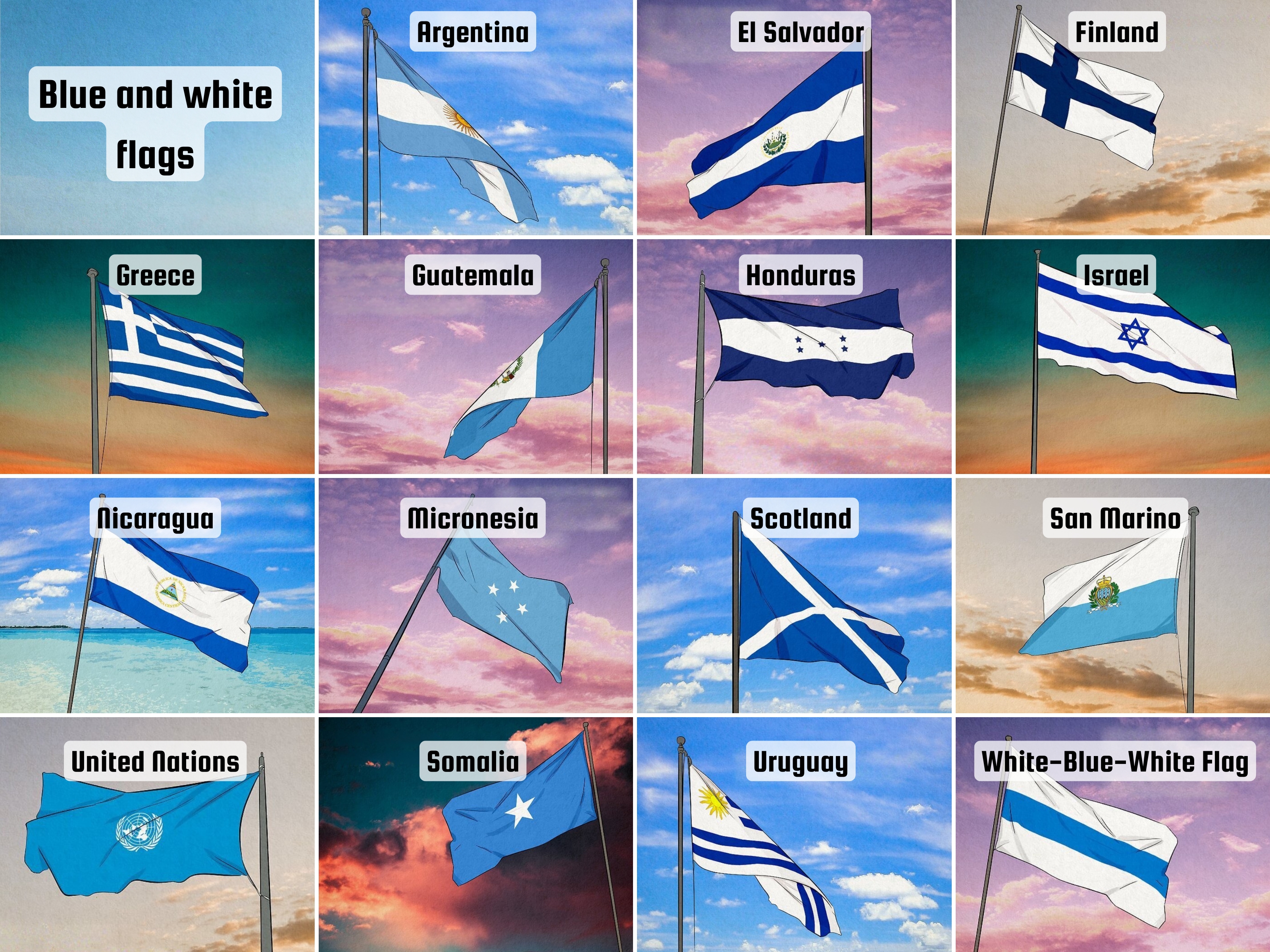
Blue and white flags have a strange talent: they look calm from a distance, then quietly reveal entire national histories when you look closer. A stripe can point to an ocean. A star can represent a people. A cross can carry centuries of faith, geography, and political identity. In other words, national flags are not just rectangles having a very serious fashion moment.
Across the world, countries with blue and white flags often use these colors to express peace, sky, water, purity, freedom, unity, or spiritual heritage. Sometimes the symbolism is official. Sometimes it is widely accepted through history and culture. And sometimes, as with many flags, several meanings sit together like polite guests at a diplomatic dinner.
This guide explores 15 countries with blue and white flags, including the meanings behind their colors, symbols, stars, crosses, stripes, and coats of arms. Some flags are purely blue and white. Others include additional details such as suns, seals, or maps, but blue and white remain central to their identity.
Why Are Blue and White So Common in National Flags?
Blue and white are among the most meaningful color pairings in vexillology, the study of flags. Blue frequently represents sky, water, seas, loyalty, justice, hope, or national aspiration. White often symbolizes peace, purity, snow, honesty, unity, or spiritual ideals. Put them together, and you get a color combination that feels clean, dignified, and surprisingly flexible.
That flexibility explains why blue and white appear in flags from South America, Central America, Europe, Africa, and the Pacific. In coastal nations, blue may point to oceans. In northern countries, white may represent snow. In religious or cultural contexts, blue and white may connect to sacred garments, crosses, or historic emblems. The same two colors can tell very different stories depending on where they fly.
15 Countries with Blue and White Flags and Their Meanings
1. Argentina
Argentina’s flag features three horizontal bands: light blue, white, and light blue, with the golden Sun of May in the center. The blue and white are often linked to the sky, clouds, and the national colors used during Argentina’s independence movement.
The Sun of May refers to the May Revolution of 1810, a key moment in the country’s path toward independence. The sun also appears in Uruguay’s flag, which makes the two designs feel like patriotic cousins who show up to family events wearing similar outfits.
2. Botswana
Botswana’s flag is mostly light blue, with a black horizontal stripe bordered by white. The blue represents water, especially rain, which is deeply important in a dry country where the national motto, “Pula,” means rain.
The black and white stripes symbolize racial harmony and cooperation. When Botswana adopted the flag at independence in 1966, this meaning was especially powerful because neighboring South Africa was still under apartheid. Simple design, big message.
3. El Salvador
El Salvador’s national flag uses a blue-white-blue horizontal triband, usually with the national coat of arms in the center. Like several Central American flags, it descends from the flag of the former Federal Republic of Central America.
The blue stripes are commonly associated with the Pacific Ocean and Caribbean/Atlantic side of the region, while the white stripe represents peace and unity. The coat of arms includes the motto “Dios, Unión, Libertad,” meaning “God, Union, Liberty.” That is a lot of meaning packed into one very official-looking middle stripe.
4. Estonia
Estonia’s flag is a horizontal tricolor of blue, black, and white. While it is not only blue and white, those two colors are essential to its identity. Blue is commonly interpreted as the sky, lakes, sea, loyalty, and hope. White represents light, purity, and the aspiration toward freedom.
The black stripe gives the flag extra emotional weight, often connected with Estonian soil and past hardships. Together, the colors create one of Europe’s most elegant flags: calm, serious, and very Baltic.
5. Finland
Finland’s flag is one of the most recognizable blue and white flags in the world. It features a blue Nordic cross on a white field. The white is widely associated with Finland’s snowy landscape, while the blue represents the country’s lakes and sky.
The cross design links Finland to the broader Nordic flag tradition. It is clean, spacious, and exactly what you would expect from a country famous for lakes, forests, saunas, and making minimalism look effortless.
6. Greece
Greece’s flag features nine alternating blue and white horizontal stripes with a white cross on a blue canton. The cross reflects Greek Orthodox Christianity, a central part of Greek history and culture.
The nine stripes are often connected to the syllables of the Greek independence motto meaning “Freedom or Death.” Blue and white are also popularly associated with the sea, sky, waves, and purity of the Greek struggle for independence. Basically, it is a flag that looks like the Aegean Sea learned how to speak history.
7. Guatemala
Guatemala’s flag has vertical blue-white-blue bands with the national emblem in the center. The two blue stripes can represent the two oceans bordering Central America: the Pacific Ocean and the Caribbean/Atlantic side. They are also associated with justice, loyalty, and strength.
The white stripe stands for peace, purity, integrity, and light. The central emblem includes the resplendent quetzal, a symbol of liberty, along with crossed rifles, crossed swords, a laurel wreath, and a scroll marking Central American independence.
8. Honduras
Honduras uses a blue-white-blue horizontal triband with five blue stars in the center. The stars represent the five nations of the former Federal Republic of Central America: Honduras, Guatemala, El Salvador, Nicaragua, and Costa Rica.
The blue bands are commonly associated with the Pacific Ocean and Caribbean Sea, while the white band symbolizes peace and prosperity. The five stars also express hope for Central American unity. It is a flag with regional nostalgia built right into the design.
9. Israel
Israel’s flag has a white field with two horizontal blue stripes and a blue Star of David in the center. The design is strongly associated with Jewish identity and heritage.
The blue stripes are commonly linked to the tallit, the traditional Jewish prayer shawl, while the Star of David is one of the best-known symbols of Judaism and Jewish peoplehood. The result is a flag that is simple in layout but deeply layered in cultural and religious meaning.
10. Kosovo
Kosovo’s flag has a blue field with a gold map of Kosovo and six white stars above it. Although gold is clearly present, blue and white play a major role in the flag’s overall design.
The blue background is often connected to European identity and Kosovo’s Euro-Atlantic aspirations. The six white stars represent the country’s major ethnic communities, emphasizing unity and diversity. The gold map highlights Kosovo’s territorial identity.
11. Federated States of Micronesia
The flag of the Federated States of Micronesia is a light blue field with four white stars arranged in a diamond pattern. The blue represents the Pacific Ocean, which is not exactly a small detail when your country consists of islands spread across a vast oceanic region.
The four white stars represent the four states of the federation: Yap, Chuuk, Pohnpei, and Kosrae. It is one of the clearest examples of a blue and white flag where geography and political structure are both easy to read at a glance.
12. Nicaragua
Nicaragua’s flag uses the familiar Central American blue-white-blue horizontal triband, with the national coat of arms in the center. Like the flags of El Salvador, Guatemala, and Honduras, it reflects the legacy of the former Federal Republic of Central America.
The blue stripes are commonly associated with the Pacific Ocean and Caribbean Sea, as well as justice and loyalty. The white stripe symbolizes peace, purity, and the land between the two bodies of water. The coat of arms includes a triangle, volcanoes, a rainbow, and a Phrygian cap, giving the flag a full symbolic toolkit.
13. San Marino
San Marino’s flag has two horizontal bands: white on top and light blue on the bottom, with the national coat of arms in the center. The white and blue are often interpreted as clouds and sky surrounding the mountainous republic.
The coat of arms includes three towers on three peaks, a crown symbolizing sovereignty, and the motto “Libertas,” meaning freedom. For one of the world’s smallest republics, San Marino manages to fit a lot of confidence onto a flag.
14. Somalia
Somalia’s flag is beautifully simple: a light blue field with a single white five-pointed star in the center. The white star is known as the Star of Unity.
Each of the five points represents a region traditionally associated with Somali people. The blue field has historical connections to the United Nations flag, reflecting the UN’s role in Somalia’s path toward independence. The design is clean, bold, and instantly recognizable.
15. Uruguay
Uruguay’s flag features nine horizontal stripes alternating white and blue, with a white canton containing the golden Sun of May. The nine stripes represent the country’s original departments at the time the flag was adopted.
The Sun of May links Uruguay to the independence symbolism of the Río de la Plata region. The blue and white stripes were influenced by Argentina’s flag, while the overall striped structure also shows inspiration from the United States flag. It is a thoughtful blend of regional identity and republican design.
Common Meanings Behind Blue and White Flags
Blue Often Represents Water, Sky, and Hope
Many countries use blue to point toward oceans, lakes, rivers, or the sky. Finland uses blue for lakes and sky. Micronesia uses blue for the Pacific Ocean. Central American flags often connect blue with the seas around the region. Botswana gives blue an especially practical meaning: rain and water.
White Often Represents Peace and Purity
White appears again and again as a symbol of peace, honesty, purity, light, or unity. In Guatemala, El Salvador, Nicaragua, and Honduras, white is tied to peace and national harmony. In Finland, white evokes snow. In Israel, white forms the background for symbols of Jewish heritage.
Stars Usually Stand for Unity or Political Identity
Stars appear in several blue and white flags. Honduras has five stars for the former Central American federation. Micronesia has four stars for its four states. Kosovo has six stars for major ethnic communities. Somalia’s single white star points to Somali unity. One star can say a lot, but several stars can basically hold a regional meeting.
Crosses and Coats of Arms Add Cultural Depth
Greece and Finland use cross designs, though their meanings and histories differ. Central American countries often use coats of arms to add messages about liberty, geography, independence, and national values. San Marino’s coat of arms brings in towers, sovereignty, and freedom.
Quick Comparison Table: Blue and White Flags
| Country | Main Blue and White Design | Core Meaning |
|---|---|---|
| Argentina | Light blue-white-light blue with Sun of May | Independence, sky, national identity |
| Botswana | Light blue with black and white stripe | Rain, water, racial harmony |
| El Salvador | Blue-white-blue with coat of arms | Peace, unity, Central American heritage |
| Estonia | Blue-black-white tricolor | Sky, soil, freedom, purity |
| Finland | Blue Nordic cross on white | Lakes, sky, snow, Nordic identity |
| Greece | Blue and white stripes with cross | Faith, freedom, sea, independence |
| Guatemala | Blue-white-blue vertical bands | Peace, justice, oceans, liberty |
| Honduras | Blue-white-blue with five stars | Central American unity, peace, oceans |
| Israel | White field, blue stripes, Star of David | Jewish heritage, faith, identity |
| Kosovo | Blue field with white stars and gold map | Ethnic unity, European aspiration |
| Micronesia | Blue field with four white stars | Pacific Ocean, four states |
| Nicaragua | Blue-white-blue with coat of arms | Peace, oceans, justice, liberty |
| San Marino | White and light blue with coat of arms | Clouds, sky, freedom, sovereignty |
| Somalia | Blue field with white star | Somali unity, independence history |
| Uruguay | Blue and white stripes with Sun of May | Original departments, independence |
Experience Notes: What Blue and White Flags Teach Travelers, Students, and Curious Humans
One of the best ways to remember flags is not to memorize them like exam vocabulary, but to connect them with real places, landscapes, and stories. Blue and white flags are especially easy to connect with experience because the colors often point to things people can actually see: water, sky, snow, clouds, waves, stars, and sunlight.
Imagine walking through Helsinki in winter and seeing Finland’s blue cross against a snowy street. The meaning is not abstract anymore. White really does feel like snow. Blue really does feel like lakes and cold northern sky. The flag suddenly seems less like a graphic design and more like a weather report with national pride.
Now picture Greece. You see blue and white flags on ferries, balconies, restaurants, and postcards. The colors echo the sea, the sky, and the whitewashed architecture associated with many Greek islands. Even before reading about the cross or the independence symbolism, a traveler can feel why the design works. It belongs to the landscape like olive trees belong to Greek hillsides.
In Central America, blue and white flags tell a different kind of story. Guatemala, Honduras, El Salvador, and Nicaragua share visual DNA because they were connected through the former Federal Republic of Central America. Once you know that, the flags stop looking like random lookalikes and start reading like a family album. Each country kept the blue-white-blue structure, then added its own emblem, stars, or arrangement to say, “Yes, we are related, but please do not mix us up at the flag parade.”
For students, this is a useful trick: when flags look similar, ask what historical union, empire, region, religion, or political movement connects them. Similar colors usually have a reason. Sometimes that reason is geography. Sometimes it is revolution. Sometimes it is shared culture. Flags rarely copy each other by accident.
Blue and white flags also show how small design choices create big emotional differences. Somalia’s flag is minimal: one white star on blue. Micronesia’s flag is also minimal, but its four stars form a political map of the federation. Israel’s flag uses just blue symbols on white, yet the Star of David and tallit-like stripes carry deep cultural meaning. Botswana’s light blue field feels open and bright, but the black-and-white stripe turns the design into a statement about equality.
Collectors, teachers, and travelers often find that flags become easier to remember when grouped by theme. You might group Argentina and Uruguay together because both use the Sun of May. You might group Finland and Greece because both include crosses. You might group Honduras, Guatemala, El Salvador, and Nicaragua because of their Central American heritage. This turns memorization into storytelling, which is much better than staring at rectangles until your brain files a complaint.
Another practical experience: blue and white flags are common at international sports events, and they can be confusing from far away. A quick clue helps. Greece has stripes and a cross. Finland has a Nordic cross. Israel has the Star of David. Somalia has one white star. Micronesia has four stars. Honduras has five stars. Argentina and Uruguay both have a sun, but Argentina has three bands, while Uruguay has multiple stripes and a canton. Congratulations, you are now slightly more prepared for the Olympics opening ceremony than the average couch commentator.
The deeper lesson is that flags are compact cultural introductions. They are not full histories, but they open the door. A blue stripe may lead you to learn about the Pacific. A white star may lead you to a story of unity. A coat of arms may introduce a national bird, a mountain, a revolution, or a motto. The design is small, but the meaning can be enormous.
Conclusion
Countries with blue and white flags prove that two colors can carry a surprising amount of history. Argentina and Uruguay connect blue and white to independence and the Sun of May. Finland turns the colors into snow, lakes, and Nordic identity. Greece blends sea, faith, and freedom. Central American flags use blue and white to preserve a shared regional past. Somalia and Micronesia show how stars can represent unity, states, and people across distance.
Whether you are studying flags, planning travel content, preparing a quiz, or simply trying to stop confusing Honduras with Nicaragua, the key is to look beyond the colors. Blue and white may look peaceful, but behind them are revolutions, oceans, mountains, faith traditions, regional dreams, and national pride. Not bad for a piece of cloth that also has to survive wind.