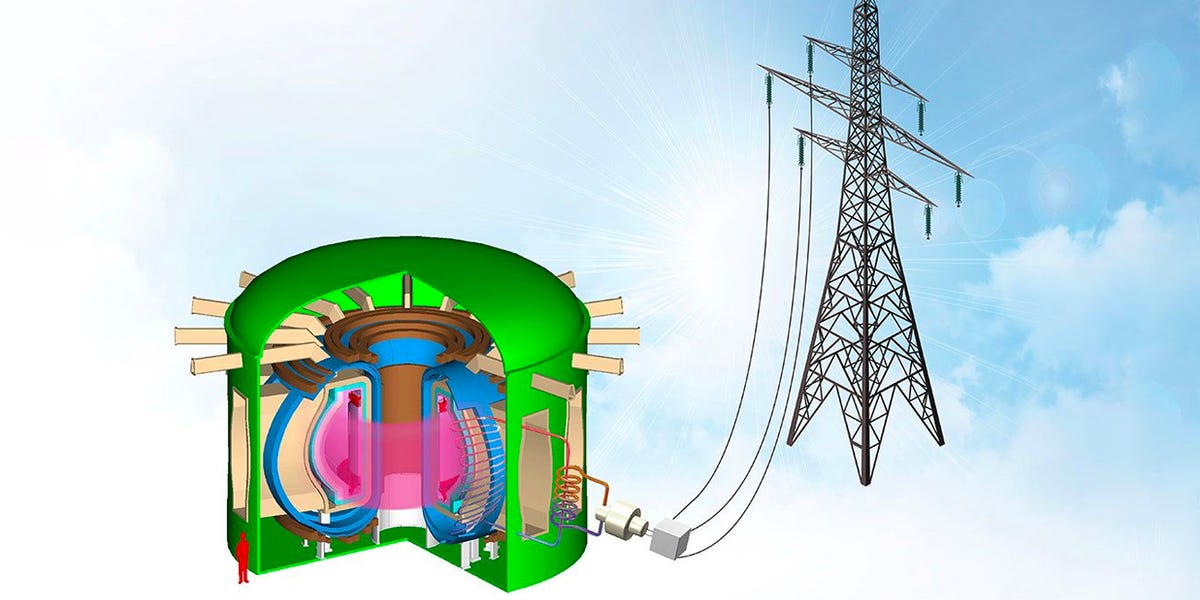
Editor’s note: As of June 2026, no fusion power plant has yet delivered net electricity to the public grid. The race is now moving from “Can fusion work in a lab?” to “Can fusion produce useful, reliable electricity as a power plant?” That second question is the thrilling, expensive, plasma-wrangling story below.
For decades, nuclear fusion has been the clean-energy equivalent of a flying car: dazzling, always promised, and usually parked somewhere just beyond the horizon. But the horizon is getting suspiciously close. Private fusion companies, national laboratories, regulators, utilities, and giant electricity customers are now preparing for the first fusion power plant designed to generate net electricitymeaning more usable electric power out than the plant consumes to run the reaction and deliver energy.
The title sounds simple: First Fusion Power Plant to Generate Net Electricity. In reality, it hides a mountain of physics, engineering, permitting, supply-chain drama, and a small army of people who know how to keep ultra-hot plasma from throwing a tantrum. The stakes are enormous. If fusion becomes commercially viable, it could offer clean, firm, high-density energy with fuel measured in tiny amounts rather than trainloads. It could help power data centers, factories, cities, desalination plants, and industrial processes without the carbon emissions of fossil fuels.
But let’s keep our lab coats buttoned. Fusion has already achieved “net energy gain” in an experimental setting, most famously at the National Ignition Facility in December 2022, where a laser-driven experiment produced more fusion energy from the target than the laser energy delivered to it. That was historic. It was not, however, a power plant. It did not plug into the grid, pay taxes, annoy neighbors with construction traffic, or send electrons to a customer. The first fusion power plant to generate net electricity must do all the unglamorous things that make energy real.
What “Net Electricity” Actually Means
Fusion articles often toss around phrases like “net gain,” “Q greater than one,” “ignition,” and “commercial breakeven” as if everyone keeps a plasma dictionary next to the coffee maker. The meanings matter.
Scientific net energy gain usually means the fusion reaction produced more energy than the energy directly delivered to the fuel. That is a laboratory milestone. It proves the physics can cross a critical threshold.
Net electricity is harder. A power plant must produce enough electricity to cover all the energy needed to operate its magnets, lasers, fuel systems, cooling systems, vacuum equipment, controls, maintenance processes, and power-conversion hardwarethen still export electricity to the grid or customer. In plain English: after the machine feeds itself, there must be leftovers for the rest of us.
This is why the first fusion power plant to generate net electricity will be a much bigger achievement than a single spectacular experiment. It must behave less like a fireworks show and more like a reliable appliancegranted, an appliance that may contain plasma hotter than the center of the sun. Your toaster could never.
Why Fusion Is So Hardand So Tempting
Fusion is the process that powers the sun and stars. Instead of splitting heavy atoms, as traditional nuclear fission plants do, fusion joins light atomic nuclei together. When those nuclei combine, a small amount of mass becomes energy. The result can be extraordinarily energy-dense.
The appeal is obvious. Fusion fuel can be derived from abundant sources such as deuterium, a form of hydrogen found in water, while many proposed designs also rely on tritium or helium-3-related fuel cycles. Fusion does not produce the same long-lived high-level waste profile as fission reactors, and it does not depend on a runaway chain reaction. If the delicate conditions fail, the reaction stops. Fusion is less “dragon in a basement” and more “campfire that goes out if you stop doing 900 impossible things correctly.”
The difficulty is equally obvious. Atomic nuclei are positively charged, so they repel each other. To force them close enough to fuse, scientists must create extreme temperatures, pressures, densities, or magnetic conditions. In many designs, the fuel becomes plasma: a charged, electrically responsive gas that must be confined and controlled. Plasma is famous for not caring about your project schedule.
The Lab Breakthrough That Changed the Conversation
The modern commercial fusion race gained momentum after the National Ignition Facility at Lawrence Livermore National Laboratory achieved fusion ignition in 2022. In that experiment, powerful lasers compressed a tiny fuel target and produced more fusion energy than the laser energy delivered to the target. That achievement showed that controlled fusion could cross a long-sought scientific threshold.
Still, the experiment was not a practical power station. The facility required far more total energy from the wall than the laser energy that reached the target. It fired in pulses, not as a steady commercial generator. It was built for national security science, not for selling electricity at a competitive rate. In other words, it was a moonshot moment, not yet an electric bill.
But moonshot moments matter. They change what investors believe, what governments fund, and what engineers dare to build. After ignition, commercial fusion no longer sounded like pure science fiction. It sounded like science fiction with a procurement department.
The Companies Racing Toward the First Fusion Electricity
Several private companies now claim credible pathways toward fusion power. The two most closely watched U.S.-linked contenders are Helion Energy and Commonwealth Fusion Systems, though they use very different approaches.
Helion Energy: Direct Electricity and an Aggressive Timeline
Helion Energy, based in Washington state, is one of the boldest players in the race. Its planned Orion fusion power plant in Malaga, Washington, is designed to deliver electricity to Microsoft under a landmark power purchase agreement. The company’s target is at least 50 megawatts after ramp-up, with initial operations planned around 2028 if development remains on track.
Helion’s approach is especially interesting because it aims to generate electricity directly from changes in magnetic fields rather than relying only on the familiar “heat water, make steam, spin turbine” model. Most power plants, whether coal, gas, nuclear fission, or many proposed fusion systems, ultimately use heat to spin turbines. Helion wants to skip part of that energy-conversion conga line.
The potential advantage is efficiency and simplicity. The challenge is proving that the physics, materials, pulse timing, fuel cycle, and power electronics can work together repeatedly at power-plant scale. If successful, Helion could become the first company to deliver fusion-generated electricity to a commercial customer. If not, it will still have forced the entire industry to move faster, which is a useful public service even if the plasma refuses to behave.
Commonwealth Fusion Systems: High-Field Tokamak and Grid-Scale Ambition
Commonwealth Fusion Systems, spun out of MIT research, is pursuing a compact high-field tokamak approach using high-temperature superconducting magnets. Its demonstration machine, SPARC, is intended to prove commercially relevant net fusion energy. Its planned ARC power plant is designed to bring roughly 400 megawatts of clean electricity to the grid in the early 2030s.
CFS has selected Chesterfield County, Virginia, for its first ARC plant, named the Fall Line Fusion Power Station. The company has also taken a major grid-integration step by applying to connect the plant to PJM Interconnection, one of the largest power markets in the United States. That is a quiet but important detail. A fusion plant does not become real just because the physics is elegant. It becomes real when it can interconnect, dispatch power, satisfy regulators, and compete in the same marketplace as gas turbines, solar farms, wind projects, batteries, and conventional nuclear plants.
CFS may not be first by calendar date if Helion succeeds earlier, but its planned 400-megawatt scale makes it one of the most important candidates for the first grid-scale commercial fusion plant. Think of Helion as the sprinter trying to break the tape first, while CFS is training for the marathon with a very expensive magnet backpack.
Why Big Tech Wants Fusion So Badly
The race for the first fusion power plant is not happening in a vacuum. Electricity demand is rising, and artificial intelligence has made power planning feel like someone spilled espresso into the grid forecast. Data centers need enormous amounts of reliable electricity. They also need clean energy if companies want to meet climate goals without simply buying accounting instruments and hoping nobody reads the footnotes.
This is why companies like Microsoft and Google have shown interest in fusion power agreements. They need firm, clean power that can operate when the wind is calm and the sun has clocked out for the night. Solar and wind are essential, but the grid also needs resources that can produce electricity on demand. Batteries help, but long-duration, high-capacity clean power remains a major challenge.
Fusion, if it works economically, could fit that gap. It would not replace every energy source. It would join a portfolio that includes renewables, storage, transmission upgrades, geothermal, advanced fission, demand response, efficiency, and probably a few technologies that currently exist only in grant proposals with dramatic fonts.
The Engineering Checklist for the First Net-Electric Fusion Plant
To generate net electricity, the first fusion plant must solve a long list of problems at once. The reaction must produce enough energy. The system must capture that energy efficiently. Components must survive intense heat, radiation, vibration, magnetic forces, and repeated cycling. Fuel must be available and managed safely. Maintenance must be practical. The plant must connect to the grid. It must earn permits. It must convince customers that it will actually deliver.
Plasma Control
The first hurdle is controlling the fusion fuel. In magnetic confinement designs, plasma must be held away from reactor walls by powerful magnetic fields. In pulsed systems, compression and timing must be extraordinarily precise. Tiny instabilities can ruin performance. Plasma is not a passive material. It swirls, leaks, wiggles, and invents new ways to ruin your lunch.
Materials That Can Survive
Fusion machines expose internal components to punishing conditions. Neutrons from deuterium-tritium fusion can damage materials over time. Plasma-facing components must handle heat loads that make ordinary industrial equipment look like a scented candle. Developing materials that survive long enough for commercial economics is one of the biggest challenges.
Fuel Supply and Tritium
Many leading fusion designs depend on tritium, a radioactive hydrogen isotope that is scarce and expensive. A mature fusion industry may need plants that breed tritium from lithium inside the reactor blanket. That is not just a chemistry errand. It is a major engineering system involving neutron capture, heat transfer, extraction, safety, and accounting. The first plant to generate net electricity may not solve the entire long-term fuel economy, but the industry cannot dodge the question forever.
Power Conversion
Producing fusion energy is one thing. Turning it into electricity is another. Some designs capture heat and use turbines. Others aim for direct energy conversion. Either way, conversion losses matter. A system that achieves impressive fusion output can still fail the net-electric test if too much energy disappears into support systems or inefficient conversion.
Operations and Maintenance
A commercial power plant cannot behave like a delicate lab instrument that needs a team of PhDs to whisper encouragement after every pulse. It must be maintainable, inspectable, repairable, and safe. Downtime affects economics. Replacement parts matter. Remote handling may be necessary. The first fusion plant must prove not only that fusion can happen, but that fusion can be managed like an energy business.
Regulation Is Becoming Real
Fusion regulation in the United States has moved toward a framework distinct from traditional fission reactor licensing. The Nuclear Regulatory Commission has indicated that near-term fusion systems can be regulated using a byproduct-materials approach, similar in some respects to the way certain particle accelerators are regulated. This distinction matters because fusion machines do not operate like fission reactors and do not depend on the same chain-reaction dynamics.
At the state level, Helion’s Orion project has already moved through important licensing steps in Washington. Regulatory approval does not prove the machine will produce net electricity, but it proves something almost as important: fusion developers are now entering the world of real facilities, real safety programs, real permits, and real communities. The paperwork age of fusion has begun. Glamorous? No. Necessary? Absolutely.
What Would Count as the Historic First?
Because fusion has several “firsts,” the industry needs clear definitions. The first fusion plant to generate net electricity should meet a practical standard: it should produce electricity from fusion, cover its own operating power needs over a meaningful period, and export net electricity to a customer or grid connection.
A single short pulse that lights a bulb for a photo opportunity would be exciting but not enough. A demonstration that produces net electricity repeatedly, under controlled operating conditions, would be far more meaningful. A plant that delivers contracted power over months would be the true commercial milestone.
That means the first announcement will deserve careful reading. Watch for the difference between “generated electricity,” “generated net electricity,” “delivered electricity,” “exported to the grid,” and “commercial operations.” These phrases are cousins, not twins. In energy, wording matters almost as much as wattage.
Economic Reality: Can Fusion Compete?
Even if the first fusion power plant generates net electricity, the next question arrives immediately: at what cost? The electric grid is brutally practical. It does not award bonus points for scientific elegance. Fusion must compete with existing energy technologies on reliability, cost, construction time, financing risk, maintenance, and regulatory confidence.
The first plant will probably be expensive. First-of-a-kind energy projects usually are. Early fission reactors, offshore wind farms, utility-scale solar projects, and lithium-ion batteries all had learning curves. The question is whether fusion can move down its cost curve quickly enough to matter for climate goals, industrial demand, and grid reliability.
Private investment suggests that many serious people believe the answer could be yes. Fusion companies have raised billions of dollars globally, and major customers are signing early agreements. Still, investment is not proof. It is a bet. Sometimes bets change the world. Sometimes they become cautionary slides in business-school lectures.
Why the First Plant Matters Even If It Is Small
The first net-electric fusion plant does not need to power a continent. It needs to prove the bridge from physics to electricity. A 50-megawatt plant could be revolutionary if it shows reliable net output and a path to scaling. A 400-megawatt plant could be transformative if it reaches grid-scale operation. In both cases, the first success would unlock confidence, financing, supply chains, talent, and policy support.
Energy history is full of modest first steps. Early airplanes did not carry vacationers to Hawaii. Early solar panels did not power entire cities. Early computers did not fit in pockets unless your pocket was a warehouse. The first fusion power plant will likely look primitive compared with future machines. That is normal. The first version of the future is rarely polished.
Potential Benefits of Commercial Fusion Power
If fusion plants become practical, they could offer several major advantages. They could provide firm clean electricity around the clock. They could reduce dependence on fossil fuels for industrial and grid applications. They could use small amounts of fuel compared with conventional power generation. They could be located near demand centers if safety, permitting, cooling, and grid conditions allow.
Fusion could also support hard-to-decarbonize sectors. Heavy industry, hydrogen production, desalination, synthetic fuels, and large computing campuses all need enormous energy inputs. A mature fusion industry could help provide clean heat and electricity without requiring the vast land footprint associated with some other resources.
That does not mean fusion is a magic wand. It will not eliminate the need for transmission, energy efficiency, storage, or renewables. It will not solve climate change by itself. It will not make your utility bill vanish like socks in a dryer. But as part of a clean-energy portfolio, fusion could become one of the most important technologies of the twenty-first century.
The Risks and Skepticism Are Real
Fusion deserves excitement, but it also deserves skepticism. The field has a long history of missed timelines. Materials challenges remain formidable. Tritium supply is uncertain. Power conversion may be harder than expected. Construction costs could balloon. Some designs may achieve impressive plasma results without becoming economical plants.
There is also a communications risk. Companies competing for capital and attention may use ambitious language before all the evidence is public. That does not mean they are wrong, but readers should separate milestones from marketing. “Building a plant” is not the same as “operating a net-electric plant.” “Planned for 2028” is not the same as “guaranteed in 2028.” In fusion, optimism is fuel, but verification is the engine.
So, Who Will Be First?
If the question is “Who might first generate commercial fusion electricity?” Helion is one of the leading candidates because of its Orion project, Microsoft agreement, direct electricity concept, Washington site, and aggressive timeline. If the question is “Who might first deliver grid-scale fusion power?” Commonwealth Fusion Systems is a major contender because of its ARC plant plan, high-field tokamak approach, Virginia site, and 400-megawatt ambition.
The most honest answer is that the race is still open. The first company to announce net electricity will need data, not just a ribbon-cutting ceremony. Independent verification, sustained operations, customer delivery, and grid integration will separate the winner from the loudest press release.
Still, the fact that we can even discuss specific plants, customers, sites, permits, and grid applications is remarkable. Fusion has moved from chalkboards and giant experiments into county meetings, interconnection queues, construction sites, and corporate energy contracts. That is not the finish line, but it is a different race than the one fusion was running ten years ago.
Experience Notes: What the First Fusion Plant Means in Real Life
Imagine standing near the site of the first fusion power plant that truly generates net electricity. It probably would not look like science fiction at first glance. There may be security fencing, concrete, trucks, substations, office trailers, and workers wearing hard hats. The future often arrives wearing steel-toed boots.
The experience would feel different depending on who you are. For an engineer, the plant would represent years of simulations, failed components, late-night tests, design reviews, and the quiet terror of discovering that one small part must work perfectly inside a machine built around extremes. The first net-electric moment would not be a single miracle. It would be the visible tip of thousands of solved problems.
For a local community, the experience would be more practical. Residents would ask about safety, jobs, water use, traffic, emergency planning, tax revenue, and whether the project will change the character of the area. Those questions are not anti-science. They are what happens when a technology leaves the lab and becomes a neighbor. A responsible fusion developer must answer them clearly, repeatedly, and without acting like “plasma” is a magic word that ends the discussion.
For an electricity customer, especially a company running data centers or industrial facilities, the first fusion plant would feel like a possible escape hatch from a tightening power market. Clean electricity is no longer just a branding exercise. It is becoming a growth constraint. If a company cannot secure reliable power, it cannot build the next facility, train the next AI model, manufacture the next product, or meet the next climate target. Fusion promises something deeply attractive: clean power that does not depend on the weather.
For ordinary people, the emotional experience may be subtler. Most of us do not wake up thinking about grid interconnection queues. We notice energy when the lights go out, the bill rises, or the air gets smoky. Fusion’s promise is that someday clean electricity could become so abundant and dependable that we stop treating energy scarcity as a permanent fact of life. That is a huge promise, and it should not be tossed around casually.
The first net-electric fusion plant would also reshape how young scientists and engineers see the field. For decades, fusion was the career path for patient optimists. A working plant would turn it into an industry. Students who once wondered whether fusion would arrive in their lifetime might instead ask which company, plant design, materials problem, or regulatory team they want to join. That talent shift could be as important as the first megawatt.
There will be a strange cultural moment, too. The old joke says fusion is always thirty years away. When the first plant generates net electricity, the joke will not disappear overnight; it will evolve. Skeptics will ask about cost, uptime, and scale. They should. But the conversation will change from “Can it ever happen?” to “How fast can it improve?” That is the moment every breakthrough technology wants.
Personally, the most fascinating part is not the star-like plasma. It is the ordinary grid connection. A fusion plant becomes historic not when it creates a beautiful reaction, but when electrons leave the facility and do useful work somewhere else. A server runs. A factory line moves. A hospital keeps cooling. A home light turns on. That humble handofffrom exotic physics to everyday electricityis the real magic trick.
If the first fusion power plant to generate net electricity succeeds, it will not end the energy transition. It will begin a new chapter. The first plant will be studied, criticized, copied, improved, and probably mocked for design choices that future engineers find charmingly awkward. That is how progress works. The first one proves the path exists. The next thousand decide how far it goes.
Conclusion
The first fusion power plant to generate net electricity will be more than a scientific headline. It will be a test of whether fusion can mature into a real energy industry. The core question is no longer only whether humans can create fusion on Earth. We can. The harder question is whether we can make fusion reliable, affordable, maintainable, safe, and useful at grid scale.
Helion Energy’s Orion project and Commonwealth Fusion Systems’ ARC plans show how quickly the race is changing. One emphasizes direct electricity and a rapid commercial timeline. The other emphasizes high-field tokamak physics and grid-scale power. Both reflect a broader shift: fusion is entering the world of customers, permits, construction, and electricity markets.
The first successful net-electric fusion plant will not instantly solve climate change or replace every power source. But it could prove that star power can become station power. And that would be one of the most important energy milestones in modern historyright up there with the first commercial nuclear plant, the first utility-scale solar farms, and the first time someone looked at a lightning storm and thought, “Maybe we can put that on a bill.”