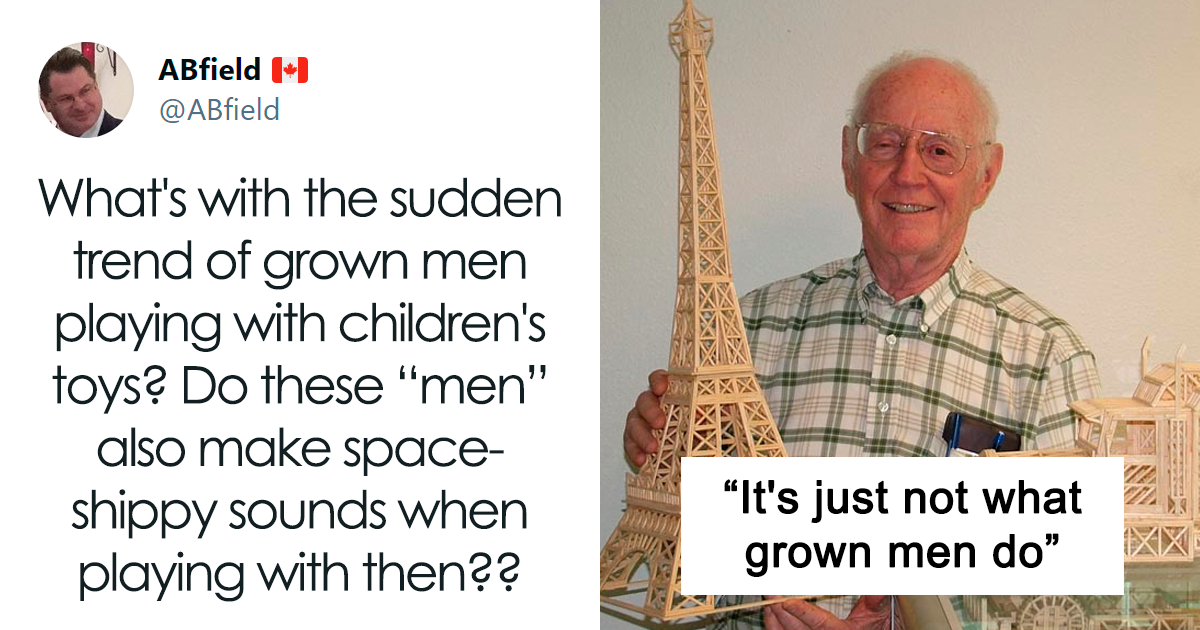
Every once in a while, the internet delivers a tiny cultural courtroom drama: someone posts a hot take, the crowd gasps, and then thousands of people arrive carrying receipts, jokes, and enough common sense to power a small city. That is exactly what happened when a guy mocked grown men for playing with “children’s toys” and was immediately shut down by people who had absolutely no patience for hobby-shaming.
The basic argument was familiar: adult men should be “serious,” “mature,” and apparently allergic to LEGO bricks, action figures, collectibles, model kits, plushies, trading cards, and anything that makes a satisfying little “click” when assembled. The response was just as familiar, but much more fun: hobbies do not expire at age 18, joy is not embarrassing, and building a spaceship after work is probably healthier than yelling at strangers online.
Behind the jokes, though, this viral moment says something bigger about masculinity, play, nostalgia, and why adults are reclaiming the hobbies they were once told to outgrow. Adult toy collecting is no longer a weird corner of the internet. It is a mainstream culture, a serious market, a creative outlet, and for many people, a comforting bridge between childhood imagination and adult stress management.
The Viral Shutdown: Why the Internet Defended Adult Toy Fans
The online reaction was fast because the insult hit a nerve. The post did not simply make fun of toys; it tried to police what grown men are allowed to enjoy. That is why so many people pushed back. They were not just defending LEGO sets or action figures. They were defending the right to have a harmless hobby without being called immature.
And honestly, the shutdown was deserved. A man carefully painting a miniature, restoring a vintage Transformer, arranging Star Wars figures on a shelf, building a 4,000-piece LEGO set, or collecting Hot Wheels is not harming anyone. He is engaging in creativity, memory, design, fandom, patience, and sometimes engineering-level problem solving. If that is childish, then a lot of museums, designers, artists, architects, and collectors are in big trouble.
The funniest part is that the insult misunderstands the hobby completely. Many adult collectors are not “playing” in the toddler sense. They are collecting, displaying, customizing, investing, photographing, building dioramas, joining communities, attending conventions, and preserving pop culture history. Even when they are simply playing, that is not a scandal. Adults play golf, fantasy football, poker, video games, escape rooms, paintball, and office icebreakers where everyone has to say “one fun fact” while secretly wanting to vanish. Toys are hardly the strangest option on the menu.
Adult Toy Collecting Is Not a Sudden Trend
One reason the mockery fell flat is that adult toy collecting has been around for decades. Comic book shops, model train clubs, tabletop gaming groups, anime conventions, LEGO fan communities, and action figure collectors existed long before social media made them visible. What changed is not that adults suddenly started liking toys. What changed is that they stopped hiding it.
Brands have noticed too. LEGO has entire lines designed for adults, including complex architecture, art, vehicles, flowers, film franchises, and display pieces. Mattel has collector platforms for Barbie, Hot Wheels, Monster High, and other nostalgia-rich brands. Hasbro Pulse speaks directly to fans of Marvel, Star Wars, Transformers, G.I. Joe, and other franchises with premium collectibles. In other words, major companies are not treating adult toy fans as a joke. They are treating them as customers with taste, money, and shelf space.
The toy industry even has a word for this audience: “kidults.” The term may sound like something invented during a marketing meeting after too much cold brew, but the trend is real. Adults buy toys for nostalgia, relaxation, collecting, fandom, display, social connection, and the simple pleasure of owning something that makes them happy. For many people, a collectible is not just plastic. It is a memory with articulation points.
Why Adults Still Love Toys
1. Nostalgia Is Powerful
A toy can act like a time machine. One look at a Pokémon card, a LEGO pirate ship, a Teenage Mutant Ninja Turtle, or a Barbie box can pull someone back to Saturday mornings, cereal bowls, cartoons, and the pure luxury of having no emails to answer. Nostalgia is not just sentimental fluff. It helps people connect their past and present identities. It reminds adults of who they were before bills, deadlines, and lower back pain entered the chat.
2. Building and Collecting Can Reduce Stress
Many adults describe toy hobbies as calming. Sorting pieces, snapping bricks together, painting figures, organizing shelves, or opening a new collectible can create a sense of focus and control. In a noisy world, small creative rituals matter. They give the brain something tactile, structured, and low-pressure to do. Nobody is asking a model kit to file taxes. That alone is soothing.
3. Toys Encourage Creativity
Play invites experimentation. A LEGO builder can modify a set, an action figure photographer can create a miniature movie scene, and a doll collector can design outfits or displays. These activities are not mindless. They involve composition, storytelling, color, proportion, patience, and imagination. Some collectors become photographers, customizers, YouTubers, bloggers, resellers, or event organizers because the hobby opens creative doors.
4. Fandom Builds Community
Adult toy fans often find friends through shared interests. Online groups, conventions, local meetups, trading communities, and collector forums create places where people can talk about rare finds, restoration tips, display ideas, and franchise lore. That kind of community matters, especially in adulthood, when making friends can be harder than finding the one missing LEGO piece that definitely fell under the couch.
The Masculinity Problem: Why Some People Mock Men for Playing
The insult aimed at men playing with toys is usually not about toys at all. It is about a narrow idea of masculinity. Some people still believe men should only enjoy hobbies that look tough, practical, competitive, expensive, or emotionally neutral. Building a model spaceship does not fit that script, so it gets dismissed as childish.
But that script is outdated. A healthy version of adulthood does not require deleting joy. A healthy version of masculinity does not require pretending not to care about anything cute, colorful, nerdy, sentimental, or fun. In fact, the ability to enjoy harmless hobbies without insecurity is a sign of confidence, not weakness.
There is also a double standard. Adults proudly collect watches, sneakers, cars, vinyl records, bourbon, sports memorabilia, antiques, and expensive kitchen knives they use twice a year. Nobody calls those “grown-up hoarding with better lighting.” Yet when the object is a figure, plush, doll, card, or brick set, suddenly the maturity police arrive with a clipboard. The difference is cultural labeling, not logic.
Are Toys Really “Children’s Toys” If Adults Use Them Differently?
The phrase “children’s toys” sounds simple, but it is not always accurate. Many products that began as toys have evolved into multi-generational collectibles. A LEGO set rated for adults is not the same as a preschool block bucket. A limited-edition Hot Wheels release is not the same as a checkout-lane toy car. A high-end action figure with detailed sculpting, fabric clothing, accessories, and display packaging is closer to pop-culture sculpture than a random toy tossed into a sandbox.
Even when an item is originally made for kids, adults can still appreciate it differently. A child may use a dinosaur figure to create a roaring battle on the carpet. An adult may collect that same figure because it represents film history, creature design, animation, childhood memory, or a carefully curated display theme. Both are valid. The dinosaur does not care. It is plastic and emotionally secure.
What the Shutdown Got Right
The people who pushed back against the mockery made several strong points. First, hobbies do not need to be productive to be valuable. Not everything has to become a side hustle, a fitness goal, or a networking opportunity. Sometimes the point of a hobby is that it gives the soul a snack.
Second, adults are allowed to enjoy things that once made them happy as children. Maturity should add responsibilities, not erase personality. A person can pay a mortgage, care for a family, hold a demanding job, and still spend Saturday night building a LEGO castle. That is not a contradiction. That is balance.
Third, shaming harmless interests usually says more about the critic than the hobbyist. When someone is deeply offended by another adult’s toy shelf, the problem is not the shelf. The problem is the belief that joy must be approved by strangers.
Why Play Still Matters in Adulthood
Play is often treated as something adults should leave behind, but that is a mistake. Play helps people relax, experiment, connect, and think creatively. It can be physical, social, imaginative, artistic, competitive, or quiet. For one person, play is basketball. For another, it is Dungeons & Dragons. For another, it is building a LEGO bonsai tree while listening to a podcast and pretending the laundry does not exist.
The point is not the object. The point is the mental state: curiosity, freedom, focus, pleasure, and low-stakes exploration. In a culture obsessed with productivity, play gives adults permission to do something because it feels good, not because it improves a résumé. That is not childish. That is human.
Specific Examples of Adult Toy Hobbies That Make Perfect Sense
LEGO Building
Adult LEGO fans often build complex sets based on architecture, art, cars, film scenes, plants, and engineering themes. These builds require patience, spatial reasoning, and attention to detail. The finished set becomes home décor, conversation starter, and proof that the builder survived bag number 17 without losing their mind.
Action Figure Collecting
Collectors often focus on specific franchises, scales, eras, or manufacturers. Some keep figures sealed; others create displays or photograph them in elaborate scenes. The hobby blends nostalgia, design appreciation, storytelling, and community trading.
Trading Cards
Pokémon, sports cards, Magic: The Gathering, and other trading card communities include adults who collect, play, grade, buy, sell, and preserve cards. The appeal includes rarity, strategy, artwork, childhood memory, and market value.
Dolls and Designer Toys
Doll collecting is often dismissed unfairly, but it can involve fashion design, miniature styling, photography, historical knowledge, and serious artistry. Designer toys and vinyl figures also sit at the intersection of art, pop culture, and collectible design.
The Instant Shutdown Was Also a Lesson in Respect
The internet can be chaotic, but this time it did something useful: it reminded everyone that harmless joy does not need a defense lawyer. People work hard. People carry stress. People survive difficult childhoods, lonely years, grief, burnout, financial pressure, and ordinary adult exhaustion. If a shelf full of figures or a weekend model build helps someone feel grounded, that is worth respecting.
Mocking adults for playing with toys may get a cheap laugh from people who confuse seriousness with maturity. But real maturity includes letting others enjoy things. It includes understanding that people are complicated. It includes knowing that a man can be responsible and playful, strong and sentimental, practical and nerdy, masculine and deeply invested in whether Optimus Prime has the correct paint application.
Experiences Related to the Topic: What Adult Toy Fans Actually Feel
Ask adult collectors why they love toys, and the answers are rarely shallow. Many people talk about memory first. A man who buys the action figure he wanted as a kid may not be buying plastic; he may be buying closure. Maybe his family could not afford it. Maybe he saw it in a store window for months. Maybe he circled it in a catalog and never got it. Years later, finding it online or at a convention can feel like giving his younger self a tiny, long-overdue high five.
Other people describe the hobby as a form of stress relief. After a long workday, building a set or organizing a display gives them a peaceful task with a clear beginning and end. There is no office politics inside a LEGO instruction booklet. There are no awkward reply-all emails in a box of miniature figures. The pieces either fit or they do not. Compared with adult life, that kind of honesty is refreshing.
Collectors also talk about connection. A father may build with his children and discover that toys create conversations that lectures never could. A parent and child sorting bricks together may end up talking about school, friendships, favorite movies, or the extremely urgent question of whether the dragon should live on top of the castle or next to the snack bowl. Play lowers the emotional temperature. It makes bonding easier.
For some adults, the hobby becomes a creative identity. They start by collecting a few figures and eventually learn photography, lighting, painting, sculpting, sewing, 3D printing, or video editing. A toy shelf turns into a studio. A casual interest becomes a community. A community becomes confidence. That is why dismissing the hobby as “childish” misses the point. These objects often become tools for self-expression.
There is also a quiet confidence in refusing to be embarrassed. Many adult toy fans have heard the jokes before: “Grow up,” “That is for kids,” “What are you, twelve?” The best response is usually not a speech. It is a shrug. A person who can enjoy what they enjoy without needing universal approval has already won. The critic is trying to make the hobbyist feel small, but the hobbyist is busy building a tiny city, posing a superhero, or arranging a display case that looks better than most people’s living rooms.
The biggest experience shared by adult toy fans is simple: joy is better when it is not hidden. There is relief in meeting others who understand why a specific figure matters, why a rare card is exciting, or why the final piece of a build feels like a personal victory. The viral shutdown worked because thousands of people recognized that feeling. They knew the critic was not attacking a toy. He was attacking permission to be happy in a harmless way. And the internet, for once, answered correctly: absolutely not, sir. Let people enjoy their tiny spaceships.
Conclusion
The story of a guy mocking men for playing with children’s toys and facing an instant shutdown is funny, but it is also revealing. Adult toy collecting has become a normal, creative, emotionally meaningful hobby. It connects people to nostalgia, community, craftsmanship, fandom, and stress relief. More importantly, it challenges the tired idea that adulthood means abandoning wonder.
Men do not become less mature because they enjoy LEGO, action figures, collectibles, or model kits. They become more honest when they stop pretending joy has an age limit. The real “man child” is not the guy making spaceship noises while building a display. It is the person so insecure that someone else’s happiness feels like a threat.
Note: This article is based on synthesized information from reputable U.S.-accessible sources covering adult toy collecting, play research, gender stereotypes, masculinity, toy industry trends, and the original viral discussion reported by entertainment and culture outlets.