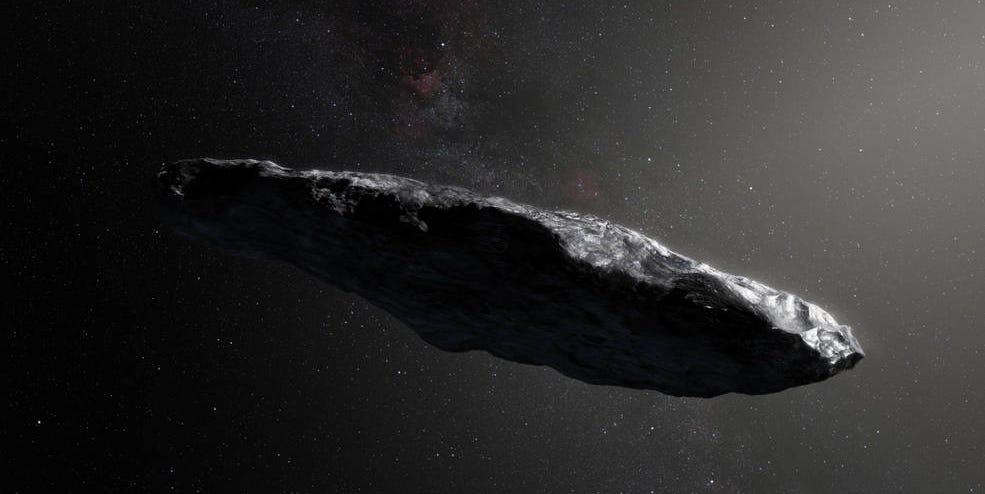
Every so often, the universe throws a pebble through our cosmic window and then refuses to explain itself. That is essentially what happened when astronomers spotted 1I/ʻOumuamua, the first known object from another star system to pass through our solar system. It arrived fast, looked strange, behaved strangely, and then left before scientists could get the good cameras out. Very rude, scientifically speaking.
The most attention-grabbing idea was that this interstellar visitor might not be a normal comet or asteroid at all. Some scientists speculated that its odd acceleration could be explained if it were extremely thin and lightweight, pushed by sunlight like a solar sail. The possibility sounded like science fiction wearing a lab coat: could an interstellar object be artificial technology drifting through space?
The short answer is: probably not. The better answer is: the debate is fascinating because it shows how science works when nature hands us a mystery with no instruction manual. Let’s unpack the story, the evidence, the skepticism, and why this strange object still matters for astronomy, astrobiology, and future space exploration.
What Was ʻOumuamua?
ʻOumuamua was discovered on October 19, 2017, by the Pan-STARRS1 telescope in Hawaii. Its name comes from Hawaiian and is often translated as “scout” or “messenger from afar arriving first.” That turned out to be poetic and accurate. Unlike regular comets and asteroids that orbit the Sun, ʻOumuamua was moving on a hyperbolic path, meaning it was not gravitationally bound to our solar system. It came from interstellar space, swung around the Sun, and headed back out into the dark between stars.
At first, astronomers classified it as a comet. Then they noticed something awkward: it did not look much like one. Comets typically develop a glowing coma and sometimes a tail as sunlight heats their ice, releasing gas and dust. ʻOumuamua showed no obvious coma, no visible tail, and no clear sign of normal cometary outgassing. That made it look more like an asteroid.
But it did not behave like a simple asteroid either. As it moved away from the Sun, scientists detected a small non-gravitational acceleration. In plain English, something seemed to be giving it an extra push. For a comet, that push usually comes from jets of escaping gas. For ʻOumuamua, those jets were not clearly seen. Cue the dramatic music, or at least a very concerned astronomer adjusting their glasses.
Why Did Scientists Talk About a Solar Sail?
The solar sail hypothesis became famous after Harvard researchers Shmuel Bialy and Abraham “Avi” Loeb examined whether sunlight itself could explain ʻOumuamua’s acceleration. Light has momentum. When photons strike a reflective surface, they transfer a tiny push. That push is weak, but in space, where there is almost no friction, weak forces can add up over time.
Human engineers have already tested this concept. Solar sails use sunlight instead of rocket fuel. The Planetary Society’s LightSail 2 demonstrated controlled solar sailing in Earth orbit, and NASA has continued developing solar-sail structures through missions such as the Advanced Composite Solar Sail System. So the physics is real. The question is whether ʻOumuamua had the right shape and mass to be pushed noticeably by sunlight.
Bialy and Loeb calculated that solar radiation pressure could explain the observed acceleration if ʻOumuamua had a very low mass relative to its surface area. That would imply something extremely thin, perhaps less than a millimeter thick if shaped like a sheet. A natural object that thin would be unusual. An artificial light sail, at least in theory, could fit the numbers.
The Alien Technology Angle: Exciting, but Not Proven
Let’s be careful here. “Could be” is not the same as “is.” Science lives in that difference. The solar sail idea did not prove ʻOumuamua was alien technology. It proposed that radiation pressure might explain the acceleration if the object had a very unusual geometry. The artificial-origin interpretation was the most sensational version of that possibility.
Loeb argued that scientists should not dismiss an artificial explanation purely because it sounds strange. His broader point was that unknown objects deserve open-minded analysis. Skeptics replied that extraordinary explanations require extraordinary evidence, and ʻOumuamua did not provide enough of it. No radio signal was detected. No controlled maneuver was observed. No image showed a shiny sail gliding majestically past the Sun like a cosmic bedsheet.
Most astronomers therefore consider a natural explanation more likely. The alien solar sail idea remains a provocative hypothesis, not a confirmed discovery. In the hierarchy of explanations, “we observed a weird natural object” currently sits much higher than “someone misplaced their interstellar spacecraft.”
Natural Explanations for the Mystery
1. Invisible or Unusual Outgassing
The simplest explanation is that ʻOumuamua was still a comet-like body, but its outgassing was difficult to detect. If it released gas without much dust, telescopes might not have seen a classic comet tail. Small amounts of escaping material could have pushed the object slightly while leaving only faint observational clues.
2. Hydrogen Released From Irradiated Ice
One later explanation suggested that ʻOumuamua may have been an icy body altered by cosmic rays during its long journey through interstellar space. Those rays could have produced trapped molecular hydrogen inside water ice. As the object warmed near the Sun, the hydrogen could have escaped and caused acceleration without producing an obvious dusty coma.
3. A Fragment From Another Planetary System
Another possibility is that ʻOumuamua was a shard from a larger body, ejected from a young planetary system. Giant planets can fling debris into interstellar space. Over millions or billions of years, radiation can redden and harden surfaces, making an object look dry and inert even if it began as something more comet-like.
4. A Strange Shape, Not a Strange Civilization
Early brightness measurements suggested ʻOumuamua was highly elongated, perhaps cigar-shaped, though later interpretations allowed for a flattened, pancake-like form. Either way, it was odd. But odd does not mean artificial. Nature makes plenty of weird things. Just look at the platypus, then remember the universe had billions of years and trillions of worlds to get creative.
How Solar Sails Actually Work
A solar sail is a spacecraft propulsion system that uses the pressure of sunlight. Photons have no rest mass, but they do carry momentum. When they bounce off a reflective sail, they transfer a tiny force. That force is small, yet continuous. Over weeks, months, or years, a solar sail can change a spacecraft’s orbit without burning fuel.
This is why the idea is so attractive for deep-space exploration. A conventional spacecraft must carry propellant, and propellant adds mass. More mass requires more propellant, and soon the rocket equation starts behaving like an accountant with a grudge. Solar sails avoid that trap by using sunlight as the engine.
The challenge is engineering. A useful sail must be extremely thin, lightweight, reflective, durable, and deployable in space. It must survive heat, radiation, micrometeoroids, and the mechanical drama of unfolding a giant membrane without turning into an expensive aluminum burrito. That is why NASA and private organizations test solar sails step by step.
Why the ʻOumuamua Debate Matters
The solar sail speculation matters less because it might prove aliens visited us and more because it forced scientists to ask better questions. What kinds of objects drift between stars? How many interstellar visitors pass through our solar system? Are they mostly icy comets, rocky fragments, fluffy aggregates, or something else entirely?
Since ʻOumuamua, astronomers have discovered more interstellar visitors. 2I/Borisov, found in 2019, behaved much more like a typical comet, with visible dust and gas. Later, 3I/ATLAS became the third known interstellar object and was categorized as a comet because telescope observations showed activity, including a coma. These discoveries suggest that interstellar objects are not all alike. Some may look familiar. Others may be cosmic oddballs.
That diversity is valuable. Every interstellar object is a free sample from another planetary system. We do not have to travel light-years to inspect them; occasionally, they come to us. Unfortunately, they also tend to move very fast and give very little notice, like guests who ring the doorbell while already backing out of the driveway.
Could Future Telescopes Solve the Next Mystery Faster?
Yes. One reason ʻOumuamua remained mysterious is that it was discovered after its closest approach to the Sun. By the time astronomers realized how special it was, the object was already racing away. Observations were limited, and no spacecraft could intercept it.
Future surveys such as the Vera C. Rubin Observatory are expected to discover more faint, fast-moving objects. Earlier detection would give astronomers more time to study shape, color, rotation, composition, and activity. More data means fewer wild guesses and better science. It may also make rapid-response spacecraft missions possible.
Mission planners have discussed interceptor concepts that could wait in space and chase newly discovered comets or interstellar objects. Solar sails themselves may play a role in these missions, because they can accelerate over time without fuel. Ironically, even if ʻOumuamua was not a solar sail, solar sails might help us study the next ʻOumuamua.
What Would Count as Evidence of an Artificial Object?
Scientists would need much stronger evidence than odd acceleration. Possible clues might include unnatural materials, controlled course corrections, repeated signals, engineered geometry confirmed by imaging, or thermal behavior inconsistent with known natural substances. A single anomaly is not enough. Space is full of surprises, and nature does not owe us simple explanations.
That does not mean the search for technosignatures is silly. Looking for signs of technology beyond Earth is a legitimate scientific effort when done carefully. Radio searches, optical surveys, atmospheric studies of exoplanets, and analysis of unusual objects all belong to the broader question of whether intelligence exists elsewhere. The key is to separate curiosity from conclusion.
In the case of ʻOumuamua, the evidence remains intriguing but insufficient. It is fair to say scientists speculated about a solar sail. It is not fair to say scientists confirmed one. That distinction is the difference between astronomy and a late-night cable show with too many thunderclaps.
Common Misconceptions About the Solar Sail Theory
Misconception: Scientists proved ʻOumuamua was alien.
No. A small group explored whether sunlight pressure could explain its motion and noted that an artificial light sail was one possible interpretation. Most scientists favor natural explanations.
Misconception: Solar sails are fictional.
No. Solar sailing is real physics and has been demonstrated by spacecraft. What remains difficult is building sails large, durable, and precise enough for ambitious missions.
Misconception: If an object has no tail, it cannot be a comet.
Not always. Some comet-like bodies may release gases that are hard to detect or produce little dust. A weak or unusual coma can escape observation, especially when an object is small, distant, and moving quickly.
Misconception: Weird means artificial.
Science has learned this lesson many times. Pulsars were once jokingly labeled “little green men” signals before researchers understood they were rotating neutron stars. Nature is an expert at making things look suspicious.
Experiences and Reflections: Why This Story Captures the Imagination
The story of an interstellar comet that might be a solar sail works so well because it taps into a very human feeling: the thrill of looking up and wondering whether we are alone. Even people who do not follow astronomy closely can understand the drama. A mysterious object arrives from another star, acts strangely, and leaves before anyone can fully identify it. That is not just a scientific puzzle; it is a perfect cosmic cliffhanger.
For many skywatchers, ʻOumuamua changed the way the night sky feels. Before its discovery, interstellar visitors seemed like theoretical objects hiding in textbooks. After 2017, they became real. Somewhere above us, debris from other solar systems can pass through our neighborhood. That realization makes the solar system feel less isolated. We are not sealed inside a glass dome; we are part of a galactic environment where material is constantly exchanged, scattered, frozen, baked, and flung across unimaginable distances.
There is also an emotional reason the solar sail idea became so popular. Humans are already trying to build light-driven spacecraft. We have imagined sending tiny probes to nearby stars using lasers and sails. So when an object appeared that might be explained by radiation pressure, people naturally connected the dots. The idea felt familiar enough to be plausible and strange enough to be irresistible. It was the scientific equivalent of hearing a twig snap in the forest and wondering whether it was a deer, a bear, or Bigfoot with excellent posture.
Anyone who has watched a meteor shower, tracked a satellite, or seen a bright planet rise over the horizon knows that space can feel personal. The objects are distant, but the experience is immediate. You stand on a sidewalk, rooftop, campsite, or backyard, and suddenly the universe is not abstract anymore. It is moving overhead. The ʻOumuamua debate gave that feeling an intellectual spark. It reminded people that astronomy is not only about cataloging objects; it is about interpreting incomplete evidence from a universe that rarely repeats itself on demand.
The best lesson from this experience is not that aliens sent a sail through our solar system. The best lesson is that mystery still exists. In an age when we can map planets, photograph black hole shadows, and land robots on Mars, a small object from another star can still make experts argue, calculate, revise, and wonder. That is healthy. Science is not weakened by uncertainty; it is powered by it.
So the next time a headline claims that an interstellar object might be alien technology, the smartest response is not instant belief or instant dismissal. It is curiosity with a seatbelt. Ask what was observed. Ask what explanations fit the data. Ask what evidence would change the conclusion. Then enjoy the ride, because the universe has a habit of being stranger than expected and far more interesting than any tidy answer.
Conclusion
The speculation that an interstellar comet could be a solar sail began with a real scientific puzzle: ʻOumuamua accelerated in a way that was hard to explain with the data available. Solar radiation pressure offered one possible answer, and an artificial light sail became the headline-friendly version of that idea. However, most scientists remain cautious, and natural explanations are still considered more likely.
That does not make the story any less important. ʻOumuamua forced astronomers to rethink what interstellar objects can look like. It pushed solar sailing into public conversation. It highlighted the need for faster surveys, better telescopes, and future interceptor missions. Most of all, it reminded us that the universe is not finished surprising us.
Whether ʻOumuamua was an extinct comet fragment, an unusual icy body, a wafer-thin natural object, or something even stranger, it served as a messenger. It told us that other star systems are sending material our way, and we are only beginning to catch those messages. The next one may arrive sooner than expected. This time, hopefully, we will be ready before it waves goodbye.