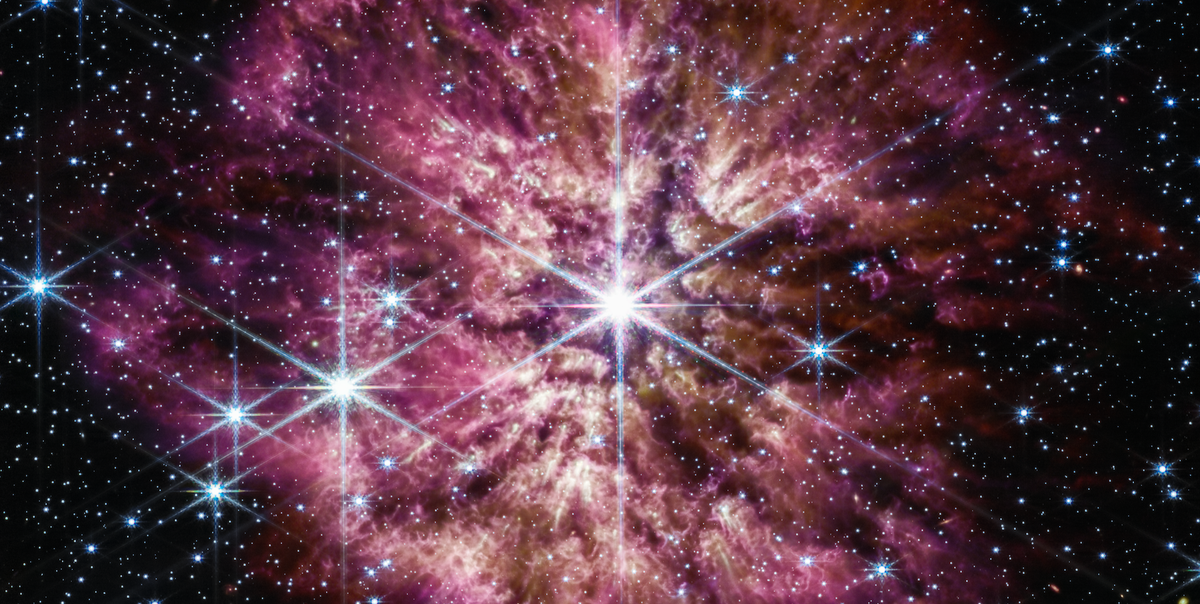
Some stars spend billions of years behaving like respectable cosmic citizens. They shine, they fuse hydrogen, they mind their business. A Wolf-Rayet star is not one of those stars. A Wolf-Rayet star is the stellar equivalent of a race car with the doors missing, the engine screaming, and pieces flying off as it barrels toward a dramatic finish.
These rare, massive stars represent one of the most extreme late-life stages in stellar evolution. They are blisteringly hot, astonishingly bright, and famous for shedding their outer layers through violent stellar winds. In many cases, they are thought to be among the final acts before a core-collapse supernova. In other words, if ordinary stars age quietly, Wolf-Rayet stars go out like rock legends.
Understanding a Wolf-Rayet star matters because these objects help astronomers answer some of the biggest questions in astrophysics: how very massive stars die, how elements like carbon are spread through galaxies, why some supernovae lose their hydrogen before exploding, and how dust forms in surprisingly hostile corners of space. They are rare, fast-evolving, and spectacularly inconvenient in the best scientific way possible.
What Is a Wolf-Rayet Star?
A Wolf-Rayet star is a very hot, very luminous, evolved massive star that is losing an enormous amount of material through strong stellar winds. It was named after French astronomers Charles Wolf and Georges Rayet, who first identified this strange class of stars in 1867 by their unusual spectra.
That spectrum is the big giveaway. Most stars show dark absorption lines in their spectra, which tell astronomers what elements are present in the star’s atmosphere. Wolf-Rayet stars flip the script. Instead of neat, narrow absorption lines, they display broad, bright emission lines. That odd signature comes from a dense, fast-moving outflow of gas around the star. In plain English, the star is blowing itself apart so aggressively that the escaping material becomes part of the show.
These stars are not just hot. They are absurdly hot. Surface temperatures can soar well above those of ordinary blue stars, and their radiation is powerful enough to drive away vast amounts of mass. Over time, those intense winds strip off the star’s outer hydrogen-rich layers, exposing deeper material that was forged by nuclear fusion inside the core.
Why Wolf-Rayet Stars Are So Rare
Wolf-Rayet stars are rare for two main reasons. First, only very massive stars are likely to become classical Wolf-Rayet stars. The universe makes far fewer heavyweight stars than small, steady stars like red dwarfs. Second, the Wolf-Rayet phase is short. Astronomically speaking, it is a blink-and-you-miss-it moment at the end of an already brief life.
That combination makes these stars unusual in the Milky Way. Astronomers know of only a relatively small number compared with the galaxy’s total stellar population. They tend to appear in active star-forming regions and spiral arms, where massive stars are born, live fast, and die even faster.
So yes, they are rare. Not unicorn rare, but definitely “drop everything and point the telescope” rare.
How a Massive Star Becomes a Wolf-Rayet Star
To understand the Wolf-Rayet stage, it helps to zoom out and look at the life of a massive star. A star begins as a collapsing cloud of gas and dust. If it gathers enough mass, its core becomes hot and dense enough to ignite fusion. For most of its life, it burns hydrogen into helium in the core, much like other stars. The difference is that a very massive star burns through its fuel at an outrageous rate.
As the star evolves, it begins fusing heavier elements in sequence. Its structure changes, its luminosity rises, and its outer layers become increasingly unstable. Powerful radiation pressure and strong stellar winds start stripping away those outer layers. In some cases, binary interaction helps too. A companion star can siphon off material and speed up the stripping process, which means not every Wolf-Rayet star follows the exact same path.
Once the hydrogen envelope is mostly gone, the hotter inner layers are exposed. At that point, astronomers may classify the star as a Wolf-Rayet star. What we are seeing is no longer the star in its youthful, hydrogen-burning phase. We are seeing a stripped, unstable, ultra-hot stellar core wrapped in a furious wind.
The Main Types of Wolf-Rayet Stars
Wolf-Rayet stars are classified by the elements that dominate their spectra, and those categories reveal what stage of internal processing is being exposed.
WN Stars
WN stars show strong lines of helium and nitrogen. These are thought to reveal products associated with hydrogen burning through the CNO cycle. In simple terms, the star has peeled back its outer layers enough for astronomers to see material that has already been chemically processed deep inside.
WC Stars
WC stars are dominated by helium, carbon, and often little or no hydrogen. These stars have been stripped even more deeply, exposing products of helium burning. This is where the story gets especially interesting, because carbon-rich winds from some Wolf-Rayet systems contribute to dust production in space.
WO Stars
WO stars are the rarest and most extreme subtype. Their spectra show strong oxygen lines in addition to carbon and helium, suggesting that the star is exposing even more advanced fusion products. Many astronomers see WO stars as an especially late evolutionary stage, very close to final collapse.
So the alphabet soup of WN, WC, and WO is not random. It is a clue to how much of the star has already been stripped away and what nuclear history is now being laid bare.
What Makes Wolf-Rayet Stars Different From Ordinary Massive Stars?
The simplest answer is this: they have taken off the mask. A normal massive O-type star still hides much of its internal story beneath a hydrogen-rich outer envelope. A Wolf-Rayet star has lost much of that covering. As a result, astronomers can study deeper layers and later evolutionary stages more directly.
Wolf-Rayet stars also lose mass at an extraordinary pace. Their stellar winds can race outward at millions of miles per hour, carving shells, bubbles, and nebulae into the surrounding medium. These winds are not a side note. They shape the star’s final fate, affect nearby gas and dust, and help determine what kind of supernova may follow.
In short, a Wolf-Rayet star is not just a big star. It is a big star in a stripped-down, high-loss, high-drama phase that reveals what massive stellar death really looks like up close.
Why Wolf-Rayet Stars Are Called Precursors to Supernovae
The phrase “precursor to a supernova” is catchy, but it needs a little nuance. Not every Wolf-Rayet star will end the same way, and astronomers still debate exactly how different Wolf-Rayet stars die. Even so, these stars are widely considered likely progenitors of some stripped-envelope supernovae, especially Types Ib and Ic, and in some cases possibly related events with very little hydrogen left.
Here is the basic idea. Once a massive star can no longer support itself through fusion, its core collapses. That collapse triggers a catastrophic explosion or, in some cases, a direct collapse into a black hole with little visible fuss. Because Wolf-Rayet stars have already lost their hydrogen-rich outer layers, the supernova signatures they produce may look different from stars that still retain those layers.
This is one reason Wolf-Rayet stars matter so much. They offer astronomers a living laboratory for the final pre-explosion state of certain massive stars. Recent observational work has strengthened the case that at least some Wolf-Rayet stars do indeed explode as supernovae, helping bridge a long-standing gap between theory and observation.
Famous Examples of Wolf-Rayet Stars
WR 124
WR 124 is one of the best-known Wolf-Rayet stars thanks to stunning imagery from the James Webb Space Telescope. Surrounded by a clumpy shell of ejected gas and dust, it offers a vivid look at what a star can leave behind before its final collapse. The object is often described as a rarely seen prelude to a supernova, and for good reason: it shows a massive star in a late, unstable phase while it is actively shedding material.
WR 140
WR 140 is a different kind of celebrity. It is part of a binary system where the winds from two massive stars slam into each other and create repeating shells of carbon-rich dust. The result is one of the most visually delightful structures in astronomy, like cosmic tree rings made by a star that absolutely refuses to die quietly.
WR 136 and the Crescent Nebula
WR 136 powers the Crescent Nebula, a glowing shell of gas in the constellation Cygnus. This is a classic example of how Wolf-Rayet winds reshape the surrounding environment. The star’s outflow crashes into previously ejected material, sculpting a nebula that astrophotographers adore and astronomers use as a real-world test case for stellar feedback.
How Wolf-Rayet Stars Help Build the Universe
For all their chaos, Wolf-Rayet stars are remarkably generous. Their winds and eventual deaths enrich space with heavy elements that later become part of new stars, planets, and possibly life. Carbon, oxygen, and other elements forged in stellar interiors do not stay politely tucked away. Wolf-Rayet stars help fling them into the interstellar medium.
They also contribute to dust formation under conditions that once seemed too harsh for dust to survive. That matters because dust is not cosmetic. It helps cool gas clouds, supports star formation, and shapes what telescopes can see. When astronomers study Wolf-Rayet dust shells, they are also studying the chemistry and ecology of galaxies.
So even though these stars are nearing the end of their lives, they are also part of the beginning of future cosmic systems. Stellar death, as usual, turns out to be suspiciously productive.
Can You See a Wolf-Rayet Star?
Usually, not with the naked eye. Wolf-Rayet stars are rare, often distant, and not exactly beginner binocular targets. But their influence can sometimes be seen through nebulae they energize or shape, especially in astrophotography and large telescopes. The Crescent Nebula is a famous example, where the central Wolf-Rayet star has helped sculpt a dramatic shell of glowing gas.
For most people, the closest “experience” of a Wolf-Rayet star comes through observatory images, spectroscopy, and mission data from telescopes like Hubble, Chandra, and Webb. Thankfully, modern astronomy has become very good at bringing remote cosmic drama to human eyeballs.
Why Wolf-Rayet Stars Still Fascinate Astronomers
Wolf-Rayet stars sit right at the crossroads of several big astrophysics problems: stellar mass loss, binary evolution, supernova progenitors, black hole formation, gamma-ray burst models, dust production, and galactic chemical enrichment. If that sounds like an unfair amount of responsibility for one type of star, that is because it is.
They are difficult to model because their winds are intense, their lives are short, and binary interactions complicate everything. They are difficult to observe because they are uncommon and often obscured by dust. Yet they are exactly the kind of objects that reward careful study, because they tell astronomers what massive stars look like just before the endgame.
And honestly, there is something irresistibly dramatic about a star that spends its final phase blasting away its own layers while lighting up the galaxy like a cosmic warning flare.
Experiences Related to Wolf-Rayet Stars: What It Feels Like to Study a Star on the Edge
There is a special kind of thrill in encountering a Wolf-Rayet star, even if that encounter happens through a monitor in a control room instead of a spaceship window. Astronomers often describe the experience less like finding a normal star and more like walking into the middle of a stellar tantrum that has been in progress for thousands of years. A Wolf-Rayet star does not simply shine. It announces itself through motion, texture, chemistry, and violence.
For observers working with spectra, the experience begins with those broad emission lines. They are unmistakable. Instead of the tidy fingerprints that many stars provide, a Wolf-Rayet spectrum looks energized, swollen, and urgent. It tells you immediately that the star is wrapped in a fast, dense outflow. The data carry a sense of motion even when the image itself is just a point of light. That is part of the weird beauty of astrophysics: a graph can feel dramatic when the physics behind it is dramatic enough.
For astrophotographers and telescope teams, Wolf-Rayet stars offer another kind of experience entirely. They often sit inside shells, bubbles, arcs, or dusty halos that make them look less like isolated stars and more like engines tearing up the scenery. The Crescent Nebula, for example, is not just pretty in the decorative sense. It is beautiful because it records a fight between stellar winds and older ejected material. Looking at it means looking at a physical history written in glowing gas.
Then there is the infrared view, where systems like WR 124 and WR 140 become almost surreal. Dust that would be invisible or muted in optical light suddenly appears as layered structure, clumps, rings, and expanding shells. Scientists studying those observations are not just admiring pretty pictures. They are measuring time, speed, cooling, chemistry, and geometry. Yet the emotional effect is still real. Many of these images feel like snapshots of something alive, unstable, and halfway between sculpture and explosion.
There is also an intellectual experience that comes with Wolf-Rayet stars: humility. These stars remind astronomers that stellar evolution is not always neat. Rotation matters. Metallicity matters. Binary companions matter. Winds matter. Sometimes a star expected to explode may collapse more quietly than hoped. Sometimes a system produces dust where theory once struggled to explain it. Sometimes a presumed Wolf-Rayet pathway turns out to be more tangled than a drawer full of old charging cables.
For science communicators, Wolf-Rayet stars are a gift because they let people feel the scale and drama of stellar evolution without oversimplifying it too much. They show that stars are not static dots pinned to the sky. They are physical systems with lifecycles, chemistry, weather, and endings. When the public sees a Webb image of WR 124 or a dusty shell around WR 140, the usual reaction is not mild appreciation. It is wonder mixed with disbelief. That emotional response matters. It is often the first step toward understanding.
Even for casual readers, learning about a Wolf-Rayet star can change the way the night sky feels. The stars stop looking permanent. They become temporary, evolving, and connected to everything else. The carbon in a living cell, the oxygen in a lung, the dust in a future planet, and the glow of a dying giant all become part of the same long story. That is the real experience of Wolf-Rayet stars: they make the universe feel active, unfinished, and far more dramatic than a calm sky would suggest.
Conclusion
A Wolf-Rayet star is one of the most extreme stellar objects astronomers can study before a massive star reaches its end. It is hot, stripped, luminous, wind-driven, and rare. In many cases, it represents a likely pathway toward a supernova, especially for stars that have already lost most or all of their hydrogen envelopes. These objects do not just help scientists understand stellar death. They help explain how galaxies are enriched, how dust forms, and how the universe recycles matter into future generations of stars and worlds.
If you want the short version, here it is: a Wolf-Rayet star is what happens when a massive star stops being polite and starts being honest about how wild stellar evolution really is.