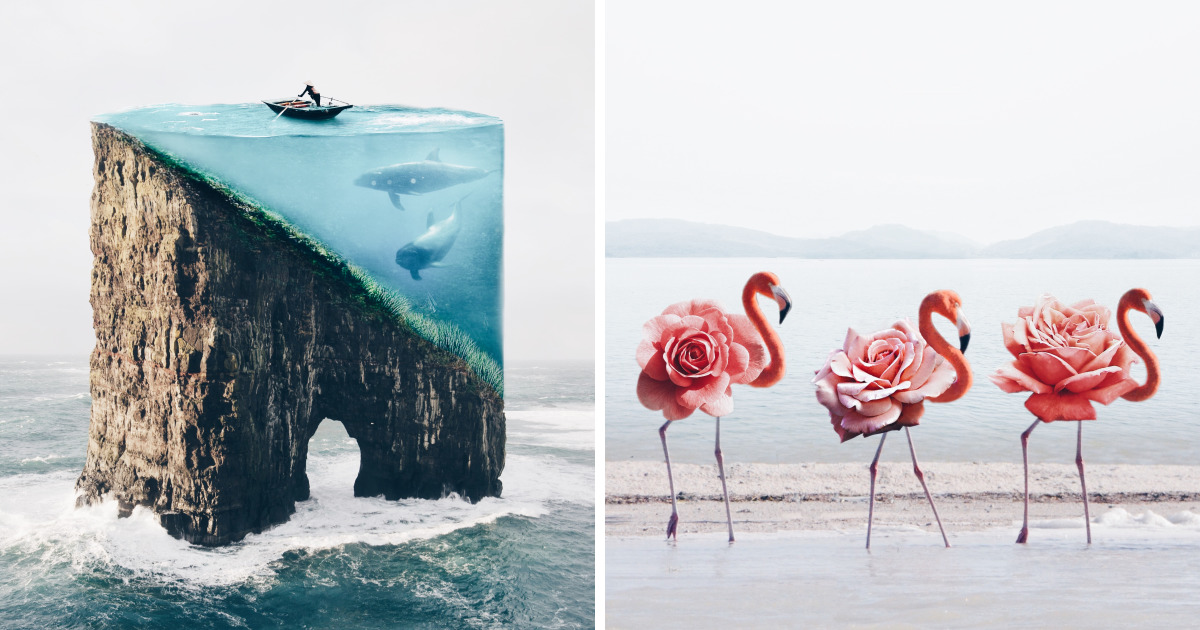
What happens when a mountain grows fur, a feather becomes a forest, or an animal carries an entire landscape on its back? In the imaginative world of Portuguese multimedia artist Luisa Azevedo, these combinations do not need to obey logic. They only need to look convincing enough to make viewers briefly question whether reality has been following the correct rulebook.
Azevedo gained international attention as a teenager by creating surreal photo manipulations from real photographs. Animals, plants, roads, clouds, buildings, oceans, and human figures were carefully blended into polished compositions that felt like fragments of unusually well-directed dreams. Her pictures were whimsical without becoming sugary, strange without becoming chaotic, and technically seamless enough to reward a second or third look.
The headline describing her as an 18-year-old artist refers to the period when her work went viral in 2017. The images, however, remain a lively example of how curiosity, daily practice, and digital tools can turn ordinary source material into memorable surreal art.
Meet Luisa Azevedo, the Artist Behind the Dreamlike Images
Luisa Azevedo is a Portuguese photographer and multimedia artist associated with Lisbon. Born in 1998, she spent much of her early life in Covilhã before moving to the Portuguese capital. Her public work has consistently reflected three interests that rarely seem to leave the studio without holding hands: art, animals, and nature.
She discovered photography through Instagram around the age of 15. At first, she took relatively simple photographs with a mobile phone. That modest beginning is worth remembering in an era when aspiring creators sometimes believe they need a professional camera, a studio the size of an airplane hangar, and a laptop capable of launching satellites before they are allowed to make anything interesting.
As her curiosity grew, Azevedo began exploring digital editing and teaching herself Photoshop through online tutorials. She published an early edited image in 2015 and gradually turned photo manipulation into a regular creative challenge. By the time international art and design publications began featuring her work, she had developed a recognizable visual language and was studying Multimedia Art at the Faculty of Fine Arts of the University of Lisbon.
Her rise illustrates an increasingly familiar path for young digital artists. The learning happens partly in school, partly through experimentation, and partly through a browser tab containing a tutorial titled something like “How to Fix This in Three Easy Steps,” followed by 47 minutes of determined confusion.
How Unexpected Objects Become Surreal Art
Azevedo’s central idea is beautifully simple: select familiar elements and combine them in ways that could never occur in ordinary life. A road might become an animal’s tail. A patch of forest might replace feathers or fur. Flowers may grow from a creature’s body, while mountains, waves, and skies slip into silhouettes that originally belonged to something else.
The result is not merely a collection of visual jokes. Her strongest surreal photo manipulations create relationships between the subjects being merged. An animal combined with a landscape can suggest that wildlife and habitat are inseparable. A creature carrying trees, oceans, or buildings may feel protective, burdened, majestic, or vulnerable depending on the composition.
This emotional ambiguity gives the images staying power. Viewers first notice the illusion, but the illusion often leads to a mood. Some pieces feel peaceful and delicate. Others contain a slight visual uneasiness, as though nature has quietly rearranged itself while humanity was distracted by notifications.
The Power of Visual Resemblance
Successful object merging usually begins with similarity. A curved road can echo the shape of a tail. Tree branches may resemble antlers or veins. A rocky ridge can imitate an animal’s spine. Ocean foam may follow the outline of fur or feathers. Once the artist recognizes that connection, two unrelated photographs can become parts of the same visual sentence.
This process requires more than technical editing skill. It demands observational awarenessthe habit of seeing shapes before labels. Most people see a mountain and think, “That is a mountain.” A surreal artist may see the same mountain and think, “That would make an excellent sleeping wolf.” Both observations are technically valid, although only one is likely to result in a mysterious Instagram post.
A Modern Continuation of the Surrealist Tradition
Surrealism developed during the early 20th century as artists and writers explored dreams, subconscious associations, chance, and imagery that escaped rational explanation. Historic Surrealists often placed recognizable objects in impossible environments or joined unrelated forms to disrupt ordinary perception.
Photography became especially useful for this purpose because people tend to trust a photograph. Paint a whale floating above a city and the viewer recognizes a fantasy. Construct the same scene from realistic photographic material and the brain may hesitate for half a second before filing a formal complaint.
Azevedo’s work belongs to this broader tradition of making the familiar strange. However, her atmosphere is generally softer than the disturbing or politically confrontational imagery associated with some earlier Surrealists. Rather than creating nightmares, she often builds quiet visual fables populated by animals, plants, clouds, and expansive landscapes.
Her digital collages also reflect the influence of contemporary visual culture. They are carefully composed, immediately readable, and strong enough to communicate on a small screen. This does not make them less artistic. It demonstrates an understanding of where modern viewers encounter art and how quickly an image must establish its central idea.
The Technical Craft Behind the Apparent Magic
A seamless composite may look effortless after completion, but convincing photo manipulation involves a long chain of small decisions. The concept is only the beginning. The artist must locate or create photographs with compatible perspectives, lighting, resolution, color, and depth.
Matching Perspective and Scale
When two photographs are taken from different angles, their combination can feel wrong even when viewers cannot explain why. A landscape photographed from above will rarely blend naturally with an animal photographed at eye level. The horizon, camera angle, and apparent distance must agree.
Scale is equally important. Surreal art can intentionally exaggerate proportions, but the exaggeration must appear deliberate. A gigantic bird flying over mountains can work beautifully. A bird that is only accidentally 14 percent too large may simply look as though someone lost an argument with the transform tool.
Using Masks, Edges, and Texture
Digital artists commonly use layers and masks to reveal or conceal sections of an image without permanently deleting them. This allows the editor to blend fur into trees, clouds into bodies, or water into an object while maintaining control over the transition.
Edges deserve obsessive attention. Hair, feathers, leaves, and branches are notoriously difficult to isolate. If the edge is too sharp, the inserted object resembles a sticker. If it is too soft, the subject begins to evaporate. The best transition respects the texture of both source images.
Creating Consistent Light and Color
Every element in a composite must appear to exist under the same light. Shadows should fall in compatible directions, highlights should have similar intensity, and the color temperature should feel consistent. An animal lit by a warm sunset will not naturally blend into a cold blue landscape without adjustment.
Color grading often provides the final unifying layer. By applying related tones, contrast, and atmospheric effects across the composition, an artist can make separate photographs feel as though they were captured in one impossible location at one impossible moment.
Why Animals and Nature Dominate the Visual Language
Azevedo’s affection for animals and natural environments is not decorative background information; it shapes the identity of her work. Creatures are frequently transformed without losing their dignity. Even when an animal has plants growing from its body or a landscape replacing part of its anatomy, it rarely becomes a cartoonish prop.
This approach encourages viewers to see nature as a connected system. Forests resemble fur. Rivers become veins. Mountains resemble resting bodies. The boundary between organism and environment becomes flexible, suggesting that the categories people use to divide the natural world may be less stable than they appear.
The images can also be read as gentle ecological metaphors. An animal carrying a forest may evoke habitat protection. A creature blended into a mountain may suggest adaptation, disappearance, or belonging. These interpretations are not forced by captions. They emerge naturally from the visual relationship between the merged subjects.
That openness is one of the work’s strengths. A picture can remain playful while still encouraging reflection. It can be attractive enough to share and thoughtful enough to remember after the scrolling stops.
Instagram as a Gallery, Classroom, and Creative Deadline
Instagram played an important role in Azevedo’s artistic development. It introduced her to photography, offered a place to publish experiments, and connected her images with an international audience. For a young artist living outside the traditional centers of the commercial art market, that access was significant.
Social media also created a practical rhythm. Producing work regularly encouraged her to improve through repetition. Each new composite presented another problem involving shape, perspective, color, masking, or storytelling. Instead of waiting for inspiration to arrive wearing a dramatic cape, she treated creativity as a daily exercise.
The platform suited her visual style. Her compositions usually contain a strong central subject, uncluttered surroundings, and an illusion that can be understood quickly. Those characteristics help an image survive the crowded environment of a social feed, where every artwork competes with vacation photographs, advertisements, recipes, pets, and someone’s extremely urgent opinion about a television finale.
However, the appeal of Azevedo’s work cannot be reduced to algorithm-friendly design. The pictures circulated widely because the underlying ideas were clear, imaginative, and technically polished. Social media provided the distribution system; the artistry supplied the reason people stopped.
What Aspiring Digital Artists Can Learn From Her Process
Begin With Available Tools
Azevedo’s path began with mobile photography rather than expensive equipment. The lesson is not that tools are irrelevant. Better tools can improve efficiency and image quality. The lesson is that waiting for ideal equipment can become a sophisticated form of procrastination.
Practice by Finishing Small Projects
Completed experiments teach more than endless planning. A simple composite may expose problems with lighting, masking, or perspective that remain invisible in a sketchbook. Finishing the work creates feedback, and feedback creates improvement.
Build a Personal Image Library
Photographing clouds, branches, animals, architecture, textures, roads, and landscapes gives an artist a collection of reusable visual ingredients. Original photography also makes the final work more personal and reduces dependence on generic source material.
Develop Concepts Before Opening the Software
Technical skill cannot rescue a weak idea forever. Before editing, an artist should be able to describe the visual connection: a waterfall resembles hair, a shell resembles a planet, or a winding road resembles a ribbon. A clear relationship gives the composite purpose.
Respect Image Rights
Digital collage does not mean every photograph online is available for unrestricted use. Artists should create their own source images, obtain permission, purchase appropriate licenses, or use material supplied under terms that permit modification. Magical worlds are considerably less magical when accompanied by a copyright dispute.
Why Luisa Azevedo’s Surreal Images Still Feel Relevant
Azevedo’s early work appeared before text-to-image systems made synthetic fantasy instantly available to millions of users. That timing adds an interesting dimension to the images today. Each composite reflects deliberate selection, manual masking, color correction, and patient construction rather than a single descriptive prompt.
This does not mean new creative technologies automatically lack value. It means the human decisions behind an image still matter. A tool can generate combinations, but an artist builds a visual language by repeatedly choosing certain subjects, moods, relationships, and forms.
Azevedo’s style is recognizable because it reflects consistent preferences: animals, natural scenery, calm compositions, elegant transitions, and transformations that feel poetic rather than random. The surprise is controlled. The impossible elements behave as though they belong together.
Her pictures also satisfy a timeless desire to see the ordinary world renewed. Viewers know what a forest, bird, mountain, or road looks like. By merging those familiar subjects, she gives them temporary freedom from their usual identities. Reality is not destroyed; it is politely asked to try something different.
Creative Experience: Building a Surreal Composite From the First Idea
The experience of creating surreal photo manipulation often begins away from the computer. It may start during a walk when the curve of a bridge resembles the back of an animal, or when a cloud looks suspiciously like it has been rehearsing for the role of a jellyfish. The important step is recording the association before daily life pushes it out of memory.
A useful concept notebook can contain rough sketches, written comparisons, color combinations, and photographs of interesting shapes. The drawings do not need to be elegant. Their job is to preserve the relationship between two objects. “Tree roots as antlers” is already a workable beginning. Nobody from a museum is coming to grade the handwriting.
Once the concept is selected, gathering source material becomes a creative investigation. The artist may need an animal photographed from the side, a forest with compatible light, and a background containing enough open space for the transformation to remain readable. Several promising photographs may fail because the camera angles disagree or because the shadows point in opposite directions.
The first digital assembly is rarely beautiful. Elements appear pasted together, proportions feel uncertain, and the original photographs stubbornly refuse to become friends. This awkward stage is normal. It allows the creator to test the idea before spending hours refining details.
After the composition works at a basic level, the slow improvements begin. The artist adjusts scale, rotates elements, reshapes contours, and removes unnecessary details. A forest may need to follow the curve of an animal’s body. A road may require subtle distortion before it behaves like a tail. Fine branches must overlap fur so the transition feels organic rather than surgically attached.
Lighting adjustments can transform the entire piece. Darkening one side of an inserted object helps it match the direction of the original light. Adding a soft shadow creates contact between elements. Atmospheric haze can push distant objects backward, while local contrast can bring the main subject forward.
Then comes the dangerous period when the image is nearly complete but the artist is no longer certain what anything looks like. After staring at one edge for an hour, a perfectly normal tree may begin to resemble an accusation. Taking a break is often more useful than adding another adjustment layer.
Returning with fresh eyes reveals problems quickly. The subject may need more breathing room. A bright detail may distract from the illusion. The overall colors may be too green, too blue, or too committed to an atmosphere best described as “haunted refrigerator.” Small corrections restore balance.
Sharing the finished work creates another kind of experience. Viewers may notice symbolism the artist never consciously intended. One person sees an ecological message; another sees a peaceful dream; someone else simply writes, “I want this animal as a pet.” All three reactions can be valid because visual art continues generating meaning after it leaves the creator’s screen.
The most useful lesson is that surreal art does not require waiting for a completely original universe to appear fully formed. It begins by observing the existing world closely. Rocks, wings, roads, flowers, clouds, and buildings already contain visual echoes of one another. The artist’s role is to notice those secret relationships and make them visible.
Conclusion: When Imagination Gives Reality a Makeover
Luisa Azevedo’s surreal art demonstrates how a familiar photograph can become the entrance to an unfamiliar world. By combining animals, landscapes, plants, objects, and architecture, she creates images that are immediately understandable yet impossible to explain through ordinary reality.
Her early success was not built on age alone. It came from curiosity, regular practice, self-directed learning, formal art education, and a consistent willingness to attempt new visual ideas. The polished results may look magical, but the process involves observation, experimentation, technical discipline, and enough patience to refine a difficult edge one pixel at a time.
Most importantly, her work reminds viewers that imagination is not separate from everyday life. It is a different way of looking at everyday life. A road can remain a road while also resembling a tail. A mountain can remain a mountain while becoming an animal. Reality provides the materials; creativity quietly rearranges the furniture.