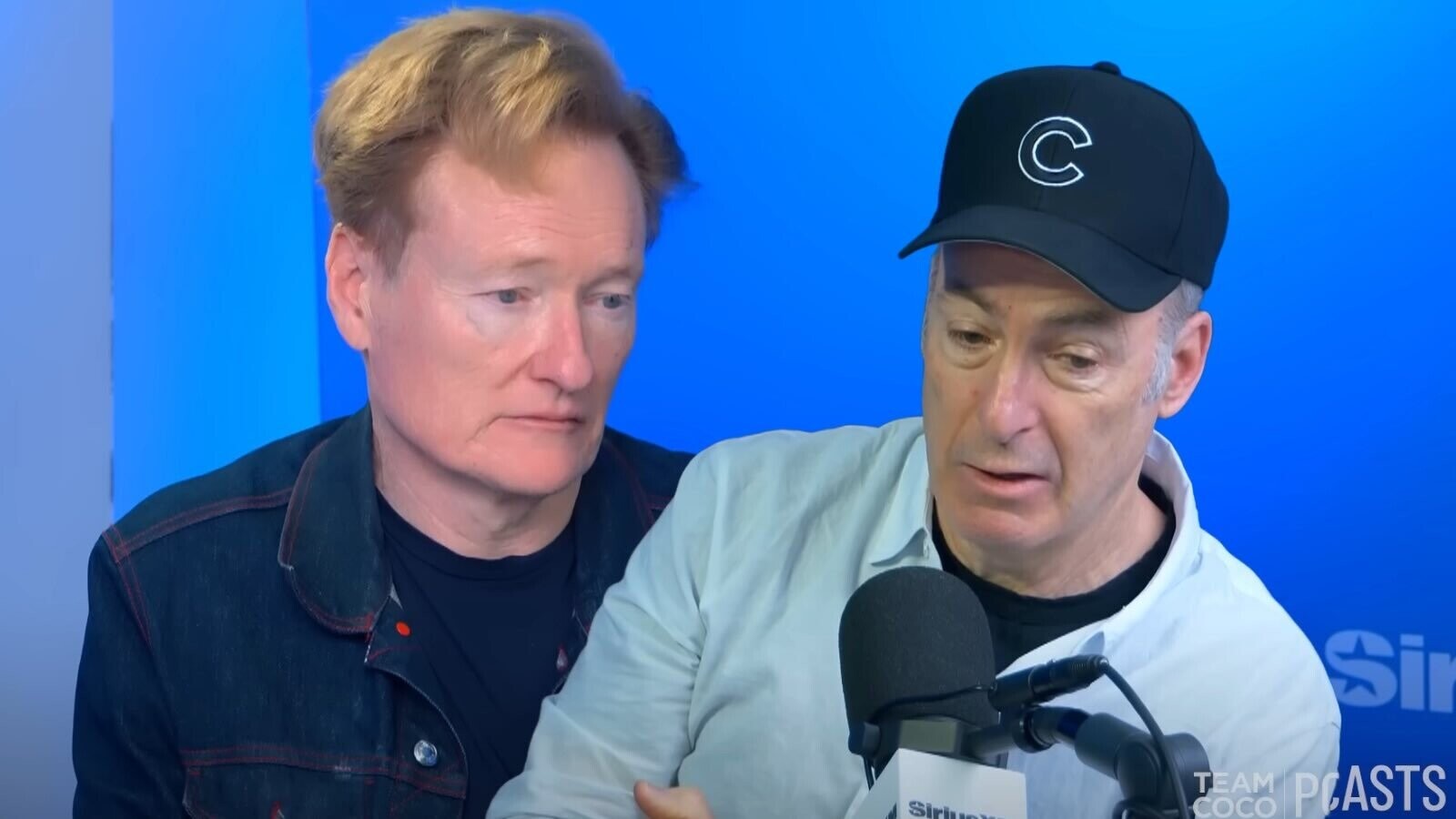
Note: This article is written for entertainment and informational purposes, based on publicly reported interviews and reputable health guidance. It is not medical advice.
Bob Odenkirk has spent decades making audiences laugh at the strangest corners of human behavior. He helped shape cult comedy with Mr. Show, turned a slippery lawyer into one of television’s most tragic characters in Better Call Saul, and somehow became an action star after most people his age are mostly action heroes when opening stubborn pickle jars. But when Odenkirk sat down with Conan O’Brien on Conan O’Brien Needs a Friend, the conversation moved beyond show business polish. It became a funny, frank, and unexpectedly moving reflection on what happens after life taps you on the shoulder and says, “Actually, we need to talk.”
The episode centered on Odenkirk’s career, his Broadway work, his acting instincts, and the new outlook he developed after surviving a heart attack while filming the final season of Better Call Saul. For fans, the interview felt like classic Odenkirk: wry, self-aware, allergic to sentimentality, and yet deeply sincere. For anyone who has ever ignored stress, postponed a checkup, or treated sleep like an optional streaming subscription, his story lands with unusual force.
The Conan Conversation: Funny, Honest, and Very Bob
On Conan’s podcast, Odenkirk discussed his role as Shelley Levene in the Broadway revival of Glengarry Glen Ross, his belief that emotional openness can serve good acting, and the perspective shift that came after nearly dying. The official episode description framed the conversation as one about “developing a new outlook on life after surviving a heart attack,” which is a polite way of saying: Bob Odenkirk has looked behind the curtain and is now less interested in wasting time on nonsense.
What makes the exchange compelling is that Odenkirk does not suddenly become a motivational-poster version of himself. He does not announce that every sunrise is a miracle while a flute plays in the background. Instead, he talks like a person who was forced to confront fragility and came back with a practical conclusion: life is precious, work is meaningful, but being overbooked can make even good things feel like homework with better lighting.
What Happened to Bob Odenkirk on the Better Call Saul Set?
In July 2021, Odenkirk collapsed while filming the sixth and final season of Better Call Saul in New Mexico. Early reports described a serious heart-related incident, and Odenkirk later explained that he had suffered what he called a “small heart attack.” Later interviews revealed the situation was far more frightening than that gentle phrase suggested.
Odenkirk has said he experienced a “Widowmaker” heart attack, a dangerous type of heart attack involving a blockage in the left anterior descending artery. During his Conan-related recollections, he described turning gray, losing consciousness, and having no memory of much of what followed. Nearby castmates and crew realized something was wrong, and the response from people on set became the crucial difference between a tragedy and a recovery story.
Medical officer Rosa Estrada has been widely credited by Odenkirk for beginning CPR and helping keep him alive until more help arrived. Reports also describe the use of an automated external defibrillator, or AED, with multiple shocks needed to restore his heartbeat. Doctors later treated the blockage and inserted stents. Odenkirk has said his memory resumes around the time he was leaving the hospital, which is both terrifying and oddly on-brand for a man whose comedy has long appreciated the absurdity of missing the most important scene.
Why the Story Still Resonates Years Later
Celebrity health stories can sometimes become clickbait confetti: shocking headline, dramatic quote, and then everyone moves on to whatever famous person wore an unusual hat at lunch. Odenkirk’s story has lasted because it connects to several very human fears. He was working. He was surrounded by people. He was in the middle of a successful career chapter. And then, without warning, his body hit the emergency brake.
That is what makes his Conan conversation more than a promotional stop. It is not only about surviving a heart attack. It is about what survival asks of a person afterward. Do you go back to the same schedule? Do you keep saying yes to every project? Do you treat recovery as a short commercial break before resuming the exact same program? Odenkirk’s answer seems to be: not if you are paying attention.
The Biggest Lesson: Slow Down Enough to Notice Your Life
One of the clearest lessons Odenkirk has shared is that overscheduling can rob even meaningful work of its meaning. After his heart attack, he has spoken about wanting to slow down, not because he hates working, but because too many commitments can turn life into a conveyor belt. You finish one thing, pivot to the next, answer another email, board another plane, and suddenly even the good stuff arrives with a deadline attached.
That lesson feels especially relevant in a culture that treats busyness like a personality trait. We praise people for being booked, slammed, swamped, crushed, underwater, and somehow still “excited.” Odenkirk’s experience challenges that badge-of-honor mentality. A full calendar is not always a full life. Sometimes it is just a polite-looking trap with color-coded reminders.
Gratitude Without the Greeting Card Gloss
Another major theme in Odenkirk’s post-heart-attack reflections is gratitude. He has repeatedly thanked the medical professionals, crew members, family, friends, and fans who supported him. But his gratitude does not feel syrupy. It feels specific. He names people. He remembers the practical acts that saved him. He understands that survival was not a solo performance.
That matters because many public recovery stories focus on individual toughness. Odenkirk’s story is more communal. Yes, he recovered. Yes, he returned to work. Yes, he continued taking on physically demanding roles. But his survival depended on other people recognizing an emergency, acting quickly, performing CPR, using an AED, and getting him to doctors who could treat the blockage. In other words, the hero of the story is not just Bob Odenkirk. It is also preparedness, teamwork, and the kind of boring safety training everyone ignores until it becomes the most important thing in the room.
Why CPR and AED Awareness Became Part of the Message
Odenkirk’s heart attack has also helped spotlight the importance of CPR and AED access. The American Heart Association explains that CPR is used when the heart stops beating and that immediate CPR can double or triple chances of survival after cardiac arrest. AEDs can also greatly increase survival chances by analyzing heart rhythm and delivering a shock when needed.
That makes Odenkirk’s story unusually practical for readers. It is not just a celebrity anecdote; it is a reminder to learn basic emergency response. If someone collapses, quick action matters. Calling emergency services, starting chest compressions, and getting an AED can buy time until trained professionals arrive. You do not need to be a doctor to become part of the chain of survival. You just need to be willing to act while everyone else is frozen in panic, confusion, or the very human hope that “someone else” is handling it.
The Strange Comedy of Memory Loss
One of the more surreal details Odenkirk has shared is that he did not remember the heart attack clearly. He has described losing days of memory, including much of his hospital stay. In earlier interviews, he said that after the event, people had to remind him what had happened. There is something darkly comic about waking up, feeling ready to work, and having everyone around you say, “Bob, absolutely not. Your heart tried to quit the show.”
That strange gap also underlines how traumatic medical events can be for both the patient and the people nearby. Odenkirk may not remember the worst moments, but his costars, crew, and family do. Recovery is not simply a matter of the body healing. It is also a process of absorbing a story other people had to carry for you until you were ready to hear it.
Returning to Work Without Pretending Nothing Happened
Odenkirk returned to Better Call Saul after several weeks and finished the final season. Entertainment Weekly later reported his clarification about which scenes were shot after the heart attack, including the fact that episode 9 contained material filmed after his return. That detail fascinates fans because the finished show gives no obvious sign of the real-life emergency behind it. Jimmy McGill continues his tragic slide into Saul Goodman, while the actor playing him had just walked back from the edge of life.
That return says something about professionalism, but it should not be mistaken for denial. Odenkirk did not come back as if nothing had happened. He came back with a changed understanding of limits. The final season was already a monumental piece of television, but his recovery added a quiet layer of human stakes. Behind the sharp writing, the courtroom tension, and the moral collapse of Jimmy McGill was a crew that had nearly lost its leading man.
How the Heart Attack Reframed His Action-Star Chapter
Odenkirk’s transformation into an action star already sounded like a dare someone made at a comedy writers’ lunch. Yet after Nobody, audiences accepted him as Hutch Mansell, a mild-looking man with a very intense set of skills. The joke, of course, is that Odenkirk looks less like a superhero and more like your favorite English teacher who has secretly memorized pressure points.
After the heart attack, his physical work carries a different meaning. Continuing to train and perform action roles is not simply about proving toughness. It is about staying engaged with the body he nearly lost. Recent reporting has described him as still physically active, still training, and still willing to take on demanding roles. That does not mean everyone should respond to a health scare by entering stunt choreography. For most of us, “action training” might mean walking after dinner and not treating the office chair as a long-term romantic partner. But Odenkirk’s version makes sense for him: discipline, purpose, and movement, without pretending he is indestructible.
What Fans Can Learn From Bob Odenkirk’s Post-Heart-Attack Outlook
1. Do not confuse momentum with meaning
Odenkirk’s reflections suggest that constant motion can hide a lack of presence. A career can be successful and still become too much. A schedule can be impressive and still leave no room to enjoy the people, places, and creative work that made the schedule worth building in the first place.
2. Prepared people save lives
The difference between a frightening story and a fatal one can be practical knowledge. CPR training, AED availability, and workplace emergency planning are not glamorous. They will not get a standing ovation at the company retreat. But when a person collapses, glamour is useless and training is gold.
3. Gratitude is better when it has names attached
Odenkirk’s public thanks to Rosa Estrada, doctors, nurses, family, castmates, crew, and fans shows that gratitude becomes more powerful when it is concrete. “Thanks, universe” is nice. “Thanks to the person who kept oxygen moving through my body” is considerably more specific.
4. Humor can coexist with seriousness
Odenkirk remains funny when discussing painful subjects, not because he trivializes them, but because humor can make fear speakable. A joke does not erase trauma. Sometimes it simply opens the door wide enough for honesty to walk in without knocking over the furniture.
The Human Side of a Hollywood Survival Story
It is tempting to frame Odenkirk’s story as a neat comeback arc: beloved actor collapses, survives, returns, triumphs. But real life is messier than a three-act structure. Recovery includes confusion, vulnerability, medical follow-ups, family fear, changed priorities, and the knowledge that luck played a role. Odenkirk’s honesty works because he does not polish away that mess.
He has not become a different person so much as a more aware version of himself. The comedy writer is still there. The actor is still there. The action performer is still there. But now the man behind all those versions seems more determined to choose how his time is spent. That is a lesson many people recognize, even without having survived a medical emergency. At some point, everyone has to ask: am I living my life, or just efficiently processing it?
Additional Experiences and Reflections Inspired by Bob Odenkirk’s Story
Odenkirk’s post-heart-attack outlook connects with a broader experience many people have after a major scare: the sudden realization that “later” is not a calendar date. People often postpone the ordinary things that make life feel rich. They delay calling a friend, taking a trip, learning a skill, booking a checkup, or sitting still long enough to enjoy coffee while it is hot. Then something happensa diagnosis, an accident, a loss, a frightening moment in a hospital hallwayand the future stops feeling like an unlimited storage unit.
One experience many readers may recognize is the strange clarity that follows fear. After a health scare, the small things often become sharper. A quiet morning feels less boring. A family dinner feels less routine. A walk around the neighborhood becomes less like exercise and more like evidence: the body still works, the sky is still doing sky things, and the dog is still emotionally devastated by every squirrel. This is not because fear magically makes life perfect. Bills remain bills. Work remains work. The printer still jams at the worst possible time, because printers are apparently built by tiny goblins. But perspective changes the weight of these annoyances.
Another related experience is learning to accept help. Many hardworking people are terrible at this. They will carry twelve grocery bags rather than make two trips, answer emails with a fever, and say “I’m fine” in a tone that suggests they are one sneeze away from becoming a Victorian ghost. Odenkirk’s story reminds us that survival is often collaborative. Someone notices. Someone calls. Someone performs CPR. Someone drives, waits, prays, texts, or sits in a chair beside the bed. Letting people help is not weakness. It is how humans are designed to get through the ridiculous obstacle course of being alive.
There is also the experience of renegotiating ambition. After a major life event, some people quit jobs, move cities, change relationships, or finally admit that they do not actually enjoy serving on six committees and pretending to understand every spreadsheet. Others make quieter changes. They leave work on time twice a week. They stop saying yes automatically. They choose one meaningful project instead of five impressive ones. Odenkirk’s lesson about slowing down is powerful because it does not reject ambition. It refines it. The goal is not to do nothing forever. The goal is to do fewer things with more attention, more humor, and more love.
For creative people, his story offers an especially useful reminder: output is not the same as purpose. Writers, actors, entrepreneurs, artists, and professionals of every kind can become addicted to the next deadline because the next deadline gives life structure. But constant structure can become a cage with better stationery. The challenge is to create without disappearing into production mode. Odenkirk’s career after his heart attack suggests that the work can continue, but the relationship to work must mature.
Finally, the most practical experience connected to this topic is preparation. Learn CPR. Notice where AEDs are located in gyms, offices, airports, schools, and public buildings. Take chest pain, shortness of breath, unusual fatigue, gray or pale skin, dizziness, nausea, and upper-body discomfort seriously. Encourage people over 50, or anyone with risk factors, to discuss heart health with a medical professional. You do not need to become paranoid. You simply need to be less casual about the machine keeping you alive. The heart is a loyal employee, but even loyal employees deserve maintenance.
Conclusion: What Bob Odenkirk Learned, and Why It Matters
Bob Odenkirk’s conversation with Conan works because it is not a glossy survival speech. It is a thoughtful, funny, sometimes sobering reflection from a man who nearly died and returned with fewer illusions about endless time. He learned that life is fragile. He learned that being too busy can dull appreciation. He learned that other people’s quick actions can save your life. He learned that gratitude should be specific, that recovery is not a straight line, and that slowing down is not quittingit may be the only way to actually feel the life you worked so hard to build.
For fans, the story adds depth to an already beloved performer. For everyone else, it offers a useful nudge: check your priorities, learn basic emergency response, respect your health, and maybe do not wait for a near-death experience to schedule a little more breathing room. Bob Odenkirk has played con men, lawyers, fathers, fighters, and ordinary men pushed past their limits. His most valuable role now may be accidental teacher: the funny guy who came back from the edge and reminded us that life is not just something to survive. It is something to notice.