Mothers give us life, advice, emergency snacks, and sentences so unexpectedly funny that they deserve to be preserved in a national archive. Preferably one with a large section labeled “Things Mom Yelled Across a Crowded Grocery Store.”
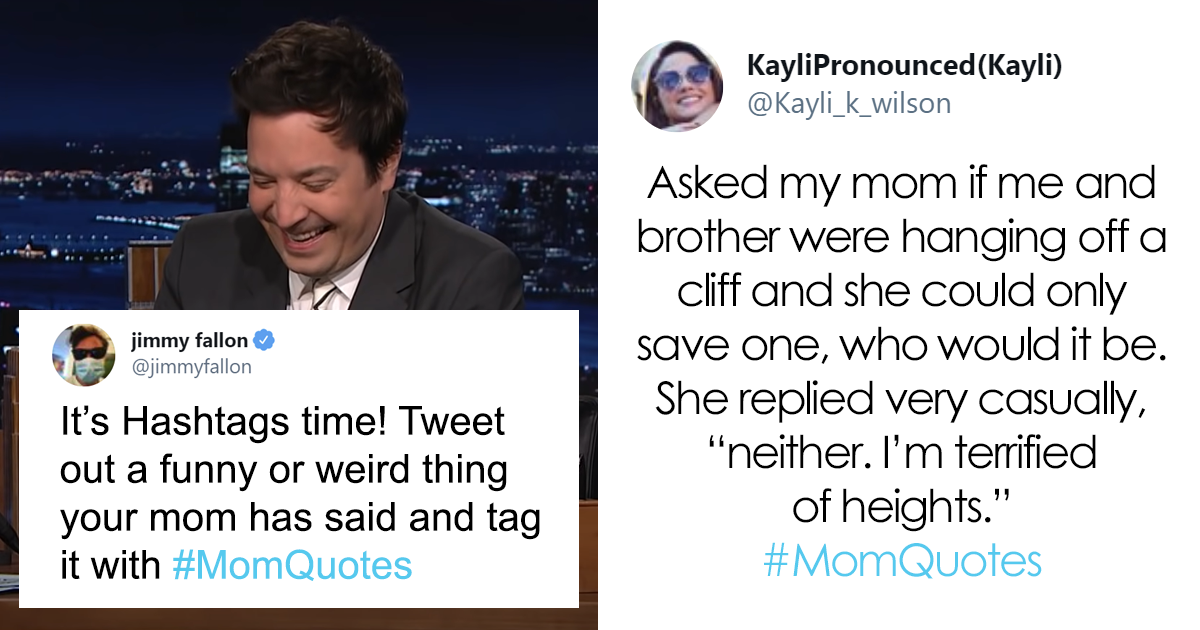
In May 2021, Jimmy Fallon invited viewers to share a funny or unusual thing their mothers had said using the hashtag #MomQuotes. The prompt followed the familiar format of The Tonight Show’s recurring “Hashtags” segment: Fallon announces a topic, viewers submit short stories on social media, and selected responses may be read on the show. Similar Mother’s Day editions had already demonstrated that ordinary family conversations can be funnier than carefully scripted comedy.
The resulting stories featured fearless honesty, accidental double meanings, technological confusion, improvised vocabulary, and the unique maternal ability to embarrass an adult child in under five seconds. Some moms delivered intentional punchlines. Others were simply trying to book a vacation, buy dish soap, or locate the correct pizza restaurant. Either way, comedy happened.
Why Jimmy Fallon’s #MomQuotes Challenge Worked So Well
The challenge succeeded because nearly everyone recognizes the basic ingredients. A mother says something strange. Her child freezes. The rest of the family immediately adopts the sentence as a permanent inside joke.
Fallon’s hashtag prompts transform these tiny private moments into collaborative storytelling. One person’s embarrassing family memory reminds thousands of readers of something equally ridiculous from their own childhood. Social platforms can create stress and conflict, but research also shows that people use them for entertainment, creativity, communication, and connection. A simple hashtag gives scattered stories one recognizable home.
There is also a reason shared humor feels so satisfying. Laughter commonly occurs during social interaction and is associated with affection, agreement, emotional regulation, and bonding. Health experts note that laughter may temporarily ease tension and activate, then relax, the body’s stress response. In other words, laughing at Mom’s latest verbal invention may be good for the familyprovided Mom is laughing too.
30 Unforgettable Mom Moments Shared for the Challenge
-
The Birthday Labor Invoice
One mother argued that her child should bring her flowers on the child’s birthday. After all, Mom performed the difficult part while the baby merely arrived, screamed, and accepted gifts. From her perspective, birthdays were annual performance reviews for labor and delivery.
-
The Grocery Store Manners Department
When someone behaved rudely in a supermarket, a quick-thinking mom politely asked which aisle contained the manners. It was a devastating insult disguised as customer service. Somewhere, an employee was probably checking inventory.
-
The Cliffside Parenting Decision
A child asked which sibling Mom would save if both were hanging from a cliff. She chose neithernot because she lacked affection, but because she was afraid of heights. Practicality defeated sentiment in record time.
-
A Maternal Definition of Personal Space
After being accused of invading her child’s personal space, one mom reminded the child where that personal space originally came from. The argument ended immediately because biology had entered the courtroom.
-
The Most Specific Safety Warning Ever
Instead of saying “drive safely,” one mother regularly warned her family to watch for deer and suspicious people. She later passed the same farewell to her grandchildren, creating a multigenerational safety program with unusually selective threats.
-
The 93-Year-Old Who Requested Clarification
During a medical appointment, a nurse asked an elderly mother whether she was sexually active. The woman calmly asked whether the nurse meant with a partner. Age had not weakened her timing, confidence, or commitment to technical accuracy.
-
The Slow Seat-Belt Prophecy
A teenager’s girlfriend complained that he was taking too long to fasten his seat belt. His mother suggested that she might appreciate his slowness in the future. The remainder of the car ride reportedly became extremely quiet, as all successful maternal ambushes should.
-
The Balsamic Vinegar Emergency
After enjoying tomatoes with balsamic vinegar, a mother tried to find the ingredient at a grocery store. Unfortunately, she loudly replaced “balsamic” with a phrase involving male anatomy. Her son promptly began considering supermarkets in another county.
-
The Passport Identity Mystery
While arranging a family vacation, one mom called her child to ask for the name and birth date printed on the passport. These were, of course, the same name she had chosen and the same birthday she had personally attended.
-
The Sister Who Was Actually a Dog
A mother phoned her daughter to praise the daughter’s sister’s adorable new haircut. There was one issue: no human sister existed. The mother was talking about the family dog, who had apparently been promoted.
-
Traffic Discipline, Puppy Style
When a boy rode his bicycle into the street, a startled mom leaned out of her car and shouted a single disciplinary word at himthe same word someone might use when a puppy chews a shoe. Maternal instinct briefly converted the entire neighborhood into obedience school.
-
The Emergency Escape Plan
One mother told her child to use her as the excuse whenever a situation felt unsafe or suspicious. She was willing to become the unreasonable villain in any story if it helped her child leave. It was funny, practical, and genuinely excellent parenting.
-
The Plastic Bag Warning That Ended Childhood Joy
A child playfully jumped toward a plastic bag blowing near the curb. Mom warned that something horrifying could be inside it. The lesson certainly discouraged reckless bag-jumping, although it may also have introduced several new anxieties.
-
The Cure for Boredom
Whenever her children complained of boredom, one mother responded that only boring people become bored. The sentence was so effective that her child later began repeating it to others. Mom had created both a motivational philosophy and a transferable guilt package.
-
The Family Bathroom Roll Call
Before leaving home, a mother always asked whether anyone needed to “piddle diddle.” She continued asking after her children passed 40. Some family traditions involve heirloom jewelry; others involve baby talk at the front door.
-
The Newspaper Reality Check
When comedian Mike Birbiglia appeared in his parents’ local newspaper, his mother concluded that the town must not have had much news that week. Fame is temporary. A mother’s ability to keep you humble is permanent.
-
Thoughts, Mostly
At a Mother’s Day meal, a waiter asked one mom what she thought after she studied the menu. She replied that she had thoughts, mostly. It was a beautifully literal answer delivered with the energy of someone who had waited years for the setup.
-
The Stock-Photo Family
One mom displayed picture frames without replacing the sample photographs. When her real children complained, she explained that the models were more attractive. Brutal? Yes. Efficient home decorating? Also yes.
-
The Mysterious Phone-Addiction Store
A mother described a supposedly vacant store filled with people standing around tables, charging phones, and staring at screens. She was horrified that nobody could disconnect for an hour. Her child explained that she had discovered an Apple Store.
-
The Great Dish-Soap Revision
An elderly mom insisted that her own mother had always used a particular dish soap. When her son pointed out that the product had not existed during Grandma’s lifetime, she paused and confidently substituted another brand. The recommendation changed; the certainty did not.
-
International Email Dialing
While her daughter vacationed in Mexico, an 85-year-old mother asked whether she needed to place a “1” before the email address because the recipient was outside the country. Telephone rules and email rules had merged into one charming communication system.
-
The No-Nonsense Dinner Review
A busy mother of six responded to complaints about dinner by noting that the food would eventually become waste anyway. It was not the slogan a restaurant would print on its menu, but it ended negotiations efficiently.
-
The Text Message Breakup
One mom ended text conversations by announcing that she was finished and saying goodbye. Every exchange sounded less like a normal sign-off and more like the final scene of a dramatic relationship.
-
The Homemade Swear Word
A mother who rarely cursed became furious with her husband and appeared ready to unleash a serious insult. Instead, she called him a “jerk-headed freak.” The family immediately adopted the phrase as its official substitute for profanity.
-
Keith Partridge in a Pear Tree
Every Christmas, one mother displayed a miniature pear tree decorated with a photograph of actor and singer David Cassidy. Her explanation transformed his television character, Keith Partridge, into a seasonal pun. The decoration was ridiculous, committed, and oddly magnificent.
-
The Candle Request
After encountering fragrant plants during a hike, a mother asked her child to help find a candle that smelled like her “bush.” The sentence was botanically understandable and socially dangerous.
-
The Family-Reunion Dating Advertisement
One mother introduced her two daughters at a family reunion by immediately announcing that both were single. It was less an introduction than a marketing campaign conducted in front of relatives who were absolutely not the target audience.
-
The Ninja Turtles of Florence
A mom praised Florence for its history and claimed visitors could enter a church where all the Ninja Turtles were buried. She had apparently blended the Renaissance artists who inspired the characters’ names with the fictional reptiles themselves. Art history has never worn more headbands.
-
Magic Jack’s and Dr. Domino’s
One mother repeatedly misnamed popular pizza chains, producing alternatives such as Magic Jack’s and Dr. Domino’s. Both sound less like restaurants and more like magicians who perform at children’s birthday parties.
-
The Fitting-Room Family Secret
While shopping for jeans with her teenage son, a mother told the salesperson that broken zippers were a family problem shared by the boy and his father. The actual cause was inexpensive clothing, but the son never returned to that store to clarify.
What Makes These Funny Mom Quotes So Relatable?
Moms Often Speak Without a Social-Media Filter
Many of the funniest responses were not traditional jokes. They were ordinary observations delivered without hesitation. A younger person might reconsider a sentence, edit it twice, and check whether it could become a meme. Mom has already said it to the waiter.
Family Language Develops Its Own Rules
Expressions such as “piddle diddle” or “jerk-headed freak” survive because families repeat them. The original moment becomes less important than the ritual of remembering it. Years later, one phrase can transport everyone back to a particular kitchen, car ride, vacation, or uncomfortable clothing store.
Embarrassment Becomes Affection With Time
In the moment, being advertised as single at a family reunion may feel like a reason to change your name and relocate. Later, the memory becomes a story told at birthdays. Family humor often improves with age because the emotional distance allows embarrassment to soften into affection.
The Best Stories Reveal Character
The anecdotes show bold mothers, protective mothers, literal mothers, competitive mothers, pun-loving mothers, and mothers who have declared open war on expensive dish soap. The punchline works because it sounds like something only that particular person would say.
Real-Life Experiences Behind the #MomQuotes Phenomenon
Almost every family has a private collection of “Mom said what?” moments, even if nobody has formally written them down. They usually surface during holiday meals, long drives, wedding receptions, or late-night conversations when someone begins with, “Do you remember the time Mom thought…” The rest of the sentence barely matters. Everyone already knows laughter is coming.
One common experience is the family technology-support call. A mother may report that “the Internet disappeared” when a browser window closes, insist that a television remote has changed its personality, or read every error message aloud except the one detail needed to solve the problem. The adult child tries to remain calm while asking whether the device is plugged in. Mom responds that it was working yesterday, which is emotionally relevant but technically unhelpful.
Then there is public-volume confusion. Some moms whisper harmless information and announce embarrassing information at stadium level. They may ask about your dating life while standing beside a stranger, discuss a medical appointment within range of six restaurant tables, or compliment your childhood bathroom habits during a wedding toast. The child experiences immediate horror. Mom appears puzzled because, from her perspective, she is simply providing context.
Food creates another rich category of family comedy. Recipes acquire unofficial names, ingredients are mispronounced, and nutritional advice becomes suspiciously flexible. A dish may be described as “basically healthy” because it contains one onion. A casserole that failed in 1997 may still be defended as an experimental success. Children complain, Mom points out that nobody else volunteered to cook, and peace negotiations conclude with cereal.
These experiences become more meaningful as families change. A sentence that once caused embarrassment can become precious after a child moves away or a parent grows older. Fallon himself has spoken publicly about his close bond with his mother, Gloria, whose humor and support were frequently recalled after her death. Stories preserve personality in a way that formal biographies rarely can: not just what someone accomplished, but how she answered the phone, corrected a waiter, invented a word, or made everyone laugh at exactly the wrong moment.
That is why keeping a family quote log can be surprisingly rewarding. It does not need to be elaborate. A shared note on a phone, a private group chat, or a notebook in the kitchen can preserve the lines everyone assumes they will remember forever. Include the date, location, and enough context to make the moment understandable. Memories fade; the phrase “Ninja Turtles buried in Florence” deserves documentation.
Sharing family stories also requires kindness. A good anecdote invites the person involved to laugh along. It should not expose private medical details, humiliate someone who dislikes attention, or turn a vulnerable mistake into permanent online entertainment. The funniest #MomQuotes feel affectionate because the storyteller clearly recognizes the warmth behind the awkward wording.
Ultimately, the experience is not really about catching mothers saying something incorrect. It is about noticing the language that makes a family unique. The accidental jokes, repeated warnings, odd nicknames, and fearless comments become part of a shared history. Long after the original conversation ends, someone repeats the line, another person performs Mom’s exact tone, and the entire room laughs before the story is even finished.
Conclusion: Moms Remain Undefeated at Accidental Comedy
Jimmy Fallon’s #MomQuotes challenge worked because it celebrated humor that was already happening in kitchens, cars, stores, restaurants, and family group chats. The mothers in these stories did not need writers’ rooms or rehearsals. They needed a confused salesperson, an inconvenient question, or approximately three seconds of silence to fill.
Behind the punchlines is something genuinely warm. These stories survive because people remember the voices that delivered them. A strange warning or mangled restaurant name can become a tiny family heirloomone that takes up no shelf space and somehow gets funnier every year.
Note: The featured anecdotes have been summarized and paraphrased from public #MomQuotes submissions for clarity, originality, and respectful publication. Context and wording may be condensed without changing the central joke.