Some homes display art. Laxmi Hussain’s home seems to breathe it.
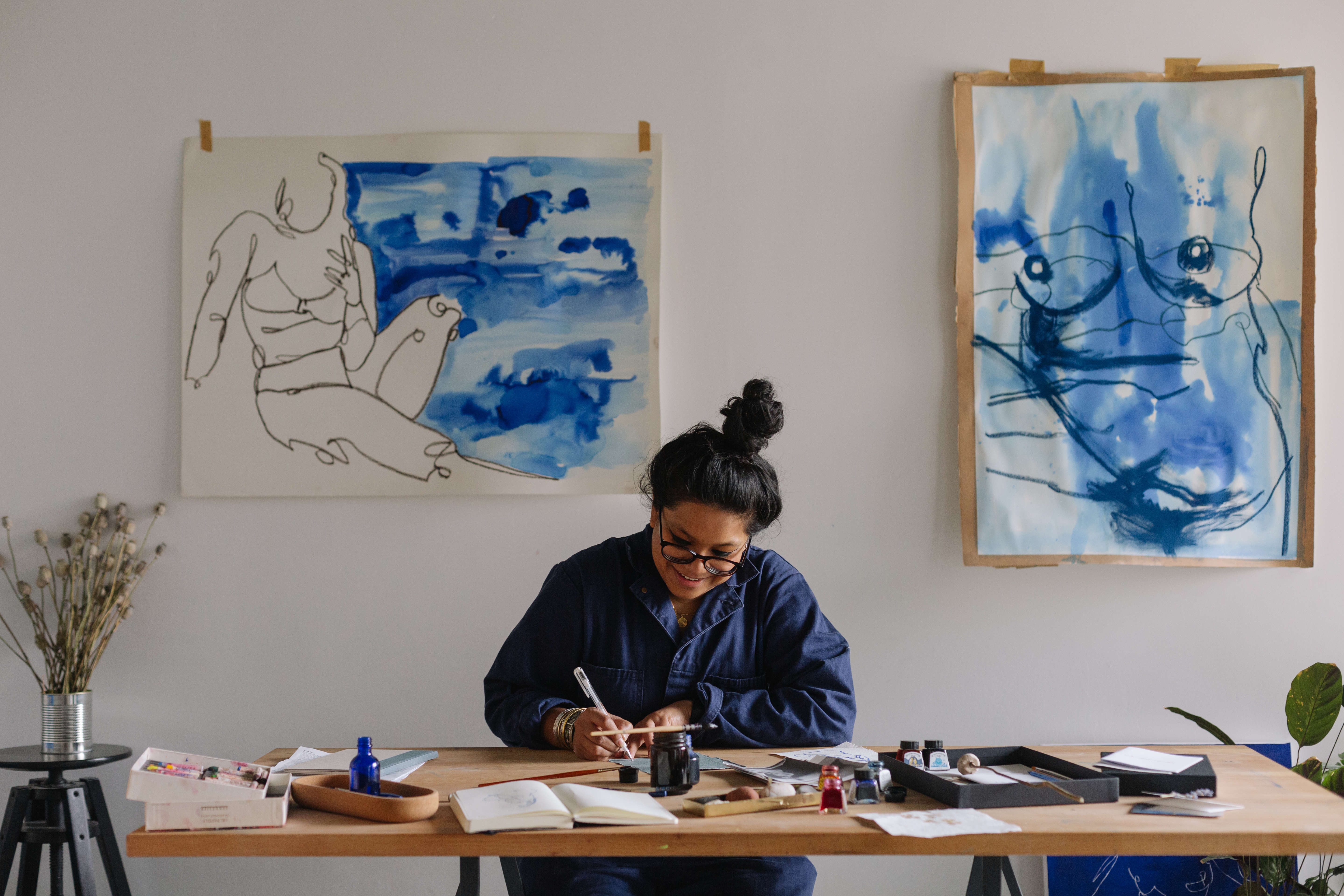
Across pale walls, practical furniture, family keepsakes, and work surfaces dusted with creative possibility, Hussain’s unmistakable blue figures appear like fragments of memory. A curved back emerges from handmade paper. A mother and child overlap. A continuous line travels around a shoulder, pauses at a hip, and leaves just enough blank space for the viewer’s imagination to finish the job.
The London artist’s domestic world and creative practice are closely intertwined. Her paintings are not decorative afterthoughts chosen to coordinate with a sofa. They grow from the same experiences that fill her home: motherhood, grief, cultural identity, changing bodies, family history, and the ongoing negotiation between caring for others and maintaining a self.
That may sound heavy, but the spaces themselves do not feel gloomy. They are bright, lived-in, useful, and refreshingly free of museum-like preciousness. This is a home where children, art supplies, inherited objects, street finds, and meaningful gifts coexist without anyone calling an emergency design meeting.
Who Is Laxmi Hussain?
Laxmi Hussain is a London-born multidisciplinary artist known for minimalist figurative paintings, fluid line drawings, works on paper, sculpture, and public art. Raised by a Filipina mother and an Indian father, she developed an early love of drawing while spending time in her parents’ corner shop. She later studied architecture, but the discipline’s rigidity eventually pushed her toward a more open-ended artistic practice.
Her career as a full-time artist gained momentum after she became a mother. Drawing with her oldest child reconnected her to the pleasure of making images without overthinking every mark. Over time, pregnancy, postpartum changes, parenting, and the loss of her own mother became central subjects in her work. Her figures now explore womanhood not as a fixed visual ideal but as an evolving physical and emotional condition.
Hussain’s work sits between abstraction and representation. A torso may be immediately recognizable, yet the face is missing. Two bodies may interlock without clear boundaries. A breast, stomach, or thigh is rendered with confident simplicity rather than polished realism. The result feels intimate without becoming literal and personal without shutting out other interpretations.
Why Blue Became the Emotional Center of the Work
Blue is the most recognizable element of Hussain’s visual language. She uses cobalt, ultramarine, and related variations across paintings, drawings, and sculptural forms. The color gives her work consistency, but its importance goes far beyond branding.
Blue was closely associated with her mother, who died from cancer in 2018. By returning to the color, Hussain created a visual thread between memory and present-day experience. The blue body can represent the artist, her mother, another woman, or an emotional state that belongs to many people at once. It becomes skin without imitating skin tone, allowing the figures to move beyond one racial identity or conventional standard of beauty.
Published interviews describe her blue palette as both a tribute and a form of emotional continuity. The color links her experience of being mothered to her experience of mothering three children herself. It holds grief, affection, strength, and vulnerability in the same spacea considerable workload for one color, but blue has always been an overachiever.
Blue Also Carries a Long Art-Historical Weight
Artists have valued intense blue pigments for centuries. Natural ultramarine was historically produced from lapis lazuli and was once so precious that its cost could rival or exceed that of gold. Synthetic ultramarine, cobalt, cerulean, and modern pigments later made saturated blues more widely available. In the 20th century, Yves Klein pushed monochromatic blue into the realm of perception, spirituality, and pure visual experience.
Hussain’s work is not an imitation of Klein, nor does it need a grand pigment-history lecture hovering over every shoulder. Still, the cultural associations of blue add depth. It can suggest distance, infinity, devotion, sadness, serenity, and the body’s inner life. In Hussain’s hands, blue is simultaneously modern, ancient, personal, and universal.
A London Home That Works as an Emotional Archive
When Hussain’s Wembley home was photographed for a 2021 profile, she lived there with her husband and three children. The family occupied a 1940s house in northwest London, not far from the studio where she worked at the time. The rooms combined affordable contemporary furnishings, family gifts, children’s objects, and Hussain’s own paintings.
The appeal of the interior comes from this lack of separation. Art is not confined to a formal gallery wall while ordinary life hides in storage bins. Small paintings appear in groups. A child’s footprint shares shelf space with a sculptural candle. A painting from the Between Mothers series hangs in the bedroom rather than waiting for a collector’s white cube.
The home demonstrates a simple principle: meaningful interiors are assembled through relationships, not shopping receipts. A room becomes memorable when objects reveal who lives there, who came before them, and what the inhabitants value. Buying everything in one afternoon might produce visual coordination, but it rarely produces a biography.
The All-White Kitchen Is More Than a Neutral Backdrop
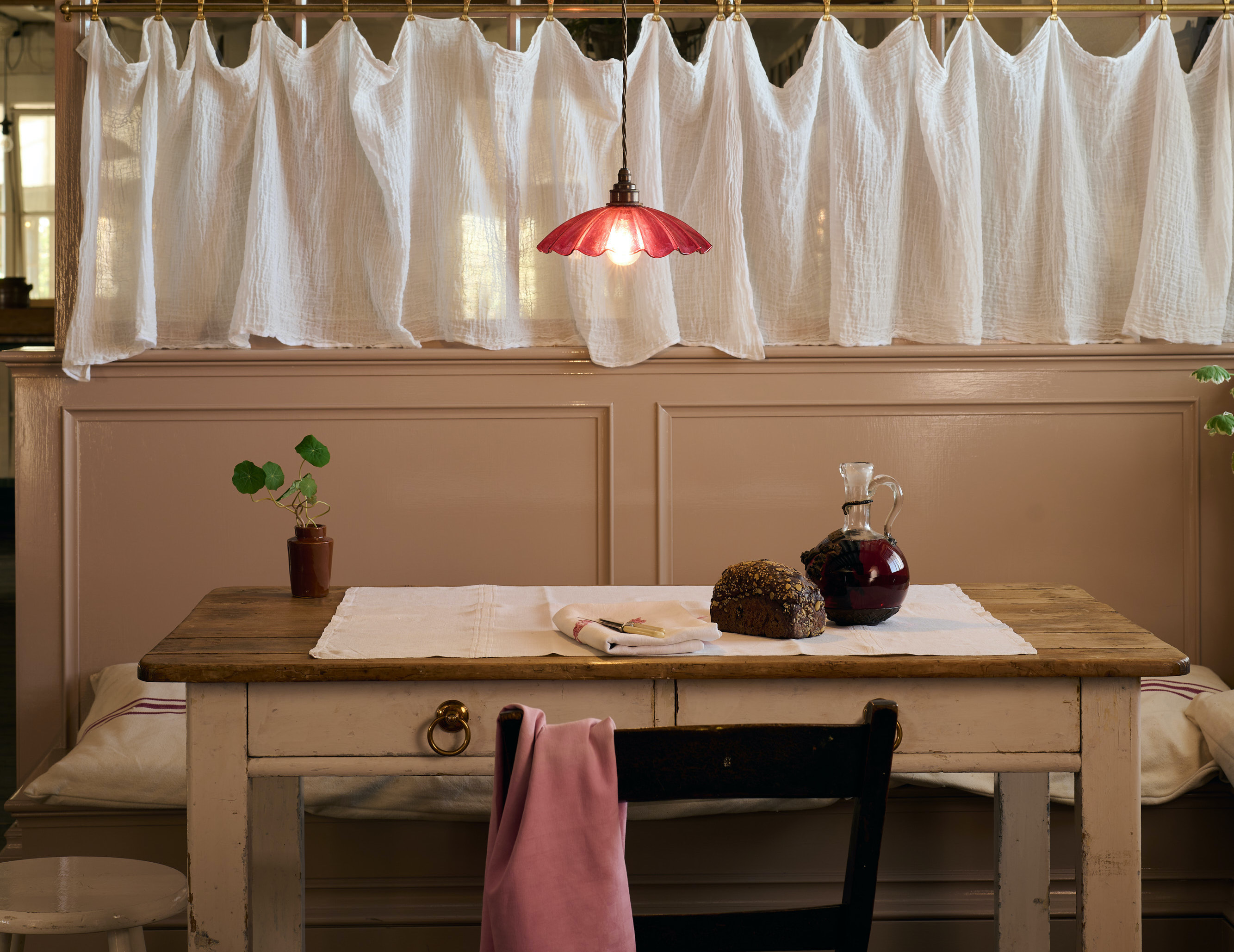
Hussain has identified the all-white kitchen as a favorite room. Its pale surfaces create a calm setting for family life, while an oak table and benchgifts from her mothergive the space emotional weight. Industrial-style cage lights introduce a practical edge, preventing the white palette from feeling too polished or clinical.
The kitchen’s restraint also makes the surrounding objects more visible. Wood grain, artwork, dishes, and everyday clutter become part of the composition. White does not erase the family’s presence; it gives that presence room to register.
For anyone attempting a similar look, this is an important distinction. A neutral interior should not feel like a beige hostage situation. It works best when it supports texture, memory, and contrast rather than replacing personality.
The Bedroom Blends Art, Family, and Tactile Materials
In the bedroom, a work from Hussain’s Between Mothers series introduces her signature blue against handmade Bhutanese paper. The paintings incorporate daisies, her mother’s favorite flower, transforming the room into a quiet site of remembrance.
A rattan bed adds warmth and texture, while smaller personal objects soften the line between display and daily life. The result is not a theme room built around “artist chic.” It is an intimate space in which materials, images, and memories have accumulated naturally.
Hussain’s use of handmade paper is especially important. The paper is not a silent support. Its fibers, tone, thickness, and irregular surface become part of the palette. Against such material, a blue line looks less like a digital outline and more like a physical event.
Inside Laxmi Hussain’s Studio
Hussain’s studio reveals the practical machinery behind the elegant finished work. Photographs show blue storage lockers, textured papers, paintings propped against walls, older chairs, tools, and worktables with previous lives. A Cesca-style chair was reportedly found on the street, while her main studio table came from her sister and had once been used for sewing.
This resourceful mix suits an artist concerned with bodies, memory, and transformation. Objects are allowed to change function. A sewing table becomes a painting table. Industrial storage becomes a bright block of color. An inexpensive or discarded chair earns a place beside original artwork.
The studio is organized but not sterile. Supplies remain accessible, and work can be viewed in groups. This is useful for an artist developing variations on a theme: one figure can be compared with another, colors can be adjusted across a series, and incomplete pieces can remain visible long enough to suggest their next move.
Her studio arrangements and home furnishings documented in published tours include blue IKEA lockers, an old IKEA chair, the found Cesca-style seat, the repurposed sewing table, heavy textured sheets, handmade cotton paper, and works from series such as Lines of Transition, Between Mothers, and Vessel.
The Power of the Continuous Line
Many of Hussain’s figures are formed with one or two long, uninterrupted lines. This technique produces an immediate sense of movement. The eye follows the mark as though tracing the body in real time, noticing where the line accelerates, thickens, bends, or disappears.
A continuous line also demands commitment. Excessive correction can kill its energy. The artist must decide which curves carry the body’s identity and which details can be omitted. Hussain’s architectural background is visible here: her figures are organic, but they are constructed with spatial awareness, proportion, and controlled geometry.
What appears effortless is usually the result of repeated looking. A simplified body is not necessarily an easy body to draw. Remove too little and the image becomes descriptive. Remove too much and it collapses into a noodle having an existential crisis. Hussain’s work maintains the difficult middle ground, where a small number of marks suggests volume, weight, tenderness, and psychological presence.
Painting Bodies Beyond a Single Ideal
Hussain has explained that she wanted to represent a wider variety of bodies because she was frustrated by the dominance of one supposed norm. Her paintings resist the polished, youthful, unchanged female body that advertising and popular imagery often present as standard.
Instead, she looks at bodies altered by time, pregnancy, birth, caregiving, grief, and ordinary life. Stomachs fold. Limbs overlap. A mother’s form may partially disappear behind a child. Rather than presenting these changes as flaws requiring correction, the work treats them as evidence of experience.
This approach places Hussain within a broader contemporary conversation about artists reclaiming representations of the female body. Museums and art publications increasingly frame bodily representation as a way to explore identity, gender, social expectations, and personal history. Artists working from lived experience have challenged the long tradition of depicting women primarily as passive objects for someone else’s gaze.
Motherhood Without the Sugar Coating
Motherhood is central to Hussain’s practice, but her work does not reduce it to soft-focus bliss. She has spoken about the closeness between a mother and infant, the physical interlocking of their bodies, and the way a mother’s identity can become blurred beneath the demands of caregiving.
In some works, a baby appears crisp and immediately visible while the maternal figure is fragmented or less clearly defined. That visual imbalance says something familiar: children are often seen in sharp detail, while the person caring for them gradually becomes background infrastructure. She is present, necessary, exhausted, loving, and somehow expected to answer emails.
Hussain also credits motherhood with strengthening her artistic ambition. Parenting did not remove creativity from her life; it gave her new subjects, new urgency, and a different relationship with fear. Her children’s willingness to draw for long stretches helped revive her own practice, and their presence in the studio became part of the creative environment rather than proof that serious work was impossible.
Incomplete Forms Invite the Viewer In
One of the most compelling features of Hussain’s figural paintings is what she leaves unfinished. A line may stop before closing the body. A face may be absent. Limbs merge into negative space. These omissions keep the work from becoming visually fixed.
The viewer must participate by mentally completing the image. That small act of interpretation makes each painting more personal. One person sees pregnancy; another sees grief, rest, sensuality, protection, isolation, or strength.
Incomplete forms also reflect the subject. Bodies are never truly finished. They age, heal, expand, contract, carry scars, and move through changing roles. Hussain’s open contours acknowledge that instability. The blank space is not missing information; it is where change remains possible.
Design Lessons From the Home and Studio
Let One Color Carry the Story
A repeated color can create continuity across different rooms, materials, and periods. Hussain’s blue appears in artworks, studio storage, and smaller details, giving the spaces a recognizable rhythm without requiring every cushion to report for matching-color duty.
Mix Sentimental Objects With Functional Pieces
The oak table from her mother, the former sewing table, children’s objects, and found furniture contribute more character than a perfectly matched suite. A home becomes richer when usefulness and emotional significance overlap.
Display Work in Progress
Finished art is only one stage of creativity. Sketches, studies, material samples, and incomplete pieces can make a studioor even a home officefeel active and inspiring. The key is to organize them intentionally so “creative process” does not become the official term for losing the floor.
Use Neutral Rooms to Support Strong Art
White walls and simple furniture allow saturated artwork to command attention. Warm wood, rattan, textured paper, and handmade surfaces prevent the neutrality from feeling cold.
Create Space for Real Life
Hussain’s interiors acknowledge that art is made around children, schedules, grief, meals, and interruptions. A creative environment does not have to be isolated from life. Sometimes the friction between the two is exactly what gives the work its meaning.
Experiencing the Body in Blue: What the Space Teaches Us
Although most people encounter Hussain’s home and studio through photography, interviews, exhibitions, or reproductions, the published spaces create a surprisingly physical impression. You can almost feel the tooth of the paper, the resistance of a long brushstroke, and the pause before a line decides whether to continue.
The first experience is one of recognition. Her figures are reduced, but they do not feel anonymous. A shoulder tipping forward or a body curving around a child can trigger memories of resting, feeding, holding, recovering, or simply occupying a body on a difficult day. The paintings do not instruct the viewer how to feel. They provide enough information to open a door and enough absence to let personal experience walk through it.
The second experience is noticing how dramatically art changes when seen in a home. In a gallery, a blue figure may be studied as composition, gesture, and contemporary figurative art. Above a bed or near a family table, the same figure becomes relational. It speaks to sleep, partnership, domestic labor, inheritance, and the people who repeatedly pass beneath it. The room supplies a second frame.
There is also an encouraging lesson for emerging artists. Hussain’s studio does not depend on a fantasy inventory of flawless designer furniture. Its character comes from adaptation: a relative’s old table, affordable lockers, reclaimed seating, and paper treated as an active material. The experience is liberating because it shifts attention away from having the perfect studio and toward building a practice with what is available.
For parents, the space offers a different kind of reassurance. Creative work does not always require life to become quiet first. Hussain has discussed working around school schedules, naps, childcare, and the presence of her children. That reality may be messy, but it also expands the definition of an artist’s life. The studio is not a sealed chamber where the creator escapes family identity. It is a place where those identities can be examined, challenged, and transformed into visual language.
Collectors may experience the work differently again. A Hussain painting rewards close attention to surface and scale. Because the forms are spare, paper texture, pigment density, and tiny irregularities matter. A reproduction communicates the composition, but an original work reveals the physical decisions behind it: where paint catches a fiber, where a line becomes translucent, and where the material refuses perfect control.
Finally, the home and studio encourage viewers to reconsider what makes an interior memorable. It is not luxury alone, nor strict consistency, nor the ability to identify every chair by surname. The strongest impression comes from alignment. The artwork, furniture, materials, and family objects all support the same larger story: bodies change, people inherit memories, ordinary objects gather meaning, and creativity can live alongside domestic life without asking permission.
That is the real experience of “the body in blue.” It is not merely looking at blue figures. It is seeing how one artist has built a visual world in which color, home, motherhood, loss, and self-acceptance continually reshape one another.
Conclusion
Laxmi Hussain’s London home and studio demonstrate that an artist’s environment can be more than a backdrop. Her interiors extend the ideas found in her figural paintings: openness, continuity, transformation, and emotional memory.
The blue bodies on her walls are beautiful, but they are not passive decoration. They question narrow ideas of femininity, preserve the presence of her late mother, record the physical realities of motherhood, and celebrate bodies that refuse to remain unchanged. Around them, inherited furniture, found chairs, handmade paper, children’s traces, and practical storage create a portrait of creativity as lived experience.
Hussain’s world feels cohesive not because everything matches, but because everything matters. That is a considerably more useful design philosophyand it requires far fewer emergency throw-pillow purchases.
Note: This independent editorial article synthesizes factual information from the artist’s published biography, interviews, studio profiles, exhibition materials, museum resources, and established art and design publications. Descriptions referring to earlier home and studio tours reflect the spaces and family details documented at the time those profiles were published.