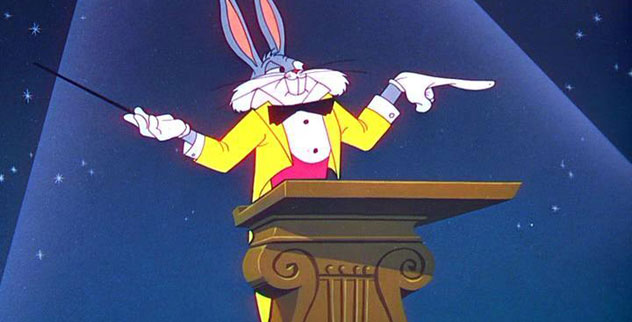
Before many children knew the names Wagner, Rossini, Liszt, or Brahms, they knew exactly what those composers sounded like. Wagner meant Elmer Fudd in a horned helmet. Rossini meant Bugs Bunny wielding barber tools with medically questionable enthusiasm. Liszt meant a grand piano, a tiny mouse, and at least one performer suffering a complete nervous breakdown.
Classical music in classic cartoons was never merely elegant background noise. Animators treated the orchestra as an invisible cast member. A violin could suggest a raised eyebrow, a cymbal crash could flatten a villain, and a racing overture could turn an ordinary chase into seven minutes of perfectly timed chaos.
The finest examples did more than borrow recognizable melodies. They reshaped major orchestral works into visual comedy, synchronized movement with rhythm, and introduced millions of viewers to opera, ballet, overtures, waltzes, and piano showpieces. Here are ten of the greatest marriages of classical music and classic animation.
Why Classical Music Worked So Well in Cartoons
Classical compositions are full of contrasts that animators adore: quiet passages followed by explosions, graceful melodies interrupted by thunderous brass, and tempos that can accelerate from a polite stroll to a runaway locomotive. In other words, much of the repertoire already behaves like a cartoon.
Golden Age animation studios also employed musicians who understood dramatic scoring. Warner Bros. composer Carl Stalling became famous for rapidly switching between melodies and synchronizing musical accents with tiny physical movements. Directors such as Friz Freleng planned scenes around musical measures, while Disney pursued an even more ambitious goal in Fantasia: making the pictures serve the music rather than simply decorating the action.
The result was an informal musical education disguised as falling anvils, exploding pianos, and rabbits wearing wigs.
10. Symphony Hour Suppé’s Light Cavalry Overture
Released in 1942, Disney’s Symphony Hour gives Mickey Mouse another opportunity to conduct an orchestra. Naturally, Goofy accidentally destroys that opportunity before the concert even begins.
The orchestra is scheduled to perform Franz von Suppé’s Light Cavalry Overture, but the instruments are badly damaged in an elevator mishap. Mickey has no practical choice except canceling the broadcast, apologizing to the audience, and filing several insurance claims. Instead, he proceeds.
The damaged instruments turn Suppé’s energetic overture into an increasingly painful musical disaster. Broken strings, distorted horns, and collapsing percussion transform the performance without abandoning the composition’s basic structure. Mickey conducts with the desperate intensity of someone attempting to steer a shopping cart down a mountain.
What makes the short memorable is its escalation. Each musical phrase reveals another mechanical problem, and every attempt to recover creates a worse sound. Classical dignity survives for approximately three seconds at a time.
9. Pigs in a Polka Brahms’ Hungarian Dances
Pigs in a Polka retells “The Three Little Pigs” through selections from Johannes Brahms’ Hungarian Dances. The familiar fairy tale becomes a nearly continuous piece of musical choreography in which construction, dancing, disguise, and attempted pig consumption follow the score.
Brahms’ sharp rhythmic changes are ideal for the story. Light, playful passages accompany the pigs’ carefree behavior, while faster and more aggressive sections energize the Big Bad Wolf’s schemes. Houses rise in time with the music, feet tap on accented beats, and the Wolf’s entrances feel less like ordinary villainy and more like an unusually hostile dance recital.
The cartoon demonstrates how classical music can replace dialogue. Viewers understand confidence, danger, foolishness, and panic through tempo and orchestration alone. It is also proof that Brahms can make almost anything seem sophisticated, including a wolf trying to enter a house through a pair of bagpipes.
8. A Corny Concerto Strauss Waltzes Meet Warner Bros. Mayhem
Bob Clampett’s 1943 A Corny Concerto affectionately parodies Disney’s Fantasia. Elmer Fudd serves as the solemn presenter at “Corny-gie Hall,” introducing animated interpretations of Johann Strauss II’s Tales from the Vienna Woods and The Blue Danube.
A Waltz Through the Woods
In the first sequence, Porky Pig hunts Bugs Bunny while the graceful waltz keeps insisting that everyone behave elegantly. Bugs responds by turning the hunt into a ballet, complete with costume changes, romantic gestures, and physical humiliation for Porky.
Daffy Disrupts the Danube
The second sequence follows a family of swans, with Daffy Duck attempting to join them. Strauss’ flowing music supports a surprisingly sweet story, although Daffy remains constitutionally incapable of behaving like a normal waterfowl.
The short works because it understands both the beauty of the music and the comic potential of treating that beauty far too seriously. The animation follows the waltzes with precision while constantly poking holes in concert-hall respectability.
7. Johann Mouse Strauss Inspires Tom and Jerry to Dance
The Academy Award-winning Johann Mouse transports Tom and Jerry to nineteenth-century Vienna and places them in the home of Johann Strauss. Jerry, known here as Johann Mouse, cannot resist dancing whenever Strauss plays a waltz.
Tom realizes that music can lure the mouse from hiding, so he teaches himself piano using a wonderfully optimistic manual titled How to Play the Waltz in Six Easy Lessons. In cartoon logic, this works. In real life, lesson seven would presumably explain scales, technique, and why your neighbors have stopped speaking to you.
The Emperor Waltz and Strauss-inspired scoring turn the usual chase into a refined performance. Jerry glides across the floor while Tom plays, momentarily replacing their violent household rivalry with artistic cooperation. Their fame eventually takes them to the imperial palace, where they perform for the emperor.
The music does not merely accompany the story; it causes the story. Without the waltz, Jerry stays hidden, Tom remains musically illiterate, and Vienna misses its most unusual piano-and-mouse act.
6. The Band Concert Rossini Battles Donald Duck
Disney’s 1935 short The Band Concert was Mickey Mouse’s first theatrically released color cartoon, and it gave him one of his most famous roles as an increasingly frustrated conductor.
Mickey’s outdoor ensemble attempts to perform the finale of Rossini’s William Tell Overture. Donald Duck, working as a vendor, repeatedly interrupts with a flute rendition of “Turkey in the Straw.” No matter how many flutes Mickey destroys, Donald produces another one, suggesting either magical powers or an extremely specialized wholesale account.
Rossini’s galloping finale already conveys speed and momentum. The animators build on that energy as the concert is disrupted by Donald, a bee, and eventually a cyclone. Even while being lifted into the air and spun through the landscape, the musicians continue playing.
The joke is not simply that the concert goes wrong. It is that Mickey remains absolutely committed to finishing the overture while nature dismantles the entire venue. His professional dedication is admirable, inspiring, and probably excluded from the band’s safety policy.
5. Rhapsody Rabbit Bugs Bunny Versus Liszt
In Rhapsody Rabbit, Bugs Bunny appears as a concert pianist performing Franz Liszt’s famously demanding Hungarian Rhapsody No. 2. He begins with formal confidence, carefully adjusting his gloves and acknowledging the audience. Then a mouse living inside the piano decides to participate.
The composition’s dramatic pauses, sudden accelerations, and showy finale provide a complete structure for the comedy. Bugs attacks difficult passages with theatrical flair while the mouse interferes with keys, strings, and tempo. At one point, Bugs answers a telephone during the performance and claims he has never heard of Franz Liszt. This is a bold position for someone currently playing several thousand of Liszt’s notes.
The cartoon turns virtuosity into combat. Piano technique, physical comedy, and character acting become inseparable. Bugs is not simply performing the music; he is fighting for artistic control against a rodent with excellent timing.
4. The Cat Concerto Tom and Jerry’s Piano War
Liszt’s Hungarian Rhapsody No. 2 receives another legendary animated treatment in MGM’s The Cat Concerto. Tom plays the role of a dignified concert pianist, while Jerry sleeps inside the instrument until the performance disturbs him.
What follows is an extraordinary piece of synchronized animation. Jerry dances on the piano’s internal mechanisms, manipulates the keys, alters Tom’s playing, and converts the instrument into a battlefield. Tom continues performing for the audience even while using his hands, feet, and occasionally his entire body to control both the music and the mouse.
The timing is exceptionally precise. Liszt’s false endings become visual fake-outs, rapid keyboard runs fuel frantic attacks, and powerful chords send Jerry bouncing through the piano. The short won the Academy Award for Short Subject (Cartoon), confirming that even prestigious institutions appreciate a well-executed keyboard assault.
Where Rhapsody Rabbit emphasizes Bugs’ personality, The Cat Concerto develops a nearly wordless duel. The music supplies every shift in mood, from elegance to irritation to total exhaustion.
3. The Sorcerer’s Apprentice Dukas Gives Mickey Magical Momentum
The Mickey Mouse segment of Disney’s Fantasia uses Paul Dukas’ symphonic poem The Sorcerer’s Apprentice, which was itself inspired by a poem by Johann Wolfgang von Goethe. This layered history becomes a remarkably clear animated story: an apprentice uses magic he does not understand and immediately creates a workplace flooding incident.
Mickey enchants a broom to carry water while his master is away. The plan succeeds so efficiently that Mickey falls asleep. Soon the broom will not stop, and Mickey’s attempts to destroy it create an army of additional brooms.
Dukas’ recurring musical themes make the sequence feel inevitable. The bassoon introduces the broom’s stiff little march, while the growing orchestra reflects the expanding catastrophe. The music becomes louder, denser, and more forceful as Mickey loses control.
Unlike many comedy shorts, the sequence allows fear and awe to share the screen with humor. Mickey’s dream of commanding the stars feels genuinely grand, while the flood becomes genuinely threatening. The cartoon visualizes orchestration itself: as more instruments join the score, more magical forces appear on screen.
2. Rabbit of Seville Rossini Runs a Cartoon Beauty Salon
Rabbit of Seville turns the overture to Rossini’s The Barber of Seville into one of animation’s most perfectly synchronized chase sequences. Elmer Fudd pursues Bugs into a theater, where Bugs takes control of the stage and transforms the hunt into an improvised opera.
Every musical gesture generates an action. Bugs massages Elmer’s scalp, applies hair tonic, produces flowers, chops vegetables on his head, and subjects him to a series of beauty treatments that would cause any legitimate salon to lose its license before intermission.
Rossini’s famous crescendos are particularly effective. As the music repeats and intensifies, Bugs’ movements grow faster and more elaborate. The visual gags do not interrupt the overture; they reveal its comic possibilities.
The short also captures something essential about Bugs Bunny. He defeats Elmer not through strength but through performance. Bugs understands the stage, the audience, the costume rack, and the rhythm of the music. Elmer has a hunting rifle. Bugs has Rossini. The outcome was never in doubt.
1. What’s Opera, Doc? Wagner’s Epic Becomes Cartoon Perfection
No classic cartoon uses classical music more boldly than Chuck Jones’ What’s Opera, Doc? The short compresses Wagnerian motifs from the Ring cycle, Tannhäuser, and The Flying Dutchman into a mock epic starring Bugs Bunny and Elmer Fudd.
Elmer becomes the mighty warrior Siegfried, although his familiar speech pattern somewhat reduces the intimidation factor. Bugs appears as the beautiful Brünnhilde, complete with braids, helmet, and an impressive ability to dance across scenery that seems designed by an expressionist architect during a thunderstorm.
The most famous moment adapts “Ride of the Valkyries” into Elmer’s declaration of his rabbit-hunting mission. Yet the cartoon offers more than a memorable lyrical parody. It uses Wagner’s enormous musical scale to exaggerate the familiar Bugs-and-Elmer conflict until it seems capable of determining the fate of the universe.
The backgrounds are monumental, the shadows are dramatic, and Elmer’s magical helmet controls storms. For once, he becomes genuinely dangerous. When the comedy briefly gives way to tragedy, the music supports an unexpectedly emotional endingbefore Bugs naturally reminds the audience that he is still Bugs Bunny.
The Library of Congress selected What’s Opera, Doc? for the National Film Registry, an honor reflecting its cultural, historical, and aesthetic importance. It is a parody made with such intelligence and visual ambition that it also functions as a tribute. Wagner may never have imagined a rabbit in drag crossing his mythological landscape, but the result feels strangely inevitable.
How Classic Cartoons Made Orchestral Music Unforgettable
These cartoons succeeded because they never treated classical music like homework. The compositions were active sources of character, rhythm, tension, and humor. Animators respected the structure of the music while cheerfully refusing to respect anyone standing near an anvil.
They also gave listeners powerful visual memories. A person may forget the title Hungarian Rhapsody No. 2, yet instantly recognize the melody as “the piano music from that cartoon.” Someone hearing the William Tell Overture may picture a cyclone carrying Mickey’s orchestra through the sky. Wagner’s heroic themes may summon Elmer Fudd before they summon Norse mythology.
That association is not a failure of musical education. It is evidence of how effectively animation can make sound memorable. The cartoons offered an accessible entrance into orchestral music and encouraged curious viewers to discover the complete compositions later.
The Experience of Revisiting Classical Cartoon Music
Watching these shorts as a child and revisiting them years later can feel like seeing two different productions projected on the same screen. During childhood, the immediate attractions are easy to identify: Tom gets hit by piano hammers, Mickey loses control of the brooms, and Elmer receives the most aggressive haircut in Hollywood history. The music feels natural, almost invisible, because it fits every movement so perfectly.
An adult viewing reveals how much labor hides beneath that apparent simplicity. A raised hand lands on a precise accent. A character pauses for exactly the length of a rest. A chase accelerates with the orchestra, and a visual punch line arrives at the musical resolution. What once looked like spontaneous chaos begins to resemble a carefully engineered machine.
It is especially enjoyable to watch one of these cartoons immediately after hearing the original composition. The experience exposes the decisions made by the animators. In Rabbit of Seville, Rossini’s crescendos suddenly seem built for escalating salon abuse. In The Cat Concerto, Liszt’s theatrical pauses become opportunities for Tom to regain his dignity before Jerry removes it again. In What’s Opera, Doc?, Wagner’s massive brass writing explains why Elmer briefly seems capable of controlling the weather.
A live orchestral screening creates another kind of experience. With musicians performing beneath the projected animation, the score stops sounding like a fixed recording and becomes physical. Bows move together, percussionists prepare for split-second effects, and the conductor must remain synchronized with action created decades earlier. The audience often laughs before the gag is complete because the music has already signaled what is coming.
Revisiting these cartoons can also produce the amusing realization that they quietly shaped musical taste. A viewer who claims to have “never listened to classical music” may recognize Rossini, Strauss, Wagner, Brahms, Suppé, Dukas, and Liszt within seconds. The knowledge arrived without formal lessons. It entered through Saturday-morning television, theatrical reruns, home video, and a suspicious number of cartoon characters carrying dynamite.
The best experience is not choosing between comedy and classical music. It is discovering that the two were never enemies. The cartoons reveal playfulness already present inside the compositions: Rossini’s momentum, Liszt’s flamboyance, Strauss’ elegance, and Wagner’s appetite for spectacle. Animation simply turns those qualities into visible action.
After one of these viewing sessions, it becomes difficult to hear the music neutrally again. A concert pianist may begin Liszt with perfect seriousness, but somewhere in the imagination, a mouse is already climbing into the instrument. That may not be what the composer intended, but it is a delightful form of cultural immortality.