Trends move fast. Tattoos, unfortunately, move at roughly the speed of a sleepy glacier carrying a permanent marker.
A meme can dominate the internet on Monday, appear on T-shirts by Wednesday, and become painfully embarrassing before the weekend. Yet somewhere during that brief cultural window, a brave soul may decide that the joke deserves a lifelong home on their forearm.
That does not mean tattoos are generally regrettable. Pew Research Center found that 32% of American adults have at least one tattoo, and most tattooed adults remain happy with their body art. Research on tattoo regret, however, suggests that people who choose designs mainly because they are fashionable may be more likely to stop liking them later. In other words, personal meaning tends to age better than whatever the algorithm is yelling about today.
The following collection examines 30 gloriously questionable tattoo choices inspired by real viral tattoo galleries, documented regret patterns, celebrity ink mishaps, and internet trends that disappeared long before the swelling did.
30 Tattoos That Lost Their Cool at Record Speed
1. Mocking SpongeBob Became a Permanent Roommate
Mocking SpongeBob was everywhere for a brief, capital-letter-filled period. Tattooing the bent cartoon character permanently captured the joke, but it also turned one person’s skin into a museum exhibit dedicated to a very specific week on the internet.
2. Pikachu Asked Whether the Tattoo Was Permanent
A Pikachu tattoo accompanied by the question “You know that’s permanent, right?” has at least one defense: Pokémon has survived multiple generations. The joke may be dated, but the electric mouse remains more culturally durable than most people’s first smartphones.
3. The Bernie Sanders Mittens Moment
Bernie Sanders sitting in a folding chair with his mittens became one of the defining memes of the 2021 presidential inauguration. It was funny, wholesome, and instantly recognizable. As a tattoo, however, it permanently preserves a joke that the internet consumed in approximately six minutes.
4. The Tide Pod Tribute
The Tide Pod challenge was dangerous, bizarre, and thankfully short-lived. A tattoo of the colorful detergent capsule preserves the visual punch line while raising an eternal question: was there truly no safer household product available for artistic inspiration?
5. “Never Forget” the Toilet Paper Shortage
One pandemic-era tattoo featured a roll of toilet paper with the solemn words “Never Forget.” It commemorated the frantic stockpiling of 2020 with all the seriousness of a national monument, except the memorial could be hidden under a sleeve.
6. The White-and-Goldor Blue-and-BlackDress
For several days in 2015, civilization divided into two camps over the color of a photographed dress. Naturally, someone tattooed the garment along with the question. The debate ended, but the tattoo remained available for every confused dermatologist and future grandchild.
7. “Winter Is Coming” Across the Forehead
A television quote can be fun. A television quote placed prominently on the forehead requires significantly more confidence. Once the series ends and public enthusiasm cools, the wearer is still personally forecasting winter during every job interview, wedding, and trip to the grocery store.
8. A Giant Rage-Comic Face
Rage comics once ruled online humor with crudely drawn expressions and wonderfully terrible spelling. Enlarging one of those faces across a person’s back transformed a disposable internet reaction into a mural from the ancient civilization known as “early Facebook.”
9. “No, This Is Patrick”
A clever tattoo based on Patrick Star’s famous phone response can still make people laugh. The danger comes when a small visual joke is expanded into a large, highly detailed commitment. Sometimes the punch line should remain smaller than the person receiving it.
10. The Internet Frog Dressed Like a Rapper
One design transformed a familiar online frog into a chain-wearing, cap-sporting celebrity. It may still work as surreal art, but meme characters often collect new meanings over time. A harmless joke can become cultural luggage without asking the wearer’s permission.
Viral examples involving SpongeBob, Pikachu, Bernie Sanders, pandemic toilet paper, “The Dress,” television quotes, rage faces, and other meme tattoos appeared in a widely shared tattoo-fail collection.
11. “Gangnam Style” in Permanent Ink
The song was unavoidable in 2012. Its dance crossed borders, broke records, and inspired people to pretend they could ride invisible horses. Tattooing the title preserved the excitement, although explaining the dance to younger relatives may now require a history lecture.
12. The Harambe Memorial
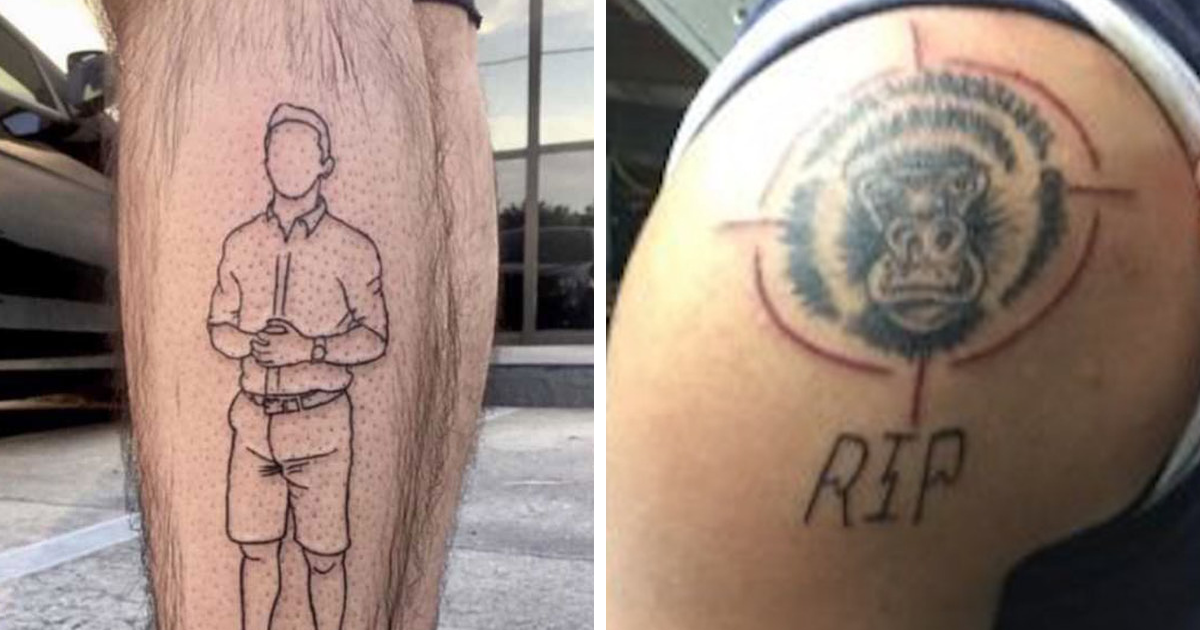
Harambe’s death became an enormous internet phenomenon, producing sincere grief, ironic tributes, and endless memes. An “RIP Harambe” tattoo occupies the uncomfortable space between heartfelt memorial and time capsule from one of the internet’s strangest cultural episodes.
13. Pickle Rick Forever
Turning Rick into a pickle became one of the most quoted moments from Rick and Morty. The character can still be funny, but the tattoo risk is obvious: repeating the joke for years may eventually feel like living beside someone who never stops quoting the same episode.
14. The MySpace Stomach Logo
Social platforms rarely last as long as tattoos. A large MySpace logo once represented online identity, friendships, music discovery, and carefully ranked Top 8 lists. Today, it functions as digital archaeology placed conveniently between the ribs and waistband.
15. The Viral Dance Character
Online dances arrive with dramatic speed and disappear just as quickly. A tattoo of a temporarily famous dancing character can become impossible to explain without performing the original move, locating an archived video, and apologizing for the internet’s behavior.
16. The Minimalist Portrait Nobody Recognizes
Outline portraits depend heavily on recognition. When the subject is attached to a fading trend, the design may eventually look like an unfinished coloring page. Minimalism is elegant, but only when future viewers do not need three clues and a search engine.
17. The Crying Reaction Figure
A stick figure wearing a dramatic crying mask may accurately summarize adulthood, so perhaps this one remains relevant. Still, tattoos based on reaction images can age like old messaging-app stickers: once hilarious, later confusing, and eventually rediscovered by nostalgic teenagers.
18. The Full Collection of Rage Faces
Why choose one outdated meme when an entire arm can host the complete emotional range of 2010? A sleeve filled with troll faces and exaggerated reactions offers impressive historical coverage, although it resembles a yearbook signed by every joke the internet abandoned.
19. “Harlem Shake” on Both Legs
The Harlem Shake inspired thousands of short videos in 2013. Groups stood calmly before erupting into costumed chaos. Splitting the phrase across two legs was certainly committed, but the tattoo stayed long after offices stopped dancing in motorcycle helmets.
20. “Don’t Sneeze on Me” Pandemic Ink
A snake, a gas mask, and a warning about sneezing captured the nervous humor of the pandemic era. As a historical marker, it works. As everyday body art, it may require an increasingly long explanation whenever someone asks why the snake is practicing respiratory etiquette.
Documented viral tattoo examples also included “Gangnam Style,” Harambe, Pickle Rick, MySpace, rage-comic characters, the Harlem Shake, and pandemic-themed artwork.
21. Big Chungus Took Over a Calf
Big Chungus turned an old Bugs Bunny frame into an enormous internet character. The meme’s deliberately ridiculous nature made it funny, but a large tattoo transforms a fleeting absurdity into something requiring the lifelong confidence of Bugs Bunny himself.
22. The “What’s Updog?” Tattoo
A dog using an old-fashioned telephone set up the classic “updog” joke. It is charming, well constructed, and guaranteed to make unsuspecting viewers ask the necessary question. Unfortunately, the owner must then deliver the same punch line until the end of time.
23. The Spicy Cat
A startled cat labeled “SPICY” may not need any cultural context at all. That gives it better survival odds than most meme tattoos. Still, attaching permanent text to a temporary reaction image is always a gamble, especially when cats invent new internet careers daily.
24. The “Bh Please” Meme Face
The exaggerated laughing face once appeared under countless dismissive captions. Tattooing it on a leg effectively installed a permanent comment section. The expression remains readable, but the style immediately identifies the era when every joke arrived in Impact font.
25. Matching Song Lyrics Across Four Thighs
Matching tattoos can strengthen friendships, but coordinating a lyric across several people creates logistical problems. The group must stay close, stand in the correct order, and continue liking the song. One disagreement turns the chorus into a badly shuffled playlist.
26. Kirby Emoji Mood Tattoos
Two Kirby-inspired expressions placed on the wrists may remain adorable even after the original online trend fades. This illustrates an important exception: a design with strong visual appeal can outlive its meme. Cute artwork occasionally escapes the expiration date.
27. The Jonas Brothers Neck Tattoo
Band devotion can be intense, especially when concerts, posters, and playlists are not enough. A neck tattoo makes the fandom impossible to miss. Fortunately, the Jonas Brothers have reunited more than once, giving this particular decision unexpected opportunities to become relevant again.
28. The Unidentifiable Dancing Celebrity
A colorful dancing figure covered in sparkles may have been instantly recognizable when created. Years later, it can resemble an enthusiastic aerobics instructor who wandered onto someone’s skin and refused to leave after the class ended.
29. “Scatman’s World” on a Foot
A song title tattoo can preserve a beloved personal memory, even when the song leaves mainstream conversation. The awkward part is placement: foot tattoos already face friction and fading, so the nostalgic message may slowly transform into an unsolved word puzzle.
30. A “That’s Hot” Celebrity Portrait
A portrait paired with the phrase “That’s Hot” permanently captures early-2000s celebrity culture. The artwork may be skillful, but the combination is so era-specific that it practically arrives with a tiny flip phone, low-rise jeans, and a reality television contract.
The final portion of the original gallery included Big Chungus, joke-based animal designs, old meme faces, coordinated lyrics, Kirby expressions, a Jonas Brothers neck tattoo, music references, and a celebrity portrait with “That’s Hot.”
Why Trendy Tattoos Become Uncool So Quickly
The central problem is not that humorous tattoos are automatically bad. A ridiculous tattoo can be joyful, beautifully executed, and deeply personal. Trouble begins when the design’s entire appeal depends on public recognition. When everyone stops recognizing it, the tattoo loses the audience that made it funny.
Tattoo history shows that body art has long represented identity, remembrance, protection, belonging, achievement, and personal experience. Those themes tend to remain meaningful because they belong to the wearer rather than to an advertising cycle or social-media feed. Trends have always influenced tattoo design, but today’s trends can rise and collapse much faster than the skin can heal.
Foreign-Language Tattoos Add Another Risk
Translation errors can make a tattoo irrelevant before the artist even puts the needle away. Ariana Grande famously attempted to celebrate “7 Rings” with Japanese characters, only for readers to point out that the shortened wording could refer to a small barbecue grill. She later tried to adjust the design, proving that copy editing is useful even in the recording industry.
Relationship Tattoos Can Outlast the Relationship
Names, wedding rings, anniversary dates, and matching symbols can feel wonderfully romantic. They can also become awkward after a breakup. Celebrity tattoo-removal stories and ordinary removal cases repeatedly feature former partners’ names, altered wedding ink, and designs connected to relationships that ended long before the removal appointments did.
Experiences and Lessons Behind Tattoo Regret
Tattoo regret does not always arrive years later. Some people experience it almost immediately. The initial excitement fades, the bandage comes off, and the new design suddenly looks larger, darker, or more visible than expected. A decision that felt adventurous in the studio can feel overwhelming the next morning, particularly when the person chose the design impulsively or allowed a friend to practice without a detailed plan.
Others enjoy their tattoos for years before their feelings change. Their personal style evolves, a relationship ends, a celebrity behaves badly, or a once-beloved phrase no longer reflects their beliefs. In these cases, the tattoo is not necessarily a mistake. It may simply be a permanent record of a temporary identity. The discomfort comes from seeing an old version of oneself every day without the option to place that version in a storage box.
Placement often shapes the experience as much as the artwork. A silly design on the upper thigh can remain a private joke. The same image on the hand, neck, or forehead becomes part of every introduction. Experienced artists frequently encourage first-time clients to consider less visible placements and to study an artist’s portfolio carefully before making a commitment. Detailed consultations also help artists adjust composition, size, line weight, and color to the client’s body rather than copying an image directly from the internet.
Cover-ups can provide a satisfying second chapter. A former partner’s name might become leaves, flowers, an animal, or a larger abstract design. A faded meme can disappear beneath darker artwork. The success of a cover-up, however, depends on the old tattoo’s size, location, density, colors, and scar tissue. The new design usually needs to be larger and strategically shaded, so “I’ll just cover it later” is not a reliable planning method.
Laser removal is another option, but it is not an instant undo button. Dermatology authorities explain that removal commonly requires multiple treatments. It can be uncomfortable, may not erase every pigment completely, and can cause temporary or lasting changes such as redness, soreness, scarring, infection, or skin discoloration. Home removal methods can be ineffective and dangerous.
People who successfully avoid regret often describe surprisingly ordinary habits. They wait several months before booking. They print the design and keep it somewhere visible. They check every word, date, symbol, and translation. They review healed examples from the artist rather than relying only on fresh, glossy social-media photos. Most importantly, they ask whether they would still enjoy the image if nobody else understood the reference.
That final question is especially useful for meme tattoos. A personal joke can remain meaningful because it recalls a friendship, trip, or life event. A trend tattoo chosen mainly to impress strangers has a weaker foundation. The strangers move on, the platform changes its algorithm, and the wearer is left maintaining an exhibition for visitors who no longer recognize the artist.
There is also value in accepting that not every dated tattoo needs removal. Old body art can become a funny personal artifact. The badly translated phrase, forgotten band logo, or ancient meme may eventually produce affection rather than embarrassment. A tattoo can be uncool and still tell a good storyand a good story generally ages better than an attempt to pretend the past never happened.
How to Choose a Tattoo That Ages Better
Choose an idea with personal value beyond its current popularity. Wait long enough for the initial excitement to settle, research artists whose established style matches the project, and request an original composition rather than a direct copy. Check spelling and translations with qualified human readers, especially when the design uses a language you do not speak.
It also helps to imagine the tattoo without its cultural context. Would the artwork still look attractive if the television show ended badly, the app disappeared, the celebrity was canceled, or the meme became impossible to explain? A strong design should offer something even after its reference loses relevance.