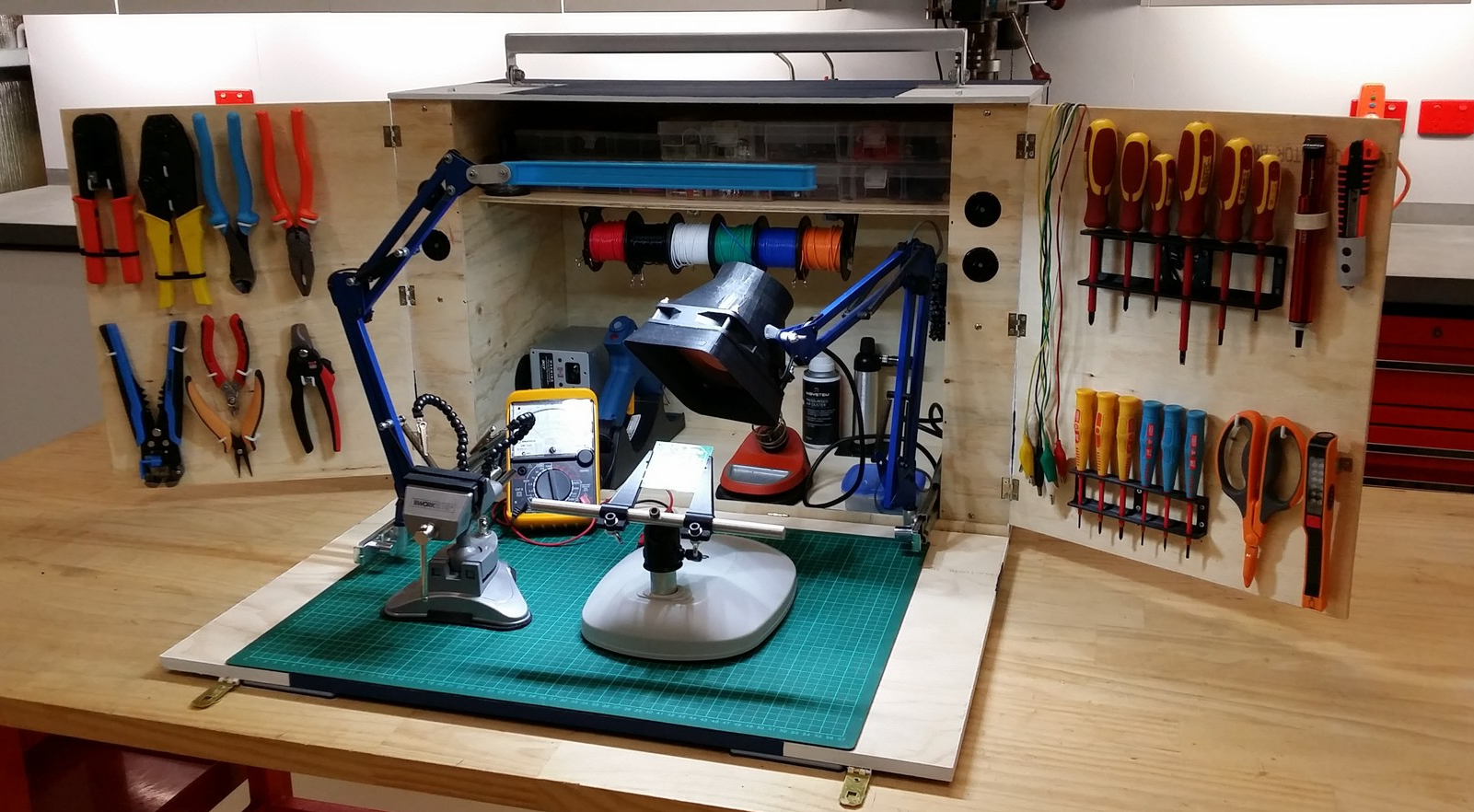
A portable workbench usually looks like a folding table, a battered toolbox, or a plastic case that has endured one too many trips down the basement stairs. The Soundwave portable electronics workstation takes a much more entertaining approach: it turns a self-contained workbench into a tribute to one of the most recognizable robots of the 1980s.
Built around the blue, silver, red, and yellow appearance of the Generation 1 Transformers character Soundwave, this fan-made workstation combines tool storage, integrated power, lighting, soldering equipment, ventilation, and a usable work surface inside a plywood cabinet. Closed, it resembles a compact piece of themed equipment. Open, it becomes a miniature electronics lab ready to repair a circuit board, assemble a prototype, or investigate why a supposedly simple project has produced smoke.
What Is the Soundwave Portable Workbench?
The original Soundwave workstation was created by a maker known online as Tez_Gelmir and documented as a portable electronics workstation. Hackaday later highlighted the project in 2014, praising both its practical organization and its detailed Transformers-inspired paint job.
The cabinet holds several major groups of electronics tools, including screwdrivers, pliers, crimpers, a soldering iron, a small vise, wire, component containers, a work light, and a fume extractor. Multiple electrical outlets are mounted inside the enclosure, while the main power cord exits through a small access opening and stores neatly when the workstation is closed.
The Soundwave theme is more than a random coat of blue paint. In the original Transformers series, Soundwave changed into a tape deck and carried cassette-shaped robotic assistants. That boxy, compartment-oriented design translates surprisingly well into a portable workbench. Tool trays become mechanical panels, drawers resemble cassette bays, and the entire cabinet looks as though it might stand up and announce that your solder joints are inferior.
Research basis for the project history and design details: Hackaday, Instructables, and Hasbro.
Why This Portable Electronics Workstation Works
It Gives Every Tool a Defined Home
Organization is the workstation’s strongest practical feature. Instead of dropping cutters, tweezers, drivers, and solder into one enthusiastic pile, the cabinet assigns them visible positions. Frequently used tools remain within easy reach, while small components live in divided containers rather than migrating into carpet fibers.
This arrangement reduces setup time. When the cabinet opens, the core tools are already in place. There is no need to search three drawers for the correct screwdriver or discover that the solder spool was last seen near the kitchen table. A well-planned tool layout also makes missing equipment easier to notice before the cabinet is packed and moved.
It Creates a Workbench Almost Anywhere
A traditional electronics bench can occupy an entire wall. The Soundwave design compresses the most important functions into a movable cabinet. It can be used in a garage, dorm room, makerspace, spare bedroom, or temporary project area, provided the supporting table is stable and the electrical setup is appropriate.
Portability always involves compromise. A compact station cannot offer the surface area or load capacity of a full-size bench, but it can deliver something equally valuable: consistency. The same tools, lighting, storage system, and power arrangement travel together instead of being reconstructed at every location.
It Separates Storage From the Active Work Area
The open doors and interior walls become vertical storage zones, leaving the central surface available for actual work. That matters when handling circuit boards, loose fasteners, wires, and small modules. A crowded work surface encourages accidental damage, misplaced screws, and the classic workshop maneuver known as sweeping everything onto the floor with one elbow.
It Makes the Workstation Enjoyable to Use
Themed tools are not automatically better tools, but personality can improve the experience of using them. The Soundwave paint scheme turns a functional plywood cabinet into a project worth displaying. It also demonstrates an important maker principle: equipment does not have to look like it was issued by a committee specializing in beige.
Research basis for portable-workbench stability, storage, mobility, and workflow considerations: Kreg, The Spruce, and element14.
Planning a Soundwave-Inspired Portable Workbench
Start With the Work You Actually Perform
Before cutting plywood, list the jobs the station must support. A basic soldering workstation may need an iron, solder, flux, cutters, tweezers, a multimeter, a small vise, component storage, and task lighting. A repair-focused station may also need spudgers, precision bits, magnification, an electrostatic-discharge mat, and labeled trays for screws.
Avoid designing around every tool you own. Portable workstations become less portable when builders attempt to include an oscilloscope, bench power supply, drill press, twelve battery chargers, and something inherited from an uncle that may be a transformer or may be part of a lawn mower.
Choose Strong but Manageable Materials
Plywood is a sensible cabinet material because it is relatively strong, easy to machine, and friendly to screws, hinges, brackets, and custom dividers. Thin material saves weight but may flex under tools or loosen around hardware. Thicker panels improve rigidity but quickly turn a portable cabinet into a lower-back assessment device.
Reinforce the areas that experience repeated stress, especially the handle, hinges, latches, vise mount, and base. Metal corner protectors can reduce damage during transportation. Rounded or protected exterior edges are also less likely to chip when the cabinet meets a doorway at an unfavorable angle.
Mock Up the Interior Before Permanently Mounting Tools
Place the intended equipment inside an unfinished cabinet and test the arrangement. Open and close every door. Remove each tool with one hand. Confirm that cords do not cross hot surfaces or interfere with hinges. Check whether component boxes can be opened without removing three other items first.
Heavy equipment should sit low and close to the cabinet’s center. This improves balance and reduces the tendency to tip when doors are open. Frequently used hand tools should remain near the front, while occasional accessories can occupy deeper compartments.
Protect the Main Work Surface
An electronics station needs a surface that can tolerate heat, scratches, clipped wire ends, and occasional drops of solder. A replaceable heat-resistant work pad is usually more practical than treating the painted cabinet itself as a sacrificial surface.
A cutting mat may work for measuring and trimming, but it should not be assumed to tolerate direct contact with a hot soldering iron. The iron needs a stable purpose-built stand, preferably positioned where its cord cannot drag across the project.
Design for Maintenance
A portable workbench should be repairable. Use removable panels where electrical connections or ventilation components may need inspection. Mount tool holders with screws rather than permanent adhesive when possible. Label wiring, switches, and outlets so future troubleshooting does not become an archaeological expedition.
Power, Ventilation, and ESD Safety
Treat Integrated Power as a Serious System
Built-in outlets are convenient, but mains-voltage wiring should not be improvised. Use listed, appropriately rated components and follow local electrical requirements. Protect flexible cords from sharp plywood edges, hinges, hot tools, and pinch points. A cord-access opening should include a smooth grommet or strain-relief fitting rather than presenting raw wood as an electrical cable sharpening service.
Power strips should be matched to the intended load and should not be daisy-chained. High-demand appliances and tools may exceed the rating of power strips designed for lower-powered electronics. The total load must remain within the ratings of the strip, cord, inlet, and supply circuit.
Capture Soldering Fumes Near the Source
A small fan that merely moves smoke around the room is not the same as effective fume extraction. Position the intake close enough to capture the plume before it reaches the breathing zone, and direct filtered or exhausted air appropriately. The extractor should not blow fumes toward another person or back across the work surface.
Mounting the light and extractor on adjustable arms makes the workstation more flexible. Both can be moved close to delicate work and folded away before transport.
Add ESD Protection for Sensitive Electronics
Electrostatic discharge can damage components without producing a dramatic spark. A modern version of the Soundwave workbench should include a static-dissipative work mat, an appropriate grounding point, and an ESD wrist strap when handling sensitive parts. ESD-safe tweezers and storage materials are useful additions for repair and assembly work.
Do not invent a grounding arrangement based on a random screw, pipe, or suspicious wire found behind the garage refrigerator. Use properly designed ESD equipment and verify that the electrical outlet and grounding system are suitable.
Research basis for electrical loading, cord protection, ergonomics, ESD control, soldering surfaces, and consumer power-strip safety: OSHA, the EOS/ESD Association, iFixit, SparkFun, CPSC, and UNC Environment, Health and Safety.
Modern Upgrades That Would Make Soundwave Even Better
The original build remains clever, but a current version could add several useful improvements without losing its retro personality.
- LED task lighting: Use an adjustable, diffused light that minimizes shadows and glare.
- Master power switch: A clearly labeled switch makes shutdown faster before closing the cabinet.
- USB-C power: A reputable, properly enclosed charger can power development boards, phones, and rechargeable tools.
- Removable ESD mat: The mat can protect components during work and roll or fold away for transport.
- Magnetic project tray: Small screws are less likely to disappear into the alternate dimension beneath the bench.
- Modular tool panels: Replaceable panels allow the layout to evolve as tools change.
- Protective corners and feet: Rubber feet improve grip, while metal or polymer corner guards reduce transit damage.
- Actual audio: A compact Bluetooth speaker would finally let Soundwave live up to his name, although it should not block ventilation or compete with concentration.
Is a Soundwave Portable Workbench Worth Building?
For makers who regularly move between work areas, the concept is excellent. It reduces setup time, improves tool organization, and creates a recognizable home for electronics projects. The themed design also makes the construction process more rewarding than assembling an ordinary utility box.
However, success depends on restraint. The best portable workbench is not the one containing the most equipment. It is the one that opens quickly, remains stable, provides a clear work area, and includes exactly the tools needed for its intended tasks.
The Soundwave workstation succeeds because it combines practical workshop thinking with unapologetic creativity. It organizes tools like a serious electronics bench while looking as though it might deploy a robotic cassette animal at any moment. That is difficult to classify as anything other than superior workshop morale.
Experience Report: Living With a Soundwave-Style Workbench
The following practical scenario reflects the experience many builders can expect when using a compact, themed electronics workstation.
The first surprise is how much faster a project begins. With an ordinary temporary setup, the opening phase often involves collecting tools from several rooms, finding an outlet, locating a lamp, and wondering who borrowed the wire cutters. With the Soundwave-style station, the cabinet is placed on a sturdy table, the doors are opened, the power cord is connected, and the main tools are already visible.
For a small repair, such as replacing a damaged connector on a low-voltage device, the workflow feels unusually controlled. The soldering iron sits in its stand, the extractor is aimed at the joint, and the light illuminates the board without requiring a flashlight to be held between the teeth. Precision drivers remain in their holders, while removed screws go directly into a magnetic tray.
The vertical layout is especially useful. Pliers and cutters can be returned to their positions immediately instead of remaining on the work surface. This leaves enough space for the circuit board, a multimeter, and a few replacement components. The benefit sounds minor until a tiny screw rolls toward the edge. An uncluttered surface provides a chance to catch it before it begins a new life under a cabinet.
The experience also reveals the limits of portability. A cabinet filled with tools becomes heavy faster than expected. Carrying it from one room to another is reasonable, but taking it up several flights of stairs encourages a rapid reconsideration of which equipment is truly essential. A large bench power supply may be useful, for example, but a compact external unit could be easier to transport separately.
Cable management requires attention as well. Cords that look perfectly organized while the station is empty may cross the work area once every device is connected. Short hook-and-loop straps and dedicated cable channels make a noticeable difference. The extractor, lamp, and soldering iron should each have a natural cord path that does not pass over the active project.
Closing the station becomes its own useful ritual. The iron is unplugged and allowed to cool. Loose solder, clipped leads, and wire scraps are removed. Components return to labeled boxes. The power system is switched off, and the cord is stored through its access opening. Because every tool has a visible location, it is easy to notice that a pair of tweezers or a driver is still missing.
The themed appearance contributes more than expected. A conventional toolbox can feel like storage. The Soundwave cabinet feels like a dedicated machine built for a purpose. Opening it creates a clear transition from ordinary room to active workshop. That small psychological cue can make it easier to concentrate, maintain the space, and finish the cleanup instead of abandoning a half-disassembled device on the dining table.
After several projects, the most valuable feature is not the paint, the outlets, or even the portability. It is repeatability. The tools remain in familiar positions, the light arrives from the same direction, and the safety equipment is already present. The workstation removes dozens of tiny decisions from the beginning of every repair. It may not transform into a robot, but it does transform scattered equipment into a dependable creative routine.