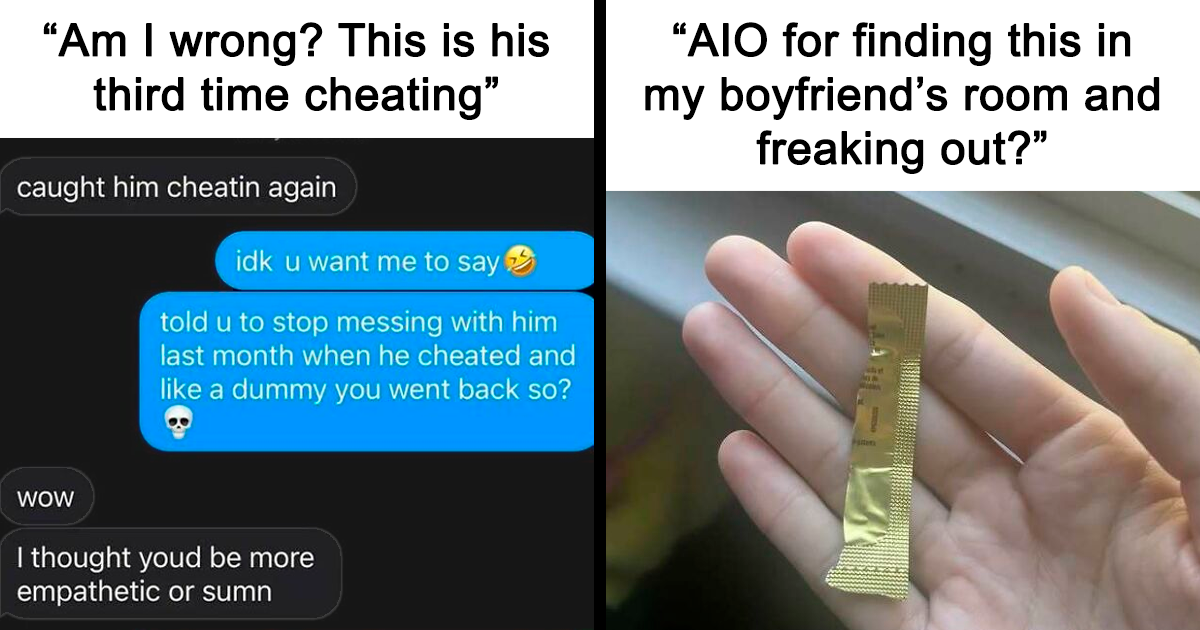
Note: The examples below are composite scenarios inspired by recurring patterns in internet advice forums, expert mental health guidance, and modern digital-life habits. They are written as realistic internet-era situations, not as one-to-one retellings of any single post.
There are few phrases on the internet more powerful than “Am I overreacting?” It’s the starter pistol for modern chaos. One minute, someone is wondering whether their boyfriend’s “work wife” is just a coworker with good Wi-Fi. The next minute, 8,000 strangers are debating emotional boundaries, attachment wounds, passive-aggressive emojis, and whether liking an ex’s beach photo counts as betrayal or just poor thumb control.
Welcome to the age of crowd-sourced emotional triage, where people turn to comment sections, Reddit threads, TikTok confessionals, and anonymous forums to answer questions that used to stay inside diaries, living rooms, or therapists’ offices. It makes sense, honestly. The internet is free, immediate, anonymous-ish, and open at 2 a.m. Therapy, meanwhile, requires scheduling, vulnerability, money, and the courage to say, “Hi, I think I may be melting down over a birthday invite.” One is a carefully trained professional. The other is a stranger named FerretJustice89. Guess which one replies faster.
Still, there’s a reason these posts explode. They sit in the sticky middle of modern conflict: not obvious enough to be clear-cut, but uncomfortable enough to keep people awake. Most “Am I overreacting?” debates aren’t really about one text, one dinner, or one badly timed joke. They’re about respect, loyalty, fairness, boundaries, and the ancient human need to ask, “Am I losing it, or is this actually weird?”
So let’s look at 50 messy, painfully believable situations that keep sparking internet debates, plus what they reveal about why people seek validation online in the first place.
Why People Ask the Internet Instead of Calling a Therapist
Before we get to the mess, let’s be fair to the mess-makers. People don’t always post online because they love drama. Many do it because they want a reality check. They’re confused, embarrassed, broke, lonely, or stuck in a situation that feels too small for a crisis line and too big for a casual brunch chat. Online communities can offer perspective, language, and that powerful little sentence: “You are not the only person this has happened to.”
That’s the helpful side. The chaotic side is that the internet tends to reward certainty, speed, and outrage. A therapist might say, “Let’s explore that pattern over time.” The internet says, “Dump him. Block her. Sue your cousin. Change the locks. Also update us.” One response builds insight. The other builds a season finale.
That’s why these debates are so addictive. They feel like morality plays starring regular people with terrible communication skills and an unlimited data plan.
The 50 Messy Situations Everyone Has Opinions About
Dating, Texting, and Romantic Confusion: Cases 1–10
- Your partner still shares a streaming account with an ex and insists it’s “just practical.”
- You found out your girlfriend vents about every fight to her group chat before speaking to you.
- Your boyfriend “forgot” to mention he had dinner with someone he used to hook up with.
- Your date texted nonstop for two weeks, then suddenly started replying like a government agency.
- Your partner says they need privacy, but keeps their phone angled like it contains nuclear codes.
- You were told “I’m bad at texting,” yet they somehow post Stories every six minutes.
- Your spouse calls a coworker their “work husband” and expects you to find that charming.
- You asked for reassurance once and got warmth; you asked 14 more times and got a sigh.
- Your partner says flirting is harmless, but only when they are the one doing it.
- You got left on read after sending a vulnerable message and then saw them active online.
These are internet gold because they hit the same nerve: uncertainty. Not cheating-cheating, maybe. But enough weirdness to send someone into a spiral with a fully charged phone.
Family Drama With Extra Seasoning: Cases 11–20
- Your mother-in-law keeps dropping by without warning and calling it “family closeness.”
- Your parents still expect you to attend every holiday even though you now have your own kids.
- Your sibling borrowed money, repaid none of it, and is currently posting vacation photos.
- A relative announced your pregnancy before you did because they were “just excited.”
- Your family expects you to forgive someone simply because “that’s still your blood.”
- Your parents treat you like the responsible child and your sibling like a fragile decorative lamp.
- You were pressured to invite a toxic family member to your wedding to “keep the peace.”
- Your adult child keeps using your home like a hotel, laundromat, and emotional support warehouse.
- A cousin mocked your boundaries and then acted shocked when you enforced them.
- Your family labels you “too sensitive” whenever you point out something rude.
Family posts explode because blood ties do not cancel out bad behavior. The internet is full of people discovering, often loudly, that genetics do not equal a lifetime VIP pass to your peace.
Friendship Fights and Group Chat Wars: Cases 21–28
- Your best friend disappears for weeks, then reappears only when their life is on fire.
- A friend made a joke at your expense in public and later said you “can’t take humor.”
- You planned a birthday dinner and your friend invited extra people without asking.
- A close friend keeps copying your major life choices and swears it’s coincidence.
- You told one friend something private and suddenly the whole friend group “just knew.”
- Your friend expects instant emotional support but is mysteriously unavailable during your crises.
- You were left out of a group trip and only found out through Instagram.
- Your roommate-friend thinks “borrowing” your stuff does not require permission.
Friendship conflict is especially brutal because the rules are less formal. There’s no contract, no ceremony, no legal form that says, “Please stop emotionally freelancing with my trust.”
Weddings, Money, and Other Elegant Disasters: Cases 29–36
- You were asked to spend thousands to be in someone’s wedding and then scolded for “not being supportive enough.”
- A couple demanded a gift from their registry and cash for the honeymoon because “love is expensive.”
- Your friend scheduled their wedding on your birthday weekend and called your disappointment petty.
- A relative expected you to split a dinner bill evenly after ordering like a visiting monarch.
- Someone asked you to cosign a loan and got offended when you hesitated.
- You found out you were only invited to a party after someone dropped out.
- A family member volunteered your home for hosting without asking you first.
- You set a spending limit for holidays and one relative acted like you had canceled Christmas itself.
Money conflict is rarely just about money. It’s about entitlement, fairness, status, guilt, and the mysterious social belief that whoever is “nice” should also be financially flexible.
Work, School, and Professional Weirdness: Cases 37–42
- Your boss messages after hours and acts surprised when you do not answer at 11:47 p.m.
- A coworker takes credit for your idea in meetings and smiles like they invented oxygen.
- Your manager calls everyone “family,” which somehow always leads to unpaid extra work.
- A colleague overshares personal drama daily and then accuses others of being cold.
- Your professor changes deadlines constantly and calls student stress “part of the real world.”
- Your workplace keeps rewarding the loudest person, not the most reliable one.
These debates get intense because work conflict often forces people to choose between self-respect and rent. That is not a fun little emotional puzzle. That is a tax bracket with feelings.
Roommates, Neighbors, and Domestic Tension: Cases 43–46
- Your roommate’s partner basically moved in but somehow still does not contribute to bills.
- Your neighbor complains about your dog while their own music rattles your windows nightly.
- You asked for basic kitchen cleanliness and got treated like a dictator with paper towels.
- Your roommate keeps posting passive-aggressive notes online instead of speaking directly to you.
Nothing turns a person into an amateur constitutional lawyer faster than shared rent and a sink full of mystery bowls.
Kids, Pets, and Moral Panic at Home: Cases 47–50
- A relative keeps ignoring your parenting rules and calls it “grandparent privilege.”
- Your ex lets the kids stay up all night and then calls you the strict one.
- Your friend says their dog is “like a child” and expects every plan to revolve around that fact.
- Someone publicly judged your parenting, pet care, or household routine based on one single moment.
These posts go nuclear because they touch identity. People can hear “I disagree with your choice” as “You are a terrible parent, partner, adult, and possibly mammal.” No wonder the comment sections combust.
What These 50 Internet Debates Actually Reveal
1. Most people are not asking about one event. They’re asking about a pattern.
That is the sneaky part. The internet post is usually about one final straw: the phone call, the rude comment, the forgotten birthday, the suspicious lunch, the last unpaid Venmo request. But underneath it is a longer story. Maybe the person has felt dismissed for months. Maybe they’ve been doing emotional labor for years. Maybe they are not overreacting to this thing; they are reacting to the 87 things that came before it.
2. Hurt feelings are real, but they are not always proof.
Here is where the internet gets messy fast. Feeling hurt does not automatically mean someone intended harm. But the opposite is also true: not every injury comes with villain music. Real-life conflict often lives in a frustrating gray zone where one person is careless, another is triggered, and both are absolutely convinced they are the reasonable one. That gray zone is basically the internet’s favorite snack.
3. Boundaries sound noble until someone dislikes yours.
People love the concept of boundaries in the abstract. Boundaries are healthy. Boundaries are empowering. Boundaries are all over social media in tasteful fonts. But once a boundary inconveniences someone, suddenly you’re “dramatic,” “cold,” “controlling,” or “hard to talk to.” That’s why so many viral posts boil down to one question: am I setting a limit, or am I being impossible? Often, the answer depends on whether the other person benefited from your lack of one.
4. Reassurance can become a trap.
Sometimes a person turns to the internet because they genuinely need perspective. Other times, they are searching for certainty that no comment section can give. They want 2,000 strangers to say, “You are correct, pure, lovable, justified, and destined never to be misunderstood again.” That kind of reassurance may feel amazing for ten minutes. Then the doubt returns, and so does the posting. It becomes less about solving the issue and more about feeding an anxious loop.
5. The internet is great at verdicts, terrible at nuance.
Online debate loves labels: toxic, narcissistic, gaslighting, abusive, manipulative, selfish, immature. Some of those labels are absolutely appropriate sometimes. But internet culture also throws them around like confetti at a wedding no one can afford. A single bad interaction is not always a diagnosis. Still, repeated patterns of intimidation, control, humiliation, isolation, threats, or fear are not “just drama” either. That is when crowd-sourcing opinions should stop and real-world support should start.
When Posting Online Can Help
Used carefully, online advice can be useful. It can help people name behavior they could not quite describe. It can offer scripts for hard conversations. It can reduce shame. It can remind someone that they are not unreasonable for wanting respect, honesty, privacy, or basic decency in a relationship. Sometimes all a person needs is enough clarity to say, “I’m not crazy. I just need to address this directly.”
It can also be a bridge, not a destination. A forum post may help someone realize they need couples counseling, individual therapy, a legal consult, a safer living situation, or one gloriously uncomfortable conversation with their sibling about borrowed money and selective amnesia.
When Posting Online Is a Terrible Substitute for Real Help
If a situation involves fear, stalking, coercion, threats, intimidation, self-harm risk, violence, or escalating emotional abuse, the internet should not be your only sounding board. Neither should it be your judge if your mental health is spiraling. Comment sections are not trauma-informed care. They are not treatment plans. They are not safety planning. And they are definitely not a replacement for help when the issue is bigger than a hot take.
In those cases, the healthiest move is often the least viral one: log off, document what matters, contact the right support, and tell one trusted person in real life what is happening.
500 More Words From the Messy Group Chat of Human Experience
One reason these “Am I overreacting?” stories hit so hard is that almost nobody feels fully rational in the middle of a close relationship conflict. Even smart, competent adults can become temporary philosophers of doom after one weird text. A read receipt becomes a betrayal. A delayed reply becomes a plot twist. A tone shift in “sounds good” becomes a dissertation topic. That doesn’t mean people are foolish. It means relationships are where our oldest fears, sharpest hopes, and least flattering coping habits tend to clock in for work.
Think about how many of these debates begin with a tiny moment that should, in theory, be easy to brush off. Someone rolled their eyes. Someone didn’t say thank you. Someone kept comparing you to a sibling, a coworker, an ex, or a mythical person who apparently folds laundry with joy. One isolated incident may be nothing. But repeated incidents start to feel like evidence. That is the emotional math people are doing online, often in public, often while underslept, under-supported, and one iced coffee away from a revelation.
There is also something oddly comforting about the internet jury box. Strangers do not come with family history. They do not interrupt with, “Well, you know how she is.” They do not pressure you to keep the peace because Thanksgiving is next month. They just look at the facts as presented and start swinging. That can feel validating, especially for people who have spent years being minimized. It can also be wildly misleading, because the internet sees a snapshot while you are living inside the full documentary.
And yet the emotional core of these stories is usually very human. People want to feel chosen without being controlled, supported without being used, heard without being mocked, and loved without having to audition for the role every single week. They want fairness in families, respect in friendships, honesty in romance, and basic sanitation in shared kitchens. Frankly, that last one should be easier than it is.
The messy truth is that many conflicts are not solved by winning the comment section. They are solved by developing tolerable discomfort. By asking a direct question instead of staging a social media autopsy. By saying, “That bothered me,” before resentment grows claws. By noticing when your need for reassurance is becoming a full-time job for everyone around you. By learning that boundaries are not punishments, silence is not always strategy, and being “easygoing” is not the same thing as being okay.
In that sense, these viral debates are less about internet culture than about modern emotional life. We are all trying to interpret incomplete information while carrying old experiences into new situations. We are all, at some point, tempted to ask the room whether our feelings are valid. The internet simply turned that impulse into content. Sometimes useful content. Sometimes ridiculous content. Sometimes content that should have stayed in the notes app forever.
But if there is one lesson hiding inside all 50 of these messy situations, it’s this: overreacting is rarely just “feeling too much.” More often, it is feeling something real without yet knowing what to do with it. And that is a much more honest place to begin.
Conclusion
The enduring appeal of “Am I overreacting?” stories is simple: they let people test their reality in front of a crowd. Sometimes the crowd helps. Sometimes it performs. Sometimes it hands out wisdom. Sometimes it hands out flamethrowers. But the reason these posts keep spreading is that they capture a deeply modern problem: people crave clarity, but they are often trying to find it in the loudest place possible.
If you recognize yourself in these debates, take the useful part and leave the circus. Look for patterns, not just moments. Ask whether the issue is discomfort, incompatibility, anxiety, poor communication, or actual harm. Use online feedback as one input, not a life sentence. And when the problem keeps repeating, keeps hurting, or keeps making you doubt your own judgment, that is often your sign that what you need is not more comments. It is a better conversation, stronger support, or real professional help.