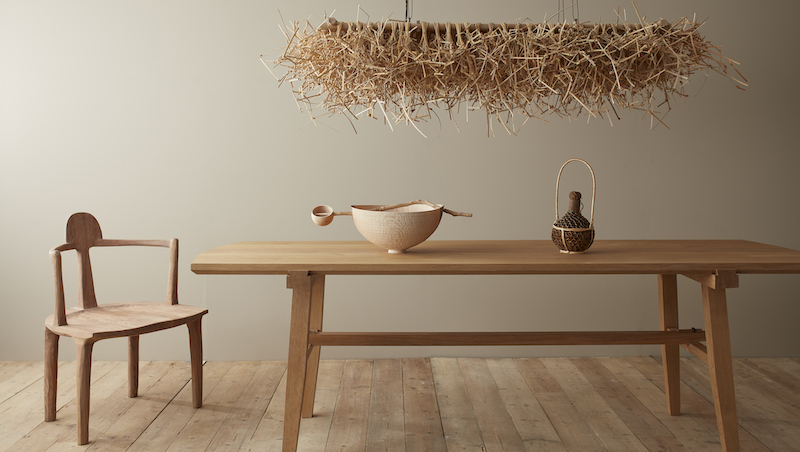
Some exhibitions ask you to admire a finished object. Plant Explorations asks you to admire the entire chain of thought behind it: the seedpod, the basket, the folded leaf, the tool mark, the archived specimen, the old note in a drawer, the contemporary maker staring at all of it and thinking, “Well, that’s interesting. What if I tried something new with something very old?” That spark is what makes Plant Explorations at The New Craftsmen feel so rich. It is not just an exhibition about beautiful craft. It is a conversation between history and making, between botany and design, and between the archive and the hand.
Created to mark The New Craftsmen’s tenth anniversary, the show turns toward the vast Economic Botany Collection at Kew and invites a group of makers to respond to it. That premise alone is catnip for anyone who loves craft, interiors, design history, or the kind of objects that make you lean in and mutter, “How on earth did they make that?” Instead of treating a botanical archive like a dusty vault of old-world curiosities, Plant Explorations treats it as living creative fuel. The result is a vivid exhibition of furniture, lighting, basketry, vessels, and sculptural works that proves the archive is not a graveyard for ideas. It is a greenhouse.
Why This Exhibition Feels Bigger Than a Pretty Show
The easiest way to misunderstand Plant Explorations is to assume it is simply a botanical-themed craft show. It is much more interesting than that. At its core, the exhibition is about how humans have used plants to solve practical problems and create beauty at the same time. That sounds straightforward until you remember how expansive that story really is. Plants have given us food, shelter, medicine, paper, dyes, rope, baskets, vessels, surfaces, tools, and rituals. Entire visual languages have grown from leaves, bark, grasses, reeds, wood, and fibers.
The New Craftsmen smartly uses this huge historical backdrop not as a lecture, but as a design engine. The featured makers do not copy archive pieces like students tracing homework five minutes before class. They translate them. They absorb shapes, techniques, and cultural clues, then turn those lessons into objects that feel contemporary, tactile, and emotionally alive. The exhibition is rooted in research, but it never gets trapped there. That is what gives it energy.
There is also something deeply timely about this approach. In an era of algorithmic sameness and fast-made everything, contemporary craft has become one of the most persuasive arguments for slowness, attention, and material intelligence. Handmade work reminds us that design is not just about style. It is about process, knowledge, labor, and the physical world. In that sense, Plant Explorations lands right in the sweet spot of what today’s design audience craves: authenticity without cliché, sustainability without sermonizing, and beauty with some brains behind it.
From Kew’s Archive to the Maker’s Bench
The exhibition gains much of its force from the source material itself. The makers were invited to explore Kew’s Economic Botany Collection, a historic archive built around the ways humans have used plants across time and geography. That matters because this is not some random pile of charming old objects. It is a serious collection of evidence: wood samples, basketry, bark cloth, gourds, plant-derived objects, and other artifacts that document how deeply human life depends on plant knowledge.
That kind of archive changes the mood of an exhibition instantly. The objects on display are no longer isolated acts of creativity; they become responses to a long lineage of experimentation. The archive suggests that making is not only expressive, but adaptive. People have always observed plants, tested their properties, borrowed their structures, and turned them into useful and beautiful things. Designers today may call this “material research.” Earlier generations just called it survival.
And that is why Plant Explorations works so well. It does not force a fake split between utility and artistry. Historically, those categories often overlapped. A basket could be both a storage system and a visual marvel. A paper object could be functional and ceremonial. A gourd could carry water and culture at the same time. This exhibition understands that the old hierarchy between “fine design” and “useful object” is mostly a modern headache. Plants, mercifully, have never cared about our categories.
The Makers and the Magic of Translation
Basketry, but Make It Sculptural
One of the strongest threads in the exhibition is basketry, which makes perfect sense. Basketry is one of the most ancient and adaptable plant-based crafts on earth, and it remains astonishingly contemporary. The basketmaker Pip Rice draws from string-wrapped forms in the Kew archive, including a cone from the Macrozamia douglasii plant collected on Fraser Island in the nineteenth century. That could easily have become an overly literal exercise in historical homage. Instead, the work turns into something looser and more sculptural, using the archive as a starting pulse rather than a final instruction sheet.
Lisa Atkin, meanwhile, brings a wonderfully imaginative edge to plant-based making by creating baskets that feel as if they belong to a fictional tribe of hunter-gatherers. It is a clever move. By inventing a speculative use-world around the objects, she sidesteps the trap of sterile museum reconstruction and makes the pieces feel active again. They become artifacts from an imagined culture that somehow feels more emotionally real than a lot of actual product design.
Then there is the broader basketry atmosphere of the show, which constantly reminds viewers that woven form is never only about containment. It is about rhythm, tension, permeability, structure, and pattern. In other words, it is one of the oldest forms of design thinking we have. Contemporary museums and craft institutions in the United States have increasingly emphasized this point over the past decade, and Plant Explorations slides right into that wider revival with confidence.
Wood, Gourds, Paper, and Quiet Drama
The exhibition also shines when it moves beyond basketry and explores how plant-based traditions migrate into adjacent disciplines. Takahashi McGil, the husband-and-wife woodturning duo, respond to ancient cylindrical water gourds with vessels that bring together Japanese influence and Western technique. The pieces are poised, restrained, and quietly ceremonial. They feel as if they have been edited rather than merely made, which is often the difference between an object you like and an object you remember.
Lola Lely contributes one of the show’s most compelling examples of material translation. Her chandelier, made from Japanese mulberry paper and finished with wax, pulls inspiration from a folded palm-leaf basket and a paper military helmet found in the archive. Read that sentence twice and enjoy the leap. A basket plus a helmet becomes a chandelier. Somewhere, an old archivist is either delighted or absolutely bewildered. Probably both.
Cyriaque Ambroise adds another layer through carved trays, stools, and tea-related objects that connect the Kew material to Japanese craft traditions. His work underscores one of the exhibition’s central ideas: that archives are not just inventories of objects, but maps of cultural exchange. Techniques travel. Forms migrate. A tray seen in one context may echo in another. Craft history is rarely neat, and that messiness is part of its beauty.
An Exhibition That Refuses to Stay in One Lane
What makes the curatorial mix especially effective is that it includes established makers already represented by The New Craftsmen alongside newer voices. That combination keeps the exhibition from feeling too polished or too academic. There is furniture next to lighting, basketry next to tableware, art next to useable objects. The result is a display that mirrors the archive’s own abundance. Plant knowledge does not live in one discipline, so the exhibition wisely refuses to do that either.
Why Botanical Archives Matter to Contemporary Design
It is tempting to treat archives as passive storage, but good archives are active design partners. They preserve techniques, materials, forms, and forgotten relationships. In the case of a botanical archive, they also preserve proof that humans have always been in conversation with plants, not just as consumers of raw material, but as observers of structure, flexibility, resilience, and pattern.
That idea is surprisingly visible across design culture right now. Botanical illustration has reentered interiors through wallpapers, textiles, and prints. Basketry has moved from “rustic accessory” status to serious sculptural language. Plant fibers and natural dyes appear in contemporary art with renewed urgency. Craft institutions are paying closer attention to material histories, while design museums increasingly frame natural materials not as quaint throwbacks but as viable, intellectually rich sources for modern practice.
Plant Explorations lands in the middle of all that, but with a sharper angle: it anchors aesthetic delight in historical evidence. The Kew archive is not just pretty reference material. It also contains records entangled with trade, empire, collecting, extraction, and global exchange. That means any response to it carries ethical and historical weight. The best thing about the exhibition is that it does not run away from that complexity.
The Politics Inside the Plant Story
Let’s talk about the subtext, because it matters. Collections like Kew’s are invaluable, but they are also inseparable from the histories that produced them. Economic botany is not a neutral phrase. It points to systems of classification, commerce, imperial ambition, resource extraction, and the movement of both plants and people across colonial networks. The archive contains knowledge, but also power.
That tension gives Plant Explorations more depth than a simple “nature-inspired design” show. The exhibition can be read as a celebration of ingenuity, yes, but also as a quiet act of reinterpretation. Contemporary makers step into a collection shaped by older hierarchies and rework its contents through present-day sensibilities. They bring care, individuality, and imagination to materials that might otherwise remain trapped in institutional language.
In practical terms, this means the show asks better questions than the average interiors feature. Not just: “Isn’t this lovely?” But also: “Where did this form come from?” “Who originally made it?” “How was that knowledge transmitted?” “What gets recorded in an archive, and what falls out?” It is rare to find an exhibition that can support both aesthetic pleasure and historical curiosity without turning into homework. This one manages it.
The New Craftsmen as the Ideal Host
The New Craftsmen has long occupied an intriguing place in contemporary craft culture. It is neither a traditional gallery nor a generic retail platform. Its strength lies in presenting craft as something lived with, commissioned, collected, and argued over in real space. That positioning makes it a particularly effective host for a project like Plant Explorations, which depends on the overlap between scholarship, design, material fluency, and domestic imagination.
The exhibition also fits the larger mission of bringing serious attention to makers who work with integrity and specificity. That phrase gets overused in design writing until it starts sounding like a throw pillow slogan, but here it actually applies. These are makers thinking through form, lineage, and material behavior with real rigor. The New Craftsmen gives them a context that feels elevated without stripping away the tactile reality of their work.
Presented in connection with London Craft Week, the show also benefits from the broader energy of a city-wide celebration of making. But even removed from that calendar moment, Plant Explorations has the kind of concept that could resonate far beyond one event. It taps into urgent themes: ecological awareness, material intelligence, cultural memory, and the renewed relevance of handmade design in an industrial and digital age.
What the Exhibition Says About the Future of Craft
If the last decade in design has taught us anything, it is that the future will not be won by smoother surfaces and faster production alone. People are hungry for objects with traceable origins, expressive form, and evidence of the hand. They want design that feels grounded, not generic. They want materials that age with dignity instead of collapsing into landfill sadness three months after purchase. They want stories, but not fake marketing stories. Real ones.
Plant Explorations points toward exactly that future. It suggests that innovation in craft does not always come from inventing entirely new materials or forms. Sometimes it comes from looking harder at what already exists: old baskets, plant specimens, folded leaves, historical tools, ancestral methods, vernacular intelligence. The archive becomes not a constraint, but a springboard.
That approach feels especially compelling now because it allows contemporary makers to be both experimental and rooted. They do not have to choose between invention and inheritance. In fact, the strongest work often comes from the friction between the two. A maker studies a historic object, notices an overlooked structural idea, rethinks it through present-day taste, and suddenly the past is no longer behind us. It is sitting on the table as a vessel, hanging overhead as a light, or leaning in the corner as a sculptural object that somehow feels both ancient and brand new.
Extended Reflection: The Experience of Moving Through Plant Explorations
Imagine walking into a show like this without knowing much more than the title. You expect leaves. Maybe some weaving. Possibly a noble amount of beige. What you actually get is something much more emotionally layered. The first feeling is visual pleasure, of course. Plant-based work has a way of softening the eye. Fibers, paper, wood, bark, and wax all absorb light differently from slick industrial surfaces. They glow instead of glare. They invite attention rather than demanding it.
Then comes the second feeling: curiosity. The forms are familiar enough to feel approachable, but strange enough to keep you thinking. Is that vessel inspired by a gourd, a ritual object, or both? Is that shade acting like paper, leather, or leaf? Is that basket trying to hold objects, or ideas? You begin to notice how much plant-based design depends on ambiguity. Materials that begin in nature rarely stay in one category for long. They bend, fold, wrap, harden, split, twist, and surprise you. Good makers do not fight that behavior; they collaborate with it.
The third feeling is harder to name, but it may be the most important: humility. A show like Plant Explorations quietly reminds visitors that human cleverness did not begin with industrial manufacturing or digital fabrication. People have been solving design problems with plant materials for thousands of years. They learned by handling what grew around them. They knew which fibers flexed, which woods carved cleanly, which leaves folded without tearing, which reeds held tension, which bark could become cloth, which gourds could become containers, which dyes would stain and stay. That is not nostalgia. That is accumulated intelligence.
And that realization changes the pace of looking. You stop scanning and start studying. The exhibition becomes less about consumption and more about attention. You notice seams, joins, edges, shadows, the slight irregularity that proves a human being made a decision there. In a world full of frictionless interfaces and machine-perfect repetition, those small moments feel almost radical. They say: someone was here, thinking with their hands.
There is also a strangely comforting domesticity to the whole experience. Even when the works are sculptural, they still speak the language of home: vessels, lights, trays, surfaces, storage, shelter, ceremony. They remind you that some of the most profound design ideas are not born in spectacular buildings or flashy prototypes, but in the daily business of living well with materials. How do you carry, contain, gather, illuminate, sit, store, serve, and mark time? Plants have helped answer those questions for centuries.
By the end of the exhibition, the archive no longer feels distant or institutional. It feels intimate. You begin to understand that a historic collection is not merely about preservation. It is about permission. It gives today’s makers permission to look backward without becoming backward-looking, to borrow without flattening, to honor precedent while still taking risks. And for visitors, that may be the most lasting experience of all. You leave not just admiring craft, but rethinking the natural world as a design library hiding in plain sight. Suddenly the humble basket looks like architecture. The folded leaf looks like engineering. The gourd looks like industrial design before industry. And a museum archive? It starts to look a lot like tomorrow’s sketchbook.
Conclusion
Plant Explorations: Makers Reimagine a Historic Archive at The New Craftsmen succeeds because it understands that craft is not a decorative side note to design history. It is design historymessy, practical, beautiful, political, and profoundly material. By asking contemporary makers to engage with Kew’s Economic Botany Collection, The New Craftsmen creates an exhibition that is as intellectually satisfying as it is visually seductive. It honors plant knowledge, handmade skill, and the archive itself while refusing to let any of them sit still.
Most importantly, it reminds us that the future of craft may depend less on novelty for novelty’s sake and more on intelligent return: return to materials, to touch, to historical awareness, to the complexity of global making traditions, and to the idea that useful objects can still carry wonder. In design terms, that is a strong message. In human terms, it is even better. It says that the old knowledge is not gone. It is still here, waiting to be handled again.