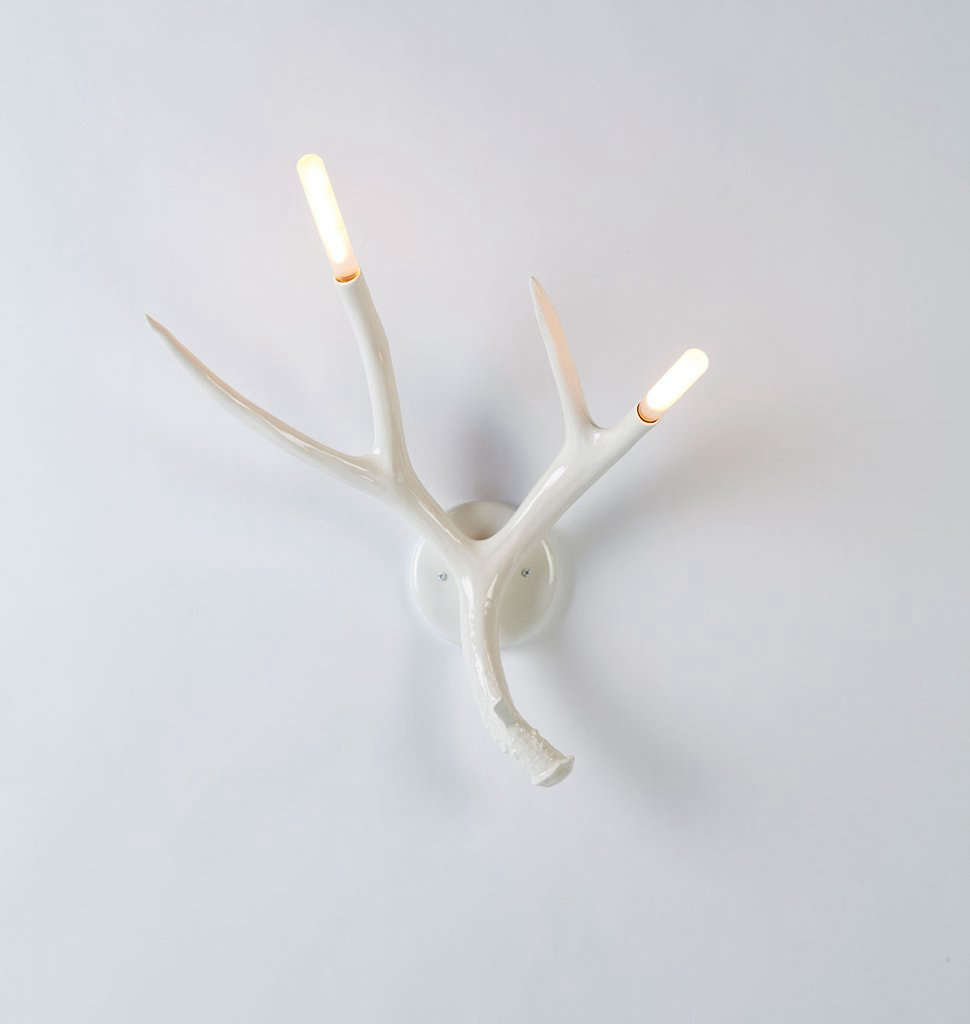
The Superordinate Antler Sconce is what happens when a woodland trophy wanders into a contemporary design studio, trades brown fur for glossy white ceramic, and develops excellent taste. Designed by Jason Miller, this sculptural wall light turns the familiar silhouette of an antler into something cleaner, stranger, and far more sophisticated than traditional lodge décor.
Although it has enough personality to dominate a room, the fixture is surprisingly adaptable. It can look playful in an eclectic apartment, elegant beside a tailored bed, or quietly surreal against a minimalist plaster wall. This guide explores the sconce’s history, specifications, lighting performance, styling potential, installation requirements, and the practical experience of living with such an unapologetically distinctive object.
What Is the Superordinate Antler Sconce?
The Superordinate Antler Sconce is a ceramic wall-mounted light designed by American designer Jason Miller. It belongs to the broader Superordinate Antlers collection, which began in 2003 and later expanded to include table lamps and chandeliers in multiple configurations.
The wall sconce reduces the collection’s central idea to a compact composition: branching antler forms extend from a round backplate while two slender lamps resemble glowing tips. Instead of copying the texture and color of a real antler, Miller translated the form into glossy white ceramic. The result sits somewhere between functional lighting, wall sculpture, and a particularly stylish inside joke.
Roll & Hill, the manufacturer founded by Miller in 2010, describes the collection as an early challenge to the rigidity of contemporary modernism. Design publications have similarly connected the Antler series with the rise of rustic-chic, neo-taxidermy, and Brooklyn’s early-2000s independent design scene.
Product history verified through Roll & Hill, Jason Miller Studio, Metropolis, Dwell, GQ, Heller Gallery, and Design Within Reach.
The Design Story Behind the Antlers
A Reaction Against Overly Serious Modernism
At the beginning of the 2000s, much contemporary furniture leaned toward visual restraint: smooth planes, perfect geometry, and enough minimalism to make a coffee mug feel emotionally complicated. Miller took a different route. His early work often reinterpreted familiar suburban objects, decorative conventions, and imperfect household forms.
The Superordinate Antler collection introduced nature without becoming conventionally “natural.” A real antler is irregular, textured, and associated with hunting culture. Miller’s version is controlled, polished, white, and unmistakably manufactured. It acknowledges the rustic original while refusing to behave like rustic decoration.
Why the Design Became Influential
The Antler lights arrived just as designers and homeowners were rediscovering handmade objects, taxidermy references, raw materials, and nostalgic American imagery. The collection became a recognizable emblem of that shift. Metropolis reported in 2010 that Miller’s ceramic Antler lamp remained his best-selling design seven years after its debut, while Dwell later identified the chandelier as an object that captured the spirit of Brooklyn design.
Architectural Digest has also noted that Miller’s early Antler chandeliers helped establish his reputation before he founded Roll & Hill. The design therefore matters for more than its entertaining silhouette. It represents a period when decorative lighting increasingly began to be treated as collectible art rather than merely equipment that prevents people from walking into furniture.
Design-context sources:
Superordinate Antler Sconce Specifications
According to the manufacturer’s current product information, the sconce measures approximately 17 inches wide, 20 inches high, and 10 inches deep. It weighs about 2 pounds and is made primarily from ceramic and glass. A five-inch round white metal backplate connects the fixture to the wall.
| Designer | Jason Miller |
|---|---|
| Original design year | 2003 |
| Dimensions | Approximately 17 inches wide, 20 inches high, and 10 inches deep |
| Weight | Approximately 2 pounds |
| Primary materials | Ceramic and glass |
| Finish | Glossy white |
| Light appearance | Warm 2700K color temperature |
| Color rendering | CRI of 90 or higher |
| Mounting | Designed for a standard four-inch electrical box |
| Recommended environment | Dry indoor locations |
Some older dealer listings show measurements or lamping details that differ from the manufacturer’s current information. Anyone planning electrical rough-in, custom millwork, or exact furniture placement should request the latest specification sheet for the voltage configuration being purchased.
Current dimensions and technical data:
What Kind of Light Does It Produce?
The Superordinate Antler Sconce is best understood as decorative ambient or accent lighting. Its warm 2700K output creates a candlelike atmosphere, while a CRI of 90 or higher helps fabrics, wood, artwork, and skin tones appear natural rather than washed out.
This is not the fixture to choose when your main goal is illuminating an entire room, performing surgery on a fitted sheet, or locating one black sock on a dark floor. It works most effectively as part of a layered lighting plan that also includes ceiling lights, table lamps, floor lamps, or discreet architectural lighting.
A dimmer can make the fixture especially useful in bedrooms, lounges, dining areas, and entry spaces. Before selecting a dimmer, confirm compatibility with the exact bulbs and voltage option supplied for the current fixture. Decorative lamps can be fussy little celebrities, and not every dimmer understands their artistic process.
Where the Superordinate Antler Sconce Works Best
Beside a Bed
Used instead of an ordinary bedside lamp, the sconce preserves nightstand space and adds an asymmetrical focal point. Architectural Digest has featured the fixture in a richly layered Manhattan sleeping nook, demonstrating that it can coexist with patterned textiles, antique furniture, photography, and global decorative objects without disappearing into the background.
In an Entryway
An entry hall is an ideal place for a sculptural wall light because visitors encounter it at close range. Position it above a narrow console, beside a mirror, or on an otherwise empty wall. The fixture immediately signals that the home contains interesting objects and possibly a resident who has strong opinions about chair legs.
In a Library or Reading Corner
The antler shape feels at home near books, dark wood, leather, and woven textiles. However, its illumination should be supplemented by a task lamp when serious reading is required. Think of the sconce as the charming host of the reading corner, not the employee responsible for doing all the work.
In an Eclectic Living Room
The glossy ceramic surface can bridge traditional and modern pieces. It looks particularly convincing with contemporary art, vintage case goods, linen upholstery, or blackened metal accents. Real-world interiors have also paired the broader Antler collection with muted California rooms, maximalist city apartments, and refined modern furnishings.
Interior examples:
How to Style the Superordinate Antler Sconce
Let the White Ceramic Create Contrast
The white finish is central to the design’s appeal. Against charcoal, forest green, navy, oxblood, or chocolate-brown walls, the branching silhouette becomes highly graphic. On white or cream walls, it appears quieter and more architectural, relying on shadows to reveal its shape.
Use Natural Materials Without Building a Theme Park
Walnut, oak, stone, wool, linen, and leather complement the antler reference without making the room look like a hunting lodge gift shop. One antler-inspired fixture is witty. Twelve matching antler accessories may cause guests to wonder whether they have entered a very expensive deer convention.
Mix It With Clean-Lined Furniture
The sconce’s organic form benefits from nearby restraint. A simple console, low platform bed, tailored sofa, or rectangular mirror gives the branching ceramic shape room to perform. The contrast between disciplined furniture and playful lighting is often more effective than surrounding the fixture with equally theatrical objects.
Treat It as Art
Leave enough negative space around the fixture for its silhouette and shadows to remain visible. Avoid placing it directly beside a crowded gallery wall unless the visual density is deliberate. Because the sconce projects about 10 inches, it also needs physical breathing room in narrow hallways and beside opening doors.
Installation and Safety Considerations
The hardwired sconce is designed to mount to a standard four-inch electrical box. Roll & Hill’s installation documentation advises using a licensed electrician, limiting each socket to one bulb, and avoiding bulbs that exceed the specified maximum wattage.
The fixture is intended for dry indoor use and should be mounted only on an appropriate noncombustible surface. It should not automatically be treated as a bathroom light, outdoor fixture, or damp-location product simply because the glossy ceramic looks easy to wipe clean.
Installation requires extra care because the branching body is ceramic. The fixture may be relatively light, but its long projections can act as levers if bumped. Plan its position away from door swings, coat hooks, tall furniture, and tight circulation paths. During bulb replacement, switch off the power and allow both the lamps and ceramic arms to cool.
Safety and installation instructions:
Price, Lead Time, and Buying Considerations
The Superordinate Antler Sconce occupies the collectible-design end of the lighting market. At the time of research, the manufacturer and several established dealers listed it at approximately $730, although pricing can change. Common quoted production lead times ranged from about 12 to 16 weeks.
That waiting period reflects its position as a specialty design product rather than an off-the-shelf hardware-store fixture. Before ordering, buyers should confirm finish, voltage, bulb inclusion, return restrictions, shipping insurance, and replacement-part availability. Made-to-order lighting may have stricter cancellation and return policies than mass-market products.
The cost makes the most sense for someone who values the sconce as both illumination and sculpture. A less expensive wall light can certainly produce more raw brightness. It probably will not provoke the same number of dinner-party conversations.
Pricing and lead-time cross-check:
Advantages and Potential Drawbacks
Reasons to Choose It
- It functions as both a decorative light and a recognizable piece of contemporary design.
- The white ceramic finish is more versatile than traditional brown faux-antler fixtures.
- Its warm light supports relaxed, atmospheric interiors.
- The compact wall-mounted format saves floor and tabletop space.
- Its design history gives it more lasting interest than a temporary rustic trend.
Reasons It May Not Suit Every Home
- The dramatic silhouette can overpower a very small or visually busy wall.
- Its 10-inch projection requires thoughtful placement.
- Ceramic branches are more vulnerable to impact than compact metal shades.
- The light output is better for atmosphere than primary illumination.
- Premium pricing and made-to-order lead times may not suit quick renovations.
Is the Superordinate Antler Sconce Still Relevant?
Many decorative products become trapped in the era that produced them. The Superordinate Antler Sconce has avoided that fate because it contains several useful contradictions. It is rustic and polished, humorous and elegant, organic and manufactured, nostalgic and contemporary.
More than two decades after its 2003 debut, the collection remains in production and continues to appear in professionally designed homes. Its longevity suggests that the fixture has moved beyond the brief neo-rustic craze it helped inspire. It may not be neutral, but neutrality is overrated when the alternative is owning something memorable.
The strongest interiors do not attempt to disguise the sconce as conventional lighting. They allow it to be a slightly strange ceramic object with a practical side job.
Continuing production and design significance:
Conclusion
The Superordinate Antler Sconce is a rare design that can make a wall feel more refined and less serious at the same time. Jason Miller’s transformation of a familiar natural form into glossy ceramic helped define a major moment in American contemporary lighting, yet the fixture remains usable rather than merely historical.
It is best suited to homeowners and designers seeking warm accent light, sculptural impact, and a conversation piece that does not need to shout. Give it sufficient wall space, pair it with restrained materials, and let the antlers do what antlers do best: branch out.
Living With the Superordinate Antler Sconce: A Practical Experience Guide
The first experience of seeing the Superordinate Antler Sconce in a room is usually different from viewing it in a product photograph. Online, the glossy white branches can appear delicate and almost two-dimensional. On a wall, the 10-inch projection gives the fixture noticeable depth. Its branches occupy real space, and the light casts additional branches in shadow. The visual effect changes as a person walks past it, making the sconce feel closer to a small sculpture than a flat decorative fitting.
During the day, the experience depends heavily on wall color. Against a pale wall, the fixture becomes subtle, especially in strong natural light. Its curves are defined by gentle gray shadows and highlights along the ceramic glaze. Against a dark wall, it becomes much bolder. The white form looks almost illustrated, as though someone drew an antler directly onto the room with an oversized piece of chalk.
At night, the warm lamps soften the design. The antler silhouette remains dramatic, but the 2700K light prevents it from feeling cold or gallery-like. In a bedroom, the result can be relaxing when the sconce is dimmed and combined with low-level lighting elsewhere. It creates atmosphere around the bed without occupying the nightstand, leaving more room for a book, a glass of water, and the phone that everyone promises not to look at before sleeping.
Placement is the part of the ownership experience that deserves the most planning. A paper template matching the fixture’s approximate width, height, and projection can prevent an expensive surprise. Tape the template to the intended wall, then open nearby doors, walk through the space, sit in adjacent chairs, and check sightlines from multiple angles. The sconce should feel intentionally prominent, not like a ceramic tree branch waiting to catch a shoulder.
Cleaning is straightforward but should be gentle. A soft, dry microfiber cloth is generally preferable for routine dusting. Each branch should be supported carefully rather than pulled or twisted. Strong cleaners, abrasive pads, and enthusiastic feather-duster fencing matches are unnecessary. The glossy finish makes dust easier to see in bright daylight, but it also makes the surface easier to maintain than a heavily textured faux-antler fixture.
Changing bulbs requires patience because the ceramic body may retain heat after use. Power should be switched off, and the fixture should be allowed to cool fully. Keeping the correct replacement bulbs on hand is sensible, particularly when the lamps have an unusual decorative shape or base. Confirming the current lamp specification at purchase avoids the classic homeowner ritual of returning from the hardware store with three bulbs, none of which fit.
The greatest long-term benefit is that the sconce can anchor a room without demanding an entire decorative theme. Owners may change bedding, artwork, rugs, or wall color while retaining the fixture as a familiar focal point. Its white finish works with more palettes than a literal brown antler would, and its humor prevents formal rooms from becoming stiff.
The main compromise is that it will never disappear politely into the architecture. Even when switched off, it remains visible and expressive. That is precisely why admirers choose it. Living with the Superordinate Antler Sconce means accepting a little visual eccentricity in exchange for warmth, craftsmanship, design history, and the pleasure of owning a light that looks nothing like a beige cylinder.
Research synthesis used 13 established sources, including the official manufacturer and studio, specialist U.S. design retailers, and major design publications.