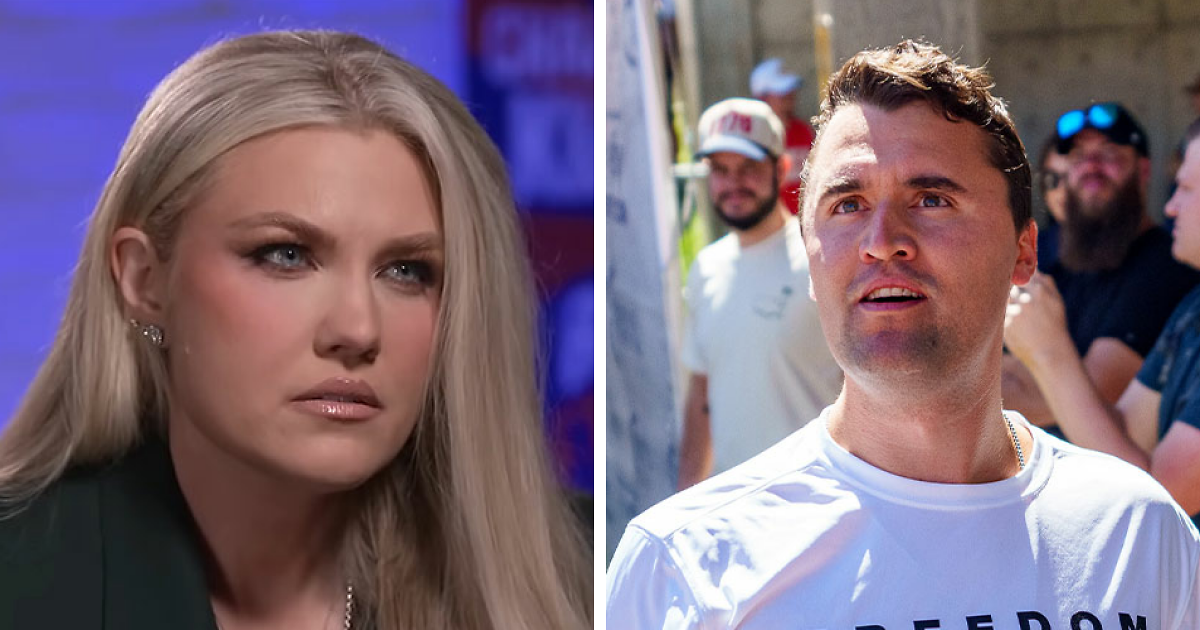
A resurfaced video of Erika Kirk mourning beside the casket of her late husband, Charlie Kirk, has triggered a fresh argument about grief, cameras, and authenticity. Critics say the intimate footage looks produced; defenders say strangers have no right to grade a widow’s pain. The clip is real, but one crucial point remains unverified: reliable reporting has not established that Erika Kirk was personally wearing a microphone.
Why the Resurfaced Erika Kirk Clip Is Drawing Attention Again
The video shows Erika Kirk beside Charlie Kirk’s casket, touching his hands, crying, and repeatedly telling him that she loves him. The footage is close, emotionally intense, and clearly made available to a public audience rather than kept only as a private family recording.
When the clip resurfaced, critics focused on the production: close-up framing, steady images, clear audio, and apparent professional filming equipment. One recurring question asked why she would agree to be “mic’d up” during such a personal moment.
That question soon hardened into an accusation. Online, “Why is the audio clear?” became “She wore a mic,” and then “The grief was staged.” Those are separate claims. Clear sound can come from an on-camera microphone, a directional microphone, a boom, a nearby phone, or separately recorded audio. It does not prove that the person on screen wore a lavalier microphone.
What the Clip Showsand What It Does Not
What viewers can reasonably observe
The moment was filmed at close range, selected for public distribution, and later appeared on Erika Kirk’s social media. Those facts support a legitimate discussion about privacy, consent, political communication, and the ethics of publishing intimate grief.
What viewers cannot prove
The footage does not establish that her tears were fake, reveal why she allowed the recording, or show whether she requested the cameras. It also does not independently prove that she wore a microphone.
Online audiences often treat editing choices as psychological X-rays. A tight close-up becomes proof of manipulation; a pause becomes proof of calculation; a clear sentence becomes proof of rehearsal. That can sound analytical, but it is mostly guesswork wearing reading glasses.
The Timeline Behind the Backlash
Charlie Kirk was fatally shot on September 10, 2025, while appearing at Utah Valley University. Two days later, Erika Kirk delivered a public address promising that the movement he built would continue. On September 18, Turning Point USA announced that its board had unanimously selected her as CEO and chair.
At his public memorial on September 21, she said she forgave the man accused of killing him and argued that hatred should not be answered with hatred. In the months that followed, she remained visible through interviews, speeches, religious messaging, and Turning Point USA events.
That transition from spouse to movement leader shaped reactions to the casket video. Supporters saw a widow sharing the cost of political violence. Critics saw a polished extension of a political brand. The same footage arrived with two competing stories already attached.
Why Some Viewers Found the Video Uncomfortable
Many people regard a final encounter with a loved one’s body as sacred and private. A camera in that room can feel intrusive even when the family has approved it. The discomfort grows when the footage uses close-ups, careful framing, and polished audiothe visual language of documentaries, campaign films, and advertising.
For critics, the issue is not simply that grief was recorded. Families have photographed funerals and final goodbyes for generations. The objection is that this moment appeared packaged for broad emotional impact. Viewers who already distrust political media interpreted that packaging as persuasion.
Public figures routinely share personal pain to preserve memory, explain decisions, connect with followers, or mobilize supporters. Several motives may exist at once. That does not automatically make the pain false, but it does turn a private experience into public communicationand public communication invites scrutiny.
Why Others Defended Erika Kirk
Defenders argued that there is no universal rulebook for mourning. Some people withdraw. Others speak constantly about the person they lost. Some preserve every photograph and voicemail; others cannot bear to look. A grieving person may cry uncontrollably one hour, conduct business the next, and laugh at a memory before bedtime.
Bereavement guidance consistently emphasizes that grief varies widely. Shock, numbness, crying, anger, yearning, disbelief, faith, ritual, and a return to routine can appear in different combinations. Social media can help people maintain bonds and receive support, although public posting also exposes them to trolls and judgment.
Sharing the casket video could therefore have been remembrance, religious witness, political communication, or a mixture of all three. Human beings rarely act from one clean motive. Even ordering lunch can involve hunger, price, habit, and the hope that nobody steals the fries.
Can Grief Be Genuine and Produced at the Same Time?
Yes. A moment can be emotionally authentic and intentionally documented. A widow can genuinely sob while knowing a camera is present. A family can believe that sharing a painful scene serves a larger purpose. Editors can shape real footage into a compelling narrative without inventing the underlying emotion.
The false choiceeither completely spontaneous or completely fakedoes not reflect modern media. Weddings are real even when professionally photographed. Graduation tears are real even when a parent is filming. Documentary subjects can experience genuine fear, joy, or grief while wearing a microphone.
Better questions are: Who chose to record the scene? Who approved publication? What context accompanied it? Was the deceased person’s dignity considered? Were children and relatives protected? Was the purpose memorial, testimony, persuasion, fundraising, or engagement? In this case, not every answer is publicly known.
Why “Fake Tears” Claims Go Beyond the Evidence
Accusing someone of fake grief is easy because the claim is nearly impossible to disprove. Cry heavily, and critics call it theatrical. Cry quietly, and they call it cold. Return to work, and they say it happened too quickly. Stay out of sight, and they say you are hiding. Grief becomes a rigged audition in which the audience keeps rewriting the script.
Short videos are especially poor tools for judging sincerity. They remove what happened before and after, compress time, and circulate with captions telling viewers what to notice. Once a post says “watch her perform,” ordinary gestures begin to look suspicious.
Erika Kirk’s choice to share intimate footage can still be debated. Her public messaging and political role can be analyzed. Criticism is strongest, however, when it stays attached to observable choices rather than pretending to read a stranger’s nervous system through a screen.
How Politics Supercharged the Reaction
Charlie Kirk was a nationally known conservative activist, and his killing was immediately absorbed into America’s partisan conflict. Erika Kirk’s mourning was therefore unlikely to be viewed neutrally. Admirers saw sacrifice and faith; opponents saw branding and strategy; conspiracy-minded users saw hidden plots in ordinary details.
Social platforms reward the harshest interpretation. “The filming choices made me uncomfortable” attracts less attention than “everything was fake.” Nuance arrives carrying a vegetable tray while outrage has already taken over the karaoke machine.
A Media-Literacy Check for the Viral “Mic” Claim
- Separate observation from conclusion. “The audio is clear” is observable; “she wore a mic” requires proof.
- Find the original upload. Reposts may crop equipment, remove captions, or alter sound.
- Look for independent verification. Thousands of repeated posts are not thousands of sources.
- Demand primary evidence. Production notes, behind-the-scenes footage, visible equipment, or a direct statement would carry more weight.
- Notice loaded captions. Words such as “fake” and “staged” prime viewers before the clip begins.
- Avoid diagnosing emotion. A short video cannot establish grief depth, motive, or mental state.
Experiences and Practical Lessons From Public Mourning
Families experiencing a highly visible death often face two realities at once. One part of the family is choosing flowers, contacting relatives, answering children’s questions, and trying to remember whether anyone has eaten. Another part may be handling cameras, public statements, memorial logistics, security, and strangers demanding details.
In that environment, recording a final goodbye can feel natural to one person and unbearable to another. A spouse may want a record because shock has made the moment feel unreal. A sibling may see the camera as an intrusion. A communications adviser may see historical documentation. A faith leader may see testimony. None of those perspectives automatically proves or disproves genuine grief.
Families and funeral professionals encounter a wide range of behavior around a body. Some people speak to the deceased. Some photograph hands, jewelry, clothing, or the casket. Some make jokes because humor is the only valve preventing emotional overload. Some cannot enter the room; others remain for hours. Culture, religion, trauma, personality, and family history all shape the response.
A camera does change the experience. Even with consent, people may become more aware of their words, posture, and timing. Self-awareness does not erase emotion, but filming creates responsibility. Families and media teams should decide who can record, what stays private, and who has final approval before publication.
Another lesson is that audiences rarely preserve the original intention. A memorial video can be reposted as comedy, conspiracy evidence, propaganda, or rage bait. Captions can reverse its meaning in seconds. Once intimate footage is public, the family loses control over where it travels and how often it resurfaces.
A careful publication process can reduce harm: delay posting until the first shock passes, explain why the footage is being shared, seek agreement from close relatives, and remove images likely to distress children. These steps cannot prevent cruelty, but they can protect dignity and reduce ambiguity.
Viewers carry responsibility, too. Discomfort is valid. People can call the video too intimate, too polished, or ethically questionable without claiming access to the widow’s heart. “I do not think this should have been published” is an argument. “She did not love him” is speculation.
Publishers should follow the same rule. A viral allegation should not become fact merely because it makes a powerful headline. Unless the microphone detail is verified, it should be clearly attributed to commenters. That distinction separates reporting a controversy from manufacturing one.
Conclusion: The Backlash Says as Much About the Internet as the Clip
The resurfaced Erika Kirk video raises reasonable questions about cameras in spaces of grief, the packaging of intimate moments, and the overlap between mourning and political communication. Viewers are entitled to feel uneasy about a final goodbye becoming public content.
But the claim that she personally wore a microphone has not been independently established by reliable reporting, and the clip cannot prove that her tears were fake. It documents one clear choice: an intensely private scene was recorded and shared.
The strongest analysis asks audiences to be precise. Critique the filming. Debate the publication. Examine the political context. Question the editing. Just do not convert suspicion into fact or assume that visible production cancels invisible pain.