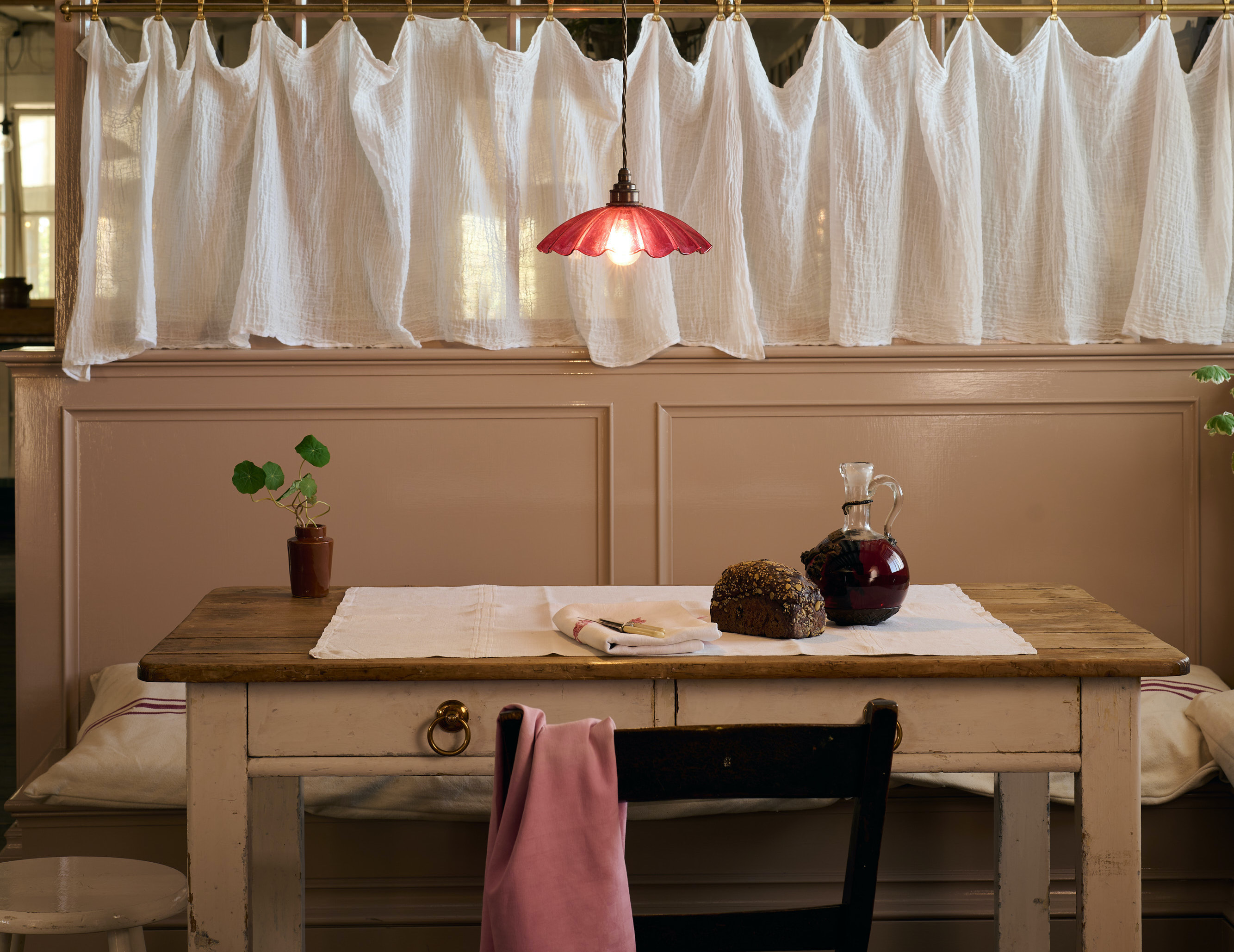
Some light fixtures quietly perform their duties and disappear into the ceiling. Frilly glass pendant lights do not believe in disappearing. They arrive with scalloped edges, milky colors, floral curves, and enough personality to make a plain hallway feel as though it inherited a very stylish grandmother.
Once dismissed as old-fashioned, ruffled glass shades are glowing again in grandmillennial, cottagecore, granny chic, and collected interiors. The attraction is easy to understand: these fixtures soften a room without making it sleepy, introduce decorative detail without occupying floor space, and look equally charming above a kitchen sink, breakfast table, bedside cabinet, or tiny powder-room vanity.
The modern revival is part of a wider shift away from sterile, copy-and-paste interiors. Designers are mixing inherited-looking objects, floral patterns, lace, warm woods, vintage lighting, and playful traditional details with cleaner contemporary furniture. In other words, granny chic is not about recreating Grandma’s house exactly. It is about borrowing her confidence and perhaps one or two of her lamps.
What Are Frilly Glass Pendant Lights?
A frilly glass pendant light is a ceiling-hung fixture with a decorative glass shade whose rim is shaped into waves, petals, pleats, flutes, or soft ruffles. Search listings may call them ruffled, scalloped, crimped, fluted, flower-shaped, bell-shaped, tulip, hanky, or handkerchief shades.
Some resemble an upside-down flower. Others look like a tiny skirt caught in a polite breeze. The glass may be opaque milk white, translucent opaline, clear, amber, pink, green, blue, marbled, etched, frosted, or decorated with painted flowers.
Common glass styles
- Milk glass: Opaque white or cream glass that diffuses the bulb and creates an even, gentle glow.
- Opaline glass: Softly translucent glass with a luminous, almost porcelain-like appearance.
- Pressed glass: Mold-shaped glass featuring ribs, diamonds, flowers, stippling, or other repeated patterns.
- Clear ruffled glass: A sparkling choice that displays the bulb and casts sharper highlights.
- Colored art glass: Pink, amber, green, blue, or multicolored glass for a more theatrical vintage look.
- Etched or frosted glass: Decorative glass that reduces glare while emphasizing engraved patterns.
Mechanical glass pressing expanded rapidly during the nineteenth and early twentieth centuries, allowing manufacturers to produce decorative forms and intricate patterns at a much greater scale. “Lacy” pressed glass used dense stippling and ornate decoration to create a brilliant, lace-like surfacean effect that feels remarkably compatible with today’s appetite for frills and texture.
Why Granny Chic Lighting Feels Fresh Again
Minimalist lighting is useful, but a plain black cylinder can only carry a conversation so far. A ruffled glass pendant adds silhouette, shadow, color, and a sense of history. It turns the ceiling into part of the decorating plan instead of treating it as the room’s forgotten fifth wall.
Frilly pendants also work because they create contrast. A vintage milk glass shade can soften flat-front kitchen cabinets. A pink scalloped pendant can make a dark wood dining nook feel playful rather than formal. A clear pressed-glass shade can add sparkle to a modern bathroom without requiring a chandelier the size of a wedding cake.
Current interiors frequently combine old-fashioned feminine details with crisp architecture, contemporary upholstery, modern art, and practical finishes. Recent designer homes have featured ruffled lighting, pressed glass, vintage milk glass pendants, floral fabrics, and skirted furnishings alongside distinctly modern elements. That tension keeps the look stylish rather than museum-like.
They make a room feel collected
A new-build room can sometimes look as though every object arrived on the same delivery truck. Adding a vintage-looking pendant immediately breaks that spell. Its unusual profile suggests that the room developed gradually, even when the fixture was purchased last Tuesday.
They flatter warm, layered interiors
Ruffled glass looks especially natural beside patterned wallpaper, painted cabinets, beadboard, quilts, pleated lampshades, brass hardware, café curtains, botanical art, and brown wood furniture. Fortunately, you do not need all of those things at once. The goal is granny chic, not a competitive antiques booth.
New Versus Vintage: Which Should You Buy?
Choose a new pendant for convenience
New frilly glass pendant lights are ideal when you want predictable dimensions, complete installation hardware, modern wiring, replacement parts, and several matching fixtures. They are particularly useful above a kitchen island, where three identical vintage shades may be harder to find than three well-behaved cats.
New fixtures may also offer adjustable rods or cords, multiple metal finishes, damp-location ratings, and compatibility with modern dimmers. Reproduction shades can deliver the romance of antique glass while simplifying installation.
Choose vintage for character
A genuine vintage shade may include tiny bubbles, slight color variations, mold lines, hand-finished edges, or gentle wear. These are not always defects. They are part of the visual evidence that the object had a life before meeting your ceiling.
Vintage pendants may be sold as complete fixtures, restored fixtures, loose shades, or mismatched combinations assembled over time. Established restoration sellers sometimes pair original glass with renewed wiring and customizable hanging hardware, giving buyers a practical middle ground between untouched antique and brand-new reproduction.
Compare the true total cost
A $45 vintage shade can become a $200 project after adding a fitter, socket, canopy, cord, rewiring, professional installation, and shipping. That may still be worthwhile, but calculate the finished cost before declaring victory in the thrift-store parking lot.
With new lighting, check whether the canopy, ceiling plate, bulb, chain, cord, or downrod is included. With vintage lighting, ask whether the listed price covers only the shade or the entire working fixture.
How to Shop for Vintage Frilly Glass Lights
Use several search terms
Sellers describe similar shades in wildly different ways. One person’s “Victorian flower lamp” is another person’s “1980s cottage pendant.” Useful searches include:
- Vintage ruffled glass pendant light
- Milk glass scalloped pendant shade
- Opaline flower ceiling light
- Crimped glass hanging lamp
- Handkerchief glass pendant
- Frilled glass shade with fitter
- Grandmillennial kitchen pendant
- Vintage tulip glass light shade
Confirm the fitter size
The fitter is the opening where the shade connects to the fixture. Measure the outside diameter carefully and ask the seller to verify it. A difference of half an inch can transform your charming restoration project into an attractive glass bowl with no immediate career prospects.
Inspect condition closely
Request photographs of the rim, fitter opening, interior, exterior, and glass held against light. Look for cracks that travel through the glass, major chips near mounting screws, repaired fractures, and stress marks around the fitter.
Tiny flea bites on an edge may be acceptable if they are stable and concealed by hardware. Long cracks or damage at pressure points deserve more caution because tightening the shade holder may worsen them.
Ask about provenance without demanding a fairy tale
A seller may not know the exact manufacturer or decade. That does not automatically make the piece undesirable. Buy it because the measurements, condition, color, and shape work for your roomnot because an online listing confidently announces that it came from a mysterious French château.
Electrical Safety Matters More Than the Ruffles
Old glass can be lovely. Old insulation can be less charming. Vintage fixtures may contain brittle wire coverings, worn sockets, questionable splices, missing grounding provisions, or hardware altered by previous owners.
Professional restoration guidance recommends replacing deteriorated wiring and sockets before installing antique gas or electric fixtures. A licensed electrician can also determine whether the ceiling box supports the fixture, whether grounding is required, and whether the assembly complies with local rules. Improperly installed or uncertified lighting modifications can create fire or shock hazards, and pendant-light recalls have included failures involving loose wiring insulation.
Do not assume that a fixture is safe because the bulb illuminates. Many unsafe electrical arrangements are perfectly capable of producing light right up until they produce a much less desirable surprise.
Choosing the Right Size and Hanging Height
Match the shade to the furniture below
A small six-inch shade can feel charming over a sink, reading nook, or narrow nightstand. A dining table or kitchen island usually needs a larger pendant or a group of smaller fixtures. Before ordering, cut a cardboard circle matching the shade diameter and hold it in position. This low-tech rehearsal prevents high-priced disappointment.
Protect sightlines
Over a dining table or island, the pendant should hang low enough to create intimacy but high enough that people can see one another without leaning sideways like suspicious characters in a detective film. Published pendant guides commonly recommend testing the fixture’s scale in the actual room and adjusting for ceiling height, furniture size, and the fixture’s overall proportions rather than relying on one measurement alone.
Allow clearance in open walkways
In an entry, bedroom, or hallway where people walk underneath, maintain generous headroom. Remember that the stated fixture height may exclude chain, cord, canopy, decorative finial, or an especially enthusiastic glass ruffle.
Bulbs That Make Vintage Glass Look Its Best
Warm white LEDs are usually flattering for granny chic interiors because they complement wood, brass, floral textiles, cream paint, and colored glass. The U.S. Department of Energy notes that traditional incandescent lamps typically produce warm light around 2700 Kelvin, a useful reference point when selecting an LED replacement.
For milk glass and opaline shades, try a warm 2700K LED with a high color-rendering rating. Frosted bulbs reduce visible hot spots. In clear glass, a decorative filament-style bulb may look attractive, but choose one with comfortable brightness because an exposed bulb at eye level can feel less “cozy cottage” and more “interrogation room.”
Check the socket’s labeled maximum wattage and use the appropriate bulb shape. LEDs consume less power than comparable incandescent bulbs, but they still create heat, especially inside small enclosed shades. Follow the fixture and bulb manufacturers’ enclosure and dimmer requirements.
Where Frilly Pendants Work Best
Above a kitchen sink
A single ruffled pendant over the sink creates a focal point without competing with cabinet storage. Milk glass suits colorful kitchens, while clear pressed glass adds sparkle to quieter rooms.
Over a breakfast nook
This is prime granny chic territory. Pair a scalloped shade with a round pedestal table, mixed chairs, a striped cushion, or floral café curtains. The fixture can be slightly more decorative here because the space is meant to feel intimate.
Beside the bed
Two petite pendants free the nightstands from lamp bases and make a small bedroom appear thoughtfully designed. Use dimmers and make sure the switches are reachable from bed unless your evening routine includes unnecessary cardio.
In a powder room
A colored or floral shade can make a tiny powder room memorable. Confirm that the fixture carries the appropriate rating for its location, especially when moisture or proximity to a tub or shower is involved.
In an entryway
A glass pendant offers a welcoming glow and introduces the home’s personality immediately. It works particularly well with a vintage mirror, narrow console, patterned runner, or gallery wall.
How to Keep Granny Chic From Becoming Cluttered
The simplest strategy is to let the pendant be one of the room’s decorative stars rather than hiring an entire cast of ruffles. Repeat one or two detailsperhaps the glass color, brass finish, or curved silhouetteelsewhere in the room.
- Pair an ornate shade with simple cabinets or walls.
- Mix floral patterns with stripes, checks, or solid colors.
- Use dark wood or black accents to ground sugary pastels.
- Combine vintage lighting with modern seating or clean-lined tables.
- Leave some surfaces relatively quiet so the room can breathe.
A pale pink pendant does not require pink wallpaper, pink chairs, pink dishes, and a pink portrait of a spaniel. One confident pink object is often much more effective.
The Lived-In Experience: What These Lights Are Actually Like
Photographs capture the ruffle, but living with a frilly glass pendant reveals subtler pleasures. During the day, the fixture behaves like hanging sculpture. Sunlight catches the ridges, brightens the translucent rim, and may throw faint patterns onto the ceiling. At night, the same shade becomes warmer and visually softer, especially when paired with a dimmable bulb.
A representative experience begins with scale. A shade that appeared modest in an online listing may look unexpectedly bold once suspended in a small kitchen. That is often a pleasant surprise. The fixture gives the room a center of gravity, and previously unrelated itemsa floral towel, brass faucet, wooden stool, and blue cabinetsuddenly seem to belong to the same story.
The second adjustment involves brightness. Opaque milk glass can absorb more light than expected. A bulb that seemed perfectly adequate in a bare socket may produce a quieter glow behind thick glass. Owners commonly solve this by selecting a brighter LED while keeping the same warm color temperature or by adding task lighting under cabinets. The pendant then supplies atmosphere while the task lights handle serious chopping, reading, and locating the cookie jar.
Clear and lightly frosted shades create the opposite experience. They may appear brighter and show the bulb more clearly. A decorative filament bulb looks beautiful when switched off, but some models can feel dazzling when viewed from a chair or bed. Trying two or three bulb styles is often the final step that makes the fixture feel intentional rather than merely installed.
Cleaning is generally straightforward but slightly more frequent than with a smooth dome. Ridges and ruffled rims collect dust, particularly in kitchens. Removing the shade every few months for careful hand cleaning keeps the glass luminous. Vintage painted decoration requires gentler treatment: mild soap, lukewarm water, a soft cloth, and no aggressive scrubbing. The phrase “dishwasher safe” should never be invented through optimism.
The greatest pleasure is often emotional rather than technical. A vintage pendant can make an ordinary daily moment feel special. Morning coffee beneath amber glass feels warmer. A hallway with a scalloped shade feels less transitional. A bedside pendant turns reading into a small ritual. Visitors frequently notice the fixture because it differs from standardized lighting found in many recently renovated homes.
There may also be imperfections. One ruffle can sit slightly lower than the others. The glass may contain bubbles. A restored metal canopy may not match the shade’s age exactly. Yet those irregularities often prevent the room from feeling overproduced. The light becomes a useful object with visible history, not a showroom accessory afraid of fingerprints.
After several months, the fixture usually stops feeling like a design trend and starts feeling like part of the house. That is the best outcome for granny chic lighting: noticeable enough to bring joy, practical enough for everyday use, and eccentric enough that nobody mistakes your home for an office waiting room.
Conclusion
Granny chic frilly glass pendant lights offer something many modern fixtures cannot: softness, history, humor, and decorative impact in one compact object. New versions provide easier installation and matching sets, while vintage shades offer irregular details and genuine character. Both can work beautifully when the scale, bulb, hanging height, electrical condition, and surrounding décor are considered carefully.
Choose the shade that makes you smile, but measure its fitter before buying, inspect vintage wiring, and resist the urge to ruffle every object in the room. A single lovely pendant can supply all the grandmotherly confidence your ceiling needs.