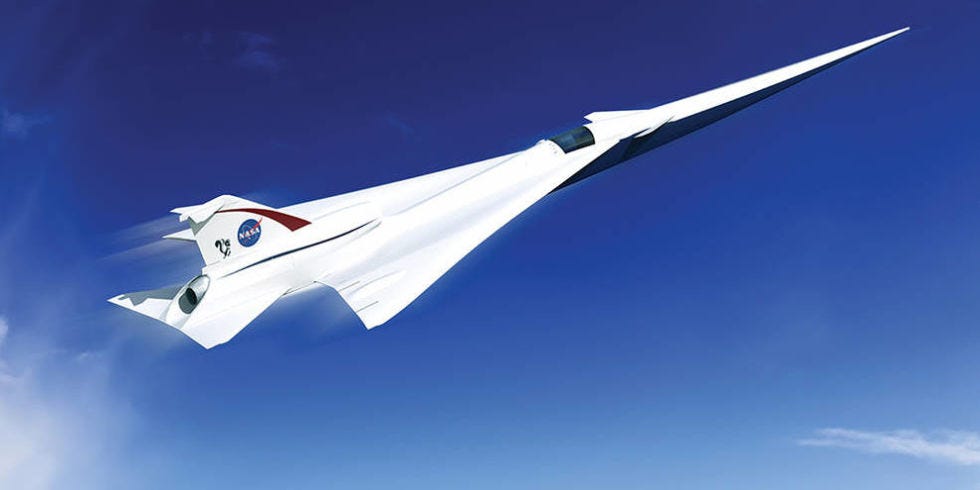
For most airplanes, flying faster than sound comes with an unavoidable announcement: a window-rattling sonic boom that can roll across the ground like thunder with an attitude problem. NASA believes that announcement can be turned down from a cannon blast to something closer to a distant car door closing.
The agency’s answer is the X-59, a needle-nosed experimental aircraft at the center of the Quesst mission. Its purpose is not to carry travelers, serve sparkling water, or make the seat-recline argument happen twice as fast. It is a research aircraft designed to prove that an airplane can travel at supersonic speed while creating a much quieter sound on the ground.
NASA is not literally eliminating every shock wave. Physics would like a word if anyone claimed that. Instead, engineers are carefully shaping and positioning the aircraft’s components so its shock waves remain separated as they move through the atmosphere. The expected result is a controlled sonic “thump” rather than the explosive double boom associated with conventional supersonic aircraft.
If the technology works and communities find the sound acceptable, NASA’s research could help regulators replace broad speed restrictions with measurable noise standards. That could eventually allow future commercial supersonic airplanes to fly over land, making coast-to-coast trips dramatically shorter.
Why Supersonic Airplanes Make Sonic Booms
An aircraft flying at subsonic speed creates pressure disturbances that travel ahead of it through the air. As the aircraft approaches the speed of sound, those pressure waves begin crowding together because the airplane is nearly keeping pace with them.
Once the aircraft exceeds Mach 1, it moves faster than the pressure disturbances can escape. The waves collect into shock waves that form a cone behind the airplane. When those concentrated pressure changes sweep across a person on the ground, they are heard as a sonic boom.
The boom is not a one-time sound produced only when the airplane “breaks” the sound barrier. A supersonic aircraft continuously produces shock waves along its flight path. Anyone positioned beneath the resulting boom carpet may hear them as the aircraft passes, even when the jet is many miles away.
Traditional supersonic designs tend to create strong pressure changes around the nose, wings, engine inlets, fuselage, and tail. As those disturbances travel toward the ground, they can merge into two dominant shocks. The resulting pressure signature resembles the letter N and is often heard as two closely spaced booms.
That sonic punctuation mark was one of the reasons Concorde generally operated supersonically over the ocean rather than populated land. The aircraft could cross the Atlantic at around twice the speed of sound, but its noise footprint made routine overland operation politically and socially difficult. Few communities were eager to receive a complimentary thunderclap whenever a flight passed overhead.
NASA’s X-59 Takes a Different Approach
The X-59 is approximately 100 feet long but has a wingspan of only about 30 feet. Much of its unusual length comes from its extremely slender nose, which accounts for nearly one-third of the aircraft. It looks less like a conventional passenger jet and more like somebody stretched a fighter plane in an image editor.
That appearance is dictated by aerodynamics, not artistic ambition. Every major exterior feature has been arranged to control when and where pressure disturbances form.
A Long Nose Creates Gentler Pressure Changes
A blunt or conventionally shaped nose pushes air aside abruptly, creating a strong shock wave. The X-59’s long, tapered nose changes the airflow more gradually. Instead of producing one large pressure jump, the shape helps create smaller disturbances distributed along the aircraft.
NASA used computational fluid dynamics, wind-tunnel testing, scale models, and acoustic simulations to refine the aircraft’s outer mold line. Engineers were not merely asking whether the airplane could fly efficiently. They were predicting how pressure changes created at high altitude would travel through different layers of the atmosphere and eventually reach the ground.
The Shock Waves Are Prevented From Joining Forces
The key idea is known as low-boom shaping. Components are positioned so the shock waves they generate remain separated rather than combining into a powerful N-wave. By the time the disturbances reach the ground, the pressure change should be spread across several smaller rises and falls.
NASA designed the X-59 to produce a sound near 75 perceived level decibels under expected conditions. Perceived loudness decibels are used to describe how people experience brief, impulsive sounds; they are not identical to the familiar decibel readings on a household sound meter. NASA compares the target sound with distant thunder or a car door closing across the street. Concorde’s sonic boom, by comparison, exceeded 100 perceived level decibels.
The difference is not just numerical. The decibel scale and human perception of sound are nonlinear, so reducing the reading by several dozen perceived loudness decibels can transform the experience from an alarming crack into a softer thump that some people may barely notice.
The Engine Sits on Top of the Aircraft
The X-59 uses a single engine mounted above the fuselage. This arrangement helps prevent strong disturbances from the engine inlet and exhaust from traveling directly toward the ground. The body of the airplane effectively shields part of the engine-related pressure signature from listeners below.
The unusual placement also helps preserve the carefully shaped underside of the aircraft. On a low-boom demonstrator, moving an inlet, changing a contour, or adding an innocent-looking bump can alter the pressure signature. Aerodynamic details that might be minor on another airplane become major characters in the X-59 story.
The Cockpit Has No Forward-Facing Window
The long nose creates one obvious complication: the pilot cannot see over it in the normal way. Rather than shortening the nose and sacrificing its acoustic benefits, NASA developed the eXternal Vision System, or XVS.
A 4K display in the cockpit shows imagery gathered by external cameras and combines it with aircraft and terrain information. The system provides the pilot with a forward view, traffic awareness, guidance symbols, and visual assistance during takeoff, approach, and landing. Traditional windows on the canopy still provide side and horizon views, but the central forward “window” is electronic.
This technology may have applications beyond the X-59. Future aircraft designers could use external vision systems to create shapes that would otherwise be impossible because a conventional windshield must remain in a pilot’s direct line of sight.
What NASA Has Already Accomplished
The X-59 made its first flight on October 28, 2025. That initial 67-minute trip was deliberately conservative: the aircraft remained subsonic, reached roughly 12,000 feet, and kept its landing gear extended while the test team evaluated basic systems and handling.
NASA then began envelope-expansion testing, gradually exploring different combinations of speed, altitude, landing-gear configuration, structural loading, and flight behavior. Some flights focused on going higher and faster, while others examined lower-speed handling, runway passes, air-data accuracy, and the forces measured by strain gauges.
On June 5, 2026, the X-59 exceeded the speed of sound for the first time. NASA test pilot Jim “Clue” Less reached approximately Mach 1.1, or 713 mph, at an altitude of 43,400 feet during an 81-minute flight. According to the pilot, the instruments provided the main indication that the aircraft had gone supersonic; there was no dramatic jolt or movie-style blast inside the cockpit.
One week later, on June 12, the aircraft reached approximately Mach 1.4, or 924 mph, at 55,000 feet. Those are the planned baseline conditions for future flights intended to produce and study the X-59’s shaped sonic signature.
Reaching the target speed does not mean the mission is finished. NASA still must complete performance testing, map the aircraft’s acoustic footprint, verify that measured sound matches years of computer predictions, and determine how atmospheric conditions affect what people hear below.
Measuring a Thump Is More Complicated Than It Sounds
The atmosphere is not an acoustically neutral hallway. Temperature, humidity, wind, turbulence, altitude, and the aircraft’s exact flight condition can change how shock waves bend and propagate toward the ground.
NASA therefore plans to use arrays of specialized microphones and ground recording stations to measure the X-59’s pressure signature. Support aircraft may also collect data above the ground, allowing researchers to follow the signature as it develops and moves through the atmosphere.
Test flights are frequently accompanied by an F-15 or F/A-18 chase plane. The chase aircraft acts as an additional set of eyes, helps coordinate communication, observes the X-59 externally, and supports the test crew while specific speeds and altitudes are evaluated.
During the X-59’s first supersonic flight, the chase aircraft’s conventional sonic booms were loud enough to obscure any sound produced by the X-59. Later acoustic-validation flights will be arranged specifically to isolate and measure the experimental aircraft’s own signature. Even in advanced aerospace research, sometimes your helpful colleague is also the loudest person in the room.
Why NASA Needs People, Not Just Microphones
NASA can measure pressure changes with impressive precision, but a microphone cannot explain whether a sound is irritating, startling, acceptable, or completely forgettable. That requires human feedback.
After the acoustic-validation phase, NASA intends to fly the X-59 over selected U.S. communities. Residents will be asked what they heard and how they reacted. Researchers can then compare survey responses with measured sound levels, flight paths, atmospheric data, and the number of exposure events.
This step is central to the Quesst mission. The ultimate question is not simply whether NASA can make a quieter boom. It is whether the remaining thump is quiet enough for regular operation over homes, offices, farms, schools, and cities.
Public reaction may also vary. One person may compare the sound to distant thunder and forget about it five seconds later. Another may be more sensitive to sudden noise. Time of day, frequency of flights, indoor insulation, neighborhood sound levels, and expectations can all influence annoyance.
By gathering responses from real communities, NASA hopes to create a dataset that regulators can use when considering acceptable limits for overland supersonic flight.
How the X-59 Could Change Aviation Rules
For decades, civil aircraft have generally been prohibited from exceeding Mach 1 over U.S. land except through specially authorized operations. The restriction is based on speed because, when it was adopted, regulators did not have a practical certification framework for separating an intolerably loud supersonic aircraft from a sufficiently quiet one.
NASA wants to help replace that speed-based approach with a noise-based standard. Under such a system, an aircraft would not receive permission merely because it was supersonic. Its manufacturer would have to demonstrate that the sound reaching the ground remained below an established threshold.
The Federal Aviation Administration has begun moving toward a regulatory framework for next-generation supersonic operations, while the International Civil Aviation Organization continues developing technical procedures for measuring and certifying en-route sonic-boom noise. NASA’s community-response data could provide an important scientific foundation for that work.
NASA itself is not building a commercial airline fleet. Its role is to demonstrate technology, validate design tools, conduct research, and provide data that private manufacturers and regulators can use. The X-59 is essentially a flying laboratory with one seat and no beverage cart.
What the X-59 Does Not Solve
Quieting the sonic boom removes one enormous obstacle, but it does not automatically make commercial supersonic travel affordable, efficient, or environmentally ideal.
Airport Noise Still Matters
Low-boom shaping primarily addresses the noise created during supersonic cruise. Future airliners must also meet strict airport noise standards during takeoff and landing, when powerful engines are operating much closer to surrounding communities.
Fuel Consumption Remains a Challenge
Flying faster requires considerable energy. A commercially viable supersonic airplane must balance speed with fuel use, operating cost, range, emissions, engine durability, and passenger capacity. A wonderfully quiet aircraft that burns money faster than fuel would not enjoy a long airline career.
The X-59 Is Not a Passenger-Aircraft Prototype
The X-59 carries one pilot and is optimized for acoustic research. A real airliner would need a pressurized passenger cabin, emergency exits, baggage space, redundant systems, economical maintenance, and engines suitable for airline service. Adding those features changes the aircraft’s size and shape, potentially changing its sonic signature as well.
Manufacturers will therefore have to apply NASA’s low-boom design methods to larger, practical aircraft rather than simply installing rows of seats inside an X-59.
What Quiet Supersonic Travel Could Eventually Mean
If low-boom technology becomes commercially and legally successful, airlines could operate supersonic routes that spend substantial time over land. That possibility is more important than merely reviving ocean-crossing Concorde routes.
A future aircraft might connect New York and Los Angeles in roughly half the time required by a conventional jet. International flights could use direct paths that cross continents rather than delaying acceleration until reaching open water. Faster cargo service could benefit time-sensitive medical supplies, critical components, and high-value shipments.
Ticket prices would probably be high during the early years. New aircraft programs are expensive, supersonic engines are demanding, and small fleets lack the cost advantages of mass production. Over time, however, better materials, engine technology, aerodynamic modeling, and operational experience could make high-speed travel available beyond the luxury market.
The X-59’s greatest contribution may not be a specific airplane. It may be the evidence that speed and acceptable community noise do not have to be permanent enemies.
Experiencing a Future Without the Traditional Sonic Boom
What Someone on the Ground Might Hear
Imagine working at home when a low-boom supersonic aircraft passes several miles overhead. With a conventional sonic boom, the event could resemble nearby thunder: abrupt, powerful, and capable of making windows, pets, and coffee cups question their life choices.
The X-59 experience is intended to be much less dramatic. A person might hear a brief, rounded thump similar to a car door closing somewhere outside. Indoors, especially in a building with modern insulation, the sound might be faint. In a quiet rural setting, it could be more noticeable, but still less startling than the sharp crack produced by a traditional supersonic aircraft.
The experience would depend heavily on weather and location. Atmospheric layers can focus or weaken sound, while wind may shift the acoustic footprint. A person directly beneath the flight path may hear something different from someone several miles to the side. That variability is exactly why NASA needs real-world measurements rather than relying entirely on laboratory predictions.
What the Pilot Experiences
For the X-59 pilot, crossing Mach 1 is not expected to feel like hitting a wall. The airplane accelerates through the sound barrier smoothly, and the pilot confirms the transition through instruments. There is no cinematic explosion in the cockpit, no sudden tunnel of light, and presumably no dramatic soundtrack unless somebody has hidden a speaker behind the seat.
The unusual experience comes from the aircraft’s external vision system. Instead of looking through a conventional windshield, the pilot uses a high-resolution display to see forward. Camera imagery, flight symbols, and navigational information become a combined digital view of the outside world.
That arrangement requires trust in cameras, processors, displays, and carefully tested backup procedures. It also gives the pilot information that an ordinary transparent window cannot provide, including integrated guidance graphics and enhanced situational cues.
What a Community Test May Feel Like
Residents selected for a Quesst community study will not simply listen once and report whether they liked the sound. Researchers need responses across multiple flights, sound levels, locations, and daily conditions.
Participants may receive surveys asking whether they noticed an event, where they were, what they were doing, and how annoying or disruptive it seemed. Those answers will be matched with microphone readings and flight information. The process turns an ordinary moment“Did you hear that?”into valuable regulatory evidence.
Repeated exposure is especially important. A single quiet thump might be acceptable, while dozens of daily events could produce a different response. Regulators will need to consider both the loudness of each event and the cumulative experience of people living beneath busy routes.
What Passengers Could Gain
Passengers on a future quiet supersonic airliner would experience the biggest difference on their watches. A domestic trip that currently consumes most of a day could become a long lunch with wings. Business travelers might attend meetings on opposite coasts without an overnight stay, while vacationers could spend more time at their destination and less time examining the seatback in front of them.
The cabin would not necessarily feel radically different. Supersonic speed is meaningful relative to the surrounding air, but passengers cruising smoothly at altitude may notice little beyond the shorter journey. As with today’s airliners, acceleration, turbulence, cabin pressure, seating, and service would shape the experience more than the number on the Mach display.
The Most Important Experience Is Public Acceptance
Ultimately, the success of quiet supersonic travel will not be decided only inside a wind tunnel, cockpit, or corporate boardroom. It will be decided beneath the flight paths.
If communities experience the sound as mild and unobtrusive, regulators may have the confidence to permit carefully certified operations. If people find repeated thumps disruptive, manufacturers may need to make aircraft quieter, modify routes, reduce flight frequency, or limit operating hours.
That makes the X-59 unusual among experimental airplanes. Its mission is not complete when the aircraft performs correctly. It succeeds only when the people on the ground help determine what acceptable supersonic flight should sound like.
Conclusion
NASA’s plan for a supersonic plane “without the boom” is really a plan to redesign the boom itself. The X-59 uses an elongated nose, precisely shaped surfaces, a top-mounted engine, swept wings, and a camera-based forward-vision system to create several weaker shock waves instead of one concentrated blast.
The aircraft has already progressed from ground testing to subsonic flight, first supersonic flight, and its Mach 1.4 mission condition. The next major scientific challenge is proving that its predicted quiet thump occurs consistently in the real atmosphere and learning how communities respond to it.
Even a successful Quesst mission will not put passengers on a quiet supersonic airliner overnight. Manufacturers must still solve questions involving fuel efficiency, emissions, airport noise, certification, operating costs, and practical cabin design. Nevertheless, removing the traditional sonic boom could reopen a door that has been effectively closed over land for more than half a century.
For the future of high-speed aviation, that quiet little thump could make a very big noise.
Note: This article reflects publicly available X-59 and Quesst mission information through August 4, 2026. NASA’s performance-testing campaign remains in progress, and broad community-response flights are planned for a later mission phase.