Long before airports, algorithmic feeds, and “Where should we get brunch?” group chats, cities were already competing to become the places everyone talked about. The ancient world had its own cultural capitals: crowded urban centers where temples rose over markets, rulers financed grand building projects, artists experimented with new styles, and scholars argued about the universe with the confidence of people who had never seen a comment section.
These cities were more than political headquarters. They were launchpads for architecture, religion, literature, trade, technology, and ideas that traveled far beyond city walls. Some were loud and sprawling. Others were ceremonial and carefully planned. A few became famous because they collected knowledge; others because they built monuments so dramatic that future generations basically had no choice but to stare.
Here are ten cultural capitals of the ancient world that helped shape civilization, one impressive stone block at a time.
What Made a City a Cultural Capital in the Ancient World?
An ancient cultural capital was not simply a place with a king, a palace, and a suspiciously large tax bill. It was a city where political power, religious life, craftsmanship, commerce, learning, and artistic expression met in one very busy place.
These cities attracted visitors, merchants, priests, diplomats, builders, performers, and intellectuals. They also had a talent for turning practical needs into cultural statements. A temple was not only a temple; it was a declaration of divine favor. A palace was not only a residence; it was a giant stone reminder of who was in charge. Even roads, walls, gardens, libraries, and marketplaces could broadcast power and identity.
1. Ur: The Sumerian City That Helped Invent Urban Life
Located in southern Mesopotamia, in present-day Iraq, Ur was one of the great cities of ancient Sumer. It flourished for thousands of years and became a major center of political authority, religious devotion, trade, and artistic production.
Ur was famous for its ziggurat, a massive stepped temple structure dedicated to the moon god Nanna. Imagine a sacred skyscraper made of mudbrick, except there was no elevator, no coffee shop in the lobby, and absolutely no casual dress code for divine ceremonies.
The city’s royal cemetery revealed extraordinary wealth, including gold ornaments, musical instruments, carved objects, imported stones, and elaborate burial goods. These discoveries show that Ur was connected to long-distance trade networks reaching far beyond Mesopotamia. Materials such as lapis lazuli, gold, carnelian, and silver traveled into the city from distant lands.
Ur mattered culturally because it combined urban planning, religious authority, artistic skill, and international exchange. It was a place where people wrote records on clay tablets, organized commercial transactions, worshiped powerful gods, and created objects that still look remarkably sophisticated today.
2. Memphis: Egypt’s Early Powerhouse of Religion and Craft
Before Thebes and Alexandria became household names among history enthusiasts, Memphis was one of ancient Egypt’s most important cities. Located near the Nile Delta, it held a strategic position between Upper and Lower Egypt and served as a major administrative, religious, and artistic center.
Memphis was associated with Ptah, a creator god and patron of craftsmen. That connection matters because the city became strongly linked with skilled production, sacred architecture, and artistic traditions. In other words, Memphis was not just a capital; it was also something like an ancient design district with much better statues and far fewer minimalist concrete cafés.
The city stood close to the monumental necropolis of Saqqara, where pyramids, tombs, temples, and sacred animal burials reflected Egypt’s deep concern with kingship and the afterlife. Memphis helped establish the visual language of pharaonic civilization: formal sculpture, massive stone construction, carefully planned ceremonial spaces, and art that made rulers look permanently calm, powerful, and incapable of having a bad hair day.
For centuries, Memphis remained influential even when political power shifted elsewhere. Its religious institutions, priesthoods, and workshops kept the city culturally relevant long after other capitals rose around it.
3. Thebes: The City of Temples, Tombs, and Divine Drama
Thebes, located in Upper Egypt near modern Luxor, became one of the most important religious and cultural centers of ancient Egypt. It rose to prominence during periods when Egyptian rulers based their authority in the south, especially during the Middle Kingdom and New Kingdom.
The city was closely associated with Amun, one of Egypt’s most powerful gods. The temple complex at Karnak became one of the largest sacred spaces ever constructed in the ancient world. It was expanded over centuries by generations of rulers, each adding pylons, courtyards, statues, obelisks, and columns as if the gods had asked for a renovation every Tuesday.
Thebes was also home to the Valley of the Kings, the Valley of the Queens, and a network of mortuary temples and elite tombs. These places preserved paintings, inscriptions, religious texts, and scenes of daily life. They offer an astonishing record of Egyptian beliefs about death, rebirth, royal power, and the afterlife.
One of the most fascinating aspects of Thebes was its community of highly skilled artisans. The workers’ village at Deir el-Medina housed the people who created royal tombs. These artists, scribes, stonecutters, and laborers left behind records that reveal not only elite culture but also the daily lives of the people who made ancient Egypt’s most famous monuments possible.
4. Babylon: The City of Law, Learning, and Legendary Walls
Babylon became one of the most famous cities of ancient Mesopotamia, partly because of its political power and partly because it had an unmatched flair for becoming legendary. Located along the Euphrates River in present-day Iraq, Babylon was a major center of administration, religion, science, literature, and architecture.
Under King Hammurabi in the eighteenth century BCE, Babylon became associated with one of the ancient world’s best-known law codes. The Code of Hammurabi was not exactly a friendly neighborhood handbook, but it represented a major effort to publicly define rules, penalties, property rights, and social order.
Babylon later reached spectacular heights under the Neo-Babylonian Empire. The city became famous for monumental walls, the Ishtar Gate, processional avenues, temples, and the great ziggurat often linked with later traditions about the Tower of Babel.
The city also had a strong intellectual tradition. Babylonian scholars studied astronomy, mathematics, calendars, omens, and written records. Their observations of the skies helped create systems for tracking celestial movements, proving that stargazing was already serious business long before telescopes, space agencies, and people arguing online about whether Mercury is ruining their week.
5. Persepolis: Persia’s Ceremonial Stage for an Empire
Persepolis was the ceremonial capital of the Achaemenid Persian Empire, one of the largest empires the ancient world had ever seen. Founded by Darius I and expanded by later rulers, Persepolis stood in southwestern Iran as a grand expression of imperial order.
The city was designed to impress. Its terraces, palaces, monumental staircases, gateways, and relief sculptures presented a carefully managed image of power. Visitors entered spaces decorated with delegations from across the empire, each bringing gifts and wearing distinctive clothing.
These reliefs did more than celebrate luxury. They communicated a political message: the empire was vast, diverse, and unified under Persian rule. It was essentially ancient international branding, carved into stone and considerably more durable than a billboard.
Persepolis reflected the cultural blending of the Persian Empire. Its architecture and decorative traditions drew inspiration from Mesopotamia, Egypt, Anatolia, Central Asia, and the Greek world. The result was not a copy of any one culture but a distinctly Persian imperial style.
Although Persepolis was destroyed after Alexander the Great conquered the empire, its surviving ruins remain among the most powerful symbols of ancient Persian civilization.
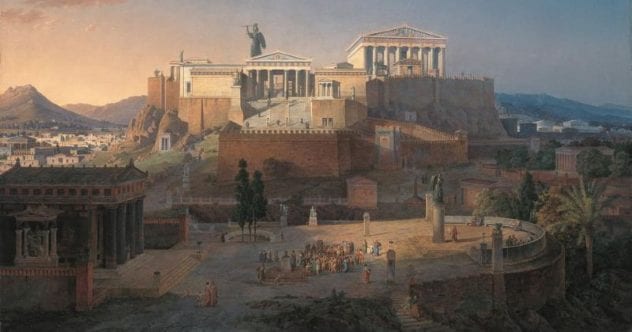
6. Athens: The City Where Drama, Democracy, and Philosophy Met
Few ancient cities have left a cultural legacy as large as Athens. During the Classical Greek period, Athens became a leading center of political experimentation, architecture, theater, philosophy, visual art, and public debate.
The Acropolis, crowned by the Parthenon, became the city’s most recognizable symbol. Built during the fifth century BCE, the Parthenon reflected Athens’ wealth, confidence, and devotion to Athena. Its columns and sculptural decoration have influenced architecture around the world, from banks and government buildings to museums that clearly wanted to look a little more impressive before lunch.
Athens was also famous for theater. Playwrights such as Aeschylus, Sophocles, Euripides, and Aristophanes created tragedies and comedies that explored war, family conflict, politics, religion, morality, and the timeless fact that humans can make terrible decisions with remarkable confidence.
Philosophers including Socrates, Plato, and Aristotle transformed discussions about ethics, knowledge, government, and human nature. Their ideas traveled through the Mediterranean and later influenced Roman, Islamic, European, and modern intellectual traditions.
Ancient Athens was not perfect, and its democracy excluded many people, including women, enslaved individuals, and foreign residents. Still, it became a cultural capital because it made public debate, artistic competition, and intellectual inquiry central parts of civic life.
7. Alexandria: The Ancient World’s Knowledge Capital
Founded by Alexander the Great in Egypt, Alexandria became one of the great cultural capitals of the Hellenistic world. Its location on the Mediterranean made it a commercial crossroads between Egypt, Greece, Africa, Asia, and the wider Mediterranean world.
Alexandria became famous for its Library and Mouseion, an institution devoted to scholarship and research. Scholars gathered there to study literature, mathematics, medicine, geography, astronomy, language, and philosophy. The Mouseion gave the modern world the word “museum,” although ancient visitors probably did not have to navigate a gift shop before leaving.
Writers and scholars in Alexandria worked to collect, copy, compare, and organize texts. The city became especially important for preserving and analyzing Greek literature. Its intellectual culture encouraged research, debate, cataloging, and the pursuit of knowledge on a large scale.
Alexandria also represented cultural fusion. Greek rulers governed Egypt, but Egyptian religious traditions remained powerful. Art, architecture, language, and ceremony mixed Greek and Egyptian elements in ways that created a unique Hellenistic identity.
Its lighthouse, the Pharos of Alexandria, became one of the Seven Wonders of the Ancient World. It guided ships into the harbor while quietly reminding every visitor that this city had both brains and excellent waterfront branding.
8. Rome: The City That Turned Power Into a Public Spectacle
Rome was not only the capital of an empire; it was a machine for producing culture on a colossal scale. From the Roman Republic through the Imperial period, Rome shaped law, architecture, engineering, religion, language, urban planning, art, and public entertainment.
The Roman Forum was the beating heart of civic life. It hosted political speeches, religious ceremonies, legal trials, commercial activity, elections, celebrations, and public gatherings. In Rome, culture was rarely hidden indoors. It happened in squares, baths, theaters, arenas, temples, and streets.
Roman architecture changed the physical look of cities across the empire. Arches, vaults, aqueducts, roads, amphitheaters, public baths, and monumental forums appeared across Europe, North Africa, and the Near East. Roman builders had a deep appreciation for infrastructure, which is one reason their roads lasted longer than some modern online subscriptions.
Rome also absorbed cultural influences from the Greeks, Etruscans, Egyptians, and many other peoples. Rather than simply copying them, Roman artists and patrons adapted foreign ideas to serve Roman identity, prestige, and imperial ambition.
The Latin language, Roman law, and Roman administrative systems continued to influence later societies long after the Western Roman Empire fell. Rome’s cultural reach was so broad that it became difficult for later civilizations to ignore, even when they really wanted to move on.
9. Chang’an: The Cosmopolitan Heart of Tang China
Chang’an, now known as Xi’an, was one of the great urban capitals of ancient and medieval China. It served as the capital of several dynasties, including the Han and Tang, and became one of the largest and most cosmopolitan cities in the world.
During the Tang dynasty, Chang’an thrived as a center of government, religion, trade, poetry, music, fashion, and artistic exchange. Merchants, diplomats, monks, and travelers arrived from India, Persia, Central Asia, Korea, Japan, Arabia, and beyond.
The city’s position near major Silk Road routes helped make it a meeting place for cultures and ideas. Foreign goods, musical instruments, religious traditions, textiles, food, and artistic styles entered the city and became part of daily life.
Chang’an was also a center of Chinese literary culture. The Tang period produced some of China’s most celebrated poets, including Li Bai and Du Fu. Poetry was not a niche hobby reserved for people carrying very expensive notebooks; it was deeply connected to education, official life, personal expression, and social status.
The city’s carefully planned layout, imperial palaces, temples, markets, and administrative districts reflected the enormous organizational capacity of the Tang state. Chang’an showed how urban planning could create both order and cultural energy at the same time.
10. Teotihuacan: The First Great Metropolis of the Americas
Teotihuacan, located in central Mexico, was one of the largest and most influential cities in the ancient Americas. At its height, it may have housed more than 100,000 people, making it a true metropolis centuries before many famous cities in Europe reached similar scale.
The city is known for its enormous Pyramid of the Sun, Pyramid of the Moon, Temple of the Feathered Serpent, and the long ceremonial avenue now called the Avenue of the Dead. These structures formed a carefully planned sacred landscape that connected architecture, religion, politics, and astronomy.
Teotihuacan’s original name is unknown. The name used today was given later by the Mexica, or Aztecs, who viewed the ruined city with awe. That alone tells you something important: even centuries after its decline, Teotihuacan was still powerful enough to inspire myth.
The city influenced cultures across Mesoamerica through trade, artistic styles, religious imagery, and political relationships. Its murals, apartment compounds, sculpture, and monumental urban design reveal a society with sophisticated social organization and strong ritual traditions.
Teotihuacan deserves a place among the world’s ancient cultural capitals because it proves that urban complexity, monumental architecture, and cultural influence were never limited to the Mediterranean or Near East. The ancient world was much bigger, more connected, and more creative than the usual history textbook shortcut suggests.
Why These Ancient Cultural Capitals Still Matter
The ten cities on this list belonged to different languages, religions, climates, and political systems. Yet they shared several qualities. They brought people together. They concentrated wealth and talent. They built monuments that carried stories into the future. They made culture visible through architecture, rituals, art, writing, performance, and public spaces.
Modern cities still work in similar ways. A city becomes culturally influential when it attracts creators, scholars, entrepreneurs, religious leaders, travelers, and ambitious people with extremely strong opinions about urban planning. The difference is that today’s cultural capitals use skyscrapers, subways, stadiums, museums, and digital networks. Ancient cities used temples, ziggurats, libraries, forums, palaces, and processional roads.
The materials changed. The human impulse did not.
Experiencing the Ancient Cultural Capitals Today
Reading about ancient capitals is one thing. Experiencing their remains, artifacts, reconstructions, and stories is another. Even when only fragments survive, these places can make history feel much less like a list of dates and much more like a world full of noise, ambition, ceremony, food, trade, gossip, religion, and very expensive construction projects.
Walking Through Ruins With a Little Imagination
Visiting an ancient city usually requires one essential travel accessory: imagination. A visitor standing among low stone walls at Babylon or Teotihuacan may not immediately see the crowded streets, painted surfaces, market stalls, priests, musicians, merchants, and officials who once moved through those spaces. Ancient ruins can be quiet now, but they were rarely quiet when they mattered most.
At Persepolis, the carved reliefs on staircases offer a particularly vivid experience. You can follow the processions of delegates bringing gifts to the Persian king and imagine the ceremonial atmosphere of an empire gathering in one place. The stone figures are still, but their original message is full of movement: many peoples, many languages, one imperial stage.
At Thebes, the scale can feel almost overwhelming. Temple columns at Karnak rise like a stone forest. Tomb paintings in the Valley of the Kings preserve colors and details that make ancient beliefs about the afterlife seem surprisingly immediate. It is difficult not to wonder what it felt like to enter those spaces when they were newly built, brightly painted, and filled with ritual activity.
Seeing Ancient Art in Museums
Museums can provide another powerful route into ancient cultural capitals. A gold headdress from Ur, a painted Egyptian coffin, a Greek vase, a Roman portrait, a Persian relief, a Tang horse figurine, or a Teotihuacan mask can reveal details that ruins alone may not show.
Objects make ancient cities personal. A clay tablet from Mesopotamia may record a business transaction. A Roman inscription may preserve a name. A Greek vase may show a theatrical scene. A Tang ceramic figure may capture the fashion, music, or global connections of Chang’an. These artifacts remind us that ancient culture was made by real people who worried about money, religion, status, family, work, and whether their artistic project would survive the next ruler’s renovation plan.
The best museum experiences do not treat ancient objects as frozen trophies. They place them in context. A statue was once part of a temple. A tablet was once handled by a scribe. A vessel may have been used in a feast, a funeral, or a household ritual. Seeing that larger story turns an object from “old thing behind glass” into evidence of a living civilization.
Exploring Ancient Capitals Through Food, Stories, and Daily Life
Another way to experience ancient cultural capitals is through daily life. Think about the smells of baking bread in Egypt, incense in Babylonian temples, olive oil and wine in Athens, spices arriving in Chang’an, or maize-based meals in Teotihuacan. Cities were cultural centers not only because rulers built monuments, but because ordinary people created traditions through cooking, clothing, music, trade, and family life.
Historical fiction, documentaries, archaeological museums, virtual reconstructions, and university lectures can help recreate these everyday worlds. A well-made reconstruction of the Roman Forum or the Library of Alexandria can make a city feel more understandable. It also reminds us that ancient buildings were often painted, crowded, decorated, and noisy. The white marble ruins we picture today would have looked very different in their original colors.
Learning the Lesson of Cultural Exchange
Perhaps the most valuable experience connected to ancient cultural capitals is recognizing how connected they were. Ur traded with distant regions. Babylonian knowledge influenced later scholars. Persian art blended traditions from across an empire. Athens shaped Roman education. Alexandria gathered texts from across the Mediterranean. Chang’an welcomed travelers from multiple continents. Teotihuacan influenced distant Mesoamerican communities.
Ancient cities were not isolated bubbles. They were crossroads. Ideas moved with merchants, soldiers, pilgrims, diplomats, enslaved people, artists, and migrants. Styles changed because people met one another. Languages mixed. Religions adapted. Technologies traveled. Cultural exchange was not a modern invention; it was already one of humanity’s favorite habits.
Bringing Ancient Cities Into Modern Travel
Modern travelers can approach ancient capitals with more curiosity than checklist tourism. Instead of rushing from one famous monument to another, it helps to ask a few better questions. Who built this place? Who worked here? What sounds would have filled the streets? Which materials came from far away? What rituals happened here? Who was included in the city’s power, and who was excluded?
Those questions make ancient cities more human. They also reveal that cultural greatness often came with inequality, conquest, forced labor, and intense competition. The monuments are impressive, but the people behind them were not all living the same life. A king’s palace, a worker’s village, a market stall, and a burial ground can tell very different versions of the same city.
That is why ancient cultural capitals remain so fascinating. They are not simply beautiful ruins. They are complicated records of human imagination. They show what people can create when knowledge, resources, faith, ambition, and collaboration collide in one place. They also show what happens when power becomes too concentrated, too expensive, or too certain that it will last forever.
Conclusion
From Ur and Memphis to Chang’an and Teotihuacan, the great cultural capitals of the ancient world changed how people built cities, organized societies, worshiped gods, recorded knowledge, and imagined power. Their legacies survive in museums, ruins, languages, legal traditions, artistic styles, and the way modern cities still compete to become places where culture happens first.
These ancient cities may no longer control empires, but they still command attention. And honestly, any place that can remain culturally relevant for two thousand years after its last grand festival deserves a spot on the itinerary.