Spend five minutes reading nostalgia threads online and you will quickly discover a universal truth: the mid-2000s were not just different, they were gloriously, confusingly, and sometimes alarmingly weird. People remember the music fondly, the mall food courts lovingly, and the digital cameras with a level of devotion usually reserved for family pets. But they also remember a long list of behaviors that were treated as completely normal back then and would now earn side-eyes, HR emails, group chats, or all three.
That is what makes this topic so fascinating. The strange stuff is not always the dramatic stuff. Sometimes it is the little everyday details: restaurants divided into “smoking” and “non-smoking” sections like smoke respected invisible borders, calling a friend’s house and having a terrifying conversation with their parent first, or casually posting enough personal information online to make a modern privacy expert lie down in a dark room. Other times, the weirdness was more serious: body shaming as mainstream entertainment, workplace comments brushed off as jokes, and cruel celebrity coverage treated like harmless fun.
Below are 21 things people online still bring up when they talk about what used to be widely acceptable about 20 years ago. Some are funny. Some are embarrassing. Some are a little bleak. All of them remind us that culture changes fast, and sometimes the best proof is looking back and saying, “Wait… we really did that?”
1. Smoking almost everywhere indoors
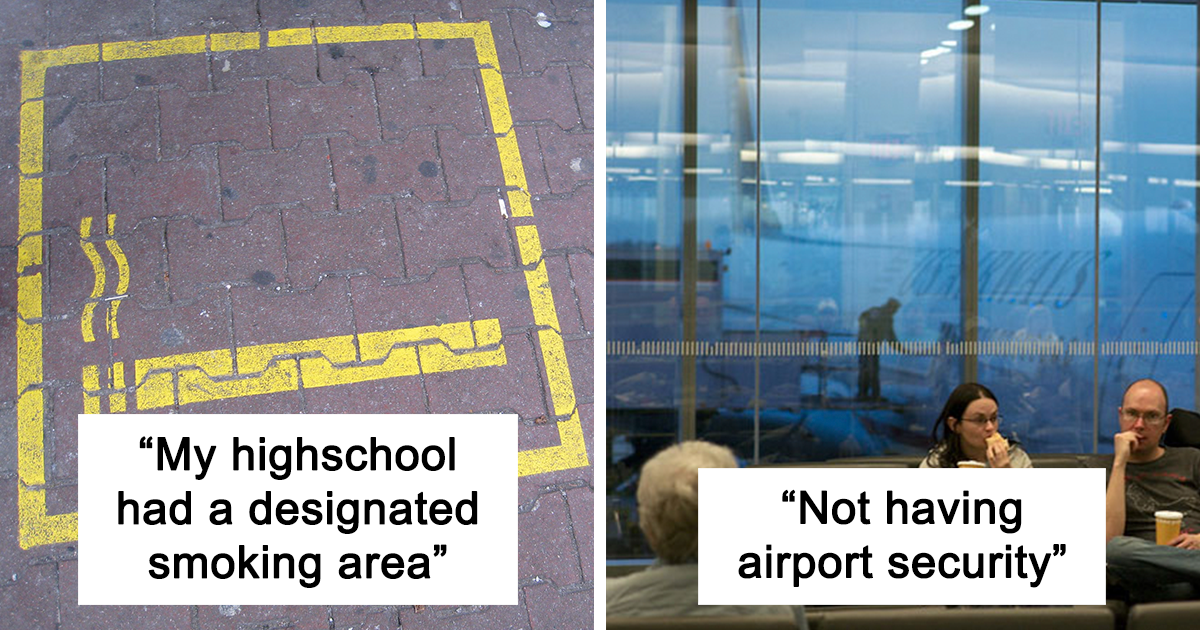
People online still sound mildly haunted when they describe restaurants, bowling alleys, bars, and even family spaces that smelled like an ashtray with ambition. One of the strangest old norms was the idea that smoking indoors was simply part of public life. The “non-smoking section” was often a few feet away from the smoking section, as if air politely followed directions. Today, the idea of inhaling someone else’s cigarette with your mozzarella sticks feels absurd.
2. Tanning until you were basically a rotisserie chicken
Two decades ago, a deep tan was routinely sold as the shortcut to looking healthy, glamorous, and vacation-ready, even if the “vacation” was just lying in a glowing indoor tanning bed next to a bottle of aggressively coconut-scented lotion. Online commenters often mention how normal it seemed to chase sun damage on purpose. Now that skin health gets taken more seriously, that era feels less bronzed goddess and more “why were we slow-roasting ourselves for beauty?”
3. Body shaming as everyday comedy
One of the biggest things people online point to is how normal it used to be to mock someone’s weight in magazines, on TV, in movies, and in regular conversation. Entire headlines were built around whether a celebrity had “gained” or “lost” five pounds. Sitcoms threw in fat jokes like seasoning. Reality shows treated humiliation as character development. Today, that culture looks meaner in retrospect than many people realized at the time.
4. Paparazzi chaos being treated like harmless entertainment
There was a stretch in pop culture when stalking celebrities in public, photographing them at vulnerable moments, and picking apart every image felt almost weirdly acceptable. People online often mention how tabloid culture made invasive behavior seem normal, even funny. A star could be having a terrible day, and the public response was basically, “Excellent, put it on the cover.” Looking back, the cruelty of that whole machine is impossible to ignore.
5. Slut-shaming famous women as a national hobby
The 2000s had a special talent for judging women from every possible angle at once. If a celebrity seemed too sexy, she was attacked. If she tried to look wholesome, she was mocked. If private images were leaked, too many people acted as if the woman was the scandal rather than the violation. Online discussions about that era often circle back to how brutally famous women were policed, with the public treating their humiliation like a spectator sport.
6. Casual homophobic jokes in mainstream entertainment
Many people online say rewatching older shows can feel like opening a nostalgia box and finding one extremely loud problem inside. Lazy gay jokes, panicky masculinity humor, and “no homo” energy were often treated as harmless punch lines. What once passed as standard sitcom banter now lands very differently. It is a reminder that humor does not exist in a vacuum, and that cultural comfort with certain jokes can age like milk left on a car dashboard in July.
7. Creepy workplace comments being dismissed as “just joking”
Twenty years ago, a surprising amount of inappropriate office behavior was brushed aside as personality, flirting, or old-school workplace culture. A weird remark about someone’s body, clothes, or dating life could get shrugged off instead of challenged. People online often compare that atmosphere with today’s much lower tolerance for harassment and boundary-crossing. Not every workplace was lawless, obviously, but too many people were expected to laugh along and keep moving.
8. Racially insensitive costumes, mascots, and “parody”
This is one of the darker examples people bring up. Things that leaned on caricature, stereotype, and racial mockery often survived in mainstream culture far longer than they should have. Old photos, costumes, ads, and school traditions still circulate online as proof that a lot of ugliness was normalized under the label of fun, nostalgia, or “not that serious.” Looking back, it is obvious that what many people called parody was often just disrespect in a flimsy disguise.
9. Letting kids disappear for hours with basically no live tracking
Ask enough people online about childhood in the early 2000s and they will eventually describe biking around the neighborhood until sunset with little more than “be home by dinner” as the safety plan. No GPS tracking. No location sharing. No stream of check-in texts. Parents worried, of course, but there was still more cultural comfort with kids having unsupervised time. Today, that level of freedom feels adventurous to some and unthinkable to others.
10. Treating the family desktop in the living room as peak internet safety
Back then, a lot of households seemed to believe that putting the computer in a shared room solved every online problem. The logic was simple: if the monitor faced the hallway, surely the internet itself would behave. People online laugh about how innocent that now seems. Early social networking, chat rooms, file sharing, and digital oversharing were all exploding, and many adults were still operating on the theory that proximity to a lamp made cyberspace safe.
11. Posting way too much personal information online
Early social media had a kind of reckless innocence. People listed schools, birthdays, relationship drama, favorite bands, inside jokes, and enough emotional subtext to fuel a semester-long literature class. Online commenters often describe old profiles as digital diaries with worse privacy settings. At the time, it felt social and fun. In hindsight, it also feels like an entire generation volunteered for a group project in public oversharing without reading the assignment instructions.
12. Calling someone without texting first
For younger readers, yes, this really happened. People simply dialed your number and expected you to answer. No warning text. No “Are you free?” message. No formal negotiation. Just a ringtone and destiny. Online nostalgia threads love this one because it captures how communication etiquette has changed. What once seemed normal now feels weirdly aggressive to a lot of people, as though every call arrives wearing dress shoes and demanding eye contact.
13. Showing up at someone’s house unannounced
Speaking of social boldness, people absolutely used to appear at friends’ houses with little or no warning and hope for the best. The most stressful version involved ringing the bell while praying the friend answered instead of a suspicious parent. People online describe this with a mix of fondness and horror. It could be spontaneous and fun, but it also required a level of social bravery modern messaging culture has politely retired.
14. Public humiliation as entertainment on makeover and reality shows
There was once a thriving genre of television built around telling people they were embarrassing, unfashionable, clueless, or in need of being fixed. The audience was expected to enjoy the discomfort because it supposedly led to transformation. Online commenters often mention how ruthless some of those shows look now. The makeover itself was sold as empowerment, but the path there was frequently paved with mockery, body criticism, and manufactured shame.
15. Openly ranking women’s bodies in pop culture
It is hard to overstate how normal it once was for magazines, websites, and TV hosts to evaluate women’s bodies like Olympic judges with worse manners. Best bikini body. Worst beach body. Too thin. Too curvy. Not toned enough. Too toned somehow. People online regularly point out that the culture treated women’s appearances as public property. Today, that constant scoring system looks exhausting, invasive, and frankly absurd.
16. Treating mental health struggles like weakness or drama
Another big shift people mention is how differently anxiety, depression, burnout, and therapy were discussed. Twenty years ago, many people grew up hearing that you should tough it out, stop overreacting, or simply stay busy. Mental health support existed, but the cultural language around it was much less open. That older attitude did not make people stronger. It mostly made them quieter. In hindsight, a lot of people were struggling while pretending they were just “stressed.”
17. Schools and sports relying on shame as motivation
People online often remember teachers, coaches, and other authority figures using humiliation as a completely standard tool. Embarrassing students in front of the class, mocking mistakes, or using fear as motivation could be treated as character building. Some people survived it and laugh now. Plenty of others remember it less fondly. Today, more people question whether public shaming actually teaches anything besides how to dread raising your hand.
18. Casual rude comments about appearance from family, friends, and strangers
In older social norms, people often felt free to comment on your weight, skin, haircut, outfit, or acne like they were offering weather updates. Online threads about the 2000s are full of stories about adults casually saying things that would now be considered deeply intrusive. The strange part is not just that it happened. It is that many people were expected to accept it as honesty, concern, or humor instead of what it often was: unnecessary meanness.
19. Printing MapQuest directions and hoping for the best
This one lands on the lighter side of the list, but people online bring it up constantly because it now feels gloriously prehistoric. Before phones guided every turn in real time, people printed directions from a website, put the pages in the passenger seat, and entered a state of spiritual commitment. Miss one turn and the whole mission could collapse. The wild part is that this felt normal, efficient, and sophisticated at the time.
20. Developing every photo, including the deeply unfortunate ones
Digital convenience has erased one of the strangest old rituals: waiting to discover whether an entire batch of photos was useful, blurry, or socially devastating. People online laugh about how normal it was to develop disposable camera photos and receive physical evidence of every awkward pose, red-eye disaster, and cursed angle. You could not curate much. You simply accepted that somewhere in the envelope was a picture of you blinking like a haunted Victorian child.
21. Believing chain emails, rumors, and internet nonsense at face value
The early web had many strengths, but calm, careful media literacy was not always one of them. Chain emails, urban legends, manipulated photos, and random warnings spread with incredible speed. People online still joke about the era of all-caps messages promising doom, luck, viruses, secret laws, or celebrity scandals. The weird part is how routine it felt. Today, misinformation is still a major problem, but back then a lot of people treated forwarded nonsense like it came from the internet supreme court.
Why These Old Norms Feel So Strange Now
What changed is not just technology. It is empathy, language, and awareness. People know more about privacy than they used to. They know more about secondhand smoke, skin damage, harassment, and the long-term impact of shame. Social expectations also changed. Behaviors once defended as jokes, habits, or harmless traditions are now more likely to be examined for who they affect and why they lasted so long.
That does not mean the present is perfect. Not even close. Every era has its blind spots, and the current one will absolutely get roasted by future generations for things we barely notice right now. But looking back at what used to pass as normal can still be useful. It shows how quickly standards can change once enough people stop pretending something is harmless just because it is familiar.
Shared Experiences People Still Talk About Online
If there is one reason this topic keeps thriving online, it is because the memories feel both hilarious and uncomfortably specific. People do not just remember “the 2000s.” They remember walking into a restaurant and immediately knowing whether the smoking section was winning. They remember peeling open a laminated menu while the air smelled like fries, ketchup, and a cigarette that had somehow been alive since 1987. They remember adults acting like that was just the natural scent of civilization.
They remember social life feeling weirdly bolder and simpler at the same time. You wanted to talk to your friend, so you called the house. Then came the tiny heart attack when a parent answered and you had to speak like a respectable member of society for twelve seconds before your friend got on the line. Or you rode your bike over there and rang the bell with no warning because apparently surprise was once considered a friendship feature, not a privacy violation.
They remember the internet before everyone fully understood what the internet was doing to memory, identity, and embarrassment. Profiles were decorated like digital bedrooms. Song lyrics functioned as emotional press releases. Photo albums contained blurry party pictures, dramatic captions, and enough public oversharing to keep future employers spiritually alert. At the time, it felt expressive. Now it feels like half the population accidentally beta-tested permanent self-documentation.
People also remember how normal casual cruelty could feel. A mean joke about somebody’s body, a nasty tabloid headline, a dismissive comment at work, a mocking makeover show, a teacher using embarrassment as discipline, a relative making an uninvited remark about weight at dinner, a sitcom throwing in a cheap stereotype because apparently nuance had missed the bus. None of this was invisible, exactly. It was just tolerated more often than it should have been.
And yet nostalgia threads are not only grim. They are full of the odd warmth that comes from recognizing shared absurdity. People laugh about printing directions, carrying cameras with 27 photos of pure chaos, and getting one chance to take a decent picture before the batteries died. They laugh about tanning lotion, low-rise jeans, awkward ringtone choices, and the era when calling after 9 p.m. somehow felt like advanced strategy. They laugh because humor is often how people process change.
That is why these conversations keep resurfacing. They are not just lists of outdated habits. They are snapshots of how ordinary life felt before certain social corrections took hold. They capture the tiny rules, blind spots, and rituals that shaped everyday experience. More than anything, they remind people that normal is never fixed. It is just whatever a culture has not fully questioned yet.
Conclusion
When people online swap stories about the weirdly acceptable things from 20 years ago, they are doing more than making fun of frosted lip gloss and terrible media etiquette. They are tracking a real cultural shift. The line between “normal” and “nope” moved on smoking, privacy, parenting, body image, workplace conduct, and entertainment built on humiliation. Some changes came from better information. Others came from people getting tired of being the punch line. Either way, the result is the same: the past can feel comfortingly familiar right up until it suddenly looks completely unhinged.