Speed is one of those physics ideas that sounds intimidating until you realize you use it constantly. When you estimate how long it will take to walk to class, compare a sprinter’s pace, check whether a train is crawling or flying, or wonder why your delivery driver has been “three minutes away” for twenty minutes, you are thinking about speed. In science, engineering, sports, transportation, and everyday problem-solving, the cleanest standard unit for speed is metres per second, written as m/s.
The good news? Calculating speed in metres per second is not a secret ritual performed by people wearing lab coats and suspiciously clean safety goggles. It usually comes down to three practical methods: using the basic speed formula, converting from another speed unit, or using graphs and real-world measurements. Once you understand these three ways, speed questions become much less scary and much more like a tidy math recipe.
This guide explains 3 ways to calculate speed in metres per second, with simple formulas, step-by-step examples, common mistakes, and real-life experiences that make the topic easier to remember. No teleportation required.
What Does Metres per Second Mean?
Metres per second tells you how many metres an object travels in one second. If a cyclist moves at 5 m/s, that means the cyclist covers 5 metres every second, assuming the speed stays constant. If a toy car moves at 2 m/s, it travels 2 metres in each second. If your cat hears a food bag open and crosses the room at approximately “small furry rocket” speed, you could measure that in m/s too.
In the International System of Units, the metre is the standard unit of length, and the second is the standard unit of time. That makes metres per second a natural unit for scientific speed calculations. In physics, speed is usually defined as distance travelled divided by the time taken. Average speed uses the total distance and total elapsed time, while instantaneous speed describes how fast something is moving at one particular moment.
Speed vs. Velocity: A Quick but Important Difference
Before calculating, it helps to separate speed from velocity. Speed tells only how fast something is moving. Velocity tells how fast and in what direction. A car moving at 20 m/s has a speed of 20 m/s. A car moving at 20 m/s north has a velocity of 20 m/s north.
That direction matters. If you walk 10 metres forward and then 10 metres back to your starting point, your total distance is 20 metres. Your displacement, however, is zero because you ended where you began. Your average speed is based on the 20 metres you actually walked. Your average velocity is based on displacement, so it would be zero. Physics is not being rude; it is just being precise.
Way 1: Calculate Speed Using Distance and Time
The Basic Formula
The most direct way to calculate speed in metres per second is to use the classic formula:
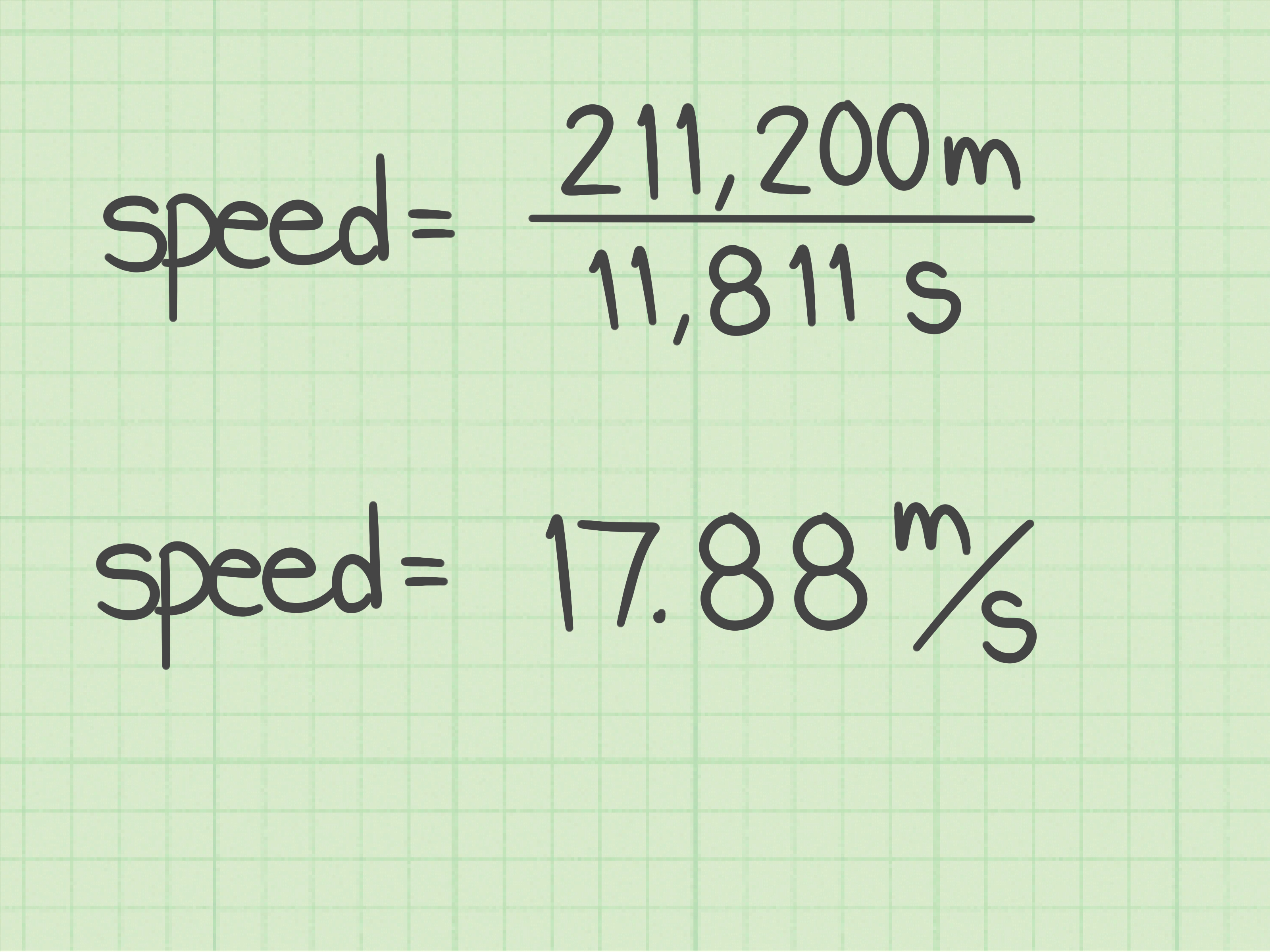
Speed = Distance ÷ Time
When distance is measured in metres and time is measured in seconds, the answer automatically comes out in metres per second.
s = d ÷ t
In this formula:
- s means speed
- d means distance
- t means time
Example 1: A Runner on a Track
Suppose a runner covers 100 metres in 12.5 seconds. To find the runner’s average speed:
Speed = 100 m ÷ 12.5 s = 8 m/s
So the runner’s average speed is 8 metres per second. That means, on average, the runner travels 8 metres every second. Not bad. Most of us reach that speed only when someone says there is one slice of pizza left.
Example 2: A Toy Car
A toy car rolls 6 metres across the floor in 3 seconds.
Speed = 6 m ÷ 3 s = 2 m/s
The toy car’s speed is 2 m/s. This is a perfect classroom example because both measurements are already in the correct units.
When This Method Works Best
This method is best when you already know the distance in metres and the time in seconds. It is commonly used in school physics problems, sports timing, lab experiments, and simple motion studies. You measure how far something moved, measure how long it took, divide, and then celebrate quietly because the units behaved themselves.
Common Mistake: Mixing Units
The biggest trap is mixing metres with minutes or kilometres with seconds. If the distance is in metres but the time is in minutes, your answer will be metres per minute, not metres per second. To get m/s, convert the time to seconds first.
For example, if a person walks 120 metres in 2 minutes, do not calculate 120 ÷ 2 and call it 60 m/s. That would make the walker faster than many vehicles. First convert 2 minutes to 120 seconds:
Speed = 120 m ÷ 120 s = 1 m/s
Now the answer makes sense. A walking speed of 1 m/s is reasonable. A walking speed of 60 m/s would require either superpowers or a paperwork error.
Way 2: Convert Another Speed Unit into Metres per Second
Sometimes speed is not given in metres per second. You might see kilometres per hour, miles per hour, feet per second, or even knots. In those cases, the trick is to convert the existing speed into m/s.
Converting Kilometres per Hour to Metres per Second
To convert kilometres per hour to metres per second, divide by 3.6.
m/s = km/h ÷ 3.6
Why 3.6? Because 1 kilometre equals 1,000 metres, and 1 hour equals 3,600 seconds. So:
1 km/h = 1,000 m ÷ 3,600 s = 0.2778 m/s
That is the same as dividing by 3.6.
Example 3: A Car Traveling at 72 km/h
A car travels at 72 km/h. Convert that speed to m/s:
72 ÷ 3.6 = 20
So the car is moving at 20 m/s. That means every second, it covers about 20 metres. Suddenly, “just one second of distraction” while driving sounds much more serious, because it is.
Converting Metres per Second to Kilometres per Hour
The reverse is just as useful. To convert from m/s to km/h, multiply by 3.6.
km/h = m/s × 3.6
For example:
10 m/s × 3.6 = 36 km/h
Converting Miles per Hour to Metres per Second
In the United States, speed is often shown in miles per hour. To convert mph to m/s, multiply by 0.44704.
m/s = mph × 0.44704
For quick mental estimates, many people use 0.45. That gives a close approximation, although the exact conversion factor is better for schoolwork, engineering, or any situation where rounding errors might cause trouble.
Example 4: A Vehicle Moving at 60 mph
A car is moving at 60 mph. Convert to m/s:
60 × 0.44704 = 26.8224 m/s
Rounded to one decimal place, the car is traveling at about 26.8 m/s. In other words, highway speed is not just “fast.” It is nearly 27 metres every second, which is why physics teachers and traffic safety experts both enjoy reminding everyone that stopping distance matters.
When This Method Works Best
Use unit conversion when a speed is already known but written in a different unit. This method is common in road travel, aviation, sports data, science articles, international comparisons, and homework problems that are clearly designed to check whether you are awake.
Way 3: Calculate Speed from a Graph or Real-World Measurement
The third way to calculate speed in metres per second is to gather information from a graph, chart, video, experiment, or real-life measurement. This method is especially useful when distance and time are not handed to you in a neat sentence.
Using a Distance-Time Graph
On a distance-time graph, speed is represented by the slope of the line. The steeper the line, the faster the object is moving. A flat line means the object is not moving away from the starting point at all.
To calculate speed from a distance-time graph, choose two points on the line and use:
Speed = Change in distance ÷ Change in time
This is often written as:
Speed = Δd ÷ Δt
The Greek letter delta, Δ, simply means “change in.” It looks fancy, but it is just math wearing a little hat.
Example 5: Reading a Graph
Imagine a graph shows that a cyclist is 10 metres from the start after 2 seconds and 50 metres from the start after 10 seconds.
First, find the change in distance:
50 m – 10 m = 40 m
Then, find the change in time:
10 s – 2 s = 8 s
Now divide:
Speed = 40 m ÷ 8 s = 5 m/s
The cyclist’s speed is 5 m/s.
Using Real-World Measurement
You can also calculate speed by measuring distance and timing movement yourself. For example, mark a 20-metre distance on a sidewalk, use a stopwatch to time a skateboarder, and divide distance by time.
If the skateboarder travels 20 metres in 4 seconds:
Speed = 20 m ÷ 4 s = 5 m/s
This is the same formula as Way 1, but the difference is that you collect the data yourself instead of being given the numbers.
Using Video Timing
Video can make speed calculation easier. If you know the frame rate and a measured distance in the scene, you can estimate how long an object takes to travel that distance. This is often used in sports analysis, classroom experiments, traffic studies, and motion-tracking apps.
For example, suppose a ball rolls across a 2-metre section of floor. In a video, it takes 50 frames to cross that distance. If the video records at 25 frames per second, the time is:
50 frames ÷ 25 frames per second = 2 seconds
Then calculate speed:
Speed = 2 m ÷ 2 s = 1 m/s
Congratulations: you have turned your phone into a physics tool. It may still be full of blurry pet photos, but now it has academic purpose.
Average Speed vs. Instantaneous Speed
Most simple speed calculations produce average speed. If a bus travels 300 metres in 30 seconds, its average speed is 10 m/s. That does not mean it moved at exactly 10 m/s the entire time. It might have started slowly, sped up, slowed down, stopped briefly, and then moved again. Average speed smooths all of that into one useful number.
Instantaneous speed is the speed at a specific instant. A car’s speedometer shows something close to instantaneous speed. In contrast, dividing total distance by total time gives average speed. Both are useful, but they answer slightly different questions.
How to Rearrange the Speed Formula
Once you know the basic relationship between speed, distance, and time, you can rearrange the formula to solve for missing values.
To Find Speed
Speed = Distance ÷ Time
Use this when you know distance and time.
To Find Distance
Distance = Speed × Time
Example: If a runner moves at 6 m/s for 10 seconds:
Distance = 6 × 10 = 60 m
To Find Time
Time = Distance ÷ Speed
Example: If a cyclist travels 100 metres at 5 m/s:
Time = 100 ÷ 5 = 20 s
These three formulas are connected. Many students remember them using a speed-distance-time triangle, but the real key is understanding the relationship: speed tells how much distance is covered per unit of time.
Practical Examples of Speeds in Metres per Second
Numbers are easier to understand when they connect to real life. Here are a few approximate examples:
- A relaxed walking pace may be around 1 to 1.5 m/s.
- A strong recreational runner may run around 4 to 6 m/s.
- A fast sprint can exceed 9 m/s for elite athletes.
- A car at 36 km/h travels at 10 m/s.
- A car at 72 km/h travels at 20 m/s.
- A car at 60 mph travels at about 26.8 m/s.
These comparisons help you “feel” the unit. At first, m/s can seem abstract. But once you realize that 20 m/s means 20 metres every single second, the unit becomes vivid. It also makes you less casual about tailgating, late braking, and checking a notification while moving at road speed.
Common Errors When Calculating Speed in m/s
Using the Wrong Time Unit
If time is in minutes, convert to seconds. If time is in hours, convert to seconds. The unit m/s requires seconds in the denominator. This is not negotiable; the unit police are strict but fair.
Forgetting to Convert Kilometres to Metres
If the distance is given in kilometres, multiply by 1,000 to convert it to metres. For example, 2 km equals 2,000 m. If an object travels 2 km in 100 seconds, the speed is:
2,000 m ÷ 100 s = 20 m/s
Confusing Distance and Displacement
Average speed uses total distance travelled. Velocity uses displacement. If a person walks in a circle and returns to the starting point, the distance is not zero, but the displacement is zero. For speed, count the whole path travelled.
Rounding Too Early
When solving multi-step problems, keep extra digits until the final answer. Rounding too early can make your final result less accurate. Your calculator is not tired; let it carry a few decimals for you.
Why Metres per Second Matters
Metres per second is widely used because it fits neatly into scientific formulas. Acceleration, for example, is measured in metres per second squared, or m/s². Force calculations, motion equations, energy problems, and engineering models often depend on speed being written in SI units.
Even outside formal physics, m/s is useful. It helps compare athletic performance, analyze vehicle motion, understand weather and wind speed, estimate walking and cycling pace, and interpret motion in experiments. It is a compact unit that answers a simple question: how many metres are covered each second?
Experiences Related to Calculating Speed in Metres per Second
One of the best ways to understand speed in metres per second is to measure it in ordinary situations. Classroom formulas become much more memorable when you connect them to sneakers, bikes, toy cars, sports fields, and the occasional stopwatch panic.
A simple experience is timing a walk across a measured distance. Suppose you measure 30 metres along a hallway, sidewalk, or driveway. Ask someone to walk normally while another person times the movement. If the walker takes 24 seconds, the calculation is 30 ÷ 24, which gives 1.25 m/s. That number suddenly feels real because you watched it happen. You can repeat the same test with a slow walk, a brisk walk, and a jog. The results show how speed changes with effort, stride length, and rhythm.
Another useful experience involves cycling. Mark a 50-metre stretch in a safe area, such as a park path or empty track. If a cyclist covers it in 10 seconds, the speed is 5 m/s. If the cyclist repeats the ride and takes 8 seconds, the speed increases to 6.25 m/s. This demonstrates that speed is not just about distance. Time matters just as much. The same distance covered in less time means a higher speed.
Sports make the idea even easier to grasp. In a 100-metre sprint, the average speed is calculated by dividing 100 metres by the finishing time. If someone runs 100 metres in 20 seconds, the average speed is 5 m/s. If another runner finishes in 12.5 seconds, the average speed is 8 m/s. The comparison is immediate, fair, and simple. You do not need a dramatic slow-motion replay, though it certainly makes everyone look more heroic.
Toy cars are excellent for experiments because they are easy to control and unlikely to complain. Place a ramp on the floor, mark a 2-metre distance, release the toy car, and time how long it takes to pass the mark. If it travels 2 metres in 1.6 seconds, its average speed is 1.25 m/s. Change the ramp height and repeat the test. A steeper ramp usually produces a faster speed because gravity gives the car more acceleration before it reaches the flat surface.
Video analysis is another practical experience. Record a ball rolling across a floor with a known distance marked by tape. Watch the video frame by frame or use a simple editing app to measure the time. This reduces reaction-time error from pressing a stopwatch too early or too late. It also shows why scientists often prefer repeated trials and careful measurement. One timing result can be slightly off; several trials give a more reliable average.
Real-world speed calculations also build safety awareness. When students convert 72 km/h to 20 m/s, they often realize that a vehicle covers the length of a large classroom in about one second. That changes the way speed feels. It is no longer just a number on a sign; it is distance disappearing quickly. Metres per second makes motion immediate and visual.
The most memorable experience is usually the one where the numbers surprise you. A casual walk may be just over 1 m/s. A bicycle may be 5 m/s. A car in city traffic may be 10 to 15 m/s. A highway vehicle may be above 25 m/s. Once you compare these speeds, the unit becomes familiar. You stop seeing m/s as a strange physics label and start seeing it as a practical way to describe motion in everyday life.
Conclusion
Calculating speed in metres per second is easier than it first appears. The first method is the most direct: divide distance in metres by time in seconds. The second method is conversion: change km/h, mph, or another unit into m/s using the correct conversion factor. The third method is measurement or graph analysis: collect distance and time data from a graph, experiment, video, or real-world event, then calculate the speed.
The key is always the same: speed describes how much distance is covered in a certain amount of time. If your units are metres and seconds, your answer will be in metres per second. If your units are not ready yet, convert them first. Do that, and speed problems become less like a physics ambush and more like a very organized division problem.
Whether you are solving homework, analyzing a race, measuring a toy car, comparing road speeds, or trying to understand motion more clearly, metres per second is a powerful and practical unit. It keeps calculations clean, supports scientific accuracy, and gives you a better sense of how fast things really move.
Note: This article is based on standard physics and measurement guidance synthesized from reputable educational and standards references, including NIST, OpenStax, Khan Academy, NASA educational materials, and The Physics Classroom.