Every recipe begins with hope. Sometimes it ends with dinner. Other times it ends with a smoke alarm performing a solo, a cake clinging to the ceiling, and someone quietly opening a food-delivery app.
That second category is where the internet truly shines. Members of an online cooking-fail community have shared culinary disasters involving exploded mug cakes, fossilized toast, runaway cookies, suspicious sauces, and bread sturdy enough to qualify as construction material. These are not polished food photographs taken under studio lights. They are honest records of ambition meeting thermodynamicsand thermodynamics winning.
The following roundup is inspired by real cooking disasters posted in Reddit’s Cooking Fails community and collected in an online feature published in January 2023. The descriptions and commentary have been completely rewritten and expanded with practical cooking analysis.
Why Funny Kitchen Fails Are So Relatable
Cooking combines timing, chemistry, temperature control, coordination, and the ability to remember whether you already added the salt. Even experienced food professionals admit to dropping cakes, burning sauces, melting plastic, and forgetting food under a broiler. Spending more time in the kitchen does not eliminate mistakes; it simply gives you more interesting mistakes to discuss later.
That is why cooking disasters are strangely comforting. A ruined meal reminds us that competence is built through repetition, not granted by a magical wooden spoon. As long as nobody is injured and the kitchen remains structurally attached to the house, a failed recipe can become a useful lessonor at least an excellent group-chat photo.
30 Hilarious Cooking Disasters That Deserve Their Own Warning Labels
1. Rice Noodles From the Underworld
One cook mixed turmeric, hot water, and rice noodles, expecting a colorful dinner. The result reportedly resembled a bowl of bright orange rubber worms summoned during a questionable ritual. The noodles tangled into an alarming mass that looked less like supper and more like something a low-budget movie monster would lay eggs in.
2. The Cheesecake That Chose the Floor
After hours of mixing, baking, chilling, and waiting, a baker attempted to remove a cheesecake from its pan. Gravity immediately joined the recipe. The dessert collapsed onto the surface below, proving that a cheesecake can maintain perfect structural integrity right up until the most emotionally damaging second.
3. The Brining-Bag Baking Disaster
A home cook accidentally bought a brining bag instead of an oven-safe baking bag. These products may look similar in a store, but they have very different career goals. The mistake became obvious only after heat entered the conversation and the plastic began behaving in ways no dinner guest wants to witness.
4. Expectation Versus Edible Reality
The recipe photograph promised a carefully sculpted, charming creation. The finished dish looked as though someone had described the picture over a bad phone connection. The colors were technically present, but the shape, texture, and emotional energy had all wandered off in separate directions.
5. A Cake With Ancient-Pyramid Energy
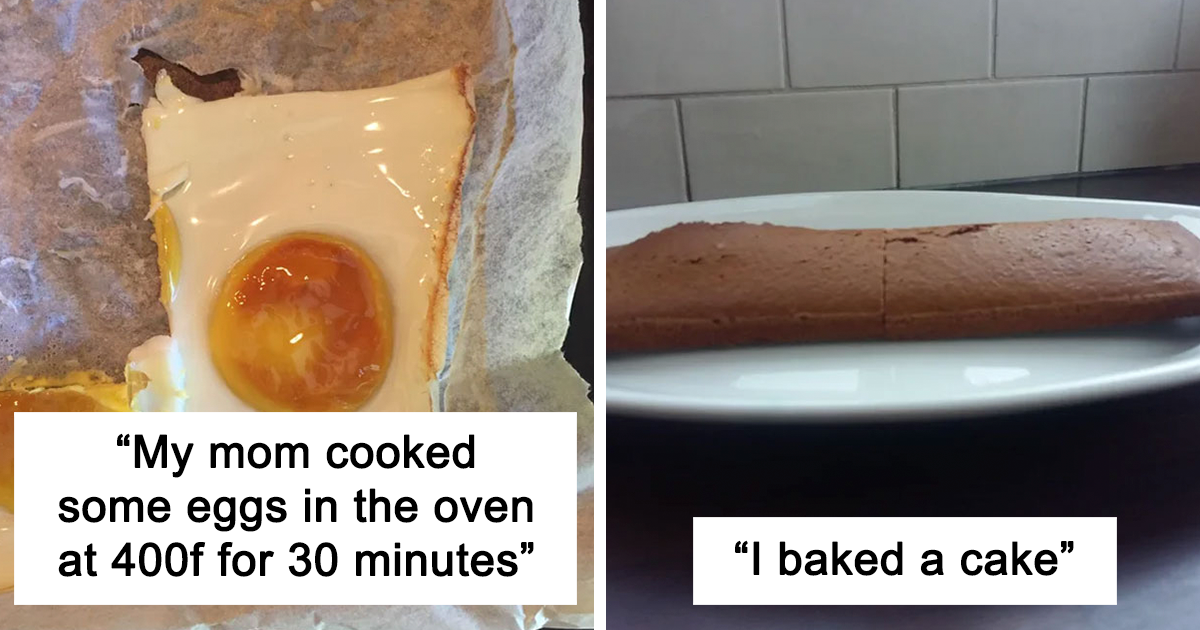
One baker proudly announced, “I baked a cake,” and the photograph supported at least half of that statement. The object appeared dense, angular, and remarkably durable. It looked capable of surviving several centuries in a desert tomb, which is impressive engineering even if it is disappointing dessert.
6. Churros That Became “Chookies”
A churro attempt spread in the oven until the pieces resembled cookies. Rather than admit defeat, the cook invented a new name: chookies. This is a powerful recovery strategy. When a recipe fails but remains edible, rebranding is often faster than apologizing.
7. Pickled Avocado: An Experiment Nobody Requested
Avocado is creamy, mild, and famously cooperative with lime, salt, and toast. Pickling it, however, produced a texture and flavor combination the cook described with immediate regret. Some ingredients enjoy acid. Others react as though they have been personally betrayed.
8. Eggs Baked Into Office Supplies
Eggs were placed in a 400-degree oven for roughly half an hour. They emerged with a dry center and a top layer described as almost plastic. Tender eggs require gentle heat because their proteins firm as they cook. Thirty minutes at high temperature does not make them extra cooked; it gives them a second job as coasters.
9. Worcestershire Eggs With an Unfortunate Appearance
A cook added Worcestershire sauce to eggs and created something that may have tasted acceptable but looked deeply suspicious. The brown, uneven pieces inspired comparisons to objects that should never appear on a breakfast plate. Flavor matters, but the eyes are often the first diners at the table.
10. The Macaron That Escaped Containment
Macarons require careful measuring, controlled mixing, and a cooperative oven. One batch ignored all three expectations and spread into a giant abstract shape. It was no longer a collection of elegant French cookies. It was one large dessert continent with poorly defined borders.
11. The Dessert Best Eaten With a Spoon
One submission was captioned simply, “I tried.” That phrase carries enormous emotional weight in cooking. The intended baked good lost its shape completely, leaving behind a soft, collapsed mixture. Fortunately, many failed cakes can still be transferred into a bowl, topped with ice cream, and introduced as pudding.
12. Halloween Cupcakes That Looked Accidentally Adult
A batch of Halloween cupcakes was decorated with white icing in a design that did not communicate the intended spooky theme. Instead, the frosting arrangement suggested something far less suitable for a school event. Food decoration is visual language, and sometimes that language needs an editor.
13. Pop-Tarts Defeated Their Operator
Packaged toaster pastries are marketed as nearly foolproof, but one community member still managed to burn them dramatically. This achievement deserves recognition. Failing a complicated soufflé is normal; turning a Pop-Tart into roofing material requires focus, distraction, or a toaster seeking revenge.
14. Carrot Cake With Full-Size Carrot Evidence
A carrot cake emerged with thick pieces of carrot visible throughout the crumb. The vegetable had apparently been chopped rather than finely shredded, giving each bite the structural complexity of a salad trapped in a sponge. The result reportedly looked bad and tasted equally committed to the theme.
15. The Exploding Mug Cake
A quick microwave mug cake expanded beyond its container and coated the microwave interior. Mug cakes need enough empty space to rise, and powerful microwaves can accelerate that rise surprisingly fast. The cook wanted a single-serving dessert and received a full-appliance cleaning project.
16. Too Much Hot Sauce in the Mixer
A workplace mixer was given an excessive amount of hot sauce. The machine distributed it with industrial enthusiasm, leaving a red scene that resembled evidence from a crime drama. The meal may have been recoverable, but everyone nearby probably developed extremely clear sinuses.
17. The Christmas Cake Comparison Nobody Wants
Two holiday cakes were photographed side by side. One was neat and festive. The other looked like Christmas had experienced severe turbulence. Comparing your first attempt with a friend’s polished creation can be discouraging, but the imperfect version usually becomes the one people remember.
18. Toast Forgotten in a Panini Press
A piece of bread remained inside a panini press until it reached a shade best described as “absence of light.” It had moved beyond toasted, past burned, and into geological specimen territory. The impressive part was not that it became black, but that it still appeared to have corners.
19. Another Mug Cake Stages a Rebellion
A second mug-cake attempt produced a swollen, uneven mass that seemed determined to escape its cup. Microwave cakes are popular because they are fast, but speed offers less time to notice an incorrect ratio. Thirty seconds can separate dessert from a chocolate-flavored volcanic event.
20. Alfredo Sauce With a Secret Identity
An attempted Alfredo sauce separated into a pale, lumpy mixture that commenters compared to several nonfood substances. Cream sauces can split when heated too aggressively or when cheese is added under unfavorable conditions. The flavor may survive, but the visual appeal often leaves without saying goodbye.
21. A Child’s First French Toast
A 12-year-old made French toast for the first time, producing a dark and uneven breakfast. It was not restaurant-ready, but it represented something important: a young cook learning through direct experience. Everyone who can make good French toast today once created a slice that was wet, burned, or somehow both.
22. The Mother-in-Law Lunch Warning
One poster reported being warned not to return home while a questionable lunch was being served. The accompanying meal looked so mysterious that avoiding it became a family emergency plan. Few cooking reviews are more decisive than a trusted relative texting, “Stay at the park.”
23. The Unidentifiable Fried Object
A blackened food item was presented with the challenge, “Guess what this was.” That is usually a sign the cooking process has removed every identifying characteristic. When potatoes, meat, and bread all converge on the same charcoal appearance, dinner becomes an archaeological investigation.
24. One Cookie to Feed Them All
Individual portions of cookie dough spread together into one enormous sheet. The creators noted that it still tasted good, which is the correct priority. A giant cookie is not necessarily a failure. It may simply be a regular cookie that has rejected society’s arbitrary expectations about personal space.
25. Pesto That Became Guacamole’s Nervous Cousin
A homemade pesto attempt turned into a thick, pale-green paste resembling avocado dip. Too little oil, an unusual ingredient ratio, or excessive processing can transform a loose sauce into something closer to wallpaper compound. It may still work on pasta, provided the pasta signs a consent form.
26. Barbecue Pizza That Lost the Taste Test
A hungry cook improvised a barbecue pizza and regretted the first bite immediately. Improvisation can create wonderful meals, but combining sauces, dough, cheese, and toppings without balancing sweetness, salt, smoke, and acidity can produce a flavor argument in which every ingredient shouts at once.
27. Slow-Cooker Bread With Defensive Capabilities
A grandmother attempted to bake bread in a slow cooker. The result appeared extremely dense and possibly dangerous to dental work. Slow-cooker bread can succeed, but moisture, proofing, cook time, and the correct recipe matter. Otherwise, the loaf may be more useful for holding a door open.
28. The “Yummy Glass” Incident
One submission involved broken glass near or inside food, immediately ending the comedy portion of the program. Unlike a collapsed cake or burnt pancake, glass contamination cannot be repaired by scraping off the suspicious section. The entire dish should be discarded because tiny fragments may be impossible to see.
29. Cookies Made Without the Ingredient That Makes Cookies
A cookie attempt apparently omitted the flour, producing a melted puddle rather than recognizable cookies. Flour provides much of a cookie’s structure. Without it, butter and sugar are free to travel across the baking sheet like tourists who have just discovered unlimited public transportation.
30. The Bread Machine That Received No Liquid
A bread-machine user wondered why the recipe had failed. The likely explanation was visible in the machine: the ingredients appeared painfully dry. Bread requires water or another liquid to hydrate the flour and form dough. Without it, a bread machine is essentially an expensive container stirring seasoned dust.
The original community roundup included these mishaps among its highest-ranked submissions, ranging from fallen cheesecake and overbaked eggs to spread cookies and an unsuccessful bread-machine experiment.
What Usually Causes These Kitchen Fails?
Inaccurate Measuring
Baking is especially sensitive to ingredient ratios. Confusing liquid and dry measuring tools, mixing up grams and milliliters, packing flour too firmly, or losing track of an ingredient can change the structure of an entire recipe. A digital scale helps with flour, sugar, butter, and other major ingredients, while measuring spoons remain useful for small quantities of salt and leavening.
Creative Substitutions Made Too Early
Experienced cooks substitute ingredients successfully because they understand what each component contributes. Beginners sometimes replace an ingredient based only on appearance. A brining bag is not a roasting bag, baking soda is not automatically interchangeable with baking powder, and two extra egg yolks can change the consistency of delicate pancake batter.
Mixing Too Muchor Not Enough
Overmixing pancake batter encourages gluten development and can produce flat, tough pancakes. Cakes present an extra complication: overmixing may make them tough, while serious undermixing can leave dense sections and weak structure. The useful instruction is not “mix as little as possible,” but “follow the tested method.”
Using the Wrong Temperature
An oven dial is not always accurate, and different pans transfer heat differently. A recipe may fail because the oven runs hot, the kitchen is unusually cold, the baking sheet was already hot, or the pan was the wrong size. An inexpensive oven thermometer can reveal whether 350 degrees on the dial is truly 350 degrees inside.
Walking Away at the Worst Time
Toast, caramel, broiled food, oil, and thin baked goods can move from golden to ruined very quickly. Timers help, but they are not a substitute for remaining nearby when food is cooking over direct heat. A phone notification can wait. Your panini press is already composing charcoal.
When a Funny Cooking Fail Becomes a Safety Problem
Burned cookies are disappointing; grease fires, cross-contamination, melted plastic, and broken glass are dangerous. Federal food-safety guidance emphasizes four basic habits: clean hands and surfaces, separate raw foods from ready-to-eat ingredients, cook food adequately, and chill perishables promptly. Harmful bacteria cannot reliably be detected by appearance, smell, or taste.
Raw poultry should not be washed because splashing water can spread contamination around the sink and nearby surfaces. Separate cutting boards and utensils should be used when possible, and tools that touched raw meat should not be reused for cooked food without proper washing.
Fire prevention deserves equal attention. Flammable packaging, towels, oven mitts, and wooden utensils should be kept away from burners. Cooking should not be left unattended, particularly when frying, broiling, or using high heat. Never pour water onto a grease fire; turn off the heat when it is safe to do so and smother a small pan fire with a fitted lid or baking sheet. Leave the area and call emergency services when a fire cannot be controlled safely.
Experiences Every Home Cook Gains From a Spectacular Failure
Most people remember their worst kitchen mistake more clearly than their twentieth successful dinner. Success is pleasant, but failure arrives with sound effects. There is the metallic crash of a pan hitting the floor, the frantic beeping of a smoke alarm, and the unforgettable silence that follows when someone lifts a lid and realizes the meal has become one continuous black object.
The first lesson is to read the entire recipe before turning on the stove. This sounds painfully basic until a recipe suddenly requests chilled dough, softened butter, a preheated baking stone, or three hours of resting time. Discovering those instructions halfway through cooking creates the kind of improvisation that leads to online fame for all the wrong reasons. Reading ahead also reveals unfamiliar techniques, required pan sizes, and ingredients that may need advance preparation.
The second lesson is to prepare ingredients before the fast part begins. Restaurant cooks call this mise en place, but at home it can simply mean chopping the onion, opening the can, and locating the salt before the oil gets hot. Searching through a cabinet while garlic burns is an avoidable form of cardio. A few bowls on the counter can make cooking calmer and prevent ingredients from being forgotten or added twice.
The third lesson is that appearance provides useful information. A recipe’s clock offers an estimate, not a legally binding contract. Pancakes should be turned when bubbles form and the edges begin to set. Bread should develop the expected color and internal structure. Sauces should be watched for separation, thickening, or scorching. Learning these signals gradually reduces dependence on rigid timing.
The fourth lesson is to taste as you go whenever it is safe. Seasoning added gradually is easier to control than a desperate final avalanche of salt. Tasting also reveals whether a sauce needs acidity, whether soup has concentrated too far, or whether a spicy ingredient is preparing to dominate the neighborhood. Raw meat, raw egg mixtures, and uncooked flour-based batter should not be sampled casually, but soups, sauces, vegetables, and cooked components can usually be checked throughout the process.
Another experience shared by nearly every cook is learning when not to rescue food. A broken cake can become a trifle. Misshapen cookies can become ice-cream toppings. Overcooked vegetables may work in a blended soup. However, food contaminated by shattered glass, melted plastic, fire-extinguisher chemicals, or unsafe handling belongs in the trash. The cost of replacing dinner is much lower than the cost of treating an injury or illness.
Finally, kitchen confidence grows when failure stops feeling personal. A split sauce is not proof that someone “cannot cook.” It means heat, fat, water, and timing did not cooperate on that attempt. A dense loaf is information about yeast, hydration, proofing, or temperature. A collapsed dessert is a lesson with frosting on it.
The most capable cooks are not people who have never failed. They are people who recognize problems sooner, understand why they happened, and keep a backup dinner in the freezer. They also know that a disaster becomes much less painful after everyone is safe, the mess is cleaned, and the photograph has received the appreciation it deserves.
Conclusion: Every Burnt Dinner Has a Silver Lining
These funny kitchen fails show how quickly a promising recipe can become a modern art installation. A missing ingredient, an inaccurate oven, an ambitious substitution, or five distracted minutes may be all it takes to turn dinner into internet history.
Yet cooking mistakes are not wasted effort. They teach ingredient behavior, timing, organization, temperature control, food safety, and humility. The next time your cookies merge into one giant disk or your cake refuses to leave its pan, take a breath. Check that everyone is safe, determine whether the food is salvageable, and learn what happened.
Then take a picture. Culinary knowledge is valuable, but comedy should never be thrown away.