A gym ball (a.k.a. stability ball, exercise ball, orwhen it’s feeling fancy“birthing ball”) is basically a giant, bouncy reminder to sit up straight.
During pregnancy and postpartum, that matters more than ever: your center of gravity shifts, your joints may feel looser, your back might file daily complaints,
and your core is doing a full-time job without overtime pay.
The good news? Used correctly, a gym ball can be a low-drama tool for comfort, gentle strength, labor prep, and postpartum rebuildingwithout needing a
complicated home gym or a personality that enjoys burpees.
Quick note before we roll: Always follow your clinician’s guidance, especially if you have pregnancy complications, significant pelvic pain,
dizziness, bleeding, fluid leakage, painful contractions, or shortness of breath that feels “not normal.” The ball is helpful, but it is not a medical degree.
Before You Start: Size, Setup, and Safety (The “Don’t Faceplant” Section)
Pick the right size
- Goal: When you sit on the ball, your feet are flat, and your hips are level withor slightly higher thanyour knees.
- Common sizes: 55 cm (shorter), 65 cm (average height), 75 cm (taller). Use your height as a starting point, then test-sit.
Choose a pregnancy-friendly ball
- Anti-burst (slow air release if punctured) is non-negotiable.
- Non-slip surface helps, especially if you’re using it on hardwood floors.
- Weight rating should comfortably exceed your body weight.
Set up your “safe zone”
- Use the ball on a non-slip mat or carpet if possible.
- Start near a wall, sturdy chair, or countertop you can hold if you wobble.
- Wear grippy socks or go barefoot (slippery socks + ball = cartoon physics).
How often is “enough”?
Many people use a gym ball in short bursts5 to 15 minutesthroughout the day for comfort and mobility.
If you’re also exercising, aim for a pace where you can still talk in full sentences (the “conversation test”).
Way #1: Use the Ball for Better Sitting, Back Relief, and Daily Comfort
If pregnancy had a theme song, it might be “My Back Hurts and I Don’t Know Why.” A gym ball can help by encouraging upright posture and gentle movement.
The secret sauce is micro-movement: tiny shifts that keep your hips and low back from locking into one stiff position.
During pregnancy: the “supported perch”
- Sit on the center of the ball with feet hip-width apart, flat on the floor.
- Stack your ribs over your pelvis (think: “tall spine,” not “military posture”).
- Relax your shoulders. If you’re holding tension in your jaw, unclench ityes, you’re allowed.
- Stay close to a wall or chair when you’re learning.
Add gentle movement (choose one)
- Pelvic rocks: Slowly tilt your pelvis forward and back like you’re “pouring” your pelvis. Keep it small and comfortable.
- Side-to-side sway: Shift weight left and right, keeping both feet grounded.
- Hip circles / figure-8: Imagine tracing a small circle with your hips. Keep it smooth, not “spin class.”
After childbirth: posture support for feeding and holding
Postpartum life involves a lot of sittingfeeding, rocking, contact naps, staring lovingly at your baby and also wondering why your water bottle is always empty.
The ball can help you sit tall with less slumping (which can reduce neck and shoulder strain).
- Use a pillow support for your arms while feeding to reduce shoulder rounding.
- Keep feet wide and stablepostpartum fatigue makes balance a little spicy.
- Skip long sessions early on; think “few minutes at a time,” especially if you’re sore.
Real-life example: the 6-minute desk reset
Set a timer for 6 minutes. Sit tall on the ball for 2 minutes, then do pelvic rocks for 2 minutes, then gentle hip circles for 2 minutes.
You’ve just upgraded your day from “human pretzel” to “functional mammal.”
Way #2: Do Pregnancy-Safe Strength and Mobility Without Angry Abs
Pregnancy fitness isn’t about sculpting a six-pack (your abs are busy doing important structural engineering). It’s about maintaining
strength where it supports your changing body: hips, glutes, upper back, and deep core coordinationwithout cranking up abdominal pressure.
Move 1: Wall-supported ball squat (glutes + legs)
- Place the ball between your mid-back and a wall.
- Walk your feet forward a bit so you feel stable.
- Inhale to lower into a comfortable squat (not necessarily deep).
- Exhale to press up, squeezing glutes gently at the top.
Pregnancy tip: Keep knees tracking over toes and avoid pushing into pain. If pelvic pressure increases, make the range smaller.
Postpartum tip: Start with mini-squats and focus on exhaling on the effort. If you had a C-section, get clearance and keep it very gentle at first.
Move 2: Seated band rows on the ball (upper back + posture)
Upper back strength is the unsung hero of pregnancy and postpartumespecially when you’re carrying extra weight up front and later carrying a baby in your arms.
- Sit tall on the ball with feet planted.
- Hold a resistance band with arms extended (anchored safely around a sturdy point or held under your feet).
- Pull elbows back like you’re tucking them into your back pockets.
- Pause, then slowly return. Keep ribs stacked (don’t “flare” the ribs up).
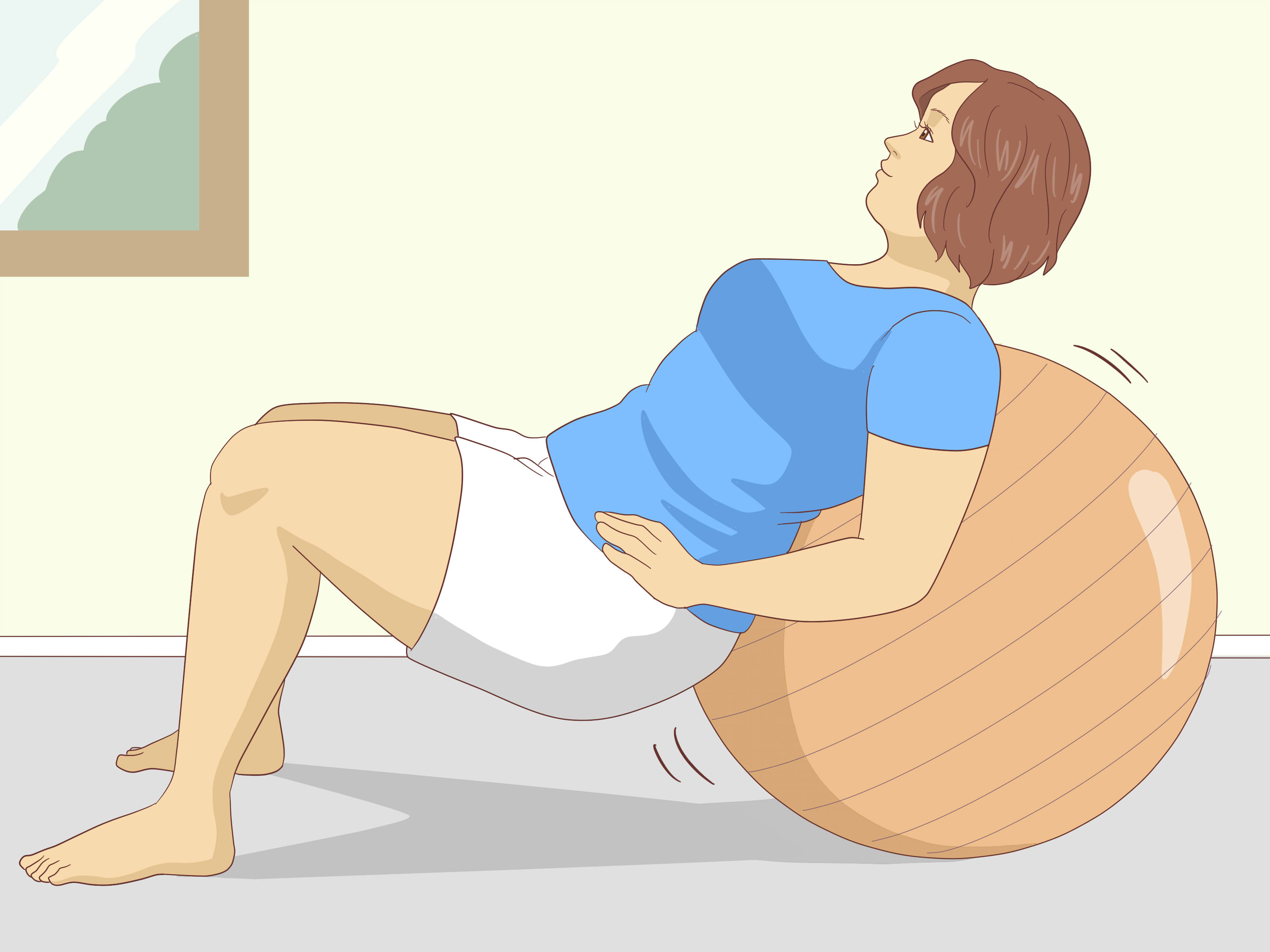
Move 3: Supported pelvic tilt with the ball (gentle low-back relief)
Pelvic tilts can be done in different positions; one friendly option uses the ball for support. Think of it as “move the pelvis, not your whole spine.”
- Sit on the floor with the ball behind you.
- Lean your upper back into the ball for support; feet flat on the floor.
- Exhale and gently tilt the pelvis to flatten the low back a bit.
- Inhale and return to neutral. Repeat slowly.
Safety tip: Have someone nearby if balance feels uncertain, and keep the movement small.
A simple strength circuit (10–12 minutes)
- Wall ball squats: 8–10 reps
- Seated band rows: 10–12 reps
- Supported pelvic tilts: 6–8 slow reps
- Repeat 1–2 rounds, resting as needed
Way #3: Use the Ball for Labor Prep Positions and “Opening Space”
The ball is famous in labor rooms, but its superpower is often misunderstood. It’s not a “bounce your baby out” device.
It’s a tool that can help you get comfortable, stay mobile, and create space in the pelvisespecially in late pregnancy and early labor,
with guidance from your care team.
Late pregnancy practice (comfort + mobility)
- Hip circles and figure-8s: slow and steady for pelvic mobility
- Gentle forward lean: sit on the ball and lean your forearms on a bed or couch, letting your back relax
- Supported rocking: small forward/back rocks to ease tailbone and low-back tension
Labor-position ideas (with clinician/doula guidance)
1) Seated and leaning forward
- Sit on the ball and lean onto a bed or counter with pillows under your arms.
- This can take pressure off the back and encourage relaxation in the pelvic floor.
2) Kneeling “hug the ball”
- Kneel on a soft surface and drape your torso over the ball.
- Let your belly hang comfortably and focus on slow breathing.
3) Side-to-side pelvic sway
- Seated on the ball, gently shift left and right (think: slow dance, not dance battle).
- Many people find this helps with back labor discomfort.
Breathing cue that helps in both pregnancy and postpartum
Try this: inhale through your nose, exhale slowly like you’re fogging a mirror, and let your shoulders drop.
On the exhale, gently “zip up” the lower belly and pelvic floor without straining.
This is less about “tighten everything” and more about “coordinate the deep system.”
Safety reminders for labor use: Keep feet wide for balance, avoid vigorous bouncing, and ask staff for positioning help if you feel unsteady.
Way #4: Postpartum Core and Pelvic Floor Re-Connection (Without Crunches)
After childbirthvaginal or C-sectionyour body is healing from a major event. Your core and pelvic floor may feel weaker, slower to respond,
or just unfamiliar. A gym ball can help you rebuild with supported, low-impact movement that emphasizes breathing, alignment, and gradual progression.
First: the “green light” checklist
- You have medical clearance for exercise beyond gentle walking (timing varies by delivery and recovery).
- You can move without sharp pain, heavy pelvic pressure, or worsening bleeding.
- If you have symptoms like leaking urine, persistent pelvic heaviness, painful sex, or significant abdominal doming, consider a pelvic floor PT consult.
Move 1: Seated breath + pelvic floor coordination (2–4 minutes)
- Sit tall on the ball with feet planted and hands on lower ribs.
- Inhale: feel ribs expand gently.
- Exhale: imagine lifting a blueberry with the pelvic floor (gentle!) and lightly drawing the lower belly inward.
- Repeat slowly. If you feel tension or pain, reduce effort.
Move 2: Ball-supported glute bridge (hips + backside support)
This one is great because strong glutes support the pelvis and low backand they’re very useful for the “carry baby, carry diaper bag, carry your sanity” phase.
- Lie on your back with calves on the ball (or heels if that feels safer).
- Exhale and lift hips a little, keeping ribs down (no big arching).
- Pause, then lower with control.
Postpartum modification: Start with feet on the floor (no ball) if the ball version feels unstable. Avoid this if lying on your back causes dizziness.
Move 3: Seated “marches” for deep core stability (tiny, mighty)
- Sit tall on the ball, hands on hips or holding a chair lightly.
- Lift one foot an inch, then set it down. Alternate sides.
- Keep the movement small and the torso steadyno leaning or twisting.
Why it works: This encourages deep core engagement without aggressive pressure.
Move 4: Supported thoracic opener (because feeding posture is real)
- Sit on the ball and interlace fingers behind your head (or hold the back of the neck gently).
- Inhale and lift the chest slightly; exhale and relax shoulders down.
- Keep ribs stacked; don’t “flare” dramatically.
A 12-minute postpartum ball routine (gentle progression)
- Seated breath + pelvic floor coordination: 2 minutes
- Seated marches: 1–2 minutes
- Ball-supported glute bridges (or feet-on-floor bridges): 6–10 reps
- Thoracic opener: 6–8 slow breaths
- Repeat once if you feel good, stop early if you don’t
What to avoid early postpartum: aggressive sit-ups/crunches, heavy straining, breath-holding, and anything that causes abdominal “doming”
or a feeling of downward pressure. If you’re unsure, a pelvic floor physical therapist can be a game-changer.
Common Questions (Because the Ball Can’t Answer Them for You)
Is a “gym ball” different from a “birthing ball”?
Often they’re essentially the same shape and function. The important differences are quality and safety features: anti-burst construction, grippy texture,
and a clear size/weight rating. If your current gym ball checks those boxes, it may work fine.
When should I skip the ball entirely?
Skip it and contact your clinician if you have warning signs during activity (like dizziness or faintness, vaginal bleeding, fluid leakage, painful regular contractions,
or significant shortness of breath), or if your provider has told you to avoid exercise due to a specific pregnancy or postpartum complication.
Can I use it every day?
Many people doespecially for short posture breaks, gentle hip mobility, or seated breathing practice. Think “frequent and small,” not “marathon bouncing session.”
Real-Life Experiences: What Using a Gym Ball Feels Like (The Extra You Asked For)
Here’s what people often notice once the gym ball becomes part of real lifemeaning: not the perfect version where you have time, energy,
and a playlist that never picks sad songs.
1) The ball becomes your “reset button.” In late pregnancy, comfort can change hour by hour. One minute you’re fine, the next minute your hips
feel like they’re negotiating a lease renewal. Many folks find that sitting on the ball for just a few minutesfeet planted, spine tallfeels like hitting
“refresh” on the low back. The tiny pelvic rocks can feel especially good after a long car ride, a work shift, or an afternoon of nesting that started as
“I’ll just organize one drawer” and ended as “why am I alphabetizing the spice rack?”
2) It sneaks movement into days when “exercise” sounds rude. Some days, a formal workout is a no-go. But the ball doesn’t demand a
full costume change and motivational speech. People often use it while watching TV, on phone calls, or during a quick break at a desk.
Hip circles can feel surprisingly soothing, and the gentle movement can ease that “stuck” feeling in the pelvis. The key is keeping it comfortable and steady
you’re aiming for mobility, not setting a world record in bouncing.
3) In labor, it can feel like having an extra piece of furniture that actually understands you. A bed is great, until it’s not.
A chair is fine, until your back says “absolutely not.” Many people like the ball because it lets them change positions easily:
sitting and leaning forward, kneeling and hugging it, or doing slow sways. The ball can also give your support person something concrete to help with
like steadying the ball or helping you transition positionsso they’re not just standing there Googling “how to be helpful” with panic eyes.
4) Postpartum, it’s surprisingly useful for the awkward “I want to feel like myself again” phase. Early recovery can be humbling.
You might be cleared for gentle movement but still feel wobbly, tired, or unsure about your core. People often report that seated breathing on the ball feels
approachablelike, “Okay, I can do this.” Over time, adding tiny marches or gentle rows can create a sense of progress without the intensity that
triggers soreness or overwhelm. And emotionally? Having a small routine can feel grounding when your schedule is basically “feed, burp, diaper, repeat,
wonder what day it is.”
5) The funniest part is how normal it becomes. At first, a gym ball in your living room feels like a statement.
Later, it’s just… there. It might become your favorite seat, your stretching buddy, or the place you go when your back needs mercy.
Some parents even find gentle, controlled rocking on the ball helpful while holding a babyas long as safety comes first:
feet planted, movement small, and no risky bouncing when you’re exhausted. The ball can be soothing, but your stability matters more than the vibe.
In the end, the gym ball works best when you treat it like a supportive sidekick: it helps you stay comfortable and mobile, but you set the rules.
Small sessions, steady footing, and listening to your body will take you further than any “perfect” routine.
Conclusion
A gym ball isn’t magicbut it’s a surprisingly practical tool for pregnancy and postpartum. Use it to improve posture and ease back tension (Way #1),
build gentle strength without stressing the core (Way #2), explore comfortable labor-friendly positions (Way #3), and reconnect with your pelvic floor and deep core
after birth (Way #4). Keep it safe, keep it steady, and keep it realistic: short, consistent, comfortable sessions beat ambitious routines that you’ll never touch again.