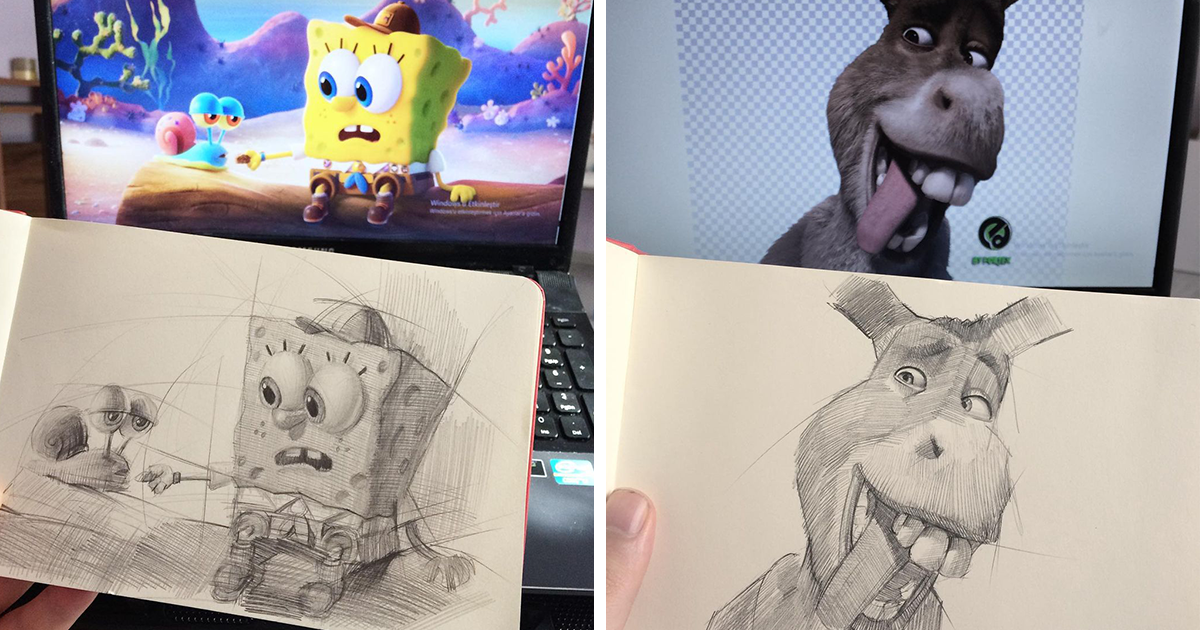
Some artists need a giant studio, a dramatic cape, and a suspiciously expensive espresso machine to make magic. Samet Türkan needs a pencil, paper, a sharp eye, and apparently the ability to make pop culture characters look like they just stepped out of our screens and sat still for a portrait session. His collection of 65 pencil drawings of favorite pop culture characters celebrates the faces many of us grew up with, laughed at, cried over, quoted endlessly, and occasionally blamed for our unrealistic expectations of heroism, friendship, or hair volume.
Türkan, an Istanbul-based Turkish artist known online as @clsamet, gained attention for sharing detailed pencil sketches of animated icons, movie heroes, celebrities, and beloved cartoon characters. His work became widely discussed after being featured in pop-culture and art communities, especially for the way he places finished sketches beside reference images, allowing viewers to compare the original character with his graphite interpretation. The result is instantly satisfying: part nostalgia, part technical demonstration, and part “wait, how did he do that with a pencil?”
This article takes a closer look at why Samet Türkan’s pencil drawings connect so strongly with fans, what makes his style effective, how his pop culture subjects help viewers appreciate traditional drawing, and why graphite still has a serious superpower in an age of digital art.
Who Is Samet Türkan?
Samet Türkan is a young artist from Istanbul, Turkey, best known online as Clsamet. His rise began through regular social media posting, where he shared pencil drawings of characters from animation, superhero films, fantasy stories, comedy franchises, and celebrity culture. Early features about his work described him as an artist studying painting and building a fast-growing audience through character sketches that felt both familiar and freshly handmade.
What makes Türkan especially interesting is not only his choice of subject but also his approachable style. His drawings do not hide behind over-polished mystery. Many posts show the reference image beside the sketch, making the process feel transparent. Viewers can admire the accuracy, compare tiny details, and understand how a flat reference becomes a textured pencil drawing. It is art education disguised as fan service, which is honestly one of the better disguises available.
Türkan’s later work and drawing guide, Pencil Drawing Portraits, also show that his interest goes beyond copying famous faces. His focus includes facial structure, light and shadow, expressions, proportions, eyes, hair, noses, and mouthsthe unglamorous but essential building blocks that make a drawing believable. In other words, behind every charming cartoon sketch is a serious amount of practice. The pencil may look humble, but it does not do free miracles.
Why Pop Culture Characters Work So Well In Pencil
Pop culture characters are perfect subjects for pencil art because people already know them emotionally. When viewers see Shrek, Woody, Dory, SpongeBob, the Joker, Harry Potter, Captain America, or a Pixar favorite, they do not need an explanation. Recognition happens instantly. That gives the artist a powerful advantage: the audience arrives with memories already attached.
But that recognition also creates pressure. If a famous character is even slightly off, viewers notice. A crooked smile, too-flat eye, or poorly shaped silhouette can turn a beloved hero into someone’s cousin wearing a Halloween costume. Türkan’s drawings succeed because they preserve the character’s essential identity while translating it into graphite. He understands that accuracy is not just about lines; it is about personality.
The Magic Of Familiar Faces
Drawing pop culture characters is not the same as drawing random objects. Characters carry emotional shorthand. SpongeBob brings chaos and optimism. Woody brings loyalty and old-school cowboy charm. The Joker brings menace, theatricality, and the strong feeling that you should not accept party invitations from him. A good pencil artist must capture these signals without color, motion, or voice acting.
Türkan’s sketches often rely on shape language, facial expression, and value contrast to communicate those traits. In animation, exaggeration is part of design. Eyes may be huge, jaws may be heroic, noses may have no medical explanation, and hands may be built like mittens. Translating that into pencil requires judgment. Too realistic, and the character loses charm. Too simple, and the drawing feels unfinished. Türkan frequently lands in the sweet spot between cartoon energy and portrait discipline.
The Technique Behind The Drawings
At first glance, pencil drawing may seem simple: gray marks on white paper. But graphite is a surprisingly flexible medium. It can create soft gradients, crisp edges, rough textures, reflective surfaces, skin tones, fur, fabric, metal, and dramatic shadows. A skilled artist can make a single pencil feel like an entire toolbox.
Türkan’s character drawings show several core techniques that make pencil portraits convincing. The first is value control. Value refers to how light or dark an area is. A strong drawing usually depends less on outline and more on the relationship between highlights, midtones, and shadows. This is especially important when converting colorful characters into black and white. Without color, the artist must rebuild visual interest through contrast.
The second technique is edge variation. Some lines are sharp and decisive, while others fade gently. Sharp edges help define eyes, mouths, armor, hairlines, or costume details. Softer edges create cheeks, shadows, fabric folds, and rounded forms. This mix keeps the drawing from looking like a coloring-book outline.
The third technique is texture mapping. A character like Shrek requires different handling than a polished superhero helmet or a fluffy animated animal. Skin, fur, metal, cloth, and cartoon surfaces each need their own pencil language. Türkan’s appeal comes from making these surfaces readable while still keeping the drawing lively.
Light, Shadow, And The Illusion Of Depth
One reason Samet Türkan’s pencil drawings stand out is his use of shadow to create dimension. Light and shadow are the difference between a flat sketch and a character that appears to occupy space. When the shadows under a chin, around an eye socket, or along a cheekbone are carefully placed, the face becomes three-dimensional. Suddenly, a cartoon character has volume. Suddenly, graphite starts acting like cinema lighting.
This is especially effective with characters from movies and animated franchises because many of them already come from highly polished visual worlds. Pixar, DreamWorks, Marvel, DC, Disney, and anime-inspired characters are designed with strong lighting, silhouettes, and expressions. Türkan’s pencil work borrows that visual drama and rebuilds it by hand.
Why Viewers Love The Reference-And-Sketch Format
One of the smartest parts of Türkan’s presentation is showing the reference image beside the finished drawing. This format turns a finished artwork into a mini “spot the skill” challenge. Viewers compare the eyes, the angle of the head, the proportions, the shadows, and the expression. It creates instant engagement because people do not just look; they inspect.
For casual fans, this side-by-side format is entertaining. For beginner artists, it is educational. It shows that drawing is not random talent falling from the sky like glitter at a craft store. It is observation. It is measuring. It is correcting. It is noticing that a character’s eye is not “somewhere near the top of the face” but exactly placed in relation to the brow, nose, mouth, and head tilt.
This makes the collection valuable beyond simple fan art. It encourages viewers to see drawing as a process. The reference image becomes the map; the pencil sketch becomes the journey. And like any good journey, there are probably eraser crumbs everywhere.
The Role Of Fan Art In Modern Visual Culture
Fan art has become one of the strongest bridges between professional entertainment and everyday creativity. Movies, TV shows, games, comics, and animation give audiences characters to love. Artists then reinterpret those characters through their own style. The result is a living conversation between pop culture and personal expression.
Türkan’s work belongs to this tradition. His drawings are not trying to replace the original characters. They celebrate them. They highlight what fans already enjoy: expressive faces, iconic silhouettes, memorable costumes, dramatic poses, and moments that feel instantly recognizable.
However, fan art also lives in a complicated space. Characters from major franchises are usually protected intellectual property. Artists should be mindful of copyright and avoid presenting fan art as official merchandise unless they have permission. Still, as commentary, practice, portfolio-building, and community sharing, fan art continues to play a huge role in how artists learn and connect with audiences.
Characters That Shine In Türkan’s Pencil Style
The collection associated with Samet Türkan includes characters from animated films, superhero stories, fantasy franchises, comedy icons, and celebrity portraits. The variety is part of the fun. One moment you are looking at a cute animated character; the next, you are staring into the intense face of a comic-book villain. It is like flipping through the world’s most emotionally unstable yearbook.
Animated Characters
Animated characters work beautifully in pencil because their designs are already bold and expressive. Characters from films like Ice Age, Toy Story, Shrek, Finding Nemo, Kung Fu Panda, and The Incredibles have instantly readable faces. Their expressions are exaggerated but carefully designed. Türkan’s pencil drawings keep that exaggeration while adding texture and handmade charm.
A character like Woody, for example, depends on warmth, nostalgia, and a very specific cowboy sincerity. Dory depends on wide-eyed innocence and motion, even when still. Shrek depends on heavy facial structure and dry comic personality. These are not just shapes; they are attitudes. Türkan’s strength is translating attitude into graphite.
Superheroes And Villains
Superheroes and villains give pencil artists a different challenge. Their faces and costumes often involve dramatic contrast, strong shadows, masks, armor, and intense expressions. A Joker sketch needs theatrical darkness. A Hulk sketch needs mass and force. A Captain America sketch needs clean heroism and structured features. Pencil is especially good at this because it can move from delicate detail to heavy shadow without changing medium.
The best superhero pencil drawings do more than reproduce a costume. They capture the myth. A shield, a grin, a scar, or a glare can carry years of storytelling. Türkan’s pop culture portraits tap into that existing mythology and make it feel personal again.
Celebrities And Real People
Celebrity portraits are less forgiving than cartoon drawings because viewers recognize real faces with alarming precision. A portrait of a performer or public figure requires accurate proportions, believable eyes, and careful handling of skin texture. When Türkan sketches real people alongside animated icons, he demonstrates range. It shows that his skills are not limited to cute characters; he can also work with realistic portrait structure.
Why Pencil Art Still Feels Fresh In A Digital World
Digital illustration is powerful, flexible, and everywhere. It offers layers, undo buttons, custom brushes, glowing effects, and enough settings to make a beginner question every life choice. Yet pencil drawing continues to feel fresh because it is direct. A graphite line has a visible human touch. Pressure changes, tiny imperfections, smudges, and paper texture all become part of the artwork.
That handmade quality matters. When viewers see a pencil drawing of a famous character, they are not only reacting to the character. They are reacting to effort. They can imagine the hours of observation, shading, sharpening, erasing, and adjusting. Pencil art makes labor visible in a way that many polished digital images do not.
Türkan’s drawings remind us that traditional media still has enormous emotional power. A pencil sketch can make a blockbuster character feel intimate. It can turn a mass-produced cultural icon into something quiet, personal, and touchable. That is a rare trick, and no software update has made it obsolete.
What Beginner Artists Can Learn From Samet Türkan
Beginner artists can learn several practical lessons from Türkan’s work. First, choose subjects you genuinely enjoy. Drawing is hard enough without forcing yourself to sketch a bowl of fruit that emotionally means nothing to you. If pop culture characters make you excited to practice, use them. Enthusiasm is fuel.
Second, study references carefully. Do not simply draw what you think a character looks like. Draw what is actually there. Notice angles, spacing, shadow shapes, and proportions. Many beginners draw symbols: an eye symbol, a nose symbol, a mouth symbol. Strong artists draw relationships.
Third, practice values. A drawing with weak values often looks flat even if the outline is accurate. Try squinting at the reference image to see big light-and-dark shapes. Build those first, then refine the details. Details are dessert; structure is dinner.
Fourth, post consistently if you want to grow online. Türkan’s early success came partly from regular sharing. Social media rewards consistency, but more importantly, consistency helps artists improve. Every drawing becomes a tiny vote for the artist you are becoming.
The Nostalgia Factor: Why These Drawings Hit So Hard
Part of the appeal of “65 Pencil Drawings Of Our Favorite Pop Culture Characters By Samet Türkan” is pure nostalgia. These are not random faces. They are characters people remember from childhood weekends, movie nights, family trips to the theater, late-night streaming, comic books, cartoons after school, or memes shared in group chats that should probably have been muted months ago.
Nostalgia makes the viewing experience warmer. A technically strong drawing is impressive, but a technically strong drawing of a character you love is irresistible. It activates memory. It invites sharing. It makes people say, “I remember that!” before they even analyze the artwork.
This emotional connection is why pop culture art performs so well online. People share what reflects them. A drawing of a beloved character becomes a small identity badge. Fans are not just admiring graphite; they are showing affection for the stories that shaped them.
How The Collection Fits Into Today’s Online Art Scene
Online art communities thrive on recognizable subjects, fast visual impact, and visible skill. Türkan’s drawings meet all three. The characters are recognizable, the pencil work is immediately impressive, and the side-by-side format makes the skill easy to appreciate. That combination is ideal for platforms like Instagram, Pinterest, YouTube, and entertainment blogs.
At the same time, his work reflects a broader trend: artists using popular characters as a training ground. This is not new. Artists have always copied masters, studied models, and learned from existing images. Today, the “masters” might include animators, film designers, comic artists, and game studios. Pop culture has become a shared visual classroom.
What separates strong fan artists from casual copying is interpretation. Türkan’s pencil drawings are compelling because they carry his hand, his pressure, his shading choices, and his sense of timing. They are recognizable, but they are not mechanical. They feel drawn, not printed.
A Personal Experience With Pop Culture Pencil Drawing
Anyone who has tried to draw a favorite character knows the emotional roller coaster. You begin with confidence. You pick a reference image, sharpen the pencil, maybe play a dramatic playlist, and tell yourself this will be the drawing that finally proves your genius. Ten minutes later, the character’s left eye has migrated to another zip code, the mouth looks suspiciously like a potato chip, and the eraser is doing more work than the pencil.
That is exactly why collections like Samet Türkan’s are inspiring. They make the process feel possible. Not easy, but possible. Seeing a familiar character broken down into pencil marks reminds beginners that every polished sketch starts with simple decisions: where to place the head, how wide the eyes should be, where the shadow falls, and how dark the darkest area needs to become.
The first time many artists attempt a pop culture portrait, they often choose a character they love too much. That sounds sweet, but it can be dangerous. Drawing your favorite character badly feels personal. It is like betraying a childhood friend with poor anatomy. But that emotional attachment also keeps you trying. You erase, redraw, shade, compare, sigh dramatically, and continue. Eventually, one feature starts to work. Maybe the eye has the right sparkle. Maybe the jawline finally matches. Maybe the hair no longer looks like wet spaghetti. That small success becomes addictive.
Pop culture drawing also teaches patience. A face is not a face because of one perfect line. It becomes recognizable through many small relationships. The distance between the eyes matters. The tilt of the eyebrows matters. The shadow under the lower lip matters. Even a cartoon character depends on structure. Türkan’s work demonstrates this beautifully because his sketches respect the design logic of each subject. He does not flatten them into generic drawings. He lets each character keep its personality.
There is also a special joy in drawing characters in pencil because graphite slows everything down. A movie character may move across the screen in seconds, but drawing that character forces you to study stillness. You notice things you missed before: the curve of a smile, the shape of a cheek, the way a villain’s eyes carry most of the drama, or how an animated character’s whole personality can sit in one eyebrow. Pencil drawing turns watching into observing.
For young artists, this can be transformative. You begin by copying a character because you love the franchise. Over time, you start noticing composition, lighting, expression, and design. You become a better viewer as well as a better artist. That is one of the quiet benefits of fan art: it trains attention. It teaches people to look closely at the images they already enjoy.
Samet Türkan’s collection captures that feeling. It is not just a gallery of cool sketches. It is an invitation to pick up a pencil and try. Maybe the first attempt will be messy. Maybe the second will still be messy, but with ambition. By the tenth, you may start to see progress. And by then, you will understand the real lesson behind these drawings: talent may open the door, but practice pays the rent.
Conclusion
65 Pencil Drawings Of Our Favorite Pop Culture Characters By Samet Türkan is more than a catchy art-gallery headline. It is a celebration of how traditional drawing can refresh familiar characters and make audiences fall in love with them again. Türkan’s pencil work succeeds because it combines recognizable pop culture subjects with careful observation, strong shading, expressive detail, and an approachable presentation style.
His drawings remind us that graphite is not old-fashioned; it is timeless. Whether he is sketching animated icons, superheroes, villains, celebrities, or fantasy characters, Türkan proves that a pencil can still compete with the loudest digital tools in the room. It may not glow, auto-save, or come with a thousand brush presets, but in the right hand, it can turn memory into art.
For fans, the collection is a nostalgic treat. For artists, it is a study in patience and technique. For everyone else, it is a friendly reminder that sometimes the simplest tools create the strongest connection. A pencil, a reference image, and a beloved character: apparently, that is enough to make the internet stop scrolling for a moment.
Note: This article is an original, publication-ready synthesis based on publicly available information about Samet Türkan, his pop culture pencil drawings, his online art presence, and general graphite portrait drawing principles. It is written in fresh wording for SEO use and does not reproduce captions, source text, or protected image content.