Some buildings welcome you with glass doors, warm brick, and a polite little awning. Others appear to ask whether you brought the launch codes. They loom over foggy streets, balance impossible slabs of concrete above narrow bases, hide windows behind armored walls, or glow red at precisely the moment a thunderstorm arrives.
Architecture cannot hatch a scheme, demand ransom, or stroke a white cat. Yet certain structures look so dramatically severe that the imagination immediately supplies a villain, a control room, and at least one suspiciously deep underground level.
This collection explores 72 real buildings and structures whose mass, lighting, geometry, history, or photographic setting gives them a powerful supervillain-headquarters aura. Some are celebrated works of Brutalism. Others are churches, monuments, factories, government complexes, towers, ruins, or ordinary buildings caught in extraordinary weather. Several entries originated as descriptive captions attached to viral photographs, so the commentary focuses on visible characteristics rather than inventing unverified histories.
Why Can a Building Look “Evil”?
Mass, Angles, and the Feeling of Being Watched
Menacing architecture usually relies on a few visual ingredients. Monumental scale can make a person feel tiny. Deep recesses resemble eye sockets. Repeated narrow windows suggest surveillance rather than hospitality. Sharp corners, cantilevers, exposed structural systems, and blank concrete walls can read as defensive, secretive, or machine-like.
Environmental-psychology research also suggests that unusual structural deviations, visual occlusion, and certain lighting conditions can increase a place’s uncanniness. Angular forms may produce different emotional responses than curved ones, while fog and darkness remove familiar visual context and allow the imagination to fill in the blanks.
Brutalism Is Not Villainy
Many entries are labeled Brutalist, a term connected to the French phrase béton brut, meaning raw concrete. The style emphasized honest materials, visible structure, bold geometry, and practical civic functions. Libraries, city halls, universities, housing projects, and cultural centers were often intended to express permanence and public purpose.
Their cinematic darkness is frequently an accidental side effect of weather, aging, scale, or decades of dystopian movies borrowing the same visual language. A concrete city hall may look capable of launching missiles, but it is probably processing parking permits.
The architectural context and documented examples in this feature were cross-checked against reporting and records from Bored Panda, Architectural Digest, Smithsonian, the Getty, UC San Diego, Boston.gov, NASA, the Los Angeles Conservancy, Atlas Obscura, NIH-hosted research, and environmental-psychology literature.
The 72 Most Menacing Buildings and Structures
1–12: Sacred Silhouettes, Surveillance Towers, and Cold Concrete
- Church of Scientology building, Kansas City, Missouri: Dramatic night lighting transforms its formal façade into the headquarters of an organization with a highly restricted elevator.
- The Iron Fountain, Armenia: Rusted metal, stark supports, and a skeletal profile make this monument resemble a dormant machine.
- German observation tower, Guernsey: Weathered concrete and narrow openings give this wartime lookout an unmistakable bunker aesthetic.
- An old house in Norway: Elevated supports make the home look less like a residence and more like a creature preparing to walk away.
- Caixa Geral de Depósitos headquarters, Portugal: Its disciplined façade projects institutional power with the warmth of a locked steel filing cabinet.
- Giant abandoned Soviet antenna: Oversized communications equipment suggests either secret transmissions or an ambitious weather-control project.
- Cooling tower with exterior stairs: The monumental cylinder is intimidating enough; the exposed staircase adds a final-boss route to the top.
- Hallgrímskirkja, Reykjavík, Iceland: Its stepped concrete wings resemble an enormous frozen rocket prepared for launch.
- Palazzo Braschi during Mussolini’s era, Rome: Historical propaganda turned the façade into an intentionally overwhelming display of authoritarian power.
- A Brutalist structure in Berlin: Repetition, shadow, and severe concrete volumes create the atmosphere of a ceremonial engineering cult.
- St. Louis Cathedral in New Orleans fog: Familiar towers become instantly spectral when Jackson Square disappears beneath heavy mist.
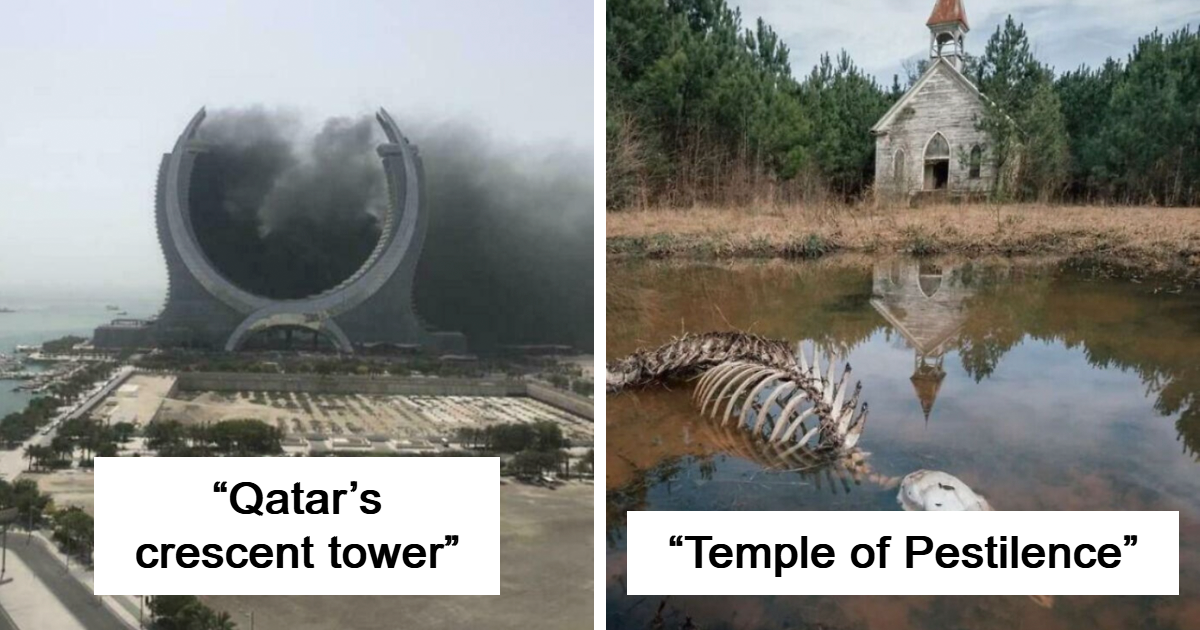
- Qatar’s Crescent Tower: Its monumental form looks like a symbol designed to be visible from an approaching spacecraft.
13–24: Fog, Factories, Bunkers, and Data Fortresses
- Downtown Cleveland in heavy weather: Low clouds and dark towers transform a business district into a scene from a corporate dystopia.
- Rheinturm, Düsseldorf, Germany: The telecommunications tower rises like a monitoring device that happens to contain a restaurant.
- The “Temple of Pestilence” photograph: A dramatic structure, barren surroundings, and an alarming nickname create instant menace.
- St. Nikolai Memorial, Hamburg: The surviving Gothic spire carries genuine wartime history and a haunting silhouette.
- The shadow-lit modern church: Orange light inside a dark geometric shell supplies an entire horror-movie plot.
- Water tower at the former Uthemann Ironworks: Decay and industrial scale make it resemble a fortress abandoned after the machines won.
- Keisuke Oka’s Arimaston Building, Tokyo: Its evolving, hand-built concrete form feels organic, irregular, and resistant to conventional architecture.
- An unidentified old factory: Broken glazing and heavy masonry create a classic “do not split up in here” atmosphere.
- Soccer field beside a World War II bunker, Hamburg: Everyday recreation beside a military relic produces a startling visual contrast.
- Beijing data building: A largely windowless mass makes digital infrastructure look as secretive as people imagine the internet to be.
- Kyoto International Conference Center, Japan: Sloping concrete walls and geometric supports give the venue the stance of a landed spacecraft.
- The “baby tower” in Fuzhou, China: Its reported social purpose is somber, while its isolated appearance intensifies the unease.
25–36: Cyberpunk Hotels, Sky Bridges, and Corporate Lairs
- Hyatt Regency photograph: Stacked balconies and a cavernous atrium resemble a council chamber for impeccably dressed villains.
- Cyberpunk residential skyscraper, Bangkok: Dense grids, glowing windows, and tropical haze create a vertical city from a neon thriller.
- “We bones that lie here wait for yours” ossuary: Architecture built around human remains requires no cinematic special effects.
- International Congress Centrum Berlin: Metallic cladding and exposed technical forms resemble a Galactic Empire convention center.
- The “Cathedral T-800” photograph: Mechanical-looking ribs invite comparisons to a certain unstoppable cinematic machine.
- The “University of Evil” photograph: Red illumination turns an academic-looking building into every mastermind’s alma mater.
- Latter-day Saint temple in California: Tall spires appear serene by day and fantastically otherworldly against a black sky.
- Halle, East Germany, photographed in 1975: Repetitive slabs and sparse public space create a famously austere modernist scene.
- The “Evil Enough?” building: Dark glazing, sheer bulk, and a concealed entrance make the structure seem personally unwelcoming.
- Umeda Sky Building, Osaka: Two towers connected by a floating observatory create a spectacular portal in the sky.
- Fog-wrapped pagoda in Pennsylvania: Red outline lighting and mist turn a picturesque landmark into a supernatural beacon.
- Oakley headquarters, Foothill Ranch, California: The sculptural campus intentionally resembles a futuristic industrial bunker.
37–48: Governments, Prisons, Ruins, and Fortified Faith
- Former Iraqi Ministry of Interior building, Baghdad: A severe state complex associated with the Ba’ath era carries both visual and historical weight.
- The sinister Dairy Queen photograph: Proof that dramatic editing and one badly timed storm can radicalize soft-serve architecture.
- Sancaklar Mosque, Turkey: Rough stone, restrained openings, and a landscape-integrated design create a mysterious yet contemplative setting.
- Times Square Building, Rochester, New York: Its winged rooftop sculpture looks especially apocalyptic beneath winter clouds.
- Tokyo Metropolitan Government Building: Twin towers and patterned stone make city administration resemble a techno-Gothic citadel.
- Abandoned steam mill, Bucharest: Broken windows and industrial brickwork evoke a laboratory whose experiment escaped.
- Metropolitan Correctional Center, Chicago: Narrow slit windows and a faceted form communicate security with remarkable efficiency.
- Castelgrande access structure, Bellinzona, Switzerland: Concrete passages cut into rock resemble the entrance to a mountain command center.
- Zeppelin Field grandstand, Nuremberg: Its role in Nazi mass rallies makes its intimidating monumentality inseparable from history.
- The unidentified “villain’s lair” house: A cliffside location and angular volumes make luxury minimalism appear suspicious after sunset.
- Calvary Church, North Carolina: A monumental roof and broad approach make the contemporary church resemble a fortified ark.
- Abandoned submarine tunnel, former Yugoslavia: A dark opening cut into coastal rock is a ready-made entrance for a hidden naval base.
49–60: Civic Monsters, Blue Whales, and Watching Façades
- Boston Government Service Center: Paul Rudolph’s muscular concrete and layered circulation create a monumental American civic megastructure.
- Edifício FIESP, São Paulo: The tapered dark volume appears to hover over the avenue like an urban sandcrawler.
- Pacific Design Center, Los Angeles: Nicknamed the Blue Whale, its enormous glass mass dominates the surrounding neighborhood.
- Twenty-three-meter Lenin monument: Political sculpture designed to command attention becomes even more imposing in dramatic weather.
- National Library of Belarus, Minsk: Its geometric form resembles a giant illuminated crystal containing a highly unforgiving database.
- Former House of the Soviets, Achinsk, Russia: Vacancy and decay amplify the shell’s association with centralized authority.
- The building with the warning sign: A prominent notice feels less like guidance and more like a legally required prophecy.
- The villain’s house spotted on a walk: Blank walls and a sharply framed entrance provide privacy with a side order of suspicion.
- “The evilest of evil buildings” photograph: Extreme perspective converts an unidentified structure into a boss battle.
- Former Palace of Rituals, Tbilisi: Sweeping Soviet-era concrete forms create an unmistakably science-fiction silhouette.
- The street-photography submission: Reflections and visual compression make an ordinary tower feel darker and more oppressive.
- The “He Is Watching You” building: Two illuminated openings resemble enormous eyes staring across the city.
61–72: Military Campuses, Parliaments, and Megastructures
- Heroic Military College, Mexico: Ceremonial forms and broad grounds give the campus the scale of an intergalactic spaceport.
- The Octagon, Egypt: Repeated geometric compounds make the enormous defense headquarters resemble a strategy map.
- Laprida Cemetery, Argentina: Stark concrete and sculptural religious imagery create a solemn, uncanny atmosphere.
- Palace of the Parliament, Bucharest: Immense scale and rigid symmetry make the building feel almost impossibly dominant.
- Battersea Power Station, London: Four giant chimneys have made this industrial landmark a favorite of filmmakers and musicians.
- A former family home turned theater, Dayton, Ohio: Towers and shadowed details demonstrate how memory can make familiar architecture wonderfully strange.
- NASA’s Vehicle Assembly Building before Hurricane Milton: One of the world’s largest buildings by volume becomes mythic beneath a major storm.
- Mexican government building under construction: Its exposed concrete skeleton reveals the repetition normally concealed by finished walls.
- Egypt’s new parliament complex: Domes, symmetry, and vast ceremonial approaches create an unmistakable seat-of-power aesthetic.
- Private Catholic university in Thailand: European-inspired towers and tropical skies produce a campus from a fantasy empire.
- Bizarre twin towers in Korea: Connected upper levels make the illuminated structures resemble a machine straddling the skyline.
- Mont-Saint-Michel, France: Its tidal isolation and towering medieval silhouette create the ultimate fantasy citadel.
What These “Evil” Buildings Teach Us About Architecture
The joke works because buildings communicate before we know what they contain. A courthouse with narrow windows feels different from a café with an open terrace. A tower emerging from fog sends a different message than the same tower beneath a bright summer sky. Material, scale, access, symmetry, and setting create expectations in seconds.
That does not mean an intimidating building is poorly designed. Boston’s civic concrete, UC San Diego’s futuristic Geisel Library, NASA’s immense Vehicle Assembly Building, and the Pacific Design Center’s saturated glass pursue very different goals. Each became memorable because it refused to disappear politely into the background.
Architecture with a strong personality risks being disliked, but it can also become a landmark, a cultural reference, and occasionally the internet’s preferred location for an imaginary weather machine.
Experiencing Menacing Architecture in Real Life
Encountering an ominous building in person is rarely the same as seeing its most dramatic photograph. Online, the structure may be cropped tightly, photographed from ground level, darkened in editing, or surrounded by fog. In reality, there may be a bus stop beside it, children eating snacks on the steps, office workers carrying iced coffee, and a cheerful gift shop selling postcards. That contrast is part of the fun. The “supervillain headquarters” suddenly has recycling bins, accessibility ramps, and someone arguing with a parking meter.
The first sensation is usually scale. A photograph can demonstrate that a building is large, but it cannot fully reproduce the physical experience of walking toward a wall that fills your field of vision. Massive concrete structures often reveal details slowly: board marks left by construction forms, small variations in aggregate, rain stains, repaired cracks, deep joints, and shadows that change as you move. What looked like one gray slab from a distance becomes a layered surface carrying evidence of labor, weather, and time.
Movement also changes the story. A Brutalist complex may seem closed from the front but unfold into terraces, ramps, courtyards, and elevated walkways once you enter. A futuristic library may resemble a hovering object from one angle and a practical stack of reading floors from another. A power station seen across a river becomes less threatening when its proportions align with bridges, streets, and neighboring buildings. Architecture is not a single image; it is a sequence.
Weather remains the most effective unpaid special-effects department. Fog removes visual context and makes towers appear infinite. Snow simplifies the landscape into stark black-and-white geometry. Rain deepens the appearance of concrete and stone, while sunset can turn reflective windows into glowing eyes. Visiting the same place at noon and again after dark can feel like touring two separate buildingsone civic, one cinematic.
For anyone photographing these places, responsible curiosity matters. Public viewpoints, guided tours, and officially accessible interiors offer plenty of drama without trespassing into abandoned factories, military property, tunnels, roofs, or unstable ruins. A long lens can compress architectural layers, a low angle can emphasize height, including a person can reveal scale, and a wide frame can show how the supposedly “evil” object participates in ordinary city life.
The most rewarding experience is often the moment when the joke gives way to understanding. A cold-looking government center may have been designed around democratic access. A monumental housing project may have pursued light, shared space, and affordability. A strange memorial may preserve a difficult national history.
You can enjoy the villainous aura while still asking what the architect intended, who used the building, whose power it represented, and why people now want to preserve or demolish it. That combinationhumor first, curiosity secondis the best way to meet architecture that appears ready to conquer the world.
Conclusion
The world’s most menacing buildings are not united by one architectural style. Their shared quality is presence. They refuse to be ignored. Concrete megastructures, Gothic spires, abandoned mills, military campuses, geometric libraries, and storm-darkened space facilities all become “evil” when form, history, weather, and imagination align.
Look again, however, and the villain’s lair may reveal itself as a library, church, theater, conference center, or workplacestill dramatic, but far more interesting than the joke alone.
Note: “Evil” describes visual mood only. Many featured sites are active civic, religious, educational, cultural, residential, or industrial places, and historically sensitive locations should always be discussed with respect.