Most of us worry about normal life problems: forgetting a password, sending a text to the wrong person, or discovering the “quick meeting” has somehow grown legs and become a 90-minute hostage situation. But some people have a much stranger problem: they share a name with a controversial celebrity or public figure, and the internet refuses to let them live peacefully.
Imagine introducing yourself as “Mike Pence” at a party, “Alex Jones” on social media, or “Sean Spicer” at passport control. Before you even explain that you are not that person, the room has already made a face. Suddenly, your name has a reputation, a search history, a political opinion, and possibly a late-night comedy monologue attached to it. You did nothing. You simply existed with paperwork your parents filled out years ago.
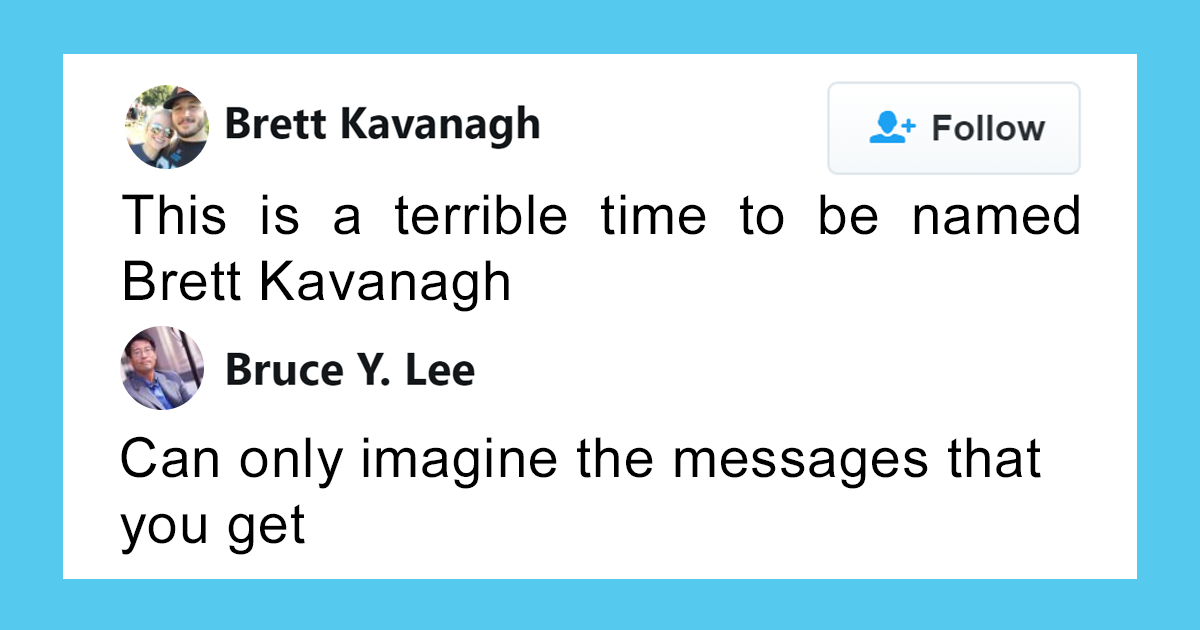
This is the comedy gold behind a viral conversation that began when Brett Kavanagh, a Kentucky man whose name was nearly identical to Supreme Court Justice Brett Kavanaugh, joked online about how exhausting it was to have that name during a heated national news cycle. The internet did what the internet does best: it turned one person’s inconvenience into a group therapy session with jokes.
Soon, people with names matching or closely resembling famous, infamous, or just aggressively over-discussed public figures began sharing their own experiences. The result was a funny, weirdly relatable reminder that your name is not just a name anymore. In the age of Google, social media, and instant assumptions, your name is also your accidental brand.
Why Having the Same Name as a Controversial Celebrity Is So Funny
The humor works because the mix-up is both absurd and totally believable. No reasonable person truly thinks the random guy in line at the grocery store is a former White House press secretary. Yet the brain still does a tiny double take. That pause is where comedy lives.
Names carry baggage. Some names sound polished, some sound old-fashioned, some sound like they belong to a friendly neighbor who owns too many lawn decorations. But when a name becomes attached to a celebrity scandal, viral meme, political argument, or cultural punching bag, innocent name twins get pulled into the chaos by association.
Search engines make it worse. A regular person named Michael Cohen or Matt Lauer is competing with thousands of news articles, videos, and social posts about someone else. Social media makes it faster. A single joke can bring thousands of replies. And everyday conversations make it inescapable: the coffee shop barista, the airport officer, the bank teller, the new coworker, and even the dentist can all become comedians for five painful seconds.
8 People Who Know the Pain of an Unlucky Famous Name
1. Brett Kavanagh: The Almost-Kavanaugh Problem
Brett Kavanagh became the accidental mascot of this entire phenomenon. During the intense public debate around Brett Kavanaugh’s Supreme Court confirmation, Kavanagh’s nearly identical name became impossible to ignore. He was not the judge. He was not part of the hearings. He was a regular person in Kentucky trying to do his job without turning every introduction into a breaking-news alert.
The funniest part is the tiny spelling difference. One name has an extra “u,” and yet that one letter might as well be a bulletproof vest. Without it, Brett Kavanagh found himself explaining, over and over, that he was not the person everyone was arguing about on television. In sales, where introductions matter, saying “Hi, I’m Brett Kavanagh” suddenly became less of a greeting and more of a dramatic plot twist.
His viral joke opened the floodgates. People immediately understood the pain because the internet loves a name coincidence almost as much as it loves correcting grammar. Kavanagh’s situation proved that even a near-match can be enough to ruin your mentions for a week.
2. Mike Pence: “Welcome to the Club”
One person named Mike Pence chimed in with the kind of exhausted humor that only comes from long-term name survival. For him, the problem was not a temporary news cycle. It was the daily reality of having a name identical to a former vice president and highly recognizable political figure.
Sharing a political name is especially intense because politics turns ordinary people into walking comment sections. A celebrity name might get you a joke. A political name might get you a debate before your coffee has even cooled. Imagine booking a table, signing an email, or joining a group chat and watching everyone’s brain visibly buffer.
The best part of the Mike Pence response was the energy: not panic, not anger, just “yes, brother, I have been living in this haunted house for years.” It was less a complaint and more a veteran welcoming a new recruit to the Name Coincidence Support Group.
3. Susan Collins: Feeling the Pain
Another social media user named Susan Collins joined the conversation, and that name carried its own political association. For anyone with a famous political double, life can become a series of unwanted references, awkward pauses, and jokes that people believe are brand-new even though you have heard them approximately 4,000 times.
The Susan Collins example shows how a name can become a public shortcut. People do not need to know your job, your hobbies, or whether you prefer dogs or cats. They hear the name and immediately jump to the famous person. It is unfair, but it is also extremely human. Our brains are lazy little filing cabinets. When they recognize a label, they grab the nearest folder.
For ordinary people, that means their name can arrive in a room before they do. The real person has to catch up and clarify: “Different Susan. Less Senate. More normal errands.”
4. Alex Jones: A Name With Volume Control Issues
Few names create an instant reaction quite like Alex Jones. Because the name is tied to a loud, controversial media personality, a regular person named Alex Jones may receive a level of attention no one ordered, requested, or put in the cart.
The funny thing about this example is how short the response was: essentially, “I feel you.” That is all it takes. A person named Alex Jones does not need a 12-paragraph essay to explain the experience. The name does the heavy lifting. Everyone instantly understands the problem.
This is what makes celebrity name twins so fascinating. Some names require context. Others arrive with their own soundtrack. If your name is Alex Jones, there is a good chance people have already made assumptions before you finish the sentence. At that point, your best defense may be humor, patience, and possibly a middle initial displayed in bold.
5. Sean Spicer: Passport Control Becomes Stand-Up Comedy
A man named Sean Spicer shared that European airport passport control had become “fun” in the most sarcastic sense of the word. That is an underrated nightmare. A name coincidence is awkward at a party, but at border control? That is where comedy starts wearing sensible shoes and asking follow-up questions.
Sean Spicer, the former White House press secretary, became a widely recognized name during a turbulent political era. For an ordinary person with the same name, every official document becomes a tiny prank. Passport? Prank. Boarding pass? Prank. Hotel reservation? Prank with complimentary breakfast.
The airport detail makes this example especially hilarious because border officers already have a professional poker face. You can imagine them scanning the passport, looking up, looking down, then deciding whether to make a joke or remain aggressively official. Either way, the traveler named Sean Spicer has probably mastered the weary smile of a man who has heard it all.
6. Rebecca Black: Friday Never Ends
Rebecca Black is a slightly different case because the singer herself was not “hated” so much as caught in a brutal wave of internet mockery after the viral song “Friday.” Still, for someone else named Rebecca Black, the association became unavoidable. One person joked that they had hated every Friday since 2011, which is both funny and impressively specific.
This example is a reminder that the internet can attach a person’s name to a single cultural moment and never let go. The song came out years ago, but the joke still lives rent-free in people’s brains. For ordinary Rebecca Blacks, the calendar itself became an enemy. Every Friday, someone somewhere probably thinks they are being original.
The humor is gentle here because it is less about scandal and more about meme fatigue. Still, it shows how pop culture can turn a normal name into a recurring punchline. Mondays are bad enough. Nobody needs a name that makes Friday complicated too.
7. Michael Cohen: The “How’s It Going, Fellas?” Energy
A person named Michael Cohen joined the thread with the casual confidence of someone who knew exactly what kind of club he had entered. The name Michael Cohen became heavily associated with Donald Trump’s former attorney, especially during years of nonstop political coverage.
For a regular Michael Cohen, the issue is not that the name is rare. It is actually common enough to belong to plenty of people. That makes the situation even stranger. You can have a perfectly ordinary name for decades, and then suddenly one famous person turns it into a headline magnet.
This is where name coincidences become a lesson in timing. A name that felt invisible in 2005 might feel radioactive in 2018. You did not change. Your name did not change. The news cycle changed, and now your email signature has dramatic tension.
8. Matt Lauer: Checkout Lines and Inevitable Questions
One person named Matt Lauer offered a practical warning: leave extra time in the checkout line for questions. That is painfully believable. When your name matches a disgraced or controversial celebrity, even small errands can become interview segments you did not agree to appear in.
This example captures the everyday awkwardness better than almost any other. It is not just social media. It is not just viral attention. It is the cashier, the receptionist, the person reading your loyalty card, the gym employee checking your membership, and the friend-of-a-friend who cannot resist saying, “Wait, like…?”
The real Matt Lauer name twin did not choose this bit. It chose him. And like many unlucky celebrity-name doubles, he appears to have learned the only sustainable strategy: get ahead of the joke, smile through it, and keep the line moving.
The Internet Has Turned Names Into Search Results
Before the internet, sharing a name with a famous person was mostly an in-person inconvenience. People might laugh when they saw your driver’s license, or your teacher might make the same joke every semester. Today, names are searchable, sortable, clickable, and endlessly compared.
That changes everything. A person with a famous name twin may struggle to control their online identity. Their LinkedIn profile might be buried under celebrity gossip. Their personal website might compete with court cases, interviews, scandal coverage, or fan pages. Even when the association is harmless, it can make a person harder to find professionally.
This is why many people add middle initials, professions, cities, or extra context to their public profiles. “Michael Cohen” becomes “Michael R. Cohen, Denver Architect.” “Alex Jones” becomes “Alexandra Jones, UX Designer.” “Sean Spicer” becomes “Sean Patrick Spicer, Not That One.” The last one may not fit neatly on a business card, but spiritually, it gets the job done.
Why We Laugh: The Psychology of Name Confusion
Names are deeply tied to identity. They are often one of the first things we learn about someone and one of the easiest details to remember when a public figure becomes famous. That makes name confusion funny because it violates expectations. We know a random person named James Cameron probably did not direct Titanic, yet the connection still flashes in our mind.
The brain loves shortcuts. If a name is familiar, we attach meaning to it. Sometimes that meaning is flattering. A person named Bruce Lee may get martial arts jokes for life. A person named James Bond may never escape spy references. But when the famous version of the name is controversial, the shortcut becomes a social pothole.
There is also a shared relief in these stories. Most people have experienced some form of mistaken identity, even if it is minor: being confused for a sibling, receiving someone else’s email, or getting tagged in the wrong social media post. Celebrity-name doubles take that everyday confusion and crank it up to sitcom volume.
What These Name Twins Teach Us About Online Reputation
The funniest stories also reveal a practical truth: online reputation is not always fully under your control. Sometimes your name gets caught in a storm created by someone with a bigger platform, a louder scandal, or a more memorable meme.
That does not mean ordinary people are helpless. The smartest move is to build a clear digital footprint. A professional profile, consistent bio, updated photo, personal website, and location or job title can help separate you from the famous person. Adding a middle initial or full middle name can also work wonders. It may feel formal, but it is cheaper than changing your name and easier than explaining every week that you are not secretly a former government official.
Humor helps too. Many of the viral responses worked because the people involved did not sound bitter. They sounded amused, tired, and extremely aware of the ridiculousness. That tone invites people to laugh with them, not at them.
Extra Experiences: What It Feels Like to Live With a Famous Name
Living with the same name as a controversial celebrity is like carrying around a tiny social booby trap. Most days, nothing happens. You buy groceries, answer emails, and live your life like a normal human. Then someone reads your name aloud and suddenly the air changes. Eyebrows rise. Someone smirks. Another person whispers, “No way.” At that moment, you know the performance has begun.
The experience can be funniest in professional settings. Imagine starting a job interview and watching the hiring manager pause at the top of your résumé. You know they are trying to stay professional, but their eyes have already betrayed them. Or picture joining a video call where your display name appears before your face does. Half the meeting is probably wondering whether to mention it. The brave ones will. The polite ones will suffer silently. The chaotic ones will send a private message to the group chat.
Customer service situations may be even worse. A hotel clerk sees the name “Matt Lauer” or “Mike Pence” and suddenly has to decide whether to comment. A pharmacy technician calls out “Rebecca Black,” and three people in line start thinking about Friday. An airport officer looks at “Sean Spicer” and briefly considers whether this is a test of national seriousness. These moments are small, but they pile up. One joke is funny. The 900th joke deserves financial compensation.
Social media adds another layer. If your name matches a celebrity in the middle of a controversy, strangers may tag you, message you, or yell at you without checking whether you are the right person. Some people receive angry comments meant for public figures. Others get jokes, memes, or bizarre questions. The internet is fast, but it is not always careful. A shared name can turn an ordinary account into an accidental complaint department.
Still, there is a strange upside. People with unlucky famous names often develop excellent comedic timing. They learn how to introduce themselves with a disclaimer. They collect stories the way other people collect mugs. They become experts in the delicate art of laughing before anyone else can. And sometimes, as the viral thread proved, they find each other. A Brett Kavanagh meets a Mike Pence, an Alex Jones nods in recognition, and a Rebecca Black arrives with Friday trauma. Suddenly, the curse becomes community.
Conclusion
The story of these eight unfortunate people with the same names as hated celebrities is funny because it is ridiculous, but it is also surprisingly revealing. A name can open doors, start conversations, create confusion, or accidentally attach a stranger to a celebrity news cycle they never asked to join.
Brett Kavanagh did not set out to become the face of unlucky name timing. He simply joked about a strange week, and the internet responded with a parade of people saying, “You think that’s bad? Listen to mine.” From Mike Pence and Susan Collins to Alex Jones, Sean Spicer, Rebecca Black, Michael Cohen, and Matt Lauer, each story proves that names can become tiny cultural landmines.
The good news is that humor is the best escape hatch. When your name becomes the joke, owning the joke can take away its power. Add a middle initial, update your online profiles, practice your best “not that one” smile, and remember: somewhere out there, another innocent person is also explaining their name to a cashier who thinks they just discovered comedy.
Note: This article is based on publicly reported accounts, public social media posts, and broader research on names, online identity, reputation, and digital harassment. The tone is intentionally lighthearted and does not claim that any private individual is connected to the public figure who shares or resembles their name.