If you’ve ever tried to leave the house on time and then realized you can’t find your keys, your shoes are missing,
and your phone is somehow in the fridgecongratulations. You understand the emotional arc of the
James Webb Space Telescope (JWST).
On March 27, 2018, NASA announced that Webb’s already-revised launch window was slipping againthis time to
approximately May 2020. The reason wasn’t a single dramatic “uh-oh” moment so much as the slow,
stubborn reality of building a one-of-a-kind observatory that has to unfold perfectly, chill to cryogenic temperatures,
and work flawlessly in deep space where a repair crew can’t just swing by with a wrench and a pep talk.
Let’s unpack what the “May 2020” delay really meant, what caused it, why it mattered to scientists and taxpayers,
and what we can learn from one of the most ambitious engineering projects in modern space science.
What NASA Actually Announced (and Why It Was a Big Deal)
NASA’s message in 2018 was basically: “We’re close… but not close enough to bet the mission on it.”
The agency said Webb was in final integration and test phases and needed more time after an independent assessment
of remaining work. The previously revised 2019 window was replaced with a new target of around May 2020.
NASA also signaled that the final cost to complete testing and prepare for launch could exceed the $8 billion
development cost that Congress had capped, and promised a report to Congress once a more specific schedule and
cost picture was available.
In other words: the telescope hardware might be “complete,” but the observatory wasn’t “ready.” And in spaceflight,
that difference is the gap between “historic first light” and “very expensive modern art.”
Quick Timeline: How We Got to “See You in May 2020”
Webb didn’t wake up one morning and decide to be late. The schedule had been tightening for years as the project’s
scope and complexity became clearer. By 2018, the telescope had already moved through multiple planned launch dates.
Here’s the simplified version of a very complicated story:
- Originally planned (years earlier): Webb was once expected to launch in the late 2010s (with earlier internal targets even further back).
- October 2018: A widely discussed target date that later slipped.
- March–June 2019: A revised window after NASA acknowledged earlier schedule issues.
- March 27, 2018: NASA announces the new target: approximately May 2020.
That last step2019 to 2020was the “delayed again” moment that caught public attention. The frustrating part?
It wasn’t because NASA stopped caring. It was because NASA cared so much that it refused to launch until the
mission had a better shot at success.
Why the Delay Happened: Integration Is Where Optimism Goes to Get Tested
If you want to understand the 2018 delay, don’t picture a telescope sitting on a shelf waiting for a ride.
Picture a machine that has to survive launch vibrations, then transform itself in space like a high-stakes,
one-time-only origami performancewhile staying cold enough to detect faint infrared signals from the early universe.
Webb isn’t “a telescope.” It’s an observatory that has to become itself
NASA emphasized that individual major elements had demonstrated they could meet requirements on their ownbut the
integration (joining the telescope element with the spacecraft element) and the full-up testing
of the combined observatory needed more time. That’s the uncomfortable stage where “each part works” has to become
“everything works together under realistic conditions.”
And “realistic conditions” here means environmental testing that simulates stresses like launch vibration and the
thermal extremes Webb will face in spaceperformed at the prime contractor’s facilities.
The spacecraft element became the schedule bully
NASA pointed specifically to issues “brought to light with the spacecraft element,” and the Standing Review Board’s
finding that more time was needed to test and integrate components together before environmental testing.
The spacecraft element includes the sunshield and spacecraft buskey systems that make Webb possible, and also make
it extremely challenging.
Reporting at the time highlighted that work on the sunshield and spacecraft section was taking longer than expected,
and that mistakes during assembly and testing contributed to schedule pressure. That’s not a moral failing; it’s what
happens when you’re building something that has never existed before and can’t be serviced like Hubble.
The sunshield: the most expensive “do not tear” sign in history
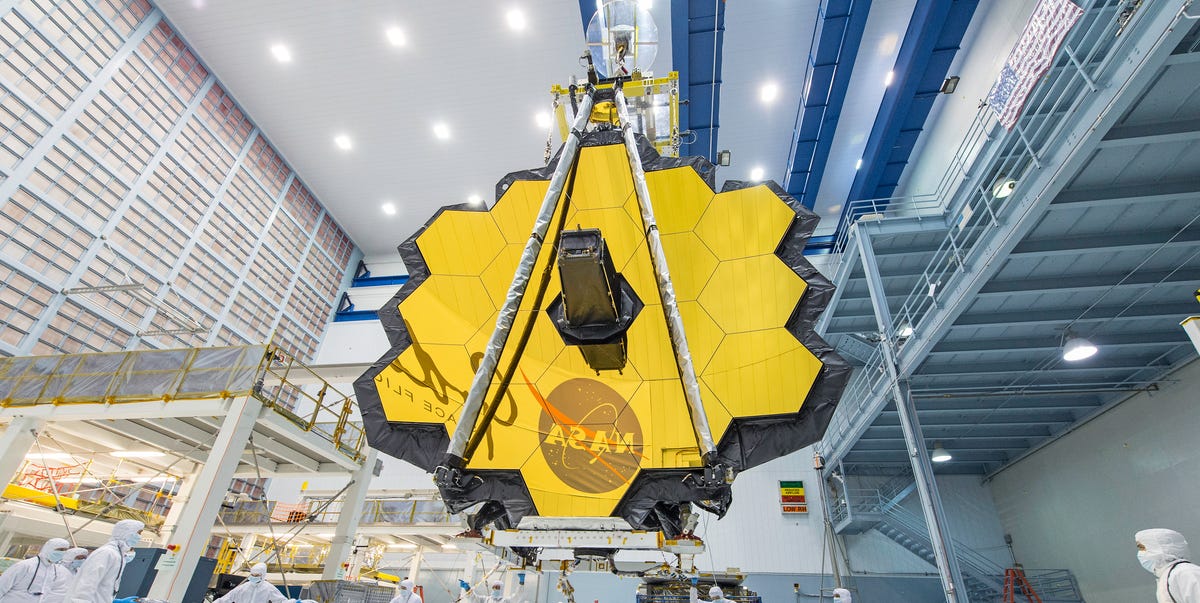
Webb’s sunshield is a five-layer, tennis-court-sized heat blocker that allows the telescope to stay extremely cold so
it can detect faint infrared light. That means it has to be thin, precise, and foldablethen deployable.
In 2018, reports described tears in the sunshield during work, and additional time needed to complete
integration and testing. When your sunshield is the mission’s thermal lifeline, “small tears” are not “small news.”
Propulsion and leaks: boring problems that can end spectacularly
Alongside sunshield challenges, reporting at the time also referenced propulsion-system issues, including leaks
discovered during testing. It’s not flashy, but propulsion is the difference between “hello, L2” and “goodbye,
mission.”
“May 2020” Wasn’t Just a DateIt Was a Confidence Statement
NASA’s messaging around the May 2020 target came with a subtle but important subtext: schedule dates are really
confidence claims. If you say “May 2020,” you’re saying, “We think we can finish integration, testing, and launch
preparation with enough margin that the odds of success are acceptable.”
Around the delay announcement, reporting captured NASA acknowledging it wasn’t fully confident in the new date.
That honesty matters, because Webb isn’t a mission you can “patch later.” Once it’s deployed far from Earth, there’s
no simple rescue plan.
So the delay was partly technical and partly philosophical: the agency was choosing mission success over calendar
pride. (A rare and beautiful thing, like a perfectly timed group text.)
Cost, Congress, and the $8 Billion Question
JWST is science, engineering, and politics doing a three-legged race. NASA’s 2018 announcement made it clear that
slipping the schedule could also push the mission’s development costs beyond the $8 billion cap
set by Congress.
Why does a cost cap matter? Because large projects don’t just spend moneythey spend time, and time is expensive.
A longer schedule can mean longer contractor staffing, extended facility use, and more rounds of testing. NASA said it
would work with ESA on the launch readiness date for the Ariane 5 rocket and then provide a cost estimate that could
exceed the cap.
There’s also a public-trust angle here: Webb had already faced scrutiny and the specter of cancellation years earlier.
In 2018, the message was “we’re going to finish this the right way,” but also “we may need Congress to agree to pay
for doing it the right way.”
So What Makes Webb Worth the Wait?
If Webb were a standard telescope, delays would be annoying and expensive. But Webb isn’t standard. It’s designed to
do science that previous observatories couldn’t do at the same scale, particularly in the infrared.
It’s built to see the early universe in infrared
Webb’s mission includes observing extremely distant galaxiesso far away that their light has been stretched into the
infrared as the universe expanded. That’s a key reason the telescope must be cold and shielded: it’s trying to detect
faint signals without being blinded by its own warmth.
It can study exoplanet atmospheres
Webb’s sensitivity is designed to help researchers study the atmospheres of planets around other stars, using
techniques like transit spectroscopy. That work can hint at atmospheric composition and physical conditionsone of the
reasons scientists were (and are) intensely eager for observing time.
It complements other missions instead of replacing them
Webb is often described as Hubble’s successor, but it’s more accurate to think of it as a different specialty:
Hubble has powerful capabilities in visible and near-infrared, while Webb is optimized for infrared performance and
deep, early-universe exploration.
NASA’s Response: Oversight, Reviews, and “Let’s Be Less Surprised Next Time”
The 2018 delay came with a management response, not just a technical one. NASA said it was establishing an external
Independent Review Board chaired by Tom Young to complement the Standing Review Board’s work and bolster
confidence in the approach to completing integration, environmental testing, launch campaign planning, commissioning,
and the deployment sequence.
NASA also described steps like increased engineering oversight and management changes. That’s not bureaucratic fluff:
when a mission is this complex, small process improvements can prevent the kind of “avoidable errors” that become
multi-month schedule hits.
Could May 2020 Have Happened? A Reality Check With Big-Project Math
Here’s the tricky thing about a “targeted” date: it’s not just about the number of tasks remaining. It’s about how
many tasks are on the critical path, how much schedule reserve you truly have, and how many unknowns remain.
And Webb had a lot of “unknown unknowns” because its deployment and test campaign were unprecedented.
That’s why NASA framed May 2020 as a target rather than a promise, and why outside reporting emphasized uncertainty.
Building Webb meant that even “minor” issuesfasteners, cables, delicate membrane layerscould ripple into months of
delay.
If you’ve ever watched a home renovation timeline go from “two weeks” to “please stop asking,” you already speak
fluent Schedule Risk Assessment.
What Happened After the May 2020 Announcement (Because History Has Spoilers)
The May 2020 target didn’t end up being the final word. In June 2018just a few months laterNASA announced another
change: the launch would move from May 2020 to March 2021, alongside updated cost figures and a plan to
implement review-board recommendations. Later, NASA also acknowledged COVID-19 impacts and additional technical
challenges that pushed the target again to late 2021.
And then, after years of delays and testing, Webb ultimately launched on Christmas Day 2021 and later
reached its operational region near the Earth–Sun L2 point, where it began the careful commissioning
process that led to science operations.
That hindsight doesn’t make the 2018 delay “good,” but it does show why NASA was so cautious: the final stretch was
genuinely hard, and success required discipline, time, and relentless verification.
Experiences: Living Through the “May 2020” Era (500+ Words)
If you followed Webb in 2018, you probably didn’t experience the delay as a neat bullet point. It felt more like a
slow drip of emotions: excitement, impatience, confusion, and then the inevitable “well… yeah, that tracks.”
Webb had become a kind of running joke among space fansexcept the punchline cost billions and the setup involved
some of the most advanced engineering on Earth.
One common experience was the weird mental whiplash between scientific time and human time. Scientists
think in decades. The universe is 13.8 billion years old. Waiting an extra year to see the first galaxies shouldn’t
matter. And yet, if you’re an early-career researcher trying to plan proposals, build a team, or time your dissertation,
a year can feel like an entire season of life. Even for non-scientists, “May 2020” carried a different weight than
“sometime later,” because dates let you hope in a specific way. A date turns anticipation into a countdown.
Another shared experience was watching the story shift from “hardware is complete” to “we still need more time.”
That phraseall flight hardware is completesounds like the finish line. But people learned (sometimes the hard
way) that space missions don’t end when the parts are built. They end when the parts are integrated, tested together,
tested again, shaken, chilled, powered, cycled, folded, unfolded, and then tested one more time because the
alternative is launching a fragile miracle into a place where miracles don’t get do-overs.
For many space enthusiasts, the May 2020 delay also created a ritual: the periodic check-in. You’d see a headline,
click it with a mix of dread and devotion, and then skim for the same handful of questions:
“Is the sunshield okay?” “Did the cost cap get busted?” “Is this a small slip or a big slip?” “Is NASA confident?”
The detailsstanding review boards, independent review boards, schedule reservebecame surprisingly familiar terms.
You didn’t need to be an engineer to understand the vibe: a project this complex is less like building a camera and
more like staging a moon landing that also has to unfold itself perfectly while wearing oven mitts.
And then there’s the human side of accountability. When reporting described avoidable mistakes or tears during
handling, it was hard not to feel two things at once: frustration that something so expensive could be delayed by what
sounded like “basic errors,” and empathy for the technicians and engineers working inside cleanrooms under enormous
pressure. People tend to imagine space hardware as untouchable perfection, but it’s built by humanscareful, trained
humansdoing delicate work in the real world. The experience of following Webb in 2018 was, in part, the experience
of being reminded that “human error” isn’t an insult; it’s a risk category. And the point of testing is to find out
where reality disagrees with optimism.
Finally, the May 2020 moment taught a quieter lesson: the public can handle bad news when it’s paired with a clear
explanation. “We need more time for integration and testing” isn’t fun, but it’s understandable. Most people have
lived some version of itwhether it’s a product launch, a construction project, or just trying to get everyone out
the door for a road trip without forgetting the snacks. Webb made space science feel oddly relatable: not because it
was simple, but because it was hard in the way all ambitious things are hardone unexpected complication at a time.
Conclusion: The Delay Was AnnoyingAnd Also the Point
“Delayed again” headlines make it sound like Webb was stuck in cosmic traffic. The truth is more specificand more
instructive. In 2018, NASA pushed the James Webb Space Telescope’s launch target to May 2020 because integration and
testing of the full observatory needed more time, and because the agency was trying to buy down risk for a mission
that cannot be repaired once it leaves Earth.
The delay also highlighted the real-world constraints of big science: budgets, oversight, schedule reserve, and the
harsh fact that delicate hardware doesn’t care about press releases. Webb’s story in the “May 2020” era was messy,
expensive, and sometimes meme-worthybut it was also an example of NASA choosing caution over bravado.
And if you’re going to fling a multi-billion-dollar telescope toward deep space and ask it to unfold perfectly,
“caution” is not a personality flaw. It’s the mission plan.