There are two kinds of people in this world: those who enjoy mowing the lawn, and those who would rather negotiate with a raccoon over property rights than push a mower in July heat. The second group is exactly why the phrase “RC lawn mower” sounds less like a gadget and more like freedom with wheels. An RC lawn mower, short for remote-controlled lawn mower, lets you cut grass from a distance using a handheld controller. It is part yard tool, part robot-adjacent beast, and part childhood dream for anyone who ever drove a radio-controlled truck through a flower bed and called it “engineering.”
The title “RC Lawn Mower Cuts With Impunity” captures the charm perfectly. A well-built remote control lawn mower can roll into tall grass, rough patches, slopes, and awkward corners without asking your knees, back, or patience to come along for the ride. But this is not just about laziness dressed in aluminum and battery packs. RC lawn mowers sit at the intersection of DIY innovation, robotics, electric power systems, lawn maintenance, and safety design. Done well, they can reduce physical strain, improve access to difficult terrain, and make mowing feel almost fun. Done poorly, they are spinning blades on a shopping cart with Wi-Fi confidence. That is a very different article, and probably a court case.
What Is an RC Lawn Mower?
An RC lawn mower is a mower controlled remotely by a person rather than pushed, ridden, or left to operate fully autonomously. Unlike a robotic lawn mower that follows a mapped route or boundary wire, an RC mower usually requires the operator to steer it in real time. Think of it as the middle child between a traditional walk-behind mower and a fully autonomous robotic mower. It keeps human judgment in the loop while removing the human body from the immediate danger zone of heat, slopes, dust, vibration, and flying debris.
Some RC mowers are homemade projects built from old electric mowers, wheelchair motors, RC receivers, motor controllers, steel frames, and a healthy amount of “I think this will work.” Others are commercial machines designed for homeowners, landscapers, farms, solar fields, retention ponds, and steep properties where walking behind a mower is uncomfortable or risky. The core idea is simple: power the blades, power the drive wheels, connect everything to a reliable remote control system, and add enough safety features that the machine behaves like a tool instead of a runaway kitchen appliance.
Why Remote-Controlled Mowing Is So Appealing
The biggest advantage of an RC lawn mower is distance. Mowing may look harmless from the porch, but a lawn mower is still a high-speed cutting machine that can throw rocks, sticks, pine cones, toys, and surprise hardware with impressive enthusiasm. By operating the mower remotely, the user can stand away from the deck, avoid exhaust or dust, and keep a better view of the whole yard.
RC mowers are especially attractive for properties with steep slopes, uneven ground, drainage ditches, pond edges, orchards, rough fields, and large open spaces. A riding mower can be dangerous on hills because of rollover risk. A push mower can be exhausting and unstable. A remote control lawn mower allows the operator to work from safer footing while the machine handles the ugly terrain. That does not make it magic. It still needs traction, braking, balance, and common sense. But it changes the mowing equation from “Can my body handle that slope?” to “Can the machine safely handle that slope while I supervise from a smarter location?”
The Hackaday-Style Spirit: Small Machine, Big Attitude
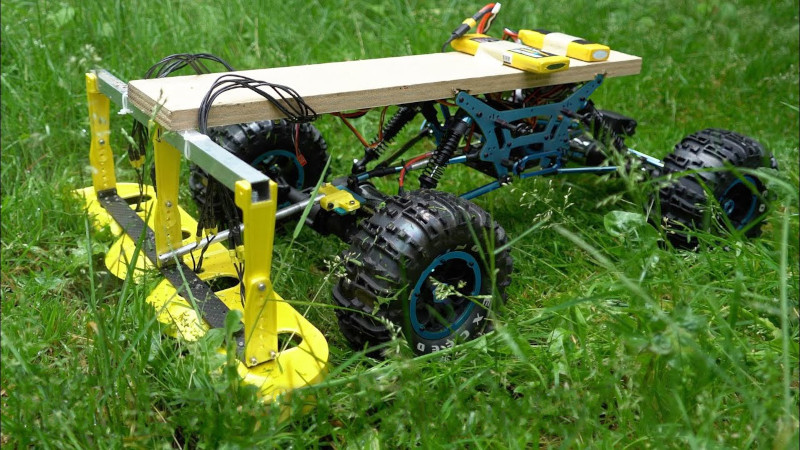
The phrase “RC Lawn Mower Cuts With Impunity” became memorable because it describes the kind of build that makers love: compact, slightly ridiculous, mechanically clever, and surprisingly effective. One notable DIY approach used an RC rock-crawler chassis as the base, paired with a brushless motor and field-oriented control to produce strong low-speed torque. That matters because tall grass is not polite. It grabs, drags, clumps, and resists. A mower that moves too fast will bog down; one with poor low-speed control will stall, dig, or chew unevenly.
The cutting system is where the idea becomes wonderfully dramatic. Instead of relying on a single large mower blade, some DIY RC mower concepts use multiple small cutter heads. A build with several motors and paired blades can distribute the cutting load across the width of the machine. This gives the mower a better chance of slicing through tall field grass without overloading one blade. In plain English: many little spinning bitey things can sometimes outperform one big spinning bitey thing, provided the engineering is not held together by hope and hot glue.
RC Lawn Mower vs. Robotic Lawn Mower
People often confuse RC mowers with robotic mowers, but they solve different problems. A robotic mower is designed to operate automatically. Many models use boundary wires, GPS-assisted mapping, onboard sensors, app scheduling, and charging stations. They usually trim lightly and frequently, which can keep a lawn tidy with minimal intervention. They are great for maintained residential lawns, but they may struggle with tall grass, rough terrain, hidden obstacles, and complicated layouts.
An RC mower, by contrast, is controlled by a human in real time. That makes it better suited for situations where judgment matters: overgrown patches, slopes, debris-heavy areas, irregular fields, or lawns with temporary obstacles. The operator can slow down, reverse, take another pass, avoid a wet spot, or attack a stubborn patch from a different angle. In other words, a robotic mower is the quiet intern that shows up every day and nibbles the lawn. An RC mower is the rugged coworker you call when the grass has unionized.
Key Components of a Good RC Lawn Mower
1. A Stable Chassis
The chassis is the skeleton of the mower. It must be strong enough to carry batteries, motors, electronics, cutting hardware, and protective guards without flexing. Low center of gravity is important, especially on slopes. Wider wheel placement improves stability, while rugged tires help the mower keep traction in grass, dirt, and uneven ground. A top-heavy RC mower is not a mower; it is a lawn-flavored rollover demonstration.
2. Drive Motors With Real Torque
Grass creates resistance, especially when it is long, wet, or thick. RC mowers need drive motors that can move slowly with control rather than simply sprint forward like a toy truck. Many DIY builders favor wheelchair motors or gear motors because they provide strong torque at low speeds. Commercial machines often use electric drive systems with adjustable speed settings and electronic braking.
3. Cutting Power That Matches the Job
A remote-controlled mower still needs to cut cleanly. Cutting systems vary widely. Some use a traditional mower blade, while others use multiple smaller blades, string-trimmer-style heads, or modular cutter assemblies. For dense grass, blade speed, blade sharpness, deck airflow, and cutting height all matter. A dull blade tears grass instead of slicing it, which can leave the lawn looking brown and stressed. Even a futuristic RC mower cannot overcome a blade that has the cutting personality of a butter knife.
4. Battery and Power Management
Electric RC mowers depend on batteries that can deliver enough current for both movement and cutting. Larger yards require higher-capacity battery packs, while steep or overgrown areas demand more power. Good power management includes fuses, properly rated wiring, protected connectors, voltage regulation for electronics, and safe charging habits. Lithium batteries are excellent when treated correctly and dramatic when treated like an afterthought.
5. Remote Control and Fail-Safe Systems
A reliable controller is essential. The mower should respond predictably, stop quickly, and fail safely if communication is lost. The best designs include an emergency stop button, signal-loss shutdown, blade interlock, and a physical kill switch. The operator should never have to wonder whether the mower heard the command to stop. This is not a Bluetooth speaker. “Maybe it connected” is not good enough.
Safety Is the Real Engineering Challenge
The most important part of an RC lawn mower is not the motors, not the remote, and not the cool factor. It is safety. Lawn mowers can cause severe injuries through blade contact, thrown debris, rollovers, and unsafe operation around children, pets, and bystanders. Remote control reduces some risks, but it can create new ones if the operator becomes overconfident or treats the mower like a toy.
Every RC lawn mower should have guarded blades, intact shields, emergency shutoff, predictable braking, clear visibility, and a strict no-bystander zone. Children and pets should be indoors or far away while mowing. The lawn should be checked for rocks, toys, cords, sticks, hoses, garden tools, and mystery objects before the mower starts. Safety glasses, sturdy shoes, long pants, and hearing protection are still smart, even if the operator is not directly behind the mower. Flying debris does not care that you are holding a remote and feeling modern.
Slopes: The Reason RC Mowers Make So Much Sense
Steep slopes are one of the strongest arguments for remote-controlled mowing. Traditional riding mowers can roll over. Walk-behind mowers can slip, slide, or pull the operator into awkward positions. Landscapers often face drainage banks, roadside slopes, pond edges, berms, and uneven ground where conventional mowing feels like a bad idea with wheels.
An RC mower allows the operator to stay off the slope while the machine does the risky work. Commercial remote-controlled mowers often advertise slope capabilities, wide tires, low profiles, and powerful electric drive systems. Still, slope ratings should never be treated as a dare. Wet grass, loose soil, hidden holes, and sharp turns can reduce stability. The safest approach is to work slowly, avoid sudden direction changes, mow in controlled passes, and keep the mower away from drop-offs, water, retaining walls, and ditches.
Commercial RC Lawn Mowers Are Becoming More Practical
Remote control mowing is no longer limited to garage builds and weekend experiments. Commercial battery-powered RC mowers now offer features such as 21-inch cutting decks, adjustable cutting heights, joystick controllers, ultrasonic sensors, bump guards, detachable batteries, mulching, bagging, and leaf-shredding attachments. Some models are designed for steep slopes and large yards, while others aim at homeowners who want less physical strain without giving up control.
These machines are not cheap, but they offer a compelling value for the right user. For someone with a small, flat suburban lawn, an RC mower may be overkill. For someone with a large property, mobility challenges, steep terrain, summer heat, or a deep emotional objection to pushing machinery, it can be a serious upgrade. The best commercial designs feel less like a novelty and more like a specialized outdoor power tool.
DIY RC Lawn Mower Builds: Brilliant, Risky, and Addictive
DIY RC mower projects are popular because they combine mechanical fabrication, electronics, radio control, electric motors, and problem-solving. Builders may start with a used mower deck, add powered wheels, install motor controllers, mount batteries, wire a receiver, and build a remote control system. It sounds straightforward until the mower veers left, the blade controller complains, the battery tray rattles loose, and the dog starts judging you from the patio.
The best DIY builds begin with planning rather than sparks. Builders should decide whether the mower will be electric or gas-powered, how the drive wheels will be powered, where the batteries will sit, how the blade will stop, how the machine will fail safe, and how the deck will prevent debris from escaping. Waterproofing, vibration isolation, wire management, and service access matter more than most first-time builders expect. A mower lives in a brutal environment: grass dust, moisture, impacts, vibration, heat, and the occasional hidden rock that has waited all year for violence.
Cut Quality: Can an RC Mower Make a Lawn Look Good?
Yes, an RC mower can make a lawn look good, but only if the fundamentals are right. Clean mowing depends on sharp blades, correct cutting height, steady speed, deck design, and mowing frequency. The one-third rule remains useful: avoid cutting more than one-third of the grass blade in a single session. Removing too much at once can stress the lawn, expose soil, encourage weeds, and create a scalped look that says, “I panicked with machinery.”
RC mowers can be excellent at slow, controlled passes. Because the operator can see the cut pattern from a distance, it is often easier to correct lines, overlap passes, and avoid missed strips. However, some remote-controlled machines may scuff turf during sharp turns, especially if they are heavy or have aggressive drive wheels. The solution is simple: slow down, make wider turns, avoid pivoting in place, and mow when the grass is dry enough to support the machine without tearing.
Environmental Benefits and Trade-Offs
Battery-powered RC mowers have clear advantages over gas mowers during operation. They produce no direct exhaust emissions at the yard, are often quieter, and remove the need to store gasoline. They can also reduce fatigue, which makes it easier to mow at the right intervals instead of waiting until the lawn becomes a prairie documentary.
Still, electric equipment has trade-offs. Batteries require responsible charging, storage, and eventual recycling. Replacement packs can be expensive. Heavy machines may compact soft soil if used carelessly. The greenest mower is not simply the one with a battery; it is the one used correctly, maintained well, and matched to the property. Mulching clippings back into the lawn can also reduce waste and return nutrients to the soil.
Who Should Consider an RC Lawn Mower?
An RC lawn mower makes sense for homeowners with large yards, steep slopes, rough fields, mobility limitations, intense summer heat, or a strong interest in outdoor technology. It can also be useful for property managers, landscapers, farms, solar sites, schools, parks, and municipalities that need to mow areas where walking or riding is unsafe.
It may not be the best choice for tiny lawns, heavily landscaped yards with narrow passages, properties full of small toys and pets, or users who do not want to learn a new machine. A remote control mower still requires attention. You are not outsourcing responsibility to a robot but moving responsibility into your hands, literally. The controller may look fun, but the machine deserves the same respect as any mower with fast-moving blades.
Buying Tips for a Remote Control Lawn Mower
Before buying an RC lawn mower, look beyond the exciting claims. Check the deck width, cutting height range, battery runtime, recharge time, mower weight, slope rating, turning behavior, waterproof rating, safety sensors, emergency stop system, and replacement blade availability. Ask whether the mower can mulch, bag, or side-discharge. Consider storage space, transport needs, and whether you can lift or move the mower if it gets stuck.
For steep properties, traction and braking matter as much as blade power. For thick grass, cutting torque and deck clearance become important. For residential neighborhoods, noise level and safety sensors may matter more. For DIY-minded users, repairability and parts availability are key. A mower that cannot be serviced is not a tool; it is a very expensive lawn ornament with firmware.
Maintenance Matters More Than the Remote
Remote control does not eliminate basic mower maintenance. Blades still need sharpening. Decks still need cleaning. Batteries still need care. Tires still need inspection. Bolts still loosen. Sensors still get covered in grass dust. The mower should be checked before each use, especially if it has been bouncing over rough ground or cutting thick vegetation.
Good maintenance improves both safety and performance. A sharp blade cuts cleanly and uses less power. A clean deck improves airflow. Proper tire pressure or wheel condition helps traction. Secure wiring prevents electrical faults. A tested emergency stop gives confidence before the machine heads into the grass. With RC mowers, a pre-mow inspection should be as normal as checking your phone battery before leaving the house.
Common Mistakes to Avoid
The first mistake is treating an RC mower like a toy. It may drive like a hobby vehicle, but it cuts like outdoor power equipment. The second mistake is mowing without clearing the lawn. A hidden rock can become a projectile. The third is disabling safety systems for convenience. Turning off sensors to reach an edge may seem harmless until a person, pet, or object enters the mowing zone.
Another mistake is overestimating slope ability. A manufacturer rating or a successful test run does not guarantee safety in wet conditions or loose soil. Finally, many users mow too low. The mower may be powerful enough to scalp the lawn, but that does not mean the grass will forgive you. Healthy mowing is about restraint. The lawn wants a haircut, not a military induction.
The Future of RC Lawn Mowers
The future will likely blend remote control, autonomy, and smarter safety systems. Expect better obstacle detection, improved battery density, lighter materials, quieter blades, app-based diagnostics, GPS assistance, machine vision, and hybrid modes that let users switch between manual remote control and assisted mowing. Commercial landscapers may increasingly use remote-controlled slope mowers to reduce worker exposure to dangerous terrain.
At the homeowner level, RC mowers may become more common as prices fall and battery technology improves. The sweet spot will be machines that are powerful enough for real grass, safe enough for residential use, easy enough for non-engineers, and repairable enough to survive several mowing seasons. The dream is simple: stand in the shade, steer with precision, drink something cold, and watch the mower do the sweaty part. Civilization was invented for less.
Experience Notes: What Using an RC Lawn Mower Feels Like
Using an RC lawn mower for the first time feels oddly familiar and completely new. The familiar part is the mowing pattern: line up, move forward, overlap slightly, turn around, repeat. The new part is that your hands are on a controller instead of a vibrating handle. You are suddenly watching the lawn from a few steps back, which changes how you think. Missed strips are easier to see. Obstacles are easier to plan around. The whole yard becomes a slow strategy game where the prize is shorter grass and the enemy is one suspiciously damp corner near the fence.
The first lesson is that speed is overrated. A beginner’s instinct is to drive the mower like an RC truck, especially if the controller feels responsive. That is fun for about eight seconds. Then the cut pattern gets sloppy, the turns become rough, and the mower starts acting less like a precision tool and more like a caffeinated goat. Slow passes give the blades time to work. They also help prevent turf damage, especially on soft ground. With an RC mower, patience produces a cleaner lawn and fewer “well, that happened” moments.
The second lesson is that visibility matters. Standing too far away can make it harder to judge edges, obstacles, and uneven terrain. Standing too close defeats part of the purpose and may expose you to debris. The best position is usually off to the side with a clear view of the mower, the next pass, and any people or pets who might wander into the area. A good operator is not just steering; they are constantly scanning. The controller is only half the job. The other half is situational awareness.
The third lesson is that lawns are not as flat as they look. From the porch, a yard may seem smooth. From the mower’s point of view, it is a miniature mountain range with roots, dips, sprinkler heads, soft patches, buried stones, and clumps of grass that appear to have personal ambitions. An RC mower makes these details obvious because you can watch how the machine reacts. If it slows, bounces, or pulls to one side, the lawn is telling you something. Sometimes it is saying, “raise the cutting height.” Sometimes it is saying, “you should have picked up that branch.”
The fourth lesson is that safety routines make the experience more relaxing, not less. Clearing the lawn before mowing, testing the emergency stop, checking the battery, confirming blade engagement, and setting a no-go zone for kids and pets may sound tedious. In practice, it makes mowing smoother. You are not constantly worrying about a hidden toy, a loose wire, or whether the mower will stop when asked. Confidence comes from preparation, not from pretending spinning blades are friendly.
The final experience is the most surprising: remote-controlled mowing can make yard work enjoyable. Not glamorous, exactly. Nobody is walking a red carpet because they trimmed the backyard. But the task becomes less punishing and more engaging. You can work from the shade, reduce physical strain, and handle tricky spots with careful control. The mower still does serious work, but the operator feels more like a pilot than a pack animal. That is the real appeal of an RC lawn mower cutting with impunity. It does not just cut grass. It cuts down the misery that often comes with mowing it.
Conclusion
RC lawn mowers are more than backyard novelties. They are practical machines for difficult terrain, large properties, physical comfort, and maker-style problem-solving. Whether built in a garage or bought as a commercial electric mower, the best remote-controlled lawn mower combines torque, traction, cutting power, battery management, and serious safety features. It can make mowing more comfortable, more precise, and, dare we say, a little entertaining.
Still, the word “remote” should never be confused with “risk-free.” A mower remains a mower: sharp, powerful, and capable of throwing debris or causing injury if used carelessly. The smartest users treat RC mowing as controlled outdoor power equipment, not a toy with a blade deck. Clear the lawn, keep people and pets away, inspect the machine, respect slopes, and never disable safety features just to save a minute. Do that, and an RC lawn mower can cut with impunity while you supervise from a safer, cooler, and much more dignified distance.
Note: This article is written in original American English and synthesized from reputable public information on RC mower builds, robotic mower standards, mower safety guidance, university extension lawn-care recommendations, and current remote-control mower product information.