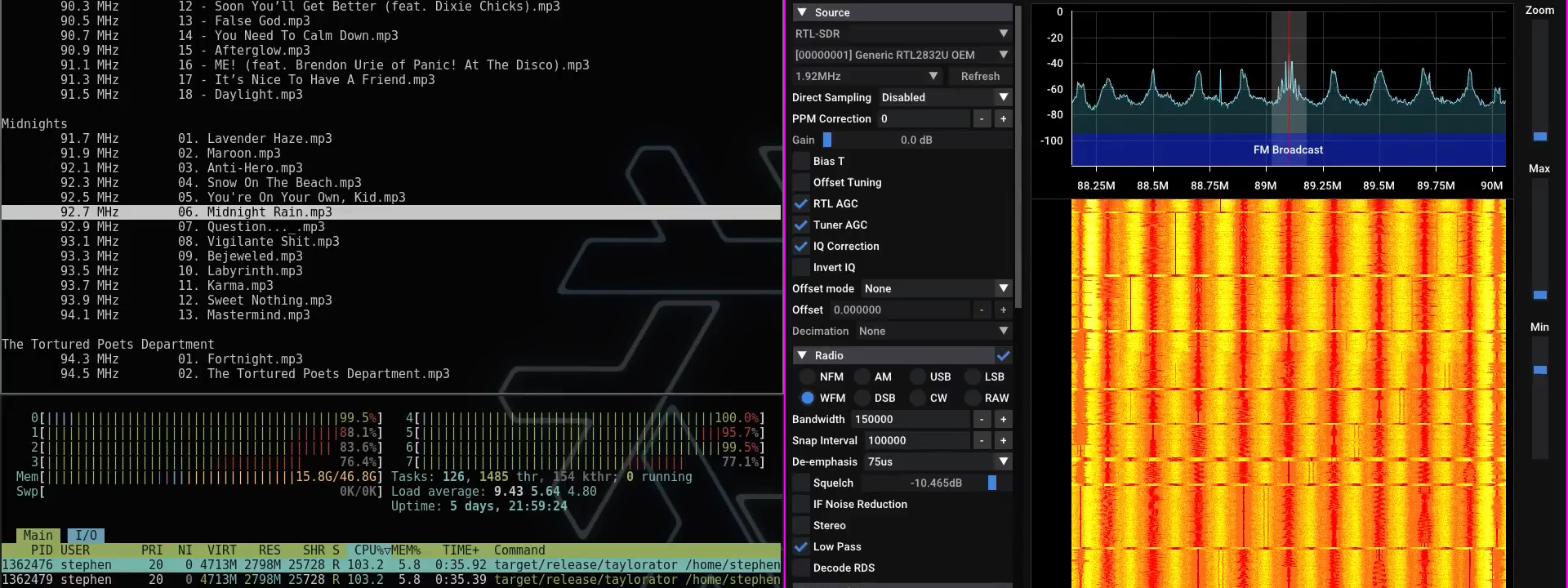
Taylorator Makes Mischief On The Airwaves sounds like the title of a sci-fi short story in which a mysterious machine hijacks every car radio in town and replaces traffic updates with glitter, guitar hooks, and suspiciously catchy choruses. In reality, Taylorator is a real software-defined radio experiment that grabbed the attention of radio hobbyists, hardware hackers, SDR fans, and anyone who has ever wondered, “What if every FM station suddenly played Taylor Swift?”
The project is clever, funny, technically impressive, and wrapped in a giant blinking warning label that says: do not treat public radio spectrum like your personal Bluetooth speaker. That tension is exactly what makes the Taylorator fascinating. It is not merely a joke about pop music. It is a demonstration of what modern software defined radio can do when a capable computer, wideband RF hardware, digital signal processing, and a mischievous idea walk into the same lab.
This article explores what the Taylorator is, how it works at a high level, why it made radio nerds grin and wince at the same time, and what it teaches home experimenters about SDR, FM modulation, signal bandwidth, responsible testing, and the delicate magic of the airwaves.
What Is the Taylorator?
The Taylorator is a software project created to transmit audio across the FM broadcast band using software-defined radio hardware. Its joke premise is simple: instead of choosing one FM channel, why not fill all usable FM radio channels with music at once? The punchline is that each station on the dial could carry a different track, turning a normal FM receiver into a roulette wheel of pop-powered chaos.
In the United States, the familiar FM broadcast band runs from 88 MHz to 108 MHz. Commercial and noncommercial stations are arranged on 200 kHz channel spacing, which is why listeners see frequencies such as 88.1, 94.5, 101.7, and 107.9 MHz instead of random numbers. Across that band, there are 100 possible channel slots. The Taylorator concept aims to populate those channel positions simultaneously.
That idea is both hilarious and technically demanding. Sending one FM signal is already a real signal-processing task. Sending many at the same time means generating many audio streams, modulating them, frequency-shifting them, combining them, and delivering the result to an SDR transmitter fast enough that the radio signal behaves in real time. This is not the digital equivalent of opening 100 browser tabs and hoping the computer survives. It is closer to conducting an orchestra where every violin insists on playing a different song.
Why Software Defined Radio Makes This Possible
Traditional radio hardware is often built around dedicated circuits: oscillators, mixers, filters, amplifiers, detectors, and modulators. A software defined radio, or SDR, moves much of that work into software. The radio hardware still matters enormously, but the shape of the signal is controlled by code.
That is the magic door the Taylorator walks through wearing sunglasses. Instead of building 100 physical FM transmitters, an SDR system can generate a wideband digital signal containing many carriers. The software prepares the signal, the computer calculates the samples, and the SDR hardware converts those samples into radio-frequency output.
Wideband SDR devices such as LimeSDR hardware are popular in advanced hobbyist and research circles because they can transmit and receive across broad frequency ranges. They are used for experimentation with wireless protocols, RF education, digital communications, and lab testing. In responsible hands, an SDR is like a laboratory microscope for radio waves. In irresponsible hands, it is a fog machine at a fire alarm convention.
The FM Band: Small Dial, Big Responsibility
One reason the Taylorator feels so mischievous is that FM radio is familiar. Most people do not think about the engineering behind the dial. They just press a preset and expect music, news, sports, emergency alerts, or a morning show host laughing too hard at a soundboard effect.
But the FM broadcast band is shared public spectrum. Licensed broadcasters operate under carefully defined rules. Even low-power FM transmitters must meet strict technical limits. In the U.S., unlicensed operation in the FM broadcast band is only allowed for extremely low-power devices that comply with FCC Part 15 limits. Those limits are not a polite suggestion written in invisible ink. They exist to prevent harmful interference.
That matters because interference is not merely annoying. A sloppy or overpowered RF signal can spill outside its intended range, raise the local noise floor, distort reception, or create unexpected problems near adjacent services. A funny lab experiment becomes much less funny if it disrupts someone else’s communications. In radio, “just kidding” is not a spectrum management strategy.
How Taylorator Works at a High Level
At a simplified level, the Taylorator performs several broad tasks. First, it prepares audio so that all tracks share a consistent sample rate. Then it applies processing suitable for FM transmission, including filtering and pre-emphasis. Next, it creates frequency-modulated signals from the audio. Finally, it offsets those signals to their assigned positions across the FM band and combines them into one wideband output stream.
That description sounds tidy, but the computing work is heavy. Each FM channel needs its own modulated signal. Each channel must land in the correct place on the spectrum. The combined output must avoid clipping, distortion, and timing problems. If the computer cannot keep up, the fantasy of “all frequencies belong to pop music” turns into a stuttering RF casserole.
The project also demonstrates an important SDR lesson: bandwidth is expensive. Not always in dollars, but in computation. Covering a wider slice of spectrum requires higher sample rates, more data movement, more memory, and more CPU work. The Taylorator’s challenge is not simply “play many songs.” It is “mathematically generate a large, synchronized, multi-channel radio signal quickly enough to feed real hardware.” That is where the project graduates from prank to serious digital signal processing exercise.
Why Radio Hackers Found It So Interesting
The Taylorator spread through maker and electronics communities because it sits at the intersection of humor and engineering. The concept is silly enough to explain in one sentence, yet rich enough to spark serious discussion about SDR architecture, FM modulation, channel spacing, lookup tables, CPU optimization, memory usage, legal boundaries, and RF hygiene.
For beginners, it provides an entertaining doorway into software defined radio. SDR can feel abstract when explained through equations alone. But “broadcast a different song on every FM channel” is immediately understandable. It makes the invisible visible. Suddenly, sample rates, complex numbers, and modulation are not just textbook terms. They are the gears behind a gloriously unnecessary machine.
For experienced radio people, the project is a stress test. It raises questions about spectral purity, filtering, harmonics, occupied bandwidth, and safe containment. It also reminds everyone that transmitting is different from receiving. Many SDR newcomers begin by listening: aircraft ADS-B, weather satellites, ham radio, pager signals, broadcast FM, or shortwave stations. Listening is generally forgiving. Transmitting demands discipline.
The Legal Elephant in the Radio Shack
Any article about the Taylorator needs to say this clearly: transmitting across the FM broadcast band without proper authorization is likely illegal in many places, including the United States, unless the operation is carefully limited to lawful, compliant, extremely low-power conditions. Even then, equipment authorization and technical limits matter.
This article is not a build guide and should not be read as encouragement to transmit over public frequencies. The responsible way to explore ideas like this is in a controlled lab environment, using appropriate shielding, attenuation, test equipment, dummy loads, and local legal guidance. The moment a signal leaves the bench and starts occupying spectrum used by the public, the experiment becomes everyone else’s problem too.
That warning should not kill the fun. It should focus it. Many of the best radio experiments happen safely without radiating into the neighborhood. Engineers and hobbyists can simulate signals, analyze spectra, use wired test setups, or keep emissions contained. In other words: you can enjoy the brain candy without throwing wrappers all over the RF landscape.
What Taylorator Teaches About Digital Signal Processing
1. Real-Time Performance Is a Ruthless Teacher
Digital signal processing looks elegant on paper. A few equations, a few arrays, a confident diagram, and everything seems manageable. Then real time enters the room carrying a stopwatch. If the software cannot produce samples as fast as the hardware needs them, the signal falls apart.
The Taylorator highlights the need for optimization. Combining many FM channels is computationally demanding, so performance tricks become essential. Instead of treating each channel as an isolated job, efficient designs reduce repeated work, precompute where possible, and avoid expensive operations in the hot path. This is where software engineering and radio engineering shake hands, then immediately argue about cache behavior.
2. Memory Matters More Than Beginners Expect
Audio feels small until you multiply it by many tracks, pre-process it, and keep enough data available for real-time modulation. The Taylorator reminds experimenters that RAM is part of the RF chain when software generates the waveform. If the computer is choking on memory, the transmitter does not care how funny the idea is.
3. Spectrum Is Not a Toy Box
The project also teaches respect. The FM band may feel ordinary because it is so familiar, but it is managed space. Every transmitter has neighbors. Even a low-power signal can become a nuisance if it is dirty, wide, amplified, or poorly contained. Good RF practice means thinking beyond “Can I make it work?” and asking “Where does the energy go?”
Possible Legitimate Uses for the Concept
Although the Taylorator’s joke version is not exactly a model citizen, the underlying concept points toward legitimate ideas. A museum exhibit could use contained RF distribution to let visitors tune different audio channels on vintage radios. A classroom could simulate multi-channel FM behavior for teaching modulation and spectrum analysis. A lab could test receiver behavior across several signals without connecting to the outside world.
In a shielded demonstration, the concept could become a playful education tool. Imagine students turning an old analog dial and hearing different explanations of waveforms, filters, and modulation on each “station.” One channel explains pre-emphasis. Another plays a tone sweep. Another carries a mock emergency alert to demonstrate why interference rules matter. That is the wholesome version of the Taylorator: less “pirate radio gremlin,” more “science museum with jokes.”
Why the Taylorator Name Works
The name is part of the charm. “Taylorator” sounds like a villainous appliance from a Saturday morning cartoon: half jukebox, half ray gun, fully committed to glitter. It also communicates the project instantly. Even people who know nothing about SDR understand the pop-culture hook.
That is valuable. Technical projects often suffer from names that read like firmware build numbers. A memorable name helps a project travel. It turns a dense DSP experiment into a story people can share. The best maker projects often do this: they sneak education inside a joke. By the time readers stop laughing, they have learned something about channel spacing, sample rates, and the difference between legal curiosity and unlawful broadcasting.
Experience Notes: What Working Around a Taylorator-Style Idea Feels Like
In a typical maker-lab setting, a Taylorator-style project would begin with excitement and mild overconfidence. Someone says, “It is just FM, right?” Five minutes later, the room is full of browser tabs about complex samples, quadrature signals, low-pass filters, and why the computer fan suddenly sounds like a small airport. That is the first real experience: radio teaches humility quickly and without snacks.
The next experience is the thrill of seeing a signal appear on a spectrum display. Even when everything is contained safely on the bench, there is something magical about creating a waveform in software and watching it become a measurable RF event. The waterfall display lights up, the carrier lands where expected, and the room briefly feels like mission control. Then someone notices a spur, a clipped peak, or a channel that is not quite centered, and the celebration becomes debugging. This is normal. RF experiments rarely say “good job” without also handing you a puzzle.
Another memorable part is learning how ordinary radios behave. A cheap FM receiver may drift, mute weak signals, blend stereo strangely, or respond differently from a nicer tuner. The Taylorator concept makes those quirks obvious because the dial is full of intentional test content. Suddenly, old radios become personalities. One receiver behaves like a disciplined engineer. Another acts like a raccoon in a vending machine.
The most important experience, however, is the safety mindset that develops around transmitting. Responsible experimenters become almost comically careful. They ask whether the signal is contained. They check levels. They avoid antennas when a dummy load is appropriate. They keep power low. They think about neighbors, licensed users, aircraft systems, public broadcasters, and the fact that radio waves do not respect apartment walls just because the project is funny.
That mindset changes how people see the wireless world. Wi-Fi, Bluetooth, GPS, FM radio, garage door openers, key fobs, weather satellites, and emergency communications all begin to feel like residents of an invisible city. The airwaves are crowded, useful, fragile, and astonishing. A project like Taylorator is fun because it reveals that hidden city. It is risky when people forget that the city has traffic laws.
The best takeaway from the Taylorator experience is not “go flood the FM dial.” It is “look how much can be learned from a ridiculous idea.” Humor lowers the barrier to entry. Engineering provides the depth. Legal caution keeps the fun from turning into a citation with a very expensive punchline. For curious makers, that balance is the sweet spot: build boldly, test responsibly, and never underestimate a radio project named like a pop-powered kitchen appliance.
Conclusion
Taylorator Makes Mischief On The Airwaves is more than a quirky SDR stunt. It is a compact lesson in modern radio experimentation: software can shape signals, hardware can move them into the real world, and public spectrum must be treated with respect. The project is funny because the idea is absurd. It is impressive because the execution requires real digital signal processing knowledge. It is controversial because transmitting across the FM band is not something to do casually, publicly, or without understanding the rules.
For homebrewers, hackers, and curious engineers, the Taylorator is best understood as inspiration, not instruction. It shows what software defined radio can do, why wideband modulation is computationally demanding, and how a playful concept can teach serious technical lessons. Keep the experiments lawful, keep the RF contained, and the airwaves can remain both fascinating and friendly.