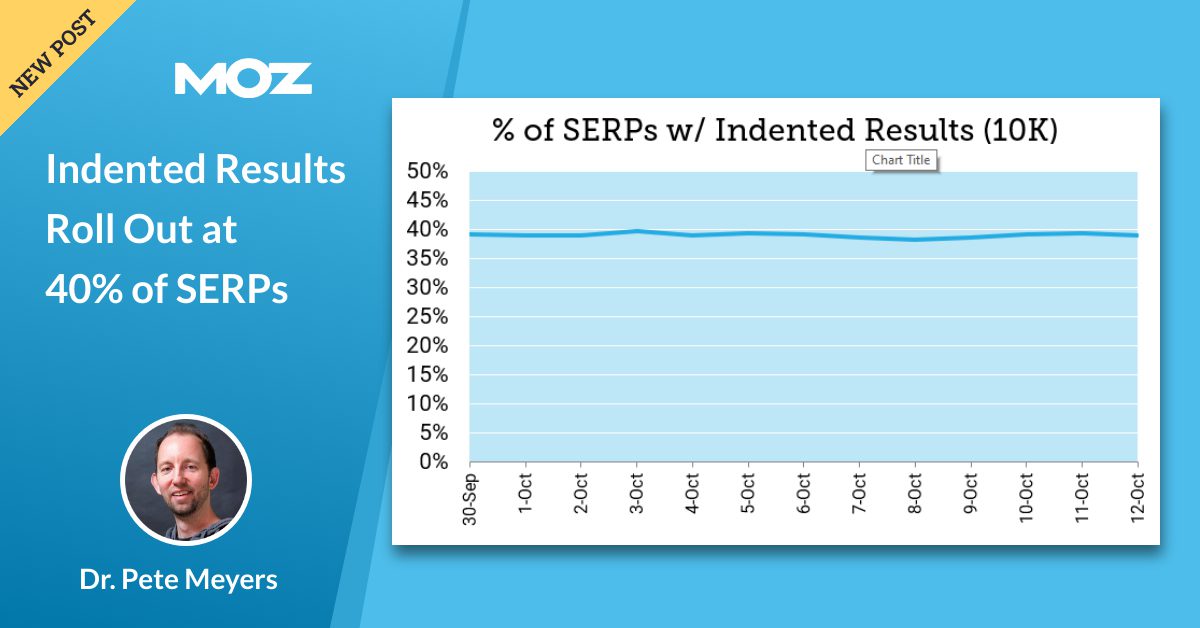
For years, SEO professionals have treated Google’s first page like beachfront property: limited space, sky-high competition, and everyone trying to plant an umbrella before the tide comes in. Then Google rolled out indented results at scale, and suddenly one website could appear with a main organic listing plus one or more related results tucked underneath it. Moz’s analysis of competitive keywords found that indented results were showing on roughly 40% of page-one SERPs, which made the SEO world collectively sit up straighter in its ergonomic chair.
The headline “Indented Results Roll Out at 40% of SERPs – Moz” may sound like a small layout update, but it pointed to something much bigger: Google was experimenting with how to group related pages from the same domain when those pages could satisfy different parts of a searcher’s intent. For brands, publishers, ecommerce sites, local businesses, and content teams, this raised a deliciously practical question: if Google is willing to show more than one of your pages together, how do you make your site worthy of that treatment?
Even though Google later stopped showing the visual indentation, the lessons remain useful. Search engines still evaluate topical relationships, internal links, title clarity, page intent, site diversity, and whether multiple URLs from one domain deserve visibility. In other words, the indent may have left the building, but the SEO strategy behind it did not pack a suitcase.
What Were Indented Results?
Indented results were organic search listings where Google displayed a main result from a domain and placed a related result from the same domain slightly underneath and to the right. Instead of showing two separate URLs from the same website as fully independent listings, Google visually grouped them. The format helped users understand that the second result was connected to the first, but offered a different destination.
For example, imagine someone searched for “best trail running shoes.” A retailer might have a general guide called “Best Trail Running Shoes for Beginners,” while another page covered “Women’s Waterproof Trail Running Shoes.” If Google believed both pages were relevant, it could show the main guide first and indent the more specific page beneath it. That second page might not have earned a traditional top ranking on its own, but it could still appear because it complemented the main result.
This is what made indented SERP results interesting. They were not the same as classic sitelinks, which often appear under a brand’s homepage for navigational searches. They were also not featured snippets, which extract a direct answer into a special box. Indented results were more like Google saying, “This domain has another page that may help you, too. Please enjoy this bonus aisle of the internet.”
Why Moz’s 40% Finding Mattered
Moz’s observation that indented results appeared across about 40% of tracked SERPs was important because SEO changes often begin as tiny tests. Many SERP features roll out slowly, appear only for narrow query types, or vanish faster than a free office donut. A 40% appearance rate suggested that Google was not merely tinkering in a dusty corner of the results page. It was making a broad adjustment to how organic results could be displayed.
For SEOs, the implications were immediate. If one domain could occupy more visual space with a main listing and a related secondary page, it could push competitors lower. On a crowded SERP filled with ads, People Also Ask boxes, videos, shopping modules, local packs, and other features, even a little extra screen real estate can matter. More visibility can mean more clicks, more brand recognition, and a better chance of answering the user’s question before a competitor does.
However, the rollout was not a magic button. There was no special “please indent me” schema markup, no guaranteed optimization switch, and no secret handshake involving a sitemap and a full moon. Google appeared to select indented results algorithmically based on relevance, query intent, domain relationships, and page-level signals.
How Indented Results Changed the SEO Conversation
The rise of indented results shifted attention from single-page ranking to topic-level visibility. Traditional SEO often asks, “Can this page rank for this keyword?” Indented results encouraged a better question: “Does this site have a cluster of pages that collectively answer the searcher’s broader need?”
That distinction matters. Search intent is rarely one-dimensional. A user searching “email marketing software” may want comparisons, pricing, integrations, reviews, automation examples, templates, and implementation advice. A site with only one page targeting that term may rank, but a site with a well-organized content hub can serve multiple angles of intent. That structure gives Google more useful options to display.
Indented results rewarded the idea that related pages should work as a team. Your pillar guide, comparison page, tutorial, case study, pricing explainer, and FAQ page should not behave like strangers at an awkward networking event. They should connect clearly, support each other, and help both users and search engines understand the relationship between topics.
Indented Results vs. Sitelinks vs. Featured Snippets
Indented Results
Indented results grouped multiple organic listings from the same domain when Google believed the pages were related and useful for the query. They could appear for non-branded searches and were not limited to homepages or navigational queries.
Sitelinks
Sitelinks usually appear below a main result, often for branded or navigational searches. They help users jump to important sections of a website, such as pricing, support, login, store locator, or contact pages. Sitelinks are more about navigation, while indented results were more about related organic relevance.
Featured Snippets
Featured snippets are answer-focused SERP features. They pull text, lists, tables, or video moments into a prominent result. Indented results did not extract an answer in the same way. They simply gave another page from the same domain a grouped organic position.
What Google’s Later Removal Really Means
Google later stopped showing the visual indentation, explaining that the format was less helpful in an environment shaped by continuous scroll and evolving result layouts. This does not mean multiple same-domain rankings disappeared. It means the specific visual treatment changed. Google’s site diversity systems still generally aim to prevent one site from dominating top results, while allowing more than one result from the same site when it seems especially relevant.
That is the part marketers should remember. The cosmetic indent is gone, but the strategic question remains: when Google considers multiple pages from your site, does each page deserve to exist? Does each URL serve a distinct intent? Are internal links clear? Are titles unique? Is the content genuinely useful, or is it just one idea wearing five different hats?
Why Indented Results Were a Big Deal for Content Strategy
Indented results exposed a truth many content teams already suspected: random blogging is not a strategy. Publishing disconnected articles and hoping Google connects the dots is like dumping puzzle pieces on the floor and calling it interior design. Search engines need signals. Users need pathways. Content needs structure.
A strong SEO content strategy groups related pages around a central topic. This is often called a topic cluster or content hub. The hub page covers the broad subject, while supporting pages explore subtopics in greater depth. For example, a site about home remodeling might build a hub around “kitchen renovation” and support it with pages on cabinet costs, countertop materials, lighting ideas, contractor questions, small kitchen layouts, and permit requirements.
If those pages are well written, internally linked, and clearly differentiated, Google has more reasons to view the site as a useful resource for the topic. During the indented-results era, that could increase the chance of multiple pages appearing together. Today, it still helps with crawling, indexing, topical authority, user engagement, and long-tail keyword coverage.
How to Optimize for the Lessons Behind Indented Results
1. Build Content Clusters, Not Content Confetti
Start by identifying broad topics your audience cares about. Then map the subtopics that support each main theme. A software company might create a hub for “CRM implementation” with supporting pages on data migration, sales pipeline setup, user training, reporting dashboards, integrations, and common mistakes.
The goal is not to create 30 nearly identical posts. The goal is to cover a topic comprehensively from different angles. Each page should have its own purpose, keyword set, and search intent. Think of it as building a neighborhood, not cloning the same house until Google calls the zoning board.
2. Use Internal Links with Descriptive Anchor Text
Internal links help users move through your site and help search engines understand page relationships. A page about “technical SEO audits” should link naturally to related pages such as “crawl budget optimization,” “canonical tags,” “XML sitemaps,” and “index coverage issues.”
Anchor text matters. Avoid vague phrases like “click here” when a descriptive phrase would help. “Learn how canonical tags work” is more useful than “read more,” because it tells both people and search engines what to expect. Just do not overdo it. If every link on your site uses exact-match anchor text like a robot trying to win a spelling bee, the experience becomes unnatural.
3. Prevent Keyword Cannibalization
Keyword cannibalization happens when multiple pages target the same keyword and serve the same intent. This can make it harder for search engines to decide which page should rank. During the indented-results rollout, some site owners wondered whether cannibalization might actually help them appear multiple times. In most cases, that is a dangerous bet.
Multiple pages can rank for related searches when they are meaningfully different. But duplicate or overlapping pages can split relevance signals, confuse internal linking, and weaken performance. If you have three pages all trying to rank for “best standing desk,” decide whether they should be merged, repositioned, redirected, or differentiated by intent, such as “best standing desk for small spaces” or “standing desk converter vs. full standing desk.”
4. Make Titles Unique and Useful
Google uses many signals to generate title links, including title tags, headings, visible page text, and anchor text. Unique, concise, descriptive titles help users choose the right page and help Google understand how pages differ.
For a content cluster, avoid boilerplate titles that blur together. “SEO Guide,” “SEO Tips,” and “More SEO Tips” are about as helpful as labeling three moving boxes “stuff.” Better titles might be “Technical SEO Audit Checklist,” “On-Page SEO Tips for Ecommerce Pages,” and “Internal Linking Strategy for Large Websites.”
5. Match Each Page to a Clear Search Intent
Search intent should guide everything. Is the user trying to learn, compare, buy, troubleshoot, locate, or calculate? A page targeting “how to fix duplicate content” should not behave like a sales landing page from the first sentence. A page targeting “best enterprise SEO platform” should probably compare options, use criteria, discuss trade-offs, and help the reader make a decision.
Indented results were interesting because they often appeared when one domain had pages that satisfied adjacent intents. That is still a smart model. Build pages that answer real follow-up questions instead of forcing one page to do every job. A Swiss Army knife is useful; a 7,000-word product page pretending to be a blog, buyer’s guide, glossary, and support manual is just tired.
Specific Example: How a Website Could Earn Multiple SERP Opportunities
Suppose you run an outdoor gear site and want to improve visibility for “beginner backpacking gear.” A weak strategy would be to publish five similar posts with slightly different titles: “Beginner Backpacking Gear,” “Best Beginner Backpacking Gear,” “Top Beginner Backpacking Gear,” and so on. That is not a content strategy; that is keyword déjà vu.
A stronger strategy would create a well-organized cluster:
- A pillar guide: “Beginner Backpacking Gear Checklist”
- A supporting guide: “How to Choose a Backpacking Tent”
- A comparison page: “Down vs. Synthetic Sleeping Bags”
- A safety article: “Backpacking First Aid Kit Essentials”
- A budget guide: “Backpacking Gear Under $500”
- A local-intent page: “Best Beginner Backpacking Trails in Colorado”
Each page answers a different question. Internal links connect the pages naturally. Titles and headings are specific. Product recommendations are supported by useful explanations. This structure gives search engines a clearer understanding of topical depth and gives users a better journey. Whether or not Google visually indents anything, the site is better positioned to earn multiple rankings across related queries.
What SEOs Should Measure
Indented results reminded marketers that rankings alone are not enough. A page may hold position three, but if another domain takes up extra visual space above it, the click-through rate can change. Modern SEO reporting should examine how the full SERP looks, not just where a URL ranks.
Track impressions, clicks, click-through rate, average position, and query-level performance in Google Search Console. Use rank tracking tools to monitor whether multiple pages from your domain appear for the same query. Watch for cannibalization. Look at pages that often rank together and ask whether they support or compete with each other.
Also review engagement after the click. If users land on one page and frequently move to another related page, that may signal a healthy content pathway. If they bounce immediately, the page may not satisfy the query. SEO is not just about getting visitors into the house. It is also about not making them regret ringing the doorbell.
Common Mistakes to Avoid
Creating Pages Just to Occupy More SERP Space
Do not create thin pages simply because you hope Google will show more of them. Weak content rarely becomes stronger by multiplying. If a topic does not deserve a separate page, fold it into a stronger guide.
Ignoring Site Architecture
If important pages are buried six clicks deep or orphaned without internal links, search engines may struggle to understand them. Keep high-value content accessible through logical navigation, hub pages, breadcrumbs, and contextual links.
Using Identical Anchor Text Everywhere
Descriptive anchor text is good. Robotic anchor text is not. Vary phrasing naturally while keeping it relevant. Users should understand where the link goes without needing a decoder ring.
Forgetting About Bing
Google gets most of the attention, but Bing also evaluates relevance, authority, content quality, page structure, and user satisfaction. A clean content architecture, strong titles, and helpful internal links support visibility across both Google and Bing.
Experience Notes: What This Topic Teaches From Real SEO Work
In practical SEO work, the indented-results conversation is valuable because it forces teams to look beyond the “one keyword, one page” mindset. I have seen many websites with decent content fail to grow because their pages were scattered like socks after laundry day. The information was there, but the structure was missing. A blog post about “SEO audits” did not link to the technical checklist. The technical checklist did not link to the crawlability guide. The crawlability guide did not point to the canonicalization article. Each page stood alone, politely ignored by its siblings.
When those pages were reorganized into a topic cluster, the results often improved gradually. Not because Google received a dramatic announcement from the website saying, “Behold, we have a hub now,” but because the signals became clearer. Users found the next useful page. Search engines discovered deeper URLs. Anchor text described relationships. The pillar page became a natural entry point, and the supporting pages captured long-tail searches that the main page could never satisfy on its own.
Another lesson is that multiple rankings are only helpful when pages have distinct roles. On several audits, the biggest problem was not a lack of content; it was too much overlapping content. One site had four articles targeting nearly the same “best accounting software for small business” query. None of them performed well. After consolidating the strongest material into one primary guide and repositioning the other pages around narrower intents, the site had a cleaner structure and better internal links. That is the less glamorous side of SEO: sometimes growth comes from deleting, merging, and redirecting rather than publishing yet another post with a heroic stock photo of a laptop.
The indented-results era also taught teams to watch the actual SERP. A keyword report may say position five, but the live results might include ads, local results, videos, People Also Ask, shopping modules, and multiple same-domain listings above you. In that environment, “position five” can feel more like “please scroll past the digital parade.” Good SEO reporting should describe the landscape, not just the rank number.
Finally, this topic is a reminder that SERP features come and go. Google may indent results, remove indentation, simplify rich results, rewrite title links, test AI answers, or change how continuous scroll behaves. Chasing every visual feature can exhaust a team. Building clear, helpful, well-linked, intent-driven content is more durable. The format may change, but relevance, usefulness, and structure keep showing up to work on Monday morning.
Conclusion
“Indented Results Roll Out at 40% of SERPs – Moz” was more than an SEO news headline. It was a snapshot of Google’s ongoing effort to organize results around user intent and related content. The visual indentation may no longer be active, but the strategic lessons are still alive: build strong topic clusters, write distinct titles, avoid keyword cannibalization, use descriptive internal links, and create pages that serve different stages of the search journey.
For marketers, the best takeaway is simple: stop treating every page like a lonely island. Search visibility improves when content works as a connected system. When your pages support one another, users find better answers, search engines understand your expertise, and your site becomes more competitive across Google and Bing. That is not just an indented-results strategy. That is good SEO with its shirt tucked in.