Note: This article is for educational and financial reporting purposes only. Goodwill accounting can become complicated quickly, especially in mergers, acquisitions, impairment testing, tax reporting, and private-company elections. When real dollars are involved, bring in a qualified CPA, valuation specialist, or accounting advisor before the numbers start wearing a tiny mustache and pretending to be “reasonable estimates.”
Introduction: Why Goodwill Accounting Matters
Goodwill accounting sounds like something friendly and fluffy, perhaps a company’s official record of being nice to customers. In reality, goodwill is one of the most important and judgment-heavy assets created in business combination accounting. It appears when one company buys another company for more than the fair value of its identifiable net assets. That premium may reflect brand reputation, customer loyalty, assembled workforce, expected synergies, market position, technology advantages, or simply the buyer’s belief that the acquired business can generate stronger future cash flows.
For accountants, business owners, investors, and finance teams, knowing how to account for goodwill is essential because it affects the balance sheet, earnings, financial ratios, acquisition analysis, and future impairment risk. A poorly calculated goodwill number can make an acquisition look cleaner than it really is. A well-supported goodwill calculation, on the other hand, helps financial statements tell a more accurate story about what was purchased and why the buyer paid a premium.
This step-by-step accounting guide explains what goodwill is, when to recognize it, how to calculate it, how to record goodwill journal entries, how impairment works, and what practical lessons finance teams should remember after the acquisition champagne has gone flat.
What Is Goodwill in Accounting?
Goodwill is an intangible asset recognized when an acquirer obtains control of a business and pays more than the fair value of the identifiable net assets acquired. In simple terms, it is the “extra” value left over after assigning fair values to the assets acquired and liabilities assumed.
For example, if Company A buys Company B for $1,500,000 and the fair value of Company B’s identifiable net assets is $1,100,000, the remaining $400,000 is recorded as goodwill. That goodwill may represent the acquired company’s strong reputation, loyal customers, trained employees, supplier relationships, operating know-how, or expected cost savings from combining the two companies.
Goodwill is not the same as a trademark, customer list, patent, or software platform if those assets can be separately identified and measured. Those items may need to be recognized as separate intangible assets in a purchase price allocation. Goodwill is the residual amount after all identifiable assets and liabilities have been properly measured.
When Should Goodwill Be Recognized?
Under U.S. GAAP, goodwill is generally recognized in a business combination, not because a company has a great reputation or because the owner’s dog has excellent networking skills. Internally generated goodwill is not recorded as an asset. A company may spend years building customer trust, brand value, and employee expertise, but those internally developed qualities are not capitalized as goodwill on the balance sheet.
Goodwill usually appears when an acquirer purchases a business and applies acquisition accounting. The acquirer identifies the consideration transferred, measures the fair value of acquired assets and assumed liabilities, recognizes identifiable intangible assets separately from goodwill, and records the remaining premium as goodwill.
This distinction matters. Buying equipment, inventory, or a group of assets that does not meet the definition of a business is not the same as buying a business. In an asset acquisition, the accounting may involve allocating cost to acquired assets rather than recognizing goodwill in the same way as a business combination.
Step-by-Step Guide: How to Account for Goodwill
Step 1: Confirm That the Transaction Is a Business Combination
Before calculating goodwill, determine whether the transaction qualifies as a business combination. A business combination occurs when an acquirer obtains control of a business. This usually means the acquired set of assets and activities includes inputs and processes capable of producing outputs.
This step is important because business combinations and asset acquisitions are accounted for differently. If the acquired group does not meet the definition of a business, goodwill may not be recognized in the same manner. Do not skip this step. It is the accounting version of checking whether you are baking a cake or assembling a bookshelf. Both involve instructions, but the results are very different.
Step 2: Determine the Consideration Transferred
Next, calculate what the buyer gave up to acquire the business. Consideration transferred may include cash, equity interests, notes payable, contingent consideration, or other forms of payment. The consideration is generally measured at fair value on the acquisition date.
For example, if the buyer pays $1,200,000 in cash and issues stock worth $300,000, total consideration transferred is $1,500,000. If the deal includes contingent consideration, such as an earnout based on future revenue targets, that arrangement also needs to be evaluated and measured at fair value at the acquisition date.
Step 3: Identify Assets Acquired and Liabilities Assumed
The acquirer must identify and measure the fair value of the assets acquired and liabilities assumed. This includes obvious items such as cash, accounts receivable, inventory, property, equipment, loans, accounts payable, and accrued expenses.
It may also include less obvious assets, such as customer relationships, trade names, developed technology, favorable leases, licenses, noncompete agreements, or backlog. These assets should not be lazily tossed into goodwill just because valuation work is inconvenient. Goodwill is the leftovers after the accounting meal is properly plated, not a junk drawer for “things we did not feel like measuring.”
Step 4: Separate Identifiable Intangible Assets From Goodwill
One common goodwill accounting mistake is failing to identify intangible assets separately. If an intangible asset is identifiable, it should be recognized separately from goodwill. An asset may be identifiable if it arises from contractual or legal rights, or if it can be separated from the business and sold, transferred, licensed, rented, or exchanged.
Examples of identifiable intangible assets include:
- Customer contracts and related customer relationships
- Trademarks and trade names
- Patents and developed technology
- Franchise rights and licenses
- Noncompete agreements
- Order backlog
Separating these assets matters because many identifiable intangible assets are amortized over their useful lives, while goodwill has different subsequent accounting rules. The split can affect future earnings, EBITDA analysis, impairment testing, and investor perception.
Step 5: Calculate Goodwill
The basic goodwill formula is:
In a simple acquisition with no noncontrolling interest and no previously held interest, the formula becomes:
Here is a practical example:
In this example, the buyer paid $1,500,000 for a business with identifiable net assets worth $1,100,000. The difference of $400,000 is recorded as goodwill.
Step 6: Record the Goodwill Journal Entry
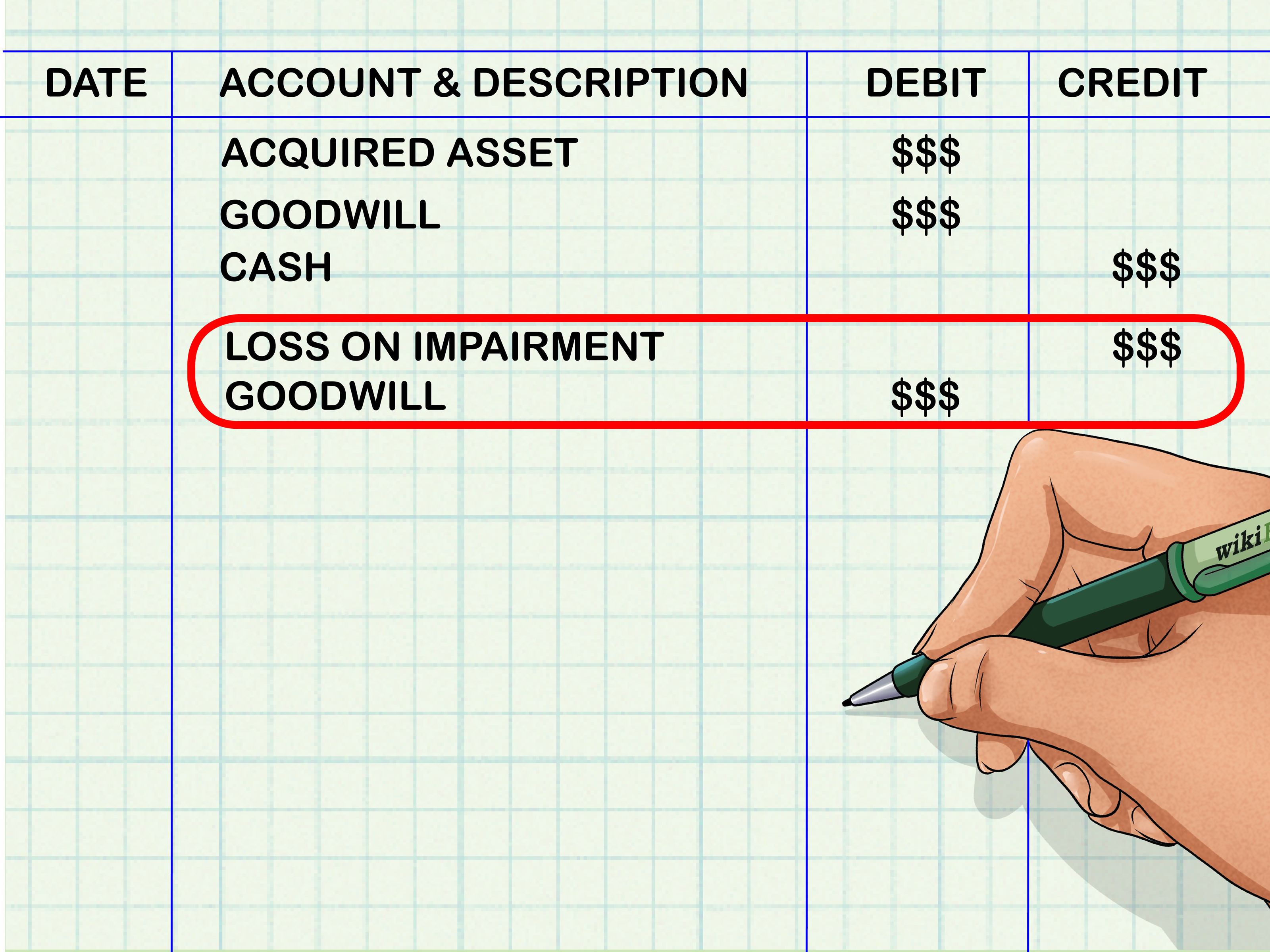
Once the goodwill amount is calculated, the acquirer records the business combination on the acquisition date. Using the example above, the journal entry would be:
This entry records the acquired assets at fair value, recognizes liabilities assumed, credits the cash paid, and records goodwill as the residual asset. After this entry, goodwill appears as an intangible asset on the balance sheet.
Step 7: Review Measurement Period Adjustments
Acquisition accounting is often not perfectly complete on day one. The acquirer may still be finalizing valuations, reviewing contracts, confirming tax balances, or analyzing contingent consideration. Under acquisition accounting, companies may have a measurement period to finalize certain provisional amounts, as long as the adjustments relate to facts and circumstances that existed at the acquisition date.
If the fair value of assets or liabilities changes during the measurement period, goodwill may also change. For instance, if a customer relationship asset is later valued higher than originally estimated, goodwill may decrease. If an assumed liability is later measured higher, goodwill may increase. The goal is not to massage the numbers until they look pretty. The goal is to reflect acquisition-date fair values as accurately as possible.
Step 8: Understand Subsequent Accounting for Goodwill
After initial recognition, goodwill is not treated like a machine, vehicle, or office chair that gets depreciated over time. Under U.S. GAAP, public companies generally do not amortize goodwill. Instead, goodwill is tested for impairment at least annually and whenever triggering events indicate that it may be impaired.
Private companies and certain not-for-profit entities may have an accounting alternative that allows goodwill to be amortized on a straight-line basis over 10 years, or less if another useful life is more appropriate and supportable. This alternative can simplify accounting for private businesses, but it must be applied carefully and consistently.
This is where book accounting and tax accounting often part ways. For tax purposes, many acquired Section 197 intangibles, including goodwill, are generally amortized over 15 years. That does not mean financial statement goodwill is automatically amortized over 15 years under U.S. GAAP. Book and tax accounting are relatives, not identical twins.
Step 9: Test Goodwill for Impairment
Goodwill impairment occurs when the carrying amount of a reporting unit, including goodwill, exceeds its fair value. In plain English, the books say the business unit is worth more than the market or valuation evidence supports. When that happens, the company may need to recognize an impairment loss.
Common goodwill impairment indicators include:
- A significant decline in revenue, margins, or cash flow
- Loss of major customers or contracts
- Adverse regulatory, legal, or economic changes
- Rising interest rates that reduce valuation multiples
- Failed integration after an acquisition
- A sustained decrease in market capitalization
- Major restructuring or plans to sell part of the business
Companies may perform a qualitative assessment to determine whether it is more likely than not that goodwill is impaired. If the qualitative review indicates possible impairment, or if the company skips the qualitative step, a quantitative impairment test is performed. The quantitative test compares the fair value of the reporting unit with its carrying amount. If carrying amount exceeds fair value, an impairment loss is recognized, limited to the amount of goodwill assigned to that reporting unit.
Step 10: Record a Goodwill Impairment Entry
Assume a reporting unit has a carrying amount of $2,000,000, including goodwill of $400,000. A valuation shows the reporting unit’s fair value is $1,750,000. The carrying amount exceeds fair value by $250,000, so the company records a goodwill impairment loss of $250,000.
This entry reduces goodwill on the balance sheet and records an impairment loss on the income statement. Goodwill impairment is a noncash expense, but do not confuse “noncash” with “not important.” It can signal that an acquisition underperformed, market conditions changed, or management paid too much. Wall Street, lenders, investors, and boards tend to notice these things. They have calculators and trust issues.
How Goodwill Appears on Financial Statements
Goodwill is presented as a separate line item on the balance sheet, usually under long-term assets or intangible assets. It should be shown separately from other intangible assets and reported net of any accumulated impairment losses or, for entities using the private-company accounting alternative, net of accumulated amortization and impairment.
On the income statement, goodwill does not create expense unless there is impairment or, for eligible entities that elect the private-company alternative, amortization. A goodwill impairment loss reduces net income, although it does not directly affect operating cash flow in the period recorded.
In the notes to the financial statements, companies may need to disclose information about goodwill balances, changes during the period, impairment losses, reporting units, valuation methods, and circumstances leading to impairment. Clear disclosure matters because goodwill often involves judgment, estimates, and assumptions. If the accounting footnotes look like fog wearing a necktie, users of the financial statements will not be amused.
Goodwill vs. Other Intangible Assets
Goodwill is different from other intangible assets because it cannot be separated from the business and sold on its own. A company can often sell or license a trademark, patent, software code, or customer list. But goodwill is tied to the acquired business as a whole. It represents expected future economic benefits from assets that are not individually identified and separately recognized.
Here is the practical difference:
- Customer list: May be recognized separately if it is identifiable and measurable.
- Trademark: May be recognized separately because it arises from legal rights.
- Patent: Usually recognized separately because it is legally protected.
- Assembled workforce: Usually included in goodwill because it is not separately recognized as an identifiable intangible asset.
- Expected synergies: Usually included in goodwill because they arise from combining businesses.
Understanding this distinction helps prevent overstated goodwill and understated amortizable intangible assets. In acquisition accounting, classification is not a minor detail. It is the difference between “we bought a customer relationship asset” and “we bought vibes.” Only one of those belongs in a serious valuation memo.
Common Mistakes in Goodwill Accounting
Mistake 1: Recording Internally Generated Goodwill
A successful company may have a valuable brand, loyal customers, and a strong reputation, but it cannot simply record internally generated goodwill. Goodwill is generally recognized only when acquired in a business combination.
Mistake 2: Skipping the Purchase Price Allocation
Some businesses record the excess purchase price as goodwill without properly valuing identifiable assets and liabilities. This shortcut can distort the balance sheet and future earnings.
Mistake 3: Confusing Book and Tax Treatment
Financial reporting rules and tax rules often differ. A 15-year tax amortization period for certain acquired intangibles does not automatically determine the financial statement treatment of goodwill.
Mistake 4: Ignoring Impairment Triggers
Goodwill should not sit untouched forever if business conditions decline. Revenue losses, margin pressure, customer departures, market changes, or failed integration may require impairment analysis before the annual testing date.
Mistake 5: Treating Goodwill as Proof of a Great Deal
High goodwill does not always mean the buyer made a brilliant acquisition. Sometimes it means the buyer paid a premium for valuable synergies. Other times it means the buyer got carried away during negotiations and accidentally bought optimism in bulk.
Practical Experience: What Goodwill Accounting Teaches in the Real World
In practice, accounting for goodwill is less about memorizing a formula and more about building a disciplined acquisition process. The best goodwill calculations usually start long before the closing date. Finance teams that wait until after the deal closes to think about purchase price allocation often find themselves digging through contracts, spreadsheets, and valuation assumptions while everyone else has already moved on to integration meetings and celebratory coffee mugs.
One practical lesson is that documentation matters. When a company pays more than the fair value of identifiable net assets, management should be able to explain why. Was the premium paid for customer retention? Geographic expansion? Cost savings? Proprietary technology? A strong sales team? A brand that customers actually recognize without squinting? The answer should be clear enough that auditors, investors, lenders, and future management teams can understand the business logic.
Another real-world lesson is that goodwill accounting exposes whether the acquisition model was realistic. During deal negotiations, forecasts often look cheerful. Revenue grows, margins expand, synergies arrive on time, and integration costs behave like polite houseguests. After closing, reality may be less charming. Customers may leave, systems may clash, employees may resist change, and expected cost savings may take longer than planned. When actual performance falls below projections, goodwill impairment risk can appear quickly.
Goodwill also teaches finance teams to respect valuation specialists. Fair value measurement is not just a spreadsheet exercise where someone adds a discount rate and hopes the audit committee nods. It requires supportable assumptions, market data, cash flow analysis, discount rates, control premiums, tax considerations, and sensitivity testing. Small changes in assumptions can create large changes in goodwill or impairment conclusions. That is why strong companies involve valuation professionals early instead of calling them later with the accounting equivalent of a kitchen fire.
For smaller private companies, the goodwill amortization alternative can be useful, especially when annual impairment testing would be costly and excessive for the needs of financial statement users. However, private companies should still think carefully before electing the alternative. The decision affects comparability, future earnings, loan covenants, and potential sale preparation. A business planning to seek outside investors, obtain bank financing, or sell to a public company may want to consider how goodwill accounting choices will be viewed by sophisticated users.
Goodwill impairment is another area where experience helps. Companies sometimes delay difficult conversations because impairment feels like admitting failure. But impairment does not always mean management was careless. Markets change. Interest rates rise. Technology shifts. Customer behavior evolves. A goodwill impairment charge can simply mean the carrying value no longer reflects current fair value. The key is to identify triggering events promptly, document the analysis, and communicate clearly.
Finally, goodwill accounting reminds business leaders that acquisitions are not just legal transactions. They are promises about future performance. The goodwill number on the balance sheet represents expectations that must eventually meet reality. A clean acquisition entry is helpful, but the real test comes afterward: integrating the business, retaining customers, achieving synergies, and generating cash flow. Goodwill may begin as an accounting calculation, but it survives only if the business earns the value management believed it was buying.
Conclusion: Goodwill Is More Than a Plug Number
Learning how to account for goodwill means understanding the full acquisition story. Goodwill begins with a business combination, continues through purchase price allocation, appears as a residual asset on the balance sheet, and later faces impairment testing or private-company amortization rules. It is not a casual plug, a reward for being popular, or a place to hide valuation uncertainty.
The best approach is methodical: confirm the transaction type, measure consideration, identify acquired assets and liabilities, separate intangible assets, calculate goodwill, record the journal entry, monitor measurement period adjustments, and test for impairment when required. With careful analysis and strong documentation, goodwill accounting becomes less mysterious and far more useful.
In short, goodwill is the accounting world’s way of saying, “You paid extra because you expect extra value.” The accountant’s job is to prove what was bought, record it properly, and keep checking whether that value still holds up. Not glamorous, perhaps, but very powerfuland considerably safer than letting acquisition math wander around unsupervised.