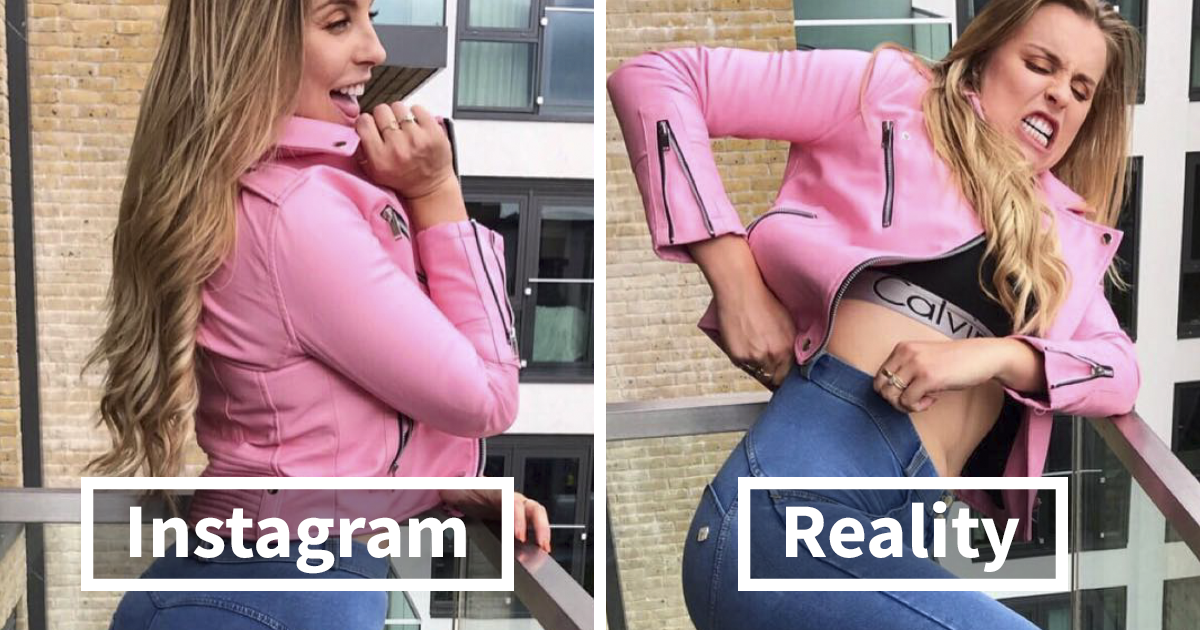
Instagram can make life look suspiciously glossy. Breakfast is always arranged like a magazine spread, hair behaves as if it signed a contract, vacations appear permanently golden, and nobody ever seems to blink, sweat, slouch, spill coffee, or stand under ceiling lights that make humans look like tired potatoes. Then along comes a woman who pulls back the curtain and says, “Actually, wait. Let’s look at the outtakes.”
That woman is widely recognized as Chessie King, a body-positive influencer, presenter, and personal trainer who became known for revealing the truth behind “perfect” Instagram pics. Instead of posting only flawless bikini shots, flattering angles, and carefully selected images, she shared side-by-side comparisons: the polished photo beside the real-life moment. The difference was not magic. It was lighting, posture, camera angle, timing, editing, and the most underrated tool in social media history: taking 87 photos and choosing one.
Her message landed because it was funny, honest, and deeply necessary. In a world where social media perfection can quietly become the measuring stick for self-worth, her posts reminded people that a photo is not a full biography. A picture can show a second. It cannot show the stomach ache, the awkward laugh, the messy bedroom just outside the frame, or the person yelling, “Can you take one more?” for the nineteenth time.
The Rise of the “Perfect Instagram Pic”
The perfect Instagram photo did not appear by accident. It evolved with smartphones, influencer culture, brand partnerships, beauty filters, and the human desire to look like we have our lives together, even when our laundry chair is entering its villain era. Instagram rewarded images that looked clean, aspirational, and emotionally simple. A beach photo said freedom. A smoothie bowl said wellness. A mirror selfie said confidence. A spotless kitchen said, “Please do not open the junk drawer.”
Over time, the platform became a highlight reel. People did not only post what happened; they posted the version of what happened that felt most attractive, impressive, or shareable. That is not automatically evil. Editing a photo or choosing a flattering angle is not a crime against humanity. The problem begins when viewers forget that the image is curated. The “perfect” post starts to feel like proof that everyone else is thinner, happier, richer, calmer, more successful, and somehow immune to bad hair days.
Chessie King’s content worked because it interrupted that illusion. By showing the “Instagram” version next to the “reality” version, she gave viewers a visual reset. The same body could look dramatically different within seconds. A tiny shift in posture could change the appearance of the waist. A camera angle could elongate legs. Bright, indirect light could smooth skin. Sitting down could create folds, lines, and softness that are completely normal. Nothing about the person changed. Only the presentation changed.
Who Is Chessie King and Why Did Her Photos Matter?
Chessie King became known for her playful, confident, and refreshingly honest approach to body image. She had the tools to create the polished influencer image: fitness background, posing knowledge, good lighting, and a camera-friendly presence. But instead of using those tools only to perform perfection, she used them to expose how perfection is manufactured.
Her side-by-side posts showed the difference between posed and unposed bodies, flattering and unflattering light, selected shots and deleted shots. In one image, she might look like the classic Instagram fitness figure: strong pose, angled hips, perfect smile, sun cooperating like a paid assistant. In the next, she might laugh naturally, stand casually, or show the body shapes people usually crop out. The point was not “one photo is fake and the other is ugly.” The point was: both are real, but only one is usually allowed to represent us online.
That distinction matters. Many people talk about “fake Instagram,” but King’s message was more nuanced. A posed photo is not necessarily a lie. It is a selected moment. The danger comes when selected moments are consumed as everyday reality. Her work encouraged followers to stop treating social media like a courtroom where their body is on trial.
The Tricks Behind “Perfect” Instagram Pictures
1. Posing Changes Everything
Pose can transform a photo faster than a suspiciously enthusiastic fitness ad. Standing tall, twisting the hips, pointing the toes, lifting the chin, pushing shoulders back, or placing weight on one leg can create a completely different silhouette. Influencers, models, and photographers know this. Most everyday viewers do not think about it while scrolling in bed with one eye open.
King’s comparisons made this visible. A body that appears “perfect” in one frame may look softer, shorter, wider, or more relaxed in the next. That does not mean the body changed. It means the pose changed. The human body is flexible, textured, and alive. It is not a marble statue, and frankly, marble statues never had to deal with bloating after tacos.
2. Lighting Is the Real Influencer
Lighting can flatter, sharpen, soften, hide, exaggerate, warm, or wash out a person’s features. Golden-hour sunlight can make almost anyone look like they are starring in a perfume commercial. Overhead bathroom lighting, on the other hand, has ended friendships with mirrors.
Many perfect Instagram pics depend on good lighting. This is not cheating; photography has always relied on light. But when viewers compare themselves in ordinary bedroom light to someone standing in professional sunlight, the comparison is unfair from the start. It is like racing a bicycle against a sports car and then blaming your legs.
3. Angles Create Illusions
A camera held slightly above the face can make features appear different. A low angle can make legs look longer. A turned hip can create curves. A forward lean can change proportions. Even lens type matters. Wide-angle phone lenses can distort the edges of an image, stretching or compressing bodies depending on where the subject stands.
That is why two pictures taken seconds apart can look like “before and after” photos. They are not evidence of transformation. They are evidence of geometry. Instagram is full of geometry wearing lip gloss.
4. Editing and Filters Polish the Final Product
Editing used to mean obvious magazine retouching. Now it can be subtle: smoothing skin, brightening eyes, whitening teeth, reshaping a line, deepening shadows, or applying a filter that makes ordinary life look like it was dipped in honey. Many edits are small enough to seem natural, which makes them more powerful.
Research on manipulated social media images has raised concerns about body dissatisfaction, especially when people compare themselves to altered images without realizing they are altered. The problem is not that people enjoy pretty photos. The problem is that constant exposure to perfected images can train the brain to see normal bodies as problems needing correction.
Why These Posts Went Viral
Chessie King’s Instagram reality posts spread because they created instant relief. People saw the side-by-side images and thought, “Oh. So it is not just me.” That feeling is powerful. Shame thrives in isolation. The moment someone shows that stomach rolls, cellulite, soft skin, awkward angles, and imperfect expressions are normal, the spell breaks a little.
Her humor also helped. Instead of delivering a lecture from the top of Mount Wellness, she made the message approachable. She showed that body acceptance does not have to be stiff or overly serious. Sometimes it looks like laughing at an outtake and posting it anyway.
The viral appeal also came from timing. Many social media users were growing tired of perfection. The polished influencer era had made feeds beautiful but exhausting. People wanted honesty, not because beauty disappeared, but because beauty without reality started to feel like a very expensive waiting room. King’s content offered permission to enjoy photos without worshiping them.
The Psychology of Social Media Comparison
Social media comparison is sneaky. Nobody opens Instagram and announces, “Today I will damage my confidence by comparing my ordinary Tuesday to someone’s sponsored vacation.” It happens quietly. A few minutes of scrolling can become a mental scoreboard: their skin, my skin; their home, my home; their body, my body; their relationship, my relationship; their lunch, my sad desk sandwich.
Psychologists often discuss social comparison as a natural human behavior. People use others as reference points. Online, however, the reference points are often edited, filtered, sponsored, staged, or incomplete. That makes comparison less like looking at real life and more like comparing your behind-the-scenes footage to someone else’s movie trailer.
For teens and young adults, the effect can be especially intense because identity, confidence, and belonging are still developing. Image-based platforms can amplify appearance pressure, particularly when likes, comments, and follower counts turn approval into visible numbers. A person is not only seeing beauty standards; they are seeing those standards rewarded in real time.
Body Positivity, Body Neutrality, and Realistic Confidence
Chessie King’s message fits into the broader body positivity movement, but it also connects with body neutrality. Body positivity often encourages people to love their bodies. Body neutrality says that even on days when love feels difficult, you can still respect your body and refuse to treat it like an enemy.
That is a helpful distinction. Not everyone wakes up ready to high-five the mirror. Some mornings, confidence is less “I am a goddess” and more “This body got me through school, work, stress, errands, awkward conversations, and a suspiciously long grocery line.” That still counts.
Realistic confidence does not require pretending every photo is flattering. It means understanding that an unflattering photo is not a verdict. It is just a photo. Maybe the light was rude. Maybe the angle was dramatic. Maybe you were mid-laugh, mid-bite, or mid-sneeze. The camera caught a fraction of a second, not your worth.
Influencer Culture and the Business of Looking Effortless
Part of the pressure comes from the fact that Instagram is not only social; it is commercial. Influencers may promote clothing, wellness products, beauty routines, travel destinations, workouts, and lifestyle brands. The image often sells the dream before the caption sells the product.
That is why transparency matters. In the United States, influencer marketing guidance emphasizes that paid relationships and material connections should be disclosed clearly. But even when ads are properly labeled, the emotional effect of polished content remains. A sponsored post can still make a viewer feel like they are looking at real life, not a carefully produced mini-campaign.
Chessie King’s posts pushed back against that business of effortlessness. She reminded followers that many “casual” photos are not casual at all. They can involve planning, posing, editing, brand expectations, and dozens of rejected images. The result may look spontaneous, but so does a magician pulling a rabbit from a hat. Nobody thinks the rabbit handled logistics.
What Viewers Can Learn From Her Message
Do Not Compare Your Daily Life to Someone’s Best Second
The most important lesson is simple: a social media post is a selected second. It may be beautiful, inspiring, funny, or meaningful, but it is not the whole life. You do not see the argument before the vacation photo, the anxiety before the event, the messy kitchen behind the recipe video, or the deleted shots before the perfect selfie.
Train Your Eye to Notice Curation
Once you understand posing, lighting, angles, filters, and editing, Instagram becomes less intimidating. You can admire a photo without absorbing it as a personal failure. You can say, “That is a great image,” instead of “Why don’t I look like that every moment of the day?”
Follow People Who Make You Feel Human
Your feed is not just entertainment; it is an environment. If certain accounts consistently make you feel inadequate, anxious, or obsessed with appearance, it may be time to unfollow, mute, or diversify what you see. Add accounts that show creativity, humor, education, hobbies, art, pets, books, cooking, nature, or real-life messiness. The algorithm may be powerful, but the unfollow button is small and mighty.
Post for Memory, Not Only Approval
There is nothing wrong with wanting a nice photo. Humans have been posing for portraits long before Instagram. But if every post becomes a performance for approval, the joy leaks out. Posting for memory means asking: Does this capture something I want to remember? Does it feel like me? Or am I trying to impress people I would not ask to water my plants?
The Bigger Cultural Shift Toward Authenticity
The popularity of Instagram reality posts suggests that many users are hungry for authenticity. That does not mean people want every photo to be blurry, chaotic, or aggressively unflattering. It means people want context. They want creators to admit when something is posed, edited, sponsored, difficult, or not as effortless as it appears.
Authenticity online is not about rejecting beauty. It is about refusing to let beauty become a trap. A beautiful photo can coexist with honesty. A creator can post a glamorous image and still say, “This took planning.” A person can enjoy fashion, fitness, makeup, or photography without pretending the final image is raw reality.
That balance is what made Chessie King’s message so effective. She did not shame people for taking flattering pictures. She simply showed that flattering pictures are often created. Once viewers know that, the power of the perfect image shrinks.
Specific Examples of Instagram vs. Reality Moments
Imagine someone posts a poolside photo. In the final image, she is standing tall, one leg forward, sunglasses on, hair lifted by a cooperative breeze, skin glowing, background clean, drink in hand. It looks effortless. Now imagine the reality: she moved a towel, asked a friend to retake the shot, adjusted her swimsuit, checked the angle, waited for strangers to leave the background, deleted 23 photos, and chose the one where the sun did not make her squint like she was solving a math problem.
Or picture a gym selfie. The final version shows defined muscles, strong posture, perfect leggings, and motivational confidence. The reality might include sweat, shaky arms, bad lighting, a crowded room, and the person spending five minutes pretending not to take a selfie while absolutely taking a selfie.
Then there is the classic brunch photo. The table looks elegant, the coffee art is intact, the pastry is photogenic, and the caption says something breezy like “slow mornings.” Behind the scenes, someone stood on a chair, the food got cold, and one friend was silently wondering when they were finally allowed to eat. Instagram perfection often has a temperature problem.
Why “Perfect” Photos Can Still Be Fun
It is worth saying clearly: perfect-looking photos are not the enemy. Photography is creative. Posing can be fun. Makeup can be art. Fashion can be self-expression. Editing can create mood and beauty. The goal is not to ban attractive images and replace the internet with fluorescent dressing-room lighting.
The healthier approach is media literacy. Viewers can enjoy polished content while remembering how it is made. Creators can share beautiful images while being honest about the process. Parents, teachers, and communities can talk openly with young people about filters, comparison, and self-worth. Platforms can improve safety tools and reduce the repetition of harmful appearance-focused content.
In other words, the answer is not “never post a good photo.” The answer is “do not let a good photo convince you that your normal life is defective.”
Experiences Related to the Truth Behind Perfect Instagram Pics
Nearly everyone who has ever taken a photo has experienced the gap between the image they wanted and the image they got. You think you are giving relaxed, glowing, main-character energy. The camera says, “Interesting choice. Here is a picture of you blinking with the posture of a confused shrimp.” This is not failure. This is photography being photography.
One common experience is taking a group photo with friends. Everyone gathers, smiles, and checks the result. Immediately, negotiations begin. One person says, “I look weird.” Another says, “My eyes are closed.” Someone else says, “Wait, take another one.” After six attempts, the chosen photo is not the one where everyone looks perfect; it is the one where the fewest people object. That is real life. It is democratic chaos with flash.
Another familiar moment happens when people travel. A scenic location looks stunning in person, but the photo does not capture the feeling. So they adjust the angle, wait for better light, move closer, move farther away, try portrait mode, and maybe ask a stranger for help. The final post may look effortless, but the process includes awkward posing, wind attacks, accidental photobombers, and the fear that the stranger holding the phone is about to sprint into the sunset.
There is also the experience of comparing yourself to your own best photo. This is rarely discussed, but it is important. Sometimes the most unrealistic standard is not another person’s image; it is the best image of yourself. You take one great photo, receive compliments, and suddenly feel pressure to look like that every day. But that photo was a moment. You are allowed to look different in the morning, after lunch, during stress, while laughing, while resting, and while existing as a three-dimensional human being with organs and responsibilities.
Many people also learn that confidence grows when they stop deleting every imperfect image. At first, keeping candid photos can feel uncomfortable. But over time, those pictures often become the most meaningful. The photo where your hair is messy may remind you of a great beach day. The picture where you are laughing too hard may capture the actual joy of the moment. The unposed image at dinner may feel more alive than the polished one. Perfect photos are nice, but real photos carry memory.
For content creators, the lesson can be even stronger. Sharing behind-the-scenes moments builds trust. Audiences are increasingly smart; they know perfection is produced. When creators admit that a photo involved posing, editing, or a pile of rejected shots, they do not lose credibility. They often gain it. People appreciate beauty more when it is paired with honesty.
The biggest experience many users share is relief. Seeing someone like Chessie King reveal the truth behind perfect Instagram pics gives people permission to breathe. It reminds them that bodies fold, faces move, skin has texture, and life does not happen in one flattering angle. That relief is not small. It can change the way a person scrolls, posts, and looks at themselves in the mirror.
Conclusion: The Perfect Photo Is Not the Whole Story
Chessie King’s side-by-side Instagram posts became popular because they exposed something people already sensed but needed to see: perfection online is often constructed. The right pose, light, angle, filter, and timing can create a stunning image. The wrong second can create an image most people would delete. Neither one defines a person.
The truth behind perfect Instagram pics is not that every image is fake. It is that every image is limited. A photo can be beautiful and incomplete at the same time. It can capture confidence without capturing insecurity, joy without capturing stress, style without capturing the mess just outside the frame.
That is why the healthiest response is not cynicism. It is perspective. Enjoy the pretty photos. Take your own. Use the good light when you find it. But remember that your worth does not disappear when the angle changes. Real life is not less valuable because it has outtakes. Usually, the outtakes are where the best stories live.