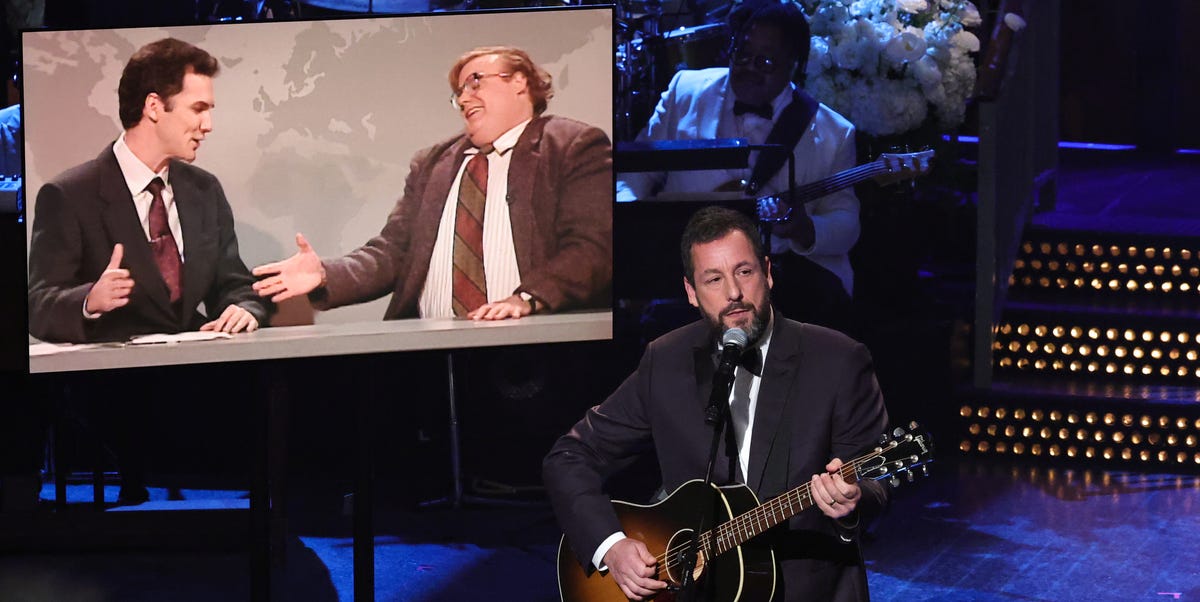
Anniversary specials are tricky little beasts. They are supposed to be funny, sentimental, star-packed, self-aware, and somehow short enough that viewers do not start checking the clock like they are trapped in an airport Chili’s. SNL50: The Anniversary Special had all the ingredients for a nostalgia overload: returning legends, surprise cameos, giant applause breaks, beloved sketches, and enough comedy history to fill several museums and at least one extremely opinionated Reddit thread. And yet, when the dust settled, one moment stood taller than the rest: Adam Sandler’s acoustic tribute, “50 Years.”
That performance did something rare for an event built on scale. It made the room feel small in the best possible way. Suddenly, the giant machinery of television receded, and what viewers saw was a former cast member with a guitar, a goofy smile, and a big heart singing about a show that changed his life. The result was not just funny. It was warm, mournful, grateful, and unexpectedly intimate. In a night designed to celebrate Saturday Night Live, Sandler’s song became the clearest explanation of why the show still matters.
So yes, the title says Sandler’s emotional tribute “officially wins” the SNL50 special. That is partly a cultural verdict and partly a literal one. Critics and entertainment outlets repeatedly singled the song out as a standout. Fans treated it like the emotional centerpiece. And later, awards recognition gave that reaction some hardware. In other words, what started as the night’s heart-swelling highlight eventually earned the kind of industry respect that turns a great moment into an official one.
Why Adam Sandler’s “50 Years” Became the Night’s Defining Moment
Sandler’s tribute worked because it understood the assignment better than almost anyone else on the broadcast. SNL is not just a show. It is a machine that discovers talent, burns through insecurity, creates legends, breaks hearts, launches careers, and leaves behind a mountain of stories. Sandler’s song captured all of that in a few minutes. He joked about the little indignities, the cast ego, the backstage rituals, and the weirdness of surviving the show’s pressure cooker. But he also made room for something more serious: the simple truth that for many people in Studio 8H, their lives really were changed by SNL.
That balance is why the number landed so hard. Sandler did not show up and suddenly become a solemn awards-season poet. He stayed Sandler. He stayed loose. He stayed funny. He cracked jokes about Lorne Michaels, shouted out crew members, and delivered lines with that familiar half-singing, half-shrugging style that feels like it was invented in a dorm room and polished over decades. But because he never became overly polished, the sincerity hit even harder. It felt earned. It felt human. And most importantly, it felt like somebody inside the family speaking to the family.
That family angle matters. Anniversary specials can turn into clip reels wearing expensive shoes. Sandler’s song avoided that trap by reminding viewers that the soul of SNL is not just in famous sketches. It lives in the writers’ rooms, the cue cards, the near-misses, the nerves, the friendships, and the people who made the show run long before social media turned every cold open into instant discourse. The song did not simply celebrate celebrity. It celebrated belonging.
The Secret Sauce: Humor, Heartbreak, and a Very Sandler Delivery System
What makes Sandler uniquely qualified for this kind of moment is that his comedy has always had a soft underbelly. Beneath the shouting, the silliness, and the man-child chaos, he has long understood how laughter and tenderness can live in the same sentence. Anyone who has seen his Chris Farley tribute, or his more dramatic film performances, knows he can pivot from ridiculous to devastating without making it feel like a trick.
In “50 Years,” he used that gift beautifully. The song bounced from punchlines to sentiment without feeling forced. One moment, it sounded like a campfire roast of SNL mythology. The next, it felt like a eulogy for an era. Sandler mentioned legends, friends, and longtime crew members with the same affection a person uses when flipping through an old photo album and realizing half the power is in the names themselves. He knew that for viewers who grew up on the show, hearing names like Gilda Radner, Jan Hooks, Phil Hartman, Chris Farley, and Norm Macdonald would do some emotional heavy lifting all on their own.
Then came the part that pushed the performance from charming to unforgettable. Sandler’s voice caught when he referenced Farley and Norm. He did not turn it into a grand piece of stagecraft. He just let the feeling be there. In a room full of icons, surprise guests, and polished television moments, that little break in the performance became the loudest thing all night. It reminded viewers that comedy history is not abstract. It is personal. People laughed together. People worked together. People are gone.
That is why the tribute did not feel manipulative. It was not squeezing tears out of the audience with a dramatic string arrangement and a five-camera slow zoom. It was a friend remembering other friends and trying to keep the room from falling apart by making one more joke on the way there.
Jack Nicholson, the Guitar, and the Power of Framing a Moment
Even the setup helped. Before Sandler performed, he was introduced by Jack Nicholson in a rare appearance. That instantly gave the segment an event status beyond ordinary nostalgia. Nicholson did not need to deliver a monologue or steal focus. His mere presence signaled that something special was about to happen. Then Sandler walked out with a guitar, and the vibe shifted from “star-studded special” to “everybody, settle in, this one matters.”
The visual language was simple but smart. No giant gimmick. No giant production number. No parade of backup dancers dressed like Coneheads. Just Sandler in a formal setting that he somehow made feel casual. It was almost funny on sight: one of comedy’s most famously rumpled guys, at one of television’s fanciest nostalgia nights, becoming the emotional emcee. It should not have worked this perfectly. Which, naturally, is part of why it did.
The song also benefited from timing. By the point Sandler appeared, viewers had already been treated to cameos, recurring characters, musical numbers, and layers of inside-baseball fan service. The special had been doing what anniversary specials do: going wide. Sandler suddenly went deep. He turned the giant event into a reflective pause. That contrast made the performance feel even stronger. He was not fighting the show’s scale. He was giving it perspective.
More Than Nostalgia: Why the Tribute Said Something True About “SNL”
The best anniversary moments do not just ask audiences to remember; they help audiences understand what exactly they are remembering. Sandler’s tribute did that by acknowledging the contradictions of SNL. The show is glamorous and brutal. It is a dream job and a stress factory. It produces national fame and private insecurity. It can make someone feel immortal on Saturday night and deeply unsure by Monday morning. Sandler wrapped all of those contradictions into a song that sounded playful on the surface but carried a lot of history underneath.
That is also why the crew shout-outs mattered so much. In a media ecosystem that loves ranking cast eras and arguing over hosts, Sandler’s willingness to spotlight the people behind the scenes gave the piece texture. It told viewers that the legacy of SNL is not only built by the faces in front of the camera. It is built by music staff, cue card handlers, nurses, writers, stage managers, and all the people whose names do not trend but whose work keeps live television from turning into a public nervous breakdown.
And because Sandler framed all of this in his own loose, affectionate voice, the tribute never sounded like a corporate anniversary statement. It sounded like somebody who had lived it. That authenticity is priceless, especially on a show whose power has always come from making audiences feel like they are part of something immediate and alive.
What “Officially Wins” Really Means Here
Let’s talk about that word: officially. On the night of the broadcast, Sandler’s song won the kind of victory that matters most in live television: it stayed with people. Reviews and recaps kept circling back to it. It was described as the emotional highlight, the touching centerpiece, and even the moment that stole the show. In an evening full of giant names and polished bits, that is a serious accomplishment. It means the performance cut through the noise.
But the phrase also has a more literal edge now. The song later received Emmy recognition in the Outstanding Original Music and Lyrics category, giving formal awards weight to what viewers already felt. Then it picked up an Astra Creative Arts TV Award for Best Original Song, which made the “wins” framing more than just fan enthusiasm. Meanwhile, the broader SNL50: The Anniversary Special went on to win the Emmy for Outstanding Variety Special (Live), further cementing the event as more than a one-night nostalgia blast.
In that context, Sandler’s performance did not just dominate the social conversation. It became one of the most award-friendly pieces of the entire celebration. That matters because comedy tributes often disappear after the applause fades. “50 Years” did not. It lingered, got replayed, got discussed, and got recognized. That is how a lovely moment becomes an enduring one.
Why This Tribute Matters for Adam Sandler, Too
Sandler’s career has always lived in a strange and wonderful tension. He is a blockbuster clown, a musical goofball, a critical punching bag, a critical darling, a dramatic actor, and an arena-filling comic all at once. Every few years, the culture rediscovers that he can do more than one thing, as if this is breaking news instead of a pattern. His SNL50 tribute was another reminder that he has one of the most underrated emotional radars in comedy.
What made the performance special was not just that Sandler cared. Lots of people care. It was that he understood how to translate care into a format that still felt entertaining. He did not deliver a speech. He did not narrate a clip package. He wrote a song that sounded like Adam Sandler and still managed to hold the weight of 50 years of comedy history. That is not easy. That is craft.
In a way, the performance also felt like a small correction to the way Sandler is often discussed. He is frequently treated as either a lovable goof or a serious actor who surprises people when he decides to “try.” But his best work has always blended those instincts. The man who wrote novelty songs also knows how memory works. The guy in basketball shorts also knows how grief sneaks into a joke. “50 Years” put that range on display in front of millions of viewers.
The Audience Experience: Why a Moment Like This Hits So Hard
Watching Sandler’s tribute was not just about appreciating a clever song. It was about experiencing a certain kind of emotional time travel. Anyone who has spent years with SNL knows the show does not live in your memory as one neat package. It lives in fragments. A sketch you watched too late on a Saturday. A cast member you loved in high school. A host your parents still quote. A joke your older sibling explained to you badly. A rerun you stumbled onto when you were supposed to be asleep. A performer who made you laugh first and then, years later, made you weirdly sad because they were gone.
Sandler’s number tapped into that exact feeling. It reminded viewers that a long-running comedy show can become part of the architecture of a life. You do not just remember the jokes. You remember who you were when you heard them. You remember staying up to watch. You remember repeating lines in cafeterias, dorm rooms, bars, and office kitchens. You remember discovering that comedy could be anarchic, silly, sharp, juvenile, brilliant, and strangely moving all at once. That is part of why the tribute did not only affect people who worked on SNL. It affected people who grew up with it from the couch.
There is also something uniquely powerful about seeing comedians get sincere without becoming stiff. The best comics understand that emotion lands harder when it arrives through personality rather than polish. Sandler did not suddenly morph into a solemn prestige-TV narrator. He remained the same slightly rumpled, musically playful guy audiences know. That continuity matters. It lets viewers feel like the emotion is real rather than performed for applause. The tears do not feel imported for the occasion. They feel like they have always been sitting there, just beneath the joke.
And then there is the communal experience of a tribute in a room full of people who share the same history. Part of what made the moment resonate was the visible reaction around him. This was not a lone artist singing into a void. It was a former cast member performing for coworkers, mentors, peers, heroes, and ghosts of a kind. Every laugh had subtext. Every name drop had a backstory. Every emotional beat carried decades of shared work, ambition, rivalry, and affection. Viewers could feel that density, even if they did not know every inside reference.
For longtime fans, the song also delivered a familiar and bittersweet realization: comedy ages, but memory does not do so neatly. Some sketches stay hilarious. Some age badly. Some performers remain frozen in the exact era when you loved them most. Anniversary specials force audiences to confront all of that at once. Sandler’s tribute handled this beautifully because it did not pretend the past was a flawless golden age. Instead, it acknowledged the chaos, the bruised egos, the weird rituals, and the losses, then wrapped them in gratitude. That is a much deeper form of nostalgia. It is not “weren’t things perfect?” It is “weren’t we lucky to have this?”
That is the real experience at the center of the performance: gratitude with a lump in its throat. You laugh because Sandler is funny. You tear up because the names mean something. You smile because the show survived. And maybe, if you have watched enough late-night television over enough years, you also feel a little stunned that a scrappy live sketch show made it to 50 and still had the power to stop a giant anniversary production in its tracks with one man, one guitar, and a handful of memories.
Final Take
SNL50: The Anniversary Special had plenty to offer: legends, callbacks, music, cameos, and enough fan service to keep comedy nerds happily overfed. But Adam Sandler’s “50 Years” stood apart because it distilled the entire purpose of the night into one performance. It was funny without being flippant, emotional without being syrupy, and nostalgic without getting trapped in a museum case. It honored the stars, the crew, the dead, the living, the chaos, and the privilege of having been part of something that lasted.
That is why Sandler’s tribute did not merely work. It won. It won the room, it won the reviews, it won the memory game, and eventually it won actual awards attention too. In a special built to celebrate 50 years of Saturday Night Live, Adam Sandler somehow gave the night its most human moment. Not bad for a guy who often looks like he got dressed five minutes after waking up. Comedy history is weird like that. Fortunately, so is Adam Sandler.